

Viktor Orbán Lost Power. Has Anyone Told Him?
Orbán conceded Hungary’s election, skipped the opposition bench, and began the stranger work of remaining larger than the office he lost.

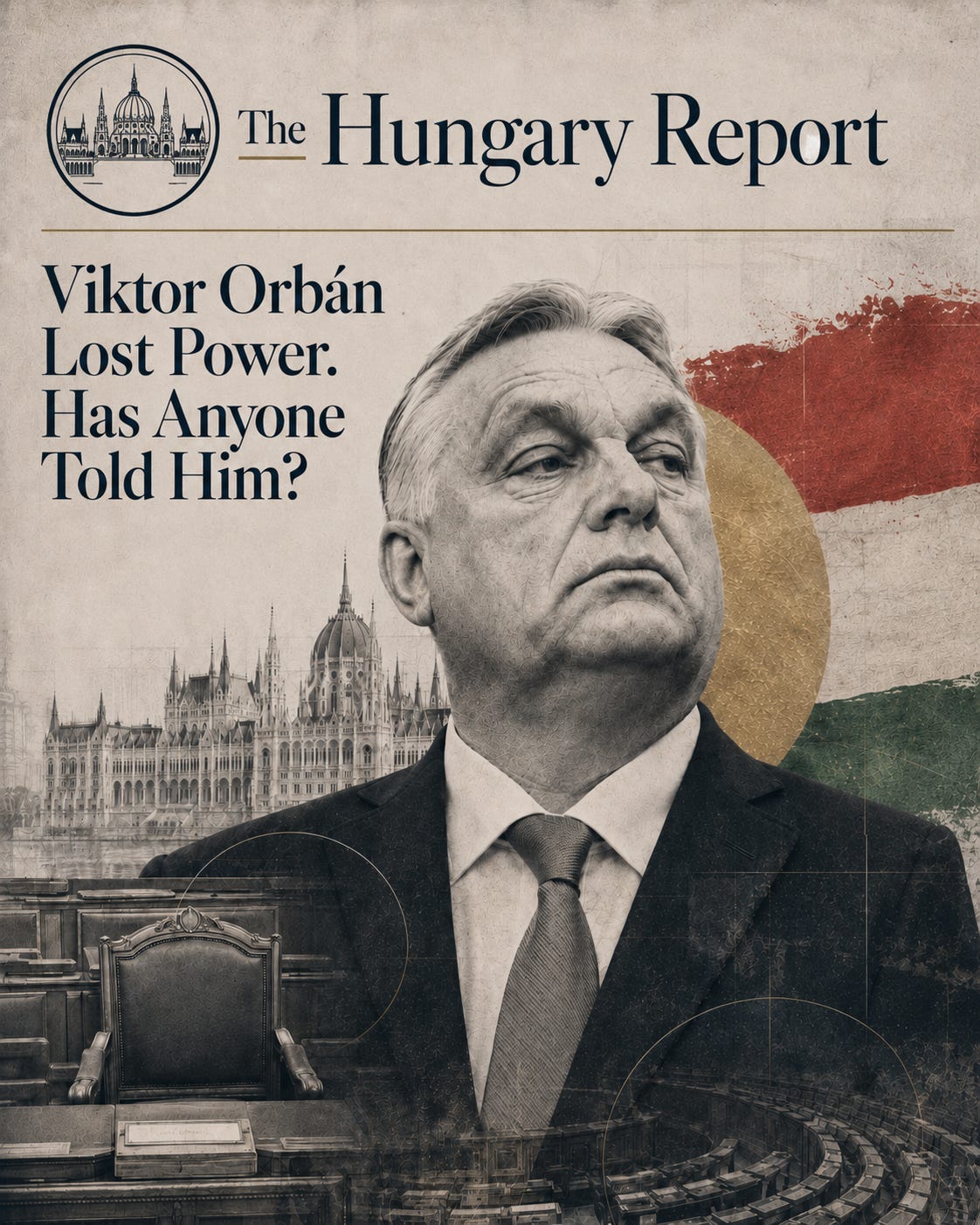
Early on Europe Day, people began pouring into Kossuth Square outside Hungary’s gorgeous, neo-Gothic parliament. They had come to watch the new National Assembly take its oath on enormous screens. They cheered each glimpse of Péter Magyar. They booed some Fidesz and Mi Hazánk lawmakers. When the new speaker, Ágnes Forsthoffer, announced that the European Union flag would return to the building, the crowd roared once again. The Guardian reported the scene outside parliament as Magyar was sworn in.
Inside, 199 representatives took their oaths at about 11 am. Viktor Orbán was not among them.
For the first time since Hungary’s first post-communist parliament in 1990, Orbán was absent from the chamber. The old prime minister was outside the room where defeat becomes official. The new one was inside, sheathed by a two-thirds majority. Later that day, the EU flag was raised again on the facade, after Orbán’s government had removed it in 2014.
The flag’s return showed, in a simple and visible way, that the symbols of the state could be changed without Orbán in the building.
Hungary had changed government. Whether it had made Orbán smaller was another question.
The absence had been prepared two weeks earlier.
On 25 April, Orbán announced in a Facebook video that he would not take his seat in the new National Assembly. The simplest democratic ritual was there for him: to move from government to opposition, to cross the chamber and accept the diminished authority that comes with defeat. In most parliamentary democracies, that transition is unremarkable. In Hungary, Orbán chose not to make it at all.
Orbán declined the chair.
His explanation did the helpful work of making the symbolism explicit. “Our task now is not in parliament,” he said, according to reporting on the announcement, but in reorganising the “national side.”
Call it what it is: post-power rank retention.
The symptoms are easy to locate. The patient concedes the election. He admits that “a political era has ended.” He calls for “complete renewal.” Then he explains that his real work is somewhere above the chamber, beyond the opposition benches, in the deeper country where his authority apparently still resides.
Sure. Opposition is for other people.
The result had been brutal. On 12 April, Magyar’s Tisza party won 141 of Hungary’s 199 parliamentary seats, reducing Fidesz to 52. Orbán’s 16-year rule was over. On election night, Orbán conceded. Five days later, in a 17 April interview with the pro-Fidesz Patrióta channel, he spoke of pain, emptiness, and rupture. He said that “a political era has ended.” He said Fidesz needed “complete renewal.” Welt reported his call for renewal after the defeat.
His next move was more nuanced. Nearly 2.4 million people had still voted for Fidesz, he said. “Let’s not act like the whole country rejected our government.”
There it was: defeat, with its sharpest edges dulled.
Orbán has not conducted himself like a man trying to overturn the result. He accepted the outcome and stayed within its legal framework, even as he looked for ways to soften its political meaning. Rather than contesting the election itself, he has focused on preserving his authority outside the institutions that now record his defeat, treating the transfer of power as real while resisting the loss of status that normally accompanies it.
He accepted the transfer of power, but not the lessened place that power’s loss was supposed to bring.
Hungarian politics has produced a curious feat of geometry. Orbán is no longer prime minister, yet everyone keeps arranging themselves in relation to him. He will not sit with the opposition. Fidesz promises renewal under the same leader. Magyar’s government, elected to move beyond the Orbán era, spends some of its earliest constitutional energy defining the terms of Orbán’s return.
Everyone agrees Orbán lost. Orbán included. What he refuses to accept is the ordinary consequence of losing, becoming just another politician. Instead, he speaks of renewal from friendly Fidesz platforms, continues to cast himself as the voice of the “national side,” and positions himself above the opposition benches he refuses to occupy. The election removed him from power. Since then, much of his effort has gone into ensuring it does not render him irrelevant.
The Seat He Would Not Take
A parliamentary seat is not glamorous. It is where defeat becomes tangible. The former prime minister sits across from the new one. Cameras record the new hierarchy. The man who once set the agenda waits for recognition from the speaker. His microphone no longer carries the voice of the state. He speaks, but from a different place in the room.
Orbán, with no apparent shame, avoided all that.
Fidesz can still function perfectly well inside parliament. Gergely Gulyás can lead the caucus, the party can settle into the rhythms of opposition, and its MPs can absorb the daily frustrations that come with no longer setting the agenda. The institution offers a ready-made role for a defeated governing party. Orbán has decided not to play it.
Orbán has chosen a more sterile arrangement. Others can manage opposition. He would rather manage meaning.
His power always ran deeper than administration. Orbán led the government while training his supporters to see it as an extension of true Hungary. Brussels, liberals, NGOs, judges, journalists, migrants, George Soros, foreign capital, Ukrainian interests: all became elements of a single story of siege. Fidesz ran the state. Orbán cast himself as the nation’s sentinel.
Losing an election damages that claim. Sitting directly in opposition would further damage it.
Orbán has placed himself outside the institution that now records his defeat. The result is awkward but effective. He is no longer prime minister, but he has not become simply the man sitting three rows back, waiting for permission to speak.
That is the strategy in miniature. Orbán accepted the election outcome but resisted the political and symbolic consequences that normally follow a defeat of this scale.
Defeat, Lightly Edited
Orbán’s language since April has been careful enough to avoid looking deranged and proud enough to avoid sounding defeated.
He has admitted pain. He has admitted rupture. He has admitted that Fidesz needs renewal. That already sets him apart from a familiar species of defeated leader, the kind who discover electoral fraud, phantom conspiracies, and suspicious ballot boxes the moment the votes stop going their way.
His acceptance has limits, though. “Let’s not act like the whole country rejected our government” is a line worth pausing over. Numerically, it has a point. Nearly 2.4 million Fidesz voters did not vanish on election night. Politically, it performs another function. It asks supporters to treat a crushing defeat as an incomplete misunderstanding.
Tisza won 141 seats. Fidesz won 52. The irony is hard to miss. Fidesz spent years redesigning the electoral system to magnify the winner. In 2026, it worked perfectly. For Tisza. Fidesz built the amplifier and then got blasted by it.
Orbán’s response has been to put his foot in the door and ask whether everyone is sure they meant to close it.
This is what makes the current moment more gripping than a simple story of denial. Orbán is saying the election changed the government but left the country’s deeper ownership unsettled.
The phrase “national side” has a peculiar role in Hungarian politics. It does not just describe a faction. It draws a map. On one side are governments, parties, elections, and temporary officeholders. On the other hand is a supposedly more authentic Hungary shaped by historical wounds, grievances, and loyalties. The references change with the moment, from Trianon and foreign domination to Brussels and sovereignty, but the story remains the same. Political opponents may win institutions. They do not fully inherit the homeland. The nation is imagined as waiting elsewhere, beyond the reach of electoral arithmetic.
Renewal, Starring the Same Man
On 13 June, Fidesz held its congress and re-elected Orbán as party leader. Reporting put the tally at 729 votes in favour, eight abstentions, and none against.
For Fidesz, renewal, in a hypocritical sense, represents a promise of transformation, watched over by the very man whose presence made true transformation so difficult.
The party has grounds for this, though. Fidesz without Orbán is a question mark with county offices. Its ideology, hierarchy, donor relationships, media habits, internal discipline, and sense of historical mission all run through him. For years, the party was organised around keeping different parts of the system moving in the same direction under a single leader.
Now, the object of alignment has lost power.
That creates a problem no congress speech can solve. Fidesz cannot credibly pretend that nothing has happened. Its parliamentary presence has been cut by more than half. Its leader is no longer the prime minister. Its enemies control a two-thirds majority. The institutions it built are under review, reversal, or investigation.
Still, Fidesz also cannot easily ask the obvious question: whether the man who built the defeated system can also be the man who renews it.
So it has answered the question by avoiding it. Orbán stays. The party changes around him, under him, because of him, and never quite beyond him.
There is logic here. A panicked succession fight after a historic defeat could yank Fidesz apart. Orbán still has a base. He still has discipline. He still possesses the rare gift of making loyalists feel that obedience is a form of patriotism. Removing him would do more than alter the leadership. It would confront the party with the sharper question of whether it possesses any independent centre of gravity at all.
For now, Fidesz has chosen gravity.
The System Still Has Keys
Orbán leaves office unusually well-equipped for a defeated man. These are the things that make demotion negotiable.
Over 16 years in power, he helped create a political environment that stretched far beyond government itself. Elections can remove a cabinet in a day. The habits, relationships, and institutions that grew around Orbán’s rule tend to move more slowly.
The wider intellectual network is also real. Mathias Corvinus Collegium was endowed in 2020 with major stakes in MOL and Richter, giving the Orbán-aligned right a financial and institutional platform beyond the usual scale of party-adjacent politics. Over time, that platform expanded into a broader ecosystem that helped project Hungarian illiberalism well beyond Hungary’s borders, cultivating influence, relationships, and ideological networks across Europe and the Anglophone right. These networks remain part of the political environment Magyar inherited. As his government reviews institutions, funding structures, and the legacy of the previous era, it will inevitably encounter organisations and relationships shaped during Orbán’s years in power.
Pity the poor former strongman, reduced to a loyal party, a vast media inheritance, an international ideological network, and millions of voters.
Orbán’s ability to act larger than a defeated opposition politician depends on these murky residues. He is not standing in an empty room insisting he still matters. He is standing inside a system built over 16 years to make him matter.
That system is now under pressure. Post-election reporting described anxiety among recipients of Hungarian right-wing patronage abroad. Other reports described Orbán-linked figures exploring ways to move wealth abroad, including through the Gulf, Singapore, Australia, and the United States, amid fears of scrutiny under the new government. Still, even these reported claims reveal something important. Some people around the old system appear to have understood defeat in very concrete terms.
Money is rarely sentimental. It tends to notice changing conditions before politicians do.
Magyar Builds the Anti-Comeback State
Péter Magyar’s government has acted as if Orbán’s defeat is real, urgent, and insufficient.
On 9 May, Magyar became prime minister. Within weeks, his government began moving against core pieces of the Orbán order. On 27 May, parliament voted 133 to 37, with five abstentions, to keep Hungary in the International Criminal Court, reversing an Orbán-era decision to withdraw from it. The government also moved against the Sovereignty Protection Office, set up investigative committees into alleged misconduct under the previous government, and pursued reforms that helped unlock €16.4 billion in frozen EU funds.
The clearest anti-comeback measure came soon after.
On 21 May, Tisza submitted a draft constitutional amendment limiting prime ministers to a maximum of eight years in office, counting cumulative service since 1990. The Guardian quoted the draft language: “A person who has served as prime minister, for a total of at least eight years, including any interruptions, may not be elected as prime minister.” In practice, the rule would bar Orbán, who served five terms over 20 years, from becoming prime minister again. On 16 June, the Hungarian parliament approved the amendment by 135 votes to 50, with six abstentions.
An assertive way to convey to the former prime minister that his retirement plans have been adjusted.
It may be defensible. Hungary had just emerged from 16 years of personalised rule. A prime ministerial term limit can be presented as a democratic guardrail against renewed concentration of power. Many democracies impose limits on presidents. Hungary’s problem was that the office of the prime minister had been turned, through party discipline and constitutional engineering, into the centre of a long political reign.
Nevertheless, the political target is visible from space. The rule applies to Orbán in practice. It tells voters that Magyar’s government sees him as a future threat serious enough to be written out of the premiership by constitutional amendment.
That may be necessary statecraft. It is also a highly visible political signal. Orbán will have no difficulty understanding what it is meant to do.
The Problem With Making Him Smaller
Magyar faces a genuine dilemma. The old system cannot be left intact simply because Orbán might claim persecution. A government with a two-thirds majority has both the mandate and the obligation to dismantle parts of the old order. Yet the longer those structures remain in place, the harder they become to undo.
Nonetheless, every move against Orbán risks confirming his size.
Fidesz has already shown how it will use this. Measures that supporters of the new government see as democratic safeguards can be reframed as evidence of insecurity. A term limit can be presented as fear of a comeback. Investigations can be cast as revenge. Efforts to repair institutions can be described as a purge. In that telling, every attempt to close the road back only reinforces the idea that Orbán remains the figure the new government cannot stop measuring itself against.
This is the trap and perhaps the lone idea Fidesz has at the moment, after such a crushing defeat. Magyar must build a country after Orbán while resisting the temptation to make every foundation stone anti-Orbán-shaped.
For Fidesz, the trap is different. The party needs renewal, but its main proof of continuity is the man who makes renewal suspect. It needs to show discipline without looking embalmed. It needs to defend its record without sounding like a museum guide in a burning building. It needs to oppose Magyar without reminding voters too vividly why they threw Fidesz out.
No wonder Orbán prefers altitude.
The Old 2002 Trick
Orbán has lost before. The useful comparison is not Donald Trump in 2020. Hungary is not facing a leader who denied defeat, but one who accepted it while carrying much of the authority, loyalty, and inheritance that made him dominant. I keep arriving back at a more superficial thought. Elections can change governments overnight, but they are much less reliable at shrinking the people who once seemed larger than the state itself. Orbán may have lost the office. Hungary is still finding out how long it takes to lose the shadow.
The more appropriate comparison is Orbán after 2002.
After that defeat, Orbán helped build the civic-circle movement that turned Fidesz from a defeated governing party into a broader right-wing social camp. The movement language and the claim that the homeland could not be in opposition helped transform defeat into injured possession. The lesson was uncomplicated and powerful. Institutions may temporarily belong to opponents. The nation does not.
The rhyme with 2026 is evident. Again, Orbán is shifting the centre away from parliament and toward the camp. Again, he is treating defeat as a problem of morale, organisation, and interpretation. Again, he is speaking as the organiser of a political community larger than the seats it holds.
The difference is that 2026 is heavier. In 2002, Orbán was a former prime minister with time ahead of him. In 2026, he is the architect of a 16-year system now being dismantled by a government with constitutional power. He is older, more exposed, and more personally fused with the structures under attack. His former state is being audited by his successor.
That may make the old trick harder to pull off. It is also the strategy he knows best.
The Man Outside the Chamber
There are reasons not to overstate this. Orbán conceded, did not challenge the result, spoke of renewal, and remained party leader. Refusing a parliamentary seat may simply be tactical, and Fidesz may eventually settle into a more conventional opposition role.
All fair points. They do not rescue the situation from its central absurdity.
A man who built a political system around himself has lost power and immediately arranged his post-power life to avoid looking smaller. His party has responded to defeat by reaffirming his indispensability. His successor has responded to victory by legislating against his return. The old media ecosystem is shaken, but still present. The old financial networks are nervous, but still relevant. The old language of the “national side” has so far survived the loss of government.
So let’s return to the scene on 9 May and join the crowd outside the Hungarian parliament, the large screens, the cheers for Magyar, the EU flag returning to the facade, and Orbán absent from the chamber for the first time since 1990.
By 16 June, parliament had approved a constitutional rule designed to stop him from becoming prime minister again. The image from May had become the logic of June. Orbán was outside the chamber. The chamber was still organising itself around him.
Still, the comparison is becoming harder to avoid. A few weeks into power, Magyar’s government is passing major laws, reopening Hungary’s relationship with Europe, reversing parts of the old order, and testing how much of Orbánism can be dismantled from inside the institutions Orbán once controlled. Fidesz promises renewal while keeping the same man at the centre, outside parliament, directing a party that says little about reform except that it is coming.
This may be how Orbán’s rank finally shrinks: not through one constitutional amendment, but through the daily sight of someone else governing.
Orbán has lost the office. Hungary is beginning to see what politics looks like when he is no longer the man holding it.
Péter,
You still see energy, confidence and a chance to challenge Magyar's rule by Orbán. I see no such outcome at all. There is a popular - and heavy weight - slogan repeated in Budapest now. "It's about time someone tell the remaining Fidesz loyalists what the results of the elections were."
Péter Magyar reminds them every passing hour.
Recent polls by Median show a free fall of Fidesz. The 2,4 million voters you cited, are a matter of the past already. Talking to my learned friends, we see the fate of Fidesz will follow SzDSz, MDF and the other - once leading - political families.
Don't forget, that no legal processes have started yet. The National Bank's scandal with 600 billion "loosing its public character", (stolen)
Szíjjártó's COVID scandal with 350 billion, Rogán's
Golden visa scam, and his
hundreds of millions from his IT security invention ...
and the list is very long.
These guys have a good chance of seeing prison sentences. (Possibly including Orbán)
The dance is just about to start. No comparison with 2002.
Peter, please indulge me for just a moment. When the last election in Hungary took place I was inspired to learn more about the country, its history and its people. I am fortunate in that I actually own a set of Encyclopedia Britannicas published in 1952 - long before Orban's reign in Hungary. It is full of information about the long, long history of your country. That's how I started.
I firmly believe in the intelligence and the common sense of the population! While I don't in any way minimize the challenges ahead, I'm confident in your people. (and I do apologize that I've yet to figure out how to add the accents that the language requires. I'm working on it.)