

Today, Budapest shimmered with hope.
On the day Péter Magyar became prime minister, Hungary stopped being a warning and became a promise.

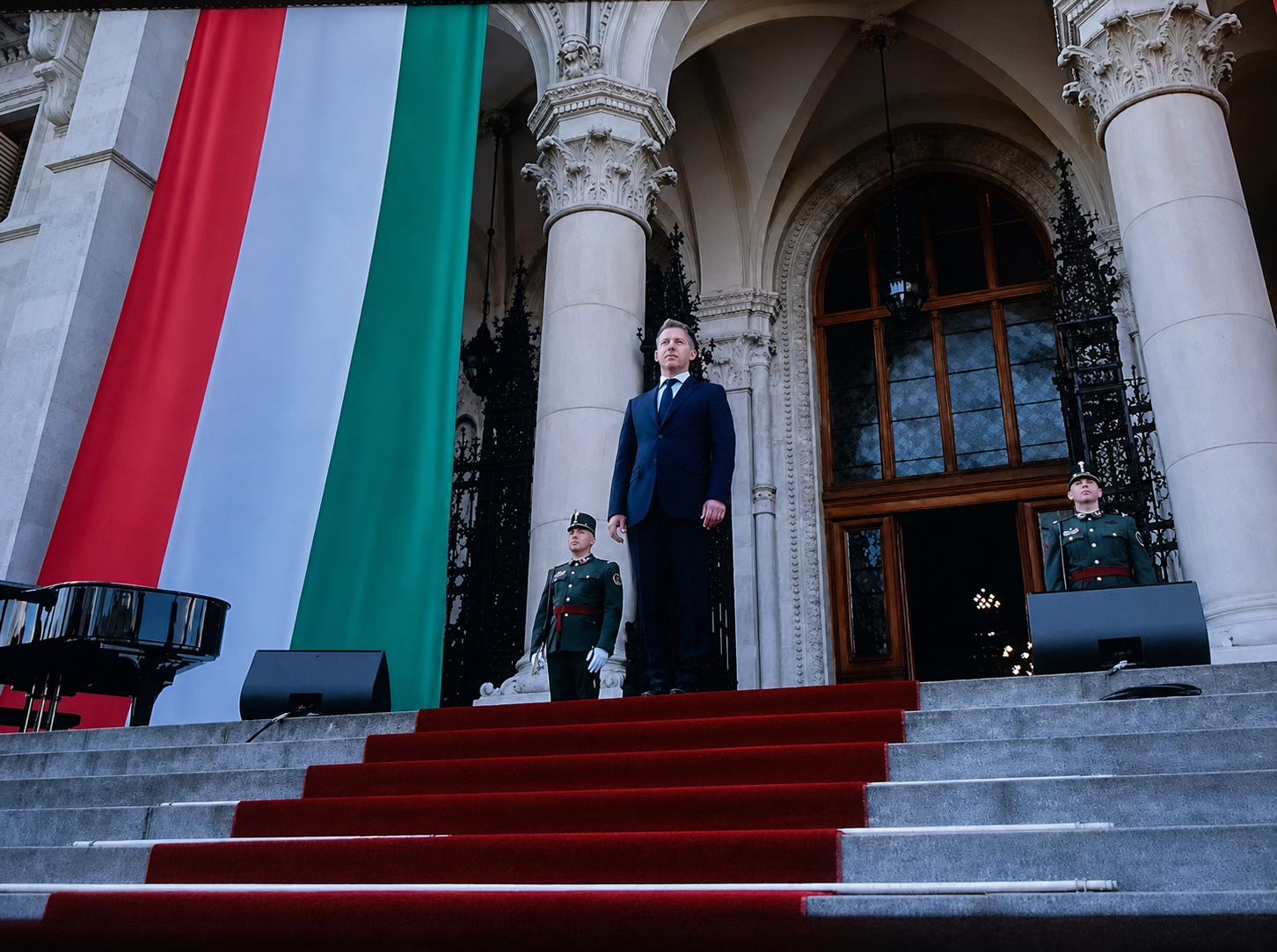
I waited for the moment when hope would cross into reality.
For most of the morning, history arrived quietly. A roll-call vote. The strike of a gavel. MPs pressing buttons beneath crystal chandeliers. Constitutional articles read aloud in the solemn, ancient language of the state. Hungary changed governments through paperwork — an almost magical absurdity, unless you have lived in a country where paperwork is all that stands between captivity and freedom.
That quiet act of faith moved me more than any spectacle ever could.
The impossible did not announce itself with thunder. It arrived, almost shyly, through procedure: a vote count, a mandate, a chamber, a name. The country held its breath and let itself believe.
Péter Magyar became prime minister of Hungary. The sentence feels miraculous.
I still pause over those words, half-expecting them to dissolve if I blink.
After sixteen years of Viktor Orbán, Hungary has a new prime minister. The words are simple. The feeling behind them is seismic. For so many Hungarians, “after Orbán” was a hidden country, a place people visited in the privacy of their thoughts, because hope had become dangerous — something to keep under lock and key, lest disappointment find it. People imagined it, joked about it, circled it in whispers, doubted it, wanted it, then stepped away before hope could cut too deep.
Today, hope crossed over into fact.
The April 12 election had already been legally closed. The challenges had failed. The results stood. The Kúria had upheld the national list result. The new parliament could assemble because millions of people voted, and the machinery of the state had to recognise what they had done.
That was everything.
Hungary has lived for years inside a political atmosphere designed to make hope feel naïve. Power seeped into every institution, every broadcast, every dinner table, every silence. The system trained people to believe that elections could happen, crowds could gather, scandals could break, anger could rise — and still, nothing would change.
This morning, the centre shifted. Ágnes Forsthoffer was elected Speaker of the National Assembly. The national and historical flags were carried into the chamber. She took the oath. The room moved with the slow grandeur of old institutions, as if the state itself was remembering that it existed before this regime and would now have to exist after it.
Then came her first symbolic decision.
The European Union flag would return to the Hungarian parliament building after twelve years.
It was a flag: cloth, colour, protocol. It was also a sentence, rewritten in public.
Its absence had become one of the quiet facts of the Orbán years, small enough for loyalists to dismiss, clear enough for everyone else to read. Today, the flag returned. No hospital was repaired. No court was freed. No stolen money came back because blue and gold reappeared on a building.
Countries speak first through symbols, before they remember how to act through law.
Today, Hungary turned one of its symbols, at last, back toward Europe.
Then, the vote.
President Tamás Sulyok formally recommended Péter Magyar as prime minister. Parliament voted: 140 in favour, 54 against, one abstention. Under Hungary’s Fundamental Law, the prime minister takes office the moment parliament elects him.
There it was, in the open — undeniable.
The old order ended not with shouts or violence, but with numbers flickering on a screen.
Magyar’s first speech inside parliament carried the weight of the room. He began with Hungarian history: Lajos Batthyány, Imre Nagy, József Antall. Prime ministers for whom office meant burden, danger, sacrifice, and memory. He said power is fleeting, while the consequences of decisions remain for generations.
Next came the line that will echo long after today:
“I will not rule over Hungary. I will serve my homeland.”
Everyone knew what it answered.
He spoke about the office of the Prime Minister being bent away from national service and placed in the service of power. He spoke about politicians becoming prisoners of their own systems. He spoke about political communities losing contact with the people from whom they first received their mandate.
He described April 12 as a mandate to change the system and begin again. Then he gave that beginning its moral order: facing the past, justice, reconciliation, renewal.
The indictment that followed was harsh. The inheritance, harsher still. The budget is close to exhausting its annual deficit target. A healthcare system hollowed out. Hundreds of thousands without their own GP. Waiting lists that stretch through people’s pain. Schools that reproduce inequality. Families are crushed by high prices and housing costs. Children are abandoned by the institutions built to protect them. Public wealth routed through foundations, private networks, overpriced projects and political clienteles. EU funds frozen because corruption had become a governing method.
He named the damage, but refused to blame the country for being damaged.
“What happened was not the fault of the Hungarian people.”
That line mattered more than I expected. In that moment, blame yielded to belonging.
After a system falls, contempt comes easily. People start talking about voters as if they were debris. Loyalty, fear, exhaustion, dependence and propaganda get flattened into moral failure. Magyar rejected that. He spoke to Fidesz voters, Mi Hazánk voters, left-wing voters, and people who had walked away from politics because walking away felt safer than caring.
Hungary needs a way back to itself. Without it, there will be nothing left to recover.
Then came justice.
Magyar announced the creation of a National Asset Recovery and Protection Office, tasked with investigating abuses of public wealth over the past 20 years. Public procurement. Concessions. Foundations. EU funds. National Bank-linked structures. TAO money flows. Private equity funds. Offshore arrangements.
“Hungary will no longer be a country without consequences,” he said.
The chamber seemed to tighten around that sentence, as if everyone present understood history was shifting.
Then he called on public officials and institutional leaders of the old regime to resign by May 31 — starting pointedly with the president.
A country that had spent years swallowing humiliation heard, at last, the language of consequence from the prime minister’s seat.
The most powerful part of the speech, for me, was quieter.
Magyar apologised.
He apologised to the victims of the Bicske child abuse scandal, to the victims of Szőlő Street, and to every victim of Hungary’s child protection system. He spoke to those who are still children and to those who carried into adulthood what the state failed to prevent.
“You are not alone,” he told them. “Hungary will not turn its head away.”
He apologised to civilians, teachers, journalists, healthcare workers and public figures who had been stigmatised, dragged through the mud, and treated as enemies for speaking up.
In Hungarian public life, “sorry” has often sounded like a foreign word. Today, a prime minister said it from the floor of parliament.
An apology repairs nothing by itself. It protects no child, rebuilds no shelter, funds no school, cleans no institution, prosecutes no abuser, and undoes no smear campaign. Yet a state that cannot apologise cannot repair. It cannot even begin.
Then the speech turned toward the people who had been made invisible by the old machinery of power.
The village child visiting Budapest. The child abandoned by state care. The mother counting every forint. The pensioner choosing between medicine, food and heating. The farmer. The young entrepreneur. The teacher. The nurse. The police officer. The firefighter. The social worker.
Again and again, the promise returned: we will work for them too.
There, I found the day’s beating heart. After years of politics that sorted Hungarians into loyal and disloyal, real and fake, useful and disposable, the language of the state finally reached outward — trying to gather those who had been used as scenery, statistics, targets, warnings.
Magyar promised checks and balances, institutional independence, and a limit on the number of terms a prime minister can serve. That promise will matter later, when applause fades and power resumes its slow work. Every new government believes itself different. The test begins when difference must become discipline.
Then the day moved outside.
Kossuth tér had a different air.
There were Hungarian flags and EU flags. People chanted “köszönjük.” Oláh Ibolya sang “Magyarország” Later, songs from “Pál utcai fiúk” filled the square, which had carried the teachers’ protests and so many other demonstrations through the hard years. Even the music seemed to remember.
The real country was out there, in the crowd —the source of today’s reality.
I have watched Magyar for months on the road. Rally after rally, town after town, speech after speech. By the end of the campaign, he looked exhausted in a way that was hard to miss. Tired around the eyes. Tense in the face. Driven forward by something larger than comfort, and probably larger than sleep, that exotic luxury humans keep pretending is optional.
Today, I think I saw him smile properly for the first time.
His face looked different. Softer. More relaxed. Almost disbelieving. As if he too was finally allowing himself to feel what had happened. As if the result had lived in numbers, logistics, responsibility, until he stepped in front of the crowd and saw it looking back at him.
That moved me more than I expected.
This was not only his release. It was theirs. It was ours. It was also mine.
“Welcome to a free, democratic Hungary,” he told them.
He asked people to look around the square, to look into each other’s eyes, to look at Budapest and the country around them. He said Hungary had not seen so many smiles, so many liberated faces, so much hope for a long time.
Later came the line that belonged to Kossuth tér:
“This is your regime change. Your homeland. Your parliament.”
He told them this story had been written by the people themselves: with work, love of country, hope, anxiety, determination and humour. He asked them to look at the Parliament building, which had long stood as a symbol of arrogance and oppression.
“And now it is yours,” he said. “You took it back.”
That was the moment the day became more than a transfer of power.
The building took on a different meaning in front of those who gathered. For years, parliament stood as a monument: beautiful, guarded, unreachable. Today, people stood before it and were told it belonged to them again. Perhaps that sounds sentimental. Some days earn the right.
There was something else in Magyar’s speech outside parliament that I want people beyond Hungary to hear.
He did not speak about Hungarians as people who merely endured; he spoke of those who revealed something to the world.
He said the world had watched Hungary with astonishment, even envy. Across continents, people learned a new phrase: - árad a Tisza - The Tisza is rising.
For years, Hungary was described abroad as a warning — a case study in democratic backsliding, where captured institutions became a system and propaganda learned to smile as it poisoned public life.
Today, Hungary became something else entirely.
A country that stood up — finally.
A country that proved fear can lose its grip.
A country that reminded the world: no system is permanent when enough citizens stop believing in its permanence.
That is the joy I want to keep.
The work is only beginning. The budget remains broken. The networks remain. Institutions will need more than applause. Trust will have to be rebuilt in families, schools, hospitals, villages, newsrooms, courtrooms, children’s homes, dinner tables. Fidesz has already begun to answer back. The old instincts reported for duty at once. Political muscle memory is harder to strip than wallpaper.
Still, today deserves its joy.
We can be careful tomorrow. We can be serious tomorrow. We can watch every promise, every appointment, every law, every compromise, every temptation of power. We should. We will.
Today, for a moment, let Hungarians celebrate themselves.
Let them smile without apology.
Let them hug strangers in Kossuth tér.
Let them hear songs that carried them through protests and feel those songs turn into celebration.
Let them look at Parliament and believe, even briefly, that the country belongs to them.
Magyar asked people to preserve something from this day, because they would need it later. He was right. When the work becomes slow, when disappointment comes, when the system resists, Hungarians will need to remember what free Hungary felt like.
The smiles.
The flags.
The songs.
The feeling of looking at strangers and recognising compatriots.
The feeling of a country exhaling.
Today, Hungary was not a warning. It was a promise kept—and a new one forged.
And for everyone watching from outside, that promise matters too.
If Hungarians could do this after all these years, despair is not wisdom. Cynicism is not realism. Fear is not fate. The Tisza rose.
And for a moment, the world could see the water moving. Many millions are inspired today, including myself.
Now it has to change what power does to people.
Now it has to prove that freedom can become work, hope can become institutions, and victory can become daily life.
But today, let the country have this.
A free Hungary stood before its own parliament, smiled at itself, and remembered, at last, how to hope.
In awe of Hungary! I am hoping Americans will draw strength and inspiration from you!
This is beautifully written and made me wish that I had been in attendance to hear the speech. The work ahead will be difficult (when ever is it not?) but I am filled with joy for the Hungarian people and with confidence that all will be resolved.