

The Right to Be Seen
Cruelty has been organised. Pride is the refusal to disappear politely.

There was always a faint current running beneath the surface, an understanding that queerness set you apart, sometimes through violence, more often through a thousand small hesitations. I saw friends fold themselves into smaller shapes, cautious in gesture and word. Until Hungary, I had not grasped how swiftly a government could amplify that undercurrent, recasting private fear into accusations and threats.
There is a point at which someone in power realises, almost with relief, that a persecuted group can be made useful. The hatred remains, of course. The contempt remains. The usefulness is the discovery.
Reduce people to a slogan, a warning, the supposed barrier between the nation and collapse. Take ordinary lives, first loves, families, teachers, books, clothes, names, bodies, voices, and place everything under suspicion. Visibility is turned into propaganda. Dignity becomes provocation. Existence itself becomes something that children must be protected from.
In 2026, Pride endures because it must.
Suspicion has acquired laws, police forms, school rules, and campaign language. Children are turned into props in a story that harms the children it claims to defend. Self-respect is reimagined as defiance. The simple act of being seen becomes a political problem.
Pride is not a seasonal display or a marketing opportunity. It is human, unruly, commercialised at times, forgetful at times, still carrying the memory of those who made it necessary. Its power lives in the reminder of who endured, who refused shame, and who still needs the street.
That is why we still have plenty of work to do.
Pride is still absolutely essential as attacking LGBTQ+ people has become politically trendy again in the ugliest corners of public life. It is a shortcut for the right and far right: a way to sound moral without solving anything, to perform courage without confronting power, to turn anxiety into votes. Again and again, the accusation returns in slightly different costumes: LGBTQ+ visibility is dangerous, children are under threat, and civilisation itself is apparently so fragile that a book, a teacher, a flag, a drag performer, a trans teenager, or a family can bring it down. The evidence is never there. The fear is the point. After years of inventing a threat and then congratulating themselves for fighting it, they still ask why Pride has to exist.
The answer is simple, and it stings.
Because people are still told to disappear politely. To treat their existence as an inconvenience. To apologise for being seen.
The backlash against LGBTQ+ people is neither distant nor theoretical. In sixty-two countries, consensual same-sex relations are criminal. Seven UN member states retain death penalty provisions for some forms of same-sex conduct. Fifty-nine restricts the open expression of sexual and gender diversity. Only 35 countries and Taiwan have legalised same-sex marriage. These figures follow people into police stations, airports, hospitals, classrooms, registry offices, family courts, and government. They decide whose relationship is recognised, whose body is documented truthfully, whose family counts, and who learns early that the law can be cold, long before it evolves into violence.
The forms vary, but the pressure is everywhere. In Uganda, the law calls for the death penalty. In Ghana, even advocacy is treated as a crime. Russia has gone further still, branding the so-called international LGBT movement “extremist”, as if identity itself were a security threat. In Turkey and Georgia, Pride has been met not with protection, but with police lines, detentions, and far-right violence. In the United States, the pressure often comes through state capitols, school boards, lawsuits, library shelves, clinic doors, and the administrative language of “parental rights”. The target shifts from healthcare to books, from bathrooms to sports, from flags to pronouns, from drag to the question of whose childhood is allowed to be visible. The system is different, but the direction is routine: make LGBTQ+ life smaller, more exposed, and more dependent on permission.
Laws shift from country to country. The method travels intact: identify a vulnerable group, isolate them, turn them into a symbol, and use them as a political means. Fear remains one of authoritarianism’s most trustworthy exports.
The same trick repeats itself in different inflexions. A book is no longer a book. It is cast as danger. A teacher becomes a suspect. A family becomes an attack on the family. Even a child beginning to understand themselves is made to sound like proof of someone else’s conspiracy. Regular life is dragged, piece by piece, into the language of peril.
Hungary became one of Europe’s clearest laboratories for this politics.
Viktor Orbán’s government understood something ugly and effective about power: if you want to build an illiberal state, you capture more than courts, newspapers, universities, prosecutors, public contracts, and television studios. You capture the social imagination. You teach people who may appear in public without explanation, and who must always arrive as a controversy. You decide which citizens get to be ordinary, and which citizens become second-class.
That is what Hungary’s so-called “child protection” politics did.
In 2020, Hungary informed transgender people that the state’s paperwork mattered more than the truth of their lives. Official documents could no longer be changed to match who they were meant to be. Later that year, the constitution tightened the state’s definition of family, leaving many real families no longer fitting within it. Same-sex couples were pushed further from the possibility of parenthood, not because they lacked love, care, patience, or home, but because the law had decided their family was the sinful kind of family. In 2021, the government forced into classrooms and onto screens, treating honest conversation about LGBTQ+ lives as something children had to be shielded from. By 2025, the same apprehension had reached the street. Pride itself could be treated as a danger, as if people walking together in daylight were the threat, rather than the politics teaching LGBTQ+ children to look at themselves with fear.
Every statute narrowed the world a little more. Every measure trained the public eye. Vulnerability became spectacle. Individuality became a problem to solve. Human beings became targets for collective hate, polished into symbols for political use.
The Hungarian state tried to teach the public how to think about LGBTQ+ people. It placed them inside a vocabulary of contamination. LGBTQ+ presence in books, schools, media, advertising, or on the street was no longer representation. It was dangerous. Visibility itself became suspect.
The words were always soft enough to pass through a press conference.
Children. Family. Morality. Protection.
The effect was permission.
Permission to stare, to mock, to suspect, to report. Permission to treat some citizens as acceptable only when they are silent, private, grateful, and small.
Polite political language often misses this. Anti-LGBTQ+ politics seeps into daily life. It changes the atmosphere in a home. It teaches people how to look at each other. It tells a teenager that the thing they are beginning to understand about themselves is dangerous. It tells a teacher to change the subject. It tells a parent to panic before they have listened. It tells a neighbour that cruelty has been authorised by the evening news.
And it tells everyone else that this is just politics.
Perhaps the most obscene part is how ordinary people are stripped of their ordinariness. A teenager trying to understand themselves becomes a symbol of national decay. A couple holding hands becomes an imported ideology. A teacher answering a question becomes a threat. A family that does not fit the government’s preferred picture becomes evidence of collapse. Power takes private lives and enlarges them into monsters, not because the danger is real, but because monsters are useful. They distract. They mobilise. They give frightened voters a place to vent their anger.
I did not come to this through theory. Rather, I came to it by watching Hungary become fluent in a kind of brutality I recognised too quickly: the old political trick of isolating, mocking, and making people useful to power. At first, I tried to treat it as politics. Then I realised that distance has its own kind of shame.
Some causes call you from principle. Others call you to account. The test is never whether you are the target. The test is whether you can watch public humiliation and still pretend neutrality is clean.
Writing about LGBTQ+ rights became heavier than commentary. Silence has a politics. Looking away has a politics. Treating this as a culture war has a political aspect. In Hungary, I saw shame become law, and law become habit.
It rarely begins with the worst thing first.
It starts before the law. That is the part people forget. The law is usually the last thing to arrive, not the first. Before it, there are jokes that teach everyone who can be mocked safely. There are headlines that turn a minority into a problem. There are dinner-table silences, schoolyard insults, television panels, and little pauses before someone says “those people”. By the time the state acts, society has already been softened for cruelty. The poster, the speech, the police decision, and the court case all land on ground that has been prepared. Cruelty rarely becomes routine in one dramatic moment. It becomes routine because enough people learn to look away in stages.
This is why the phrase “protect the children” lands with such cruelty.
Children do need protection. They need protection from violence, poverty, abuse, humiliation, neglect, hunger, loneliness, and adults who turn fear into policy. LGBTQ+ children need that protection too. They are not hypothetical. They are sitting in classrooms, scrolling through their phones, listening from the back seat of cars, eating dinner while adults on television explain that people like them are dangerous. They hear the message long before they have the words to answer it.
What does a child hear when the state treats their existence as harm?
They hear that safety means silence. They learn to lower their voice before they have even found it. They become experts in reading rooms, faces, jokes, and pauses. They work out which part of themselves can survive the day and which must be suppressed. They tell themselves to wait: until they are older, stronger, elsewhere. Love is not forbidden exactly, but it is shelved. It is placed in a future country, a future body, a future life where being seen might not feel so dangerous.
Isolation is written into law, a quiet ache that seeps into young lives and lingers for years.
Pride becomes more than a march.
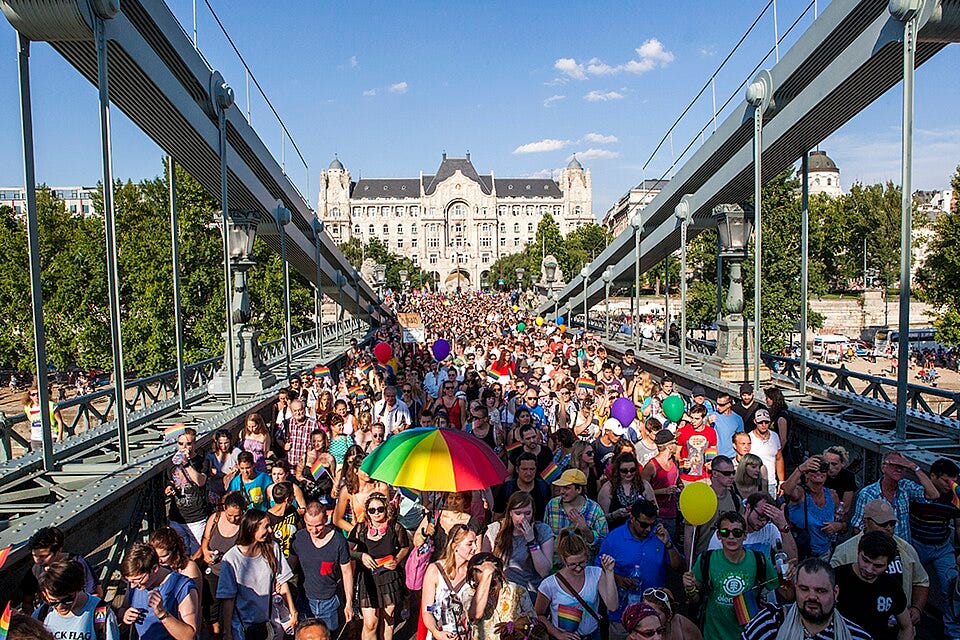
Pride is a gathering in full daylight, unmistakable and unashamed. Faces lifted. Hands trembling. Banners catching the light. Voices shaking with anger or relief. Friends and families stepping out together. Music breaking the old hush. Joy refusing the terms set by fear. Showing up in public is not decoration or performance but the embodied refusal, made visible when disappearance becomes the price of safety.
A society reveals itself through whom it tolerates in the street. Heterosexual life is public by default. It appears in wedding adverts, family photographs, school forms, films, songs, tax codes, casual conversations, and assumptions so ordinary they almost disappear. Nobody calls that propaganda. Nobody says children must be shielded from it. Nobody asks why it has to be so visible.
When LGBTQ+ people do the same thing, visibility suddenly becomes political.
The demand to keep it private is a hierarchy. It allows one group to live openly while forcing another to negotiate the terms of visibility. This is permission with conditions.
Pride refuses that bargain.
Attacks on Pride test how far the state can go in deciding which citizens are allowed to appear in public without apology. When a government proclaims the power to decide who may gather, whose stories may be told, and whose visibility counts as a threat, it redraws the borders of citizenship.
That is what made Budapest Pride so important. It was targeted through law, police action, and official rhetoric, then pushed into defiance by attempts to restrict it. Around 200,000 people reportedly attended in 2025. Budapest Pride showed what the state had tried to deny for 16 years: shame can be refused in public, not as a private act of bravery, but as a collective fact.
When assembly rights were bent around child protection, when a peaceful march was treated as a threat to public order, the issue was no longer only LGBTQ+ rights. People felt is as democracy at the street level. The question was whether a state could decide that a minority’s visibility itself constituted a violation.
The people who marched answered no.
No, you do not get to turn citizens into contaminants. No, you do not get to call humiliation protection. No, you do not get to decide that dignity depends on electoral usefulness.
This is also why Pride reaches beyond LGBTQ+ communities. If a state can do this to one group, it learns a method. It learns that fear works. It learns that enough people will accept cruelty if cruelty arrives with pleasure.
Yesterday it was migrants. Today, it is LGBTQ+ people. Tomorrow it may be Roma communities, women, teachers, journalists, the poor, the disabled, anyone whose dignity becomes inconvenient to power. The names recycle. The structure remains: find a group, isolate them, make them symbolic, present their equality as someone else’s loss, and punish those who object.
This is why Pride has never been a narrow concern. It asks a question every democracy eventually has to answer: who gets to belong in public without negotiation?
The real ordeal of democratic repair is not only whether power changes hands, but whether life changes shape. It is whether people can walk through a city without feeling like a provocation. It is whether belonging becomes ordinary, not negotiated, rationed, or granted as a favour.
The Court of Justice of the European Union has ruled against Hungary’s 2021 anti-LGBTQ+ law, finding its logic incompatible with fundamental EU values. Budapest Pride is again expected to take place. A new political context has opened a space that did not exist before.
The more serious question remains: what happens to a society after the state has spent years teaching it that LGBTQ+ people are a threat?
Laws can be repealed faster than fear can be unlearned. A court can strike down a discriminatory measure. A new government can allow a march. But what happens to the teenager who absorbed years of official contempt? What happens to the teacher who learned caution? What happens to the parent trained to confuse love with danger? What happens to a society taught to treat dignity as negotiable?
That is the work Pride still does.
It does not erase violence. It does not solve everything. It does not make the backlash disappear. It interrupts the lesson. It replaces shame with witness. It tells people who feel alone that they are not imagining the cruelty, and that they are not facing it alone.
There is joy in that. Not the decorative or commodified kind brands display each June, but a harder joy. The joy that appears when those who have been threatened still show up. The joy of knowing that survival is not silence. The joy of seeing authoritarian politics, for a moment, forced to retreat.
There is something almost pathetic about the fear of Pride.
All that state power. All those speeches. All those laws. All that manufactured panic. And still, what is the supposed threat? People gathering in solidarity. People refusing to be shamed. People insisting that their existence is not subject to political permission.
Authoritarian and reactionary politics have always relied on the idea that some people must ask permission simply to exist. The real challenge to this system lies in living openly and unapologetically, in showing up without seeking approval. What unsettles those in power is the insistence that dignity and presence do not require consent from the state or the majority.
Pride is imperfect. It has been co-opted by corporations and softened by liberal rituals that forget its origins. It can marginalise those already at the margins. It can create barriers. It can expose some people to greater risk. These tensions are real, and criticism should make Pride more honest. Drawing back in the face of rainbow capitalism leaves the field to those who want to sell it or erase it. Corporate appropriation can dilute Pride’s meaning, but it does not abolish the forces that made Pride necessary in the first place.
What endures beneath the slogans and branding is this: people standing together, even when the world makes that dangerous.
I am a heterosexual man, but some of the safest, kindest, funniest, and most accepting rooms I have ever known were LGBTQ+ spaces. Some of my closest friendships, best memories, and deepest conversations came from people who had every reason to become harder after what the world had done to them, and somehow became more generous instead.
That is one of the things bigots never understand. They imagine a threat because they have refused the friendship or relationship that would have disproved it.
I defend Pride because I have watched what happens when states discover they can win power by humiliating people. I defend it because I have seen how quickly ordinary cruelty becomes law. I defend it because the people targeted by this politics are not symbols, slogans, electoral blocs, or issues. They are human beings who deserve more than conditional permission.
The community under attack has given the world far more than it has ever been thanked for.
Art. Language. Defiance. Care. Chosen families. Political courage. New ways of surviving. New ways of loving. New ways of telling the truth about the body, the self, the state, the family, the street, the home.
A society that attacks LGBTQ+ people does not defend civilisation. It targets those who have helped make life more bearable for everyone.
So yes, Pride still matters because cruelty is organised, because children are turned into shields in ways that endanger LGBTQ+ youth, and because visibility is still treated as provocation. Democracy is not confined to the ballot box or the courthouse. It must reach the street, the classroom, the teenager’s bedroom, and the private moment when someone chooses whether to hide or step outside.
For the teenager listening from the dinner table, for the teacher changing the subject, for the friend who still checks the street before holding someone’s hand, Pride is a signal that the world has not yet fully surrendered to those who want it hidden.
Who is allowed to be visible without apology?
If the answer is still conditional, the work is not done. And if the work is not done, Pride is not a party we have outgrown. It is the promise we still owe each other: that no one should have to apologise for being themselves.
Another excellent piece- thank you!
Although I am heterosexual, I am not so insipid as to think, for a minute, that the same people who come after LGBT+ people will hesitate to come after me, and other nreurodivergent humans, once their first target has been eliminated. Besides, my bisexual nephew, who changed my own views on sexual orientation, deserves to have a full life-as do many others I've met, in the last fifty years.