

The Refinery on the Shannon
The legal route from the Shannon into Russia’s war economy, and the Irish silence that gathered around it.

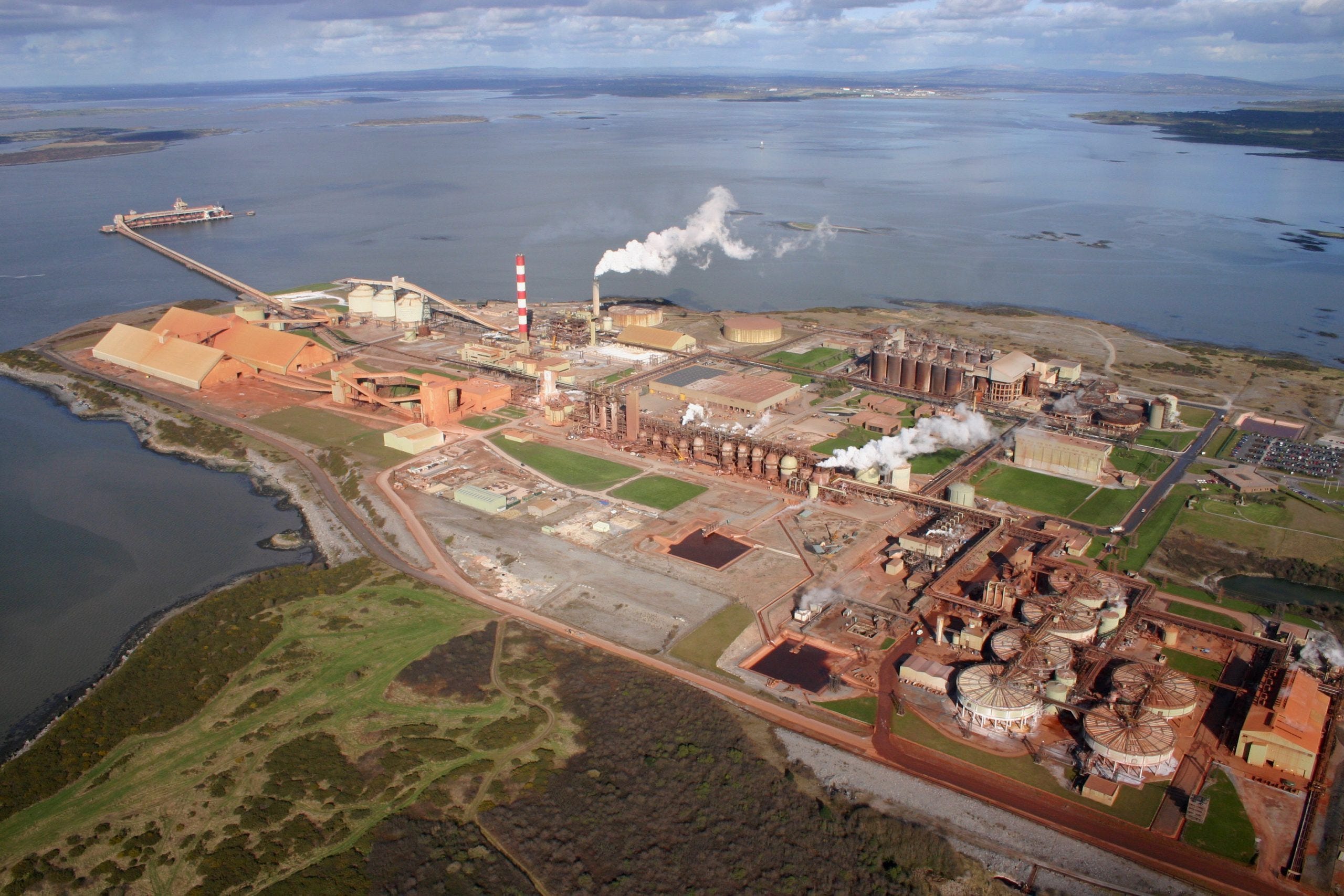
At first, I saw the story as steel: heavy, unyielding, already saturated with guilt. Even before I had written a sentence, steel brought the image of a tank.
The documents moved me elsewhere. Their pages led me away from the dense moral resonance I had first projected onto the scandal and toward something paler, more ambiguous, less ready-made for outrage.
The word was alumina.
A white powder. Aluminium oxide. Refined from bauxite. Shipped in bulk. Loaded into silos. Moved by conveyor belts. Written into customs records as another export. Alumina is essential for making aluminium, a metal used in aircraft, vehicles, infrastructure, weapons systems, and the ordinary machinery of modern life. It usually disappears into statistical tables, hidden below public language, until war forces a person to follow cargo backwards from the wound.
Growing up in Ireland meant that the story reached me before I understood it.
Ireland is not scenery to me. It is weather in the bones, in school corridors, in wet uniforms, in blurred bus windows, on football pitches under low skies. It is where I grew up, where memory settled into habit, where history lingered in conversations, commemorations, and the stories people carried with them. It is a place shaped by its past and attentive to questions of power, identity, and belonging.
Neutrality belonged to that pride. It emerged from an older wound, from the memory of a small country refusing to be drafted into the logic of larger powers. Ireland’s neutrality was never only a policy. It became woven into the country’s sense of itself: a nation that sent peacekeepers abroad, carried the memory of its own subjugation, distrusted imperial certainty, and instinctively recognised something of its own history in people living under the shadow of stronger states.
For those reasons, Ukraine made sense there.
When Russia invaded, an Irish response came with an instinctive recognition. People who had never been to Kyiv understood the sentence “a larger neighbour says your country is not real.” They understood it without theory, because Ireland’s own memory still carries the bruise of being made small by someone else’s map.
The same Ireland spoke often, and rightly, about Palestine. It was among the few countries in Europe where sympathy for Palestinians did not always have to pass through layers of diplomatic humiliation before finding its voice. Irish people saw occupation and knew the word. They saw dispossession and did not need it translated. They saw a trapped people facing a power that explained itself endlessly and called that explanation order.
Ireland also welcomed immigrants, though not without ugliness, and not without the resentments now crawling through Europe in search of a flag to wear. Still, Ireland changed. It became less homogeneous, less sealed, less certain of its old face. New languages drifted through streets that had once sounded more uniform. Classrooms, workplaces, and neighbourhoods acquired different rhythms, different memories, and different ways of belonging. The country grew more complicated and, for that reason, more alive. The new Ireland often arrived carrying exhaustion, uncertainty, and the weight of beginning again, yet it widened the place’s horizon all the same.
This is the Ireland I harboured: neutral without being numb, proud of its conscience, quick to spot a bully, capable, at its best, of making room for the wounded.
Within that Ireland, I found the route.
It begins on the Shannon Estuary, at Aughinish, in County Limerick, where ships unload bauxite, which is refined into alumina, then load it onto vessels once more and send it abroad. Since Russia’s full-scale invasion of Ukraine, a significant share of that output has travelled east, flowing from the quiet waters of the Shannon into Russia’s industrial system.
The exports were documented and moved through ordinary trade channels. They remained lawful because alumina is not currently an EU-sanctioned export, Aughinish itself is not sanctioned, and Rusal, unlike Oleg Deripaska personally, is not under EU or UK sanctions.
In 2022, Ireland exported $243 million of alumina to Russia. By 2024, the figure had risen to $376 million, a 55 per cent increase after the invasion. Almost 500,000 tonnes, worth about $200 million, reportedly went from Aughinish to Rusal’s smelter at Krasnoyarsk in 2024. The shipments accounted for roughly two-thirds of the smelter’s alumina imports and appeared sufficient to support about a quarter of Krasnoyarsk’s annual aluminium output.
Krasnoyarsk is a major Siberian industrial city and is listed by the Kyiv School of Economics as a critical military-industrial hub within Russia’s defence economy.
The plant in Limerick is owned by Rusal, the Russian aluminium conglomerate. Alumina from Aughinish is sent to Rusal smelters in Russia, where it is converted into aluminium. Leaked records reviewed by investigative reporters show that aluminium from the Krasnoyarsk chain moved through Rusal’s trading arm to Aluminium Sales Company, known as ASK. ASK sold aluminium to sanctioned or defence-linked Russian customers. Companies manufacturing weapons paid ASK $337 million for aluminium under Russian state defence contracts between February 2022 and April 2025.
That is the route at the heart of the story.
Bauxite arrives at Limerick. Alumina leaves for Siberia. Aluminium enters a Russian trading chain. Metal reaches defence-linked customers.
No public evidence directly links an individual Irish shipment to a particular missile, drone, aircraft, shell, or bomb. Alumina from Ireland mixes with material from other countries in Russian smelters, obscuring the source of any given batch. The blending of commodities, the thinning of documentation, and the complexity of war supply chains diffuse responsibility, allowing routine transactions to continue beneath the shelter of legal frameworks, employment concerns, and the persistent emphasis on civilian uses.
All of that may be true.
The route remains.
In April 2022, Patrick O’Donovan, then a minister of state, told the Dáil that Aughinish “is not in any way connected to a war machine.”
That sentence has not aged well.
This year, Kaja Kallas, the EU’s foreign-policy chief, visited Dublin and said plainly, “No European products should end up with bombs and missiles that kill Ukrainian civilians.” She also said alumina is not currently covered by EU sanctions.
After the March 2026 disclosures, Ireland’s Department of Enterprise told the Guardian that “the general principle of EU sanctions on Russia is that their imposition does not have a greater impact on a European member state than on Russia itself.”
In the careful language of government, the statement establishes a priority: sanctions are judged first by their impact on European member states. The practical consequences for a member state become the immediate concern, while the wider human costs of the war remain outside the calculation.
That statement indicates that the legal framework is being weighed against economic and political considerations rather than presented as a purely neutral principle.
Ireland stayed within the law because the law allowed the trade. Nothing about the arrangement was hidden. The ownership, the destination, and the material itself were all matters of public record. Alumina’s absence from the sanctions list was not an oversight lurking in the shadows but a deliberate failure of the regulatory framework.
That category had a history. During the 2018 and 2019 U.S. sanctions crisis around Rusal, Ireland had already learned that Aughinish was a geopolitically exposed industrial asset whose ownership implications extended to employment, supply chains, and industrial policy. The refinery’s significance was well understood by Irish officials, international regulators, and the company itself. By the time Russia launched its full-scale invasion of Ukraine, the possibility that Aughinish could become entangled in sanctions policy was neither novel nor unforeseen.
When alumina remained outside the EU sanctions net after 2022, the decision reflected a reluctance to confront the extent to which Europe’s industrial systems remained entangled with Russia. The prospect of economic disruption, political fallout, and difficult adjustments made inaction easier than reckoning with dependencies that had long been treated as manageable.
The absence of sanctions on alumina may sound like a technical policy decision. Behind that neutrality is the quiet of closed offices, stamped documents, and unchecked cargo. Raw material keeps moving while, beyond Ireland, blood is spilt and homes are destroyed. Bureaucratic language has a hollow finality at the edge of a grave. It replaces recognition with procedure and asks the air to remain still.
This is why the story is hard to move past. It reaches into Ireland’s understanding of itself and asks what that understanding means when an economic route becomes too useful to see clearly.
I do not write that with pleasure.
I write it with the embarrassment of recognition.
When concerns emerged about continuing alumina exports to Russia after the invasion, Irish officials defended the trade by emphasising that alumina was excluded from EU sanctions. The transactions, they maintained, remained lawful.
Compliance is a legal word that shapes how responsibility is understood. It allows the state to remain within established procedures while avoiding direct political judgment. Through compliance, a trade route becomes an administrative category, decisions are absorbed into regulatory frameworks, and questions of responsibility are transferred to institutions charged with oversight.
Aughinish was established as part of Ireland’s broader effort to industrialise and attract foreign investment. Planning for the refinery began in the early 1970s, and production started in 1983, during a period when the state was investing heavily in infrastructure and economic development. The Shannon Estuary’s deep-water access made the location attractive for large-scale industrial operations, and Ireland actively encouraged international companies to invest in projects that promised employment, exports, and long-term economic growth.
The plant was later owned by Glencore. Then, Rusal acquired it in 2007.
Rusal’s own materials describe Aughinish as Europe’s largest alumina refinery, with an annual capacity of 1.915 million tonnes. Rusal’s share-capital structure, updated in May 2026, lists EN+ Group as holding 56.88 per cent of the company, SUAL Partners 22.81 per cent, and other shareholders the rest. Aughinish sits inside that structure.
It is safer and more accurate to say that Russia retains corporate control over Aughinish through Rusal than to pretend the refinery belongs, in some simple, old-fashioned way, solely to Oleg Deripaska. Deripaska is one of Russia’s most prominent oligarchs, a billionaire industrialist who built much of his fortune in the aluminium sector and became closely associated with the rise of post-Soviet Russian business power. He founded the corporate empire from which Rusal emerged and remains sanctioned by the EU, the UK, and the United States. His formal power over the company changed after the U.S. sanctions crisis, when ownership and governance structures were reorganised. The plant remains inside a Russian-controlled corporate group whose founder continues to occupy a significant place in the story of Russian industrial influence.
The West learned to distinguish between the man and the company.
The supply chain kept moving.
There is an Irish story there, older than Russia’s invasion, older than sanctions, older than the latest shame. Ireland wanted to become a useful part of the world economy. Aughinish was one of the places that made that wish physical.
Now the apparatus belongs to a Russian chain.
That does not make the local workers villains, or Limerick guilty, or every employee at the plant an accomplice to a war crime. Such writing would be obscene. The people around Aughinish contend with the consequences of decisions made far above them, in boardrooms, ministries, sanctions committees, and quiet calls where the word “strategic” does a lot of moral laundry.
The plant provides work, wages, and sustenance for contractors and apprentices. It supports local shops and families. It gives some people a reason to remain in the area. At the same time, it is Europe’s largest alumina refinery, a Russian-controlled asset, a supplier to Russian smelters, and a fact Ireland cannot obscure with patriotic rhetoric.
Even the number of jobs has become part of the fog. Rusal’s own website lists a headcount of 460 at Aughinish. Later reporting, citing a KPMG figure, has reported about 900 staff or jobs supported. Both figures may be true in different ways. One may mean direct employees. The other may include contractors, apprentices, suppliers, and the wider employment ecosystem that gathers around a plant this large. But the distinction matters because jobs are the shield held up whenever the route is questioned.
A 460-person payroll and a 900-person local dependency are not the same political fact.
No serious article should treat the people of West Limerick as expendable. No serious government should hide behind imprecise numbers when those numbers are invoked to defend a route into Russia.
The Irish government’s defence rests on a set of practical considerations centred on employment, industrial stability, and economic dependence. Officials argue that Aughinish supports local livelihoods, that sanctions could jeopardise those jobs, that Europe continues to rely on alumina, and that Russia would likely obtain the material from alternative suppliers if Ireland stopped exporting it. The emphasis throughout is on immediate, measurable local consequences rather than distant suffering or the complexities of tracing responsibility through a global supply chain.
Each justification has a surface logic that is difficult to dismiss outright. The arguments appeal to immediate consequences, local livelihoods, industrial dependence, and the possibility that Russia would simply obtain the material elsewhere.
I also know what a loophole sounds like when it learns to speak Irish.
It speaks in the language of compliance.
It says proportionality.
It invokes regional jobs and economic security.
It says no evidence.
It says not currently covered.
It points to Ireland’s concrete actions in support of Ukraine: humanitarian aid, temporary protection, accommodation for tens of thousands of Ukrainian refugees, participation in EU civil-protection efforts, non-lethal military support, and consistent public backing for sanctions and diplomacy aimed at countering Russian aggression.
Meanwhile, the ships move.
Rusal’s own description of Aughinish places it comfortably within the language of European industry, a deep-water terminal moving alumina efficiently to smelters across the continent, a Shannon Estuary refinery presented as part of the ordinary circuitry of European production and supply.
A facility described in European delivery terms has, in wartime, sent vast quantities of alumina to a Siberian smelter. The public face looks west. The route runs east.
There is also a European asymmetry here that deserves its own shame. The EU has moved to block Russian aluminium from entering Europe. It has tightened parts of the trade regime and announced sanctions packages in the language of pressure and resolve. Yet alumina moving from Europe into Russia has remained outside the ban. Russian metal imports are treated as a problem. A key upstream input going out is treated as an exception.
The direction of the cargo changes the moral vocabulary.
That is why Aughinish reaches beyond Ireland. It reveals what happens when Europe’s rhetoric of resolve collides with its industrial dependencies: forceful declarations in public, carefully preserved exceptions in practice.
The issue has become more politically visible in 2026 as Ireland prepares to assume the presidency of the Council of the European Union. The Ukrainian embassy in Dublin has expressed serious concern. Irish MEPs have called for action. Independent senator Tom Clonan has reportedly described the situation as “completely and utterly untenable” if Ireland wants to say “Slava Ukraini” while remaining a major exporter of alumina to Russia’s war economy. Enterprise Minister Peter Burke has said a comprehensive probe is underway and that its results will be passed to the European Commission.
The timing is difficult to ignore. By March 2026, nobody in Dublin could plausibly say the concern was theoretical. The route had been publicly described: Aughinish, Krasnoyarsk, Rusal’s trading network, ASK, defence-linked customers. Once those links entered the public record, the focus shifted from what Ireland could have known at the outset to how Ireland responded after the route had been clearly identified.
Another uncertainty now hangs over the figures. In 2026, official Irish statistics reportedly showed that Russia accounted for 83 per cent of Aughinish’s first-quarter exports. The company disputed that figure and said the real number was closer to 51 per cent. The difference is not minor. It is the difference between a dominant destination and a merely enormous one.
Until the raw data and methodology are fully explained, the safest conclusion is not that one number has defeated the other. The safer conclusion is that a refinery at the centre of a European war loophole cannot yet be described with public confidence. Even the scale of the route is wrapped in dispute.
That, too, is part of the story. The uncertainty extends beyond what moved through the Shannon and into the challenge of establishing a clear public account of the trade.
The residue at Aughinish is also physical.
Beside the refinery lies a bauxite-residue disposal area of roughly 450 acres. Planning permission to expand it was quashed by the High Court in 2022. A revised application was approved in 2025 after objections from local farmers and environmental groups. This should not be forced into a metaphor too quickly. Red mud is not a symbol; it is a fact. It is waste, stored in a landscape, defended through planning files, challenged through courts, lived beside by people who did not choose the global aluminium system and yet inherit its remains.
The plant leaves residue in more than one language.
That is the line I cannot cross. The ships keep moving. The plant keeps operating. Alumina is shipped to Russia, where it is processed into aluminium and distributed through civilian and military supply chains. Trade records and investigative reports show Russian arms manufacturers receiving large shipments under state defence contracts from ASK. Meanwhile, the war continues to accumulate its dead. The United Nations has verified tens of thousands of civilian casualties since Russia’s full-scale invasion, including more than 12,000 civilians killed and many thousands more injured, while Ukrainian authorities and independent researchers believe the true toll is significantly higher. Entire towns have been shattered. Apartment blocks have collapsed into dust. Schools, hospitals, power stations, and homes have been struck. Millions have been displaced from the places where their lives once made sense. Behind every statistic is a person who expected to wake up in a familiar room and instead found themselves running from fire, searching through rubble, or burying someone they loved. The regulatory compliance of each shipment cannot erase the downstream human geography.
Ireland should not bear singular responsibility. That would flatter everyone else. Across Europe, clean institutions conceal areas of moral compromise, and governments have developed their own dialects of exception. The sanctions regime is severe, but it is shaped by fears about prices, shortages, industrial dependence, and the political cost of discovering that morality becomes expensive when it reaches the payroll office.
Ireland’s case hurts me because Ireland taught me better language than this.
It taught me to listen when power speaks with confidence and to remain suspicious of narratives that erase the voices of smaller nations. My understanding of neutrality is rooted in historical experience and resists passive disengagement. Sympathy for the occupied is not measured by convenience. Welcoming those displaced by conflict requires an awareness of the structures that forced them to leave.
So what do I do with an Irish refinery feeding material into Russia’s aluminium system while Irish leaders speak of Ukraine with perfectly decent words?
I do not think Ireland chose Moscow, and framing the story that way would be both too simple and too comforting, because it would allow everyone involved to imagine that the moral failure lay in a single act of allegiance rather than in a long series of decisions, omissions, exceptions, and accommodations that accumulated over time until they formed a route that nobody seemed willing to interrupt.
It is the story of a country that continued to rely on a route after its consequences could no longer be dismissed as abstract. The question is no longer whether Aughinish was legal; by every official measure, it was. The question is whether legality became a shelter once the route could be traced, and whether compliance replaced the harder burden of judgment.
Perhaps that is why the refinery on the Shannon lingers in the mind. Not because it offers a clear villain or an easy verdict, but because it leaves behind a tougher question. What do we owe our principles once keeping them becomes inconvenient?
Thanks for the incredibly detailed reporting. I had no idea. But I also was shocked today to read news of violence in Northern Ireland against immigrants. This is not the peaceful, welcoming country I thought it had become. I hope things change quickly, and that support of Ukraine will prevail. There must be a way to save jobs and still do the right thing.
A complex issue with no easy answer. I support the workers & despise the oligarchs. I hope Ireland figures out a good answer, as well as all the other instances of hopefully innocent feeding of the Russian war machine. I know America is probably aiding them, since Trump & our oligarchs only want as much money as they can grab. There will be a reckoning.