

Learning How to See Power Again
A camera cannot rebuild a country. But in Péter Magyar’s first days, making power visible again has become the first promise of democratic repair.

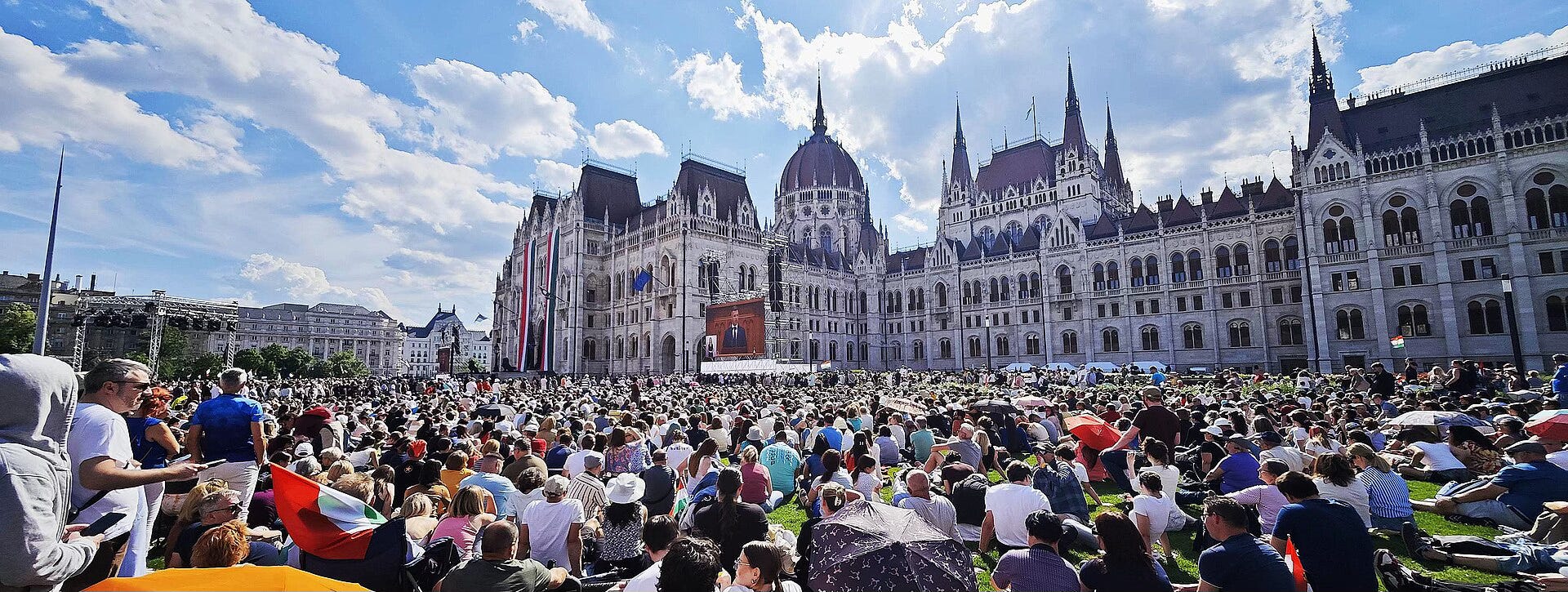
The camera followed Péter Magyar into the Karmelita, the hilltop palace that came to embody Viktor Orbán’s Hungary: elevated, guarded, theatrical, removed.
It followed him through the polished wood and private comforts of ministries linked to the old regime, where the strange little luxuries of the state sat in quiet contrast with the sacrifices demanded from ordinary people. It followed him through the first uneasy days after victory, when celebration began to give way to responsibility.
Modern politics has taught us to distrust every camera. Usually, that instinct is healthy. We have seen enough men speaking into phones to last several constitutional eras. Yet in Hungary, Magyar’s decision to keep showing the handover of the state carries a particular force. Trust cannot be rebuilt through declarations. It begins when people are allowed to see what was done in their name.
Orbán’s Hungary trained the country to accept distance. Authority withdrew into guarded buildings, loyal television studios, friendly business circles, public foundations and carefully staged rituals. Citizens were constantly addressed. They were rarely answered. They were given enemies, flags, threats, consultations and national feeling in bulk. Access was another matter.
The distance was deliberate. As government life became more remote, it acquired the glow of inevitability. Decisions seemed to happen in another climate. Money travelled along routes most citizens could only sense from the smell it left behind. Public institutions kept their names, but their daily logic increasingly served a private political world. The state spoke in the name of the nation while acting as if the nation had no right to look too closely.
Magyar’s first instinct has been strikingly literal: go there, show it, explain it.
That is why the Karmelita carried such force. The building already carried centuries of Hungarian history before Orbán made it his stage. The former Carmelite monastery in Buda Castle was built in the eighteenth century, later turned into a theatre, damaged in war, renovated under different regimes, and eventually used by cultural institutions before the government took it over. Orbán’s move there in 2019 was never only a change of address. It placed the prime minister above the city, inside a restored historic shell, in a district increasingly remade as a monument to state power and national grandeur. The official language around the move spoke of restraint and puritan simplicity. The politics of the place told a different story. This was the prime minister leaving Parliament’s immediate shadow and moving into the Castle, where history itself seemed to have been polished into a backdrop.
Buildings do not sin. They simply preserve the confidence of those who believe nobody else will ever walk through with a camera. The Karmelita was not just an office. It became the physical expression of a government that had lifted itself above the country it claimed to represent.
Magyar’s video said something simple and powerful: this was paid for by you, used above you, and hidden from you.
The ministry videos carried the same charge. Magyar did not need to speak in abstractions about excess. He showed its texture. The finish of the furniture. The softness of the private spaces. The atmosphere of a political class that seemed to treat the state as personal inheritance. The images landed because they gave form to a suspicion many Hungarians had carried for years. Sacrifice had been preached downward. Comfort had been kept upward. The sermon, as usual, came with better seating for the clergy.
This is one of the clearest features of Magyar’s early style after victory. He gives physical shape to what had often been felt but not seen. He turns atmosphere into evidence.
He has also refused the usual retreat into office. The campaign’s pulse has not been switched off. He continues to speak directly and often, carrying the public with him through the strange middle passage between winning and governing. That period can be dangerous in its own quiet way. A movement wins, the state absorbs it, and citizens are gently encouraged to become spectators again.
So far, Magyar has resisted that drift. He is still explaining, still responding, still inviting people into the unfinished process. This is not saintliness. Cameras flatter. Livestreams can become vanity. Transparency can be packaged, branded, monetised and made insufferable, because politics remains a human activity and therefore always finds a way to embarrass itself.
Hungary does not need more political content. It needs however, proof that governing is no longer taking place somewhere out of reach.
Magyar’s videos will only count if they become a discipline of explanation. They need to admit limits, explain delays, clarify trade-offs and show the public that reform is not magic. The point is not to narrate every hour of government like a man trapped inside a constitutional vlog. I can think of a particular someone with his own social media app, and that is usually where civilisation begins to ask for a break. The point is to let citizens see decisions while they are still being shaped, before they arrive fully formed and wrapped in authority.
One early example came around education.
The reported possibility that Rita Rubovszky could lead the education portfolio triggered criticism from people in the education world who had spent years fighting centralisation, humiliation and neglect. Seventeen secondary school heads asked Magyar to involve the profession in shaping future policy. In a healthier democracy, this would sound ordinary. In Hungary, after years in which teachers were treated as a national inconvenience with chalk dust, it felt like a signal.
The eventual choice of Judit Lannert, an education researcher immersed in inequality and school policy, suggested that the criticism had reached its target. This does not conjure a new education system. There are no fairy godmothers in Hungarian politics, only paperwork, budgets, exhaustion and the slow work of making things less broken. One appointment does not restore autonomy. It does not raise salaries. It does not bring back the trust drained from schools year after year.
Still, the reflex changed. People pushed, and the future government adjusted.
In Hungary, that carries a strange amount of hope.
Public contact cannot mean the leader speaks while everyone else watches. That is broadcasting with better lighting. The deeper question is whether the new government can still hear criticism once the rallies fade and the applause thins out. The education episode suggested, at least for now, that Magyar understands the difference between speaking with people and speaking over them.
The Roma presence at the inaugural session belongs in the same story.
The Roma anthem in Parliament, performed by Roma children, was not justice. It did not desegregate schools, improve housing, end discrimination, reform policing or undo generations of exclusion. But public life begins by deciding who is allowed to appear inside the national image without being reduced to a problem.
For decades, Roma Hungarians have been spoken about, spoken over, blamed, pitied, photographed, promised things and ignored again. They have been treated as a campaign tool, a social issue, a threat, a silence.
On that historic first day, Roma Hungarians were not outside the picture of national renewal. They were present in the heart of it.
That gesture now asks for substance. Symbols become dangerous when politicians mistake them for justice. A hymn does not repair poverty. A performance does not redistribute influence. A standing ovation does not undo the structures that have kept Roma communities close enough to be used and far enough from real authority. But symbols can mark a threshold that policy must then cross. The question now is whether this moment leads to budgets, schools, housing, legal protection and Roma voices in decisions that shape Roma lives.
If it ends as ceremony, it will sour. If it becomes part of government practice, it may remain as an early sign that Magyar’s idea of Hungary is wider than the one Orbán left behind.
His handling of Fidesz in Parliament has carried the same seriousness. Magyar has not treated the old ruling party as a normal opposition wounded by defeat and entitled to a quiet corner from which to complain about manners. He has treated it as the residue of a political order whose remaining structures still need to be examined and talked about.
Fidesz left behind appointments, contracts, boards, loyalties, media networks, legal traps, financial commitments and institutions shaped by years of political use. Magyar’s demand that outgoing ministers disclose decisions and obligations made after his election signalled that the final movements of the outgoing state would not be allowed to disappear into paperwork.
The calls for resignations, the promise of asset recovery and the insistence on confronting the old regime’s architecture all belong to this same early posture. Here Magyar must be careful, and so must the country. Accountability cannot become revenge. Public pressure cannot replace due process. A democratic government cannot answer abuse by inventing new informal rules around one leader’s will.
A captured state does not become neutral because voters have changed the government. Magyar now has to move with speed and care at once, which is always when politics becomes least forgiving. He has to expose what was hidden while building institutions that can survive without his personal presence. He has to keep talking to people without making government depend on his performance. Public attention must lead to records, investigations, law and consequence.
The danger is real.
But so is the hope in Hungarians.
A government cannot live forever on the satisfaction of pulling curtains down, however exhilarating those first moments may be. Hungary needs files, investigations, budgets, laws, independent institutions and consequences. Less glamour, more paperwork. Sadly, democracy is often just bureaucracy with moral purpose.
And yet Magyar’s first instinct still feels important. He has kept the transition public. He has shown what was not meant to be shown. He has continued speaking directly to citizens. He has listened when pressure came. He has treated Fidesz as the residue of a regime that must still be named, examined and dismantled through law.
That is why these first days feel larger than the usual choreography of a new government. They suggest he understands something essential about the country he has inherited. Hungary needs more than new policies. It needs a new relationship between government and citizens. It needs leaders who do not hide after asking people for courage. It needs institutions that can be questioned without treating scrutiny as treason.
For sixteen years, Hungarian public life trained people to look upward: at walls, gates, billboards, screens, speeches and controlled performances. Magyar’s first act has been to walk back toward the public and let people look closely at what was done in their name.
None of this proves what he will become. It does not guarantee renewal. It does not erase the risk of disappointment. It does not mean trust has returned, or that the old order has truly passed, or that the hardest work is already underway.
It means something simpler, and more precious at the beginning.
Hungary is being allowed to look again.
Now Magyar has to make sure that looking leads to justice, competence and a government brave enough to remain visible when the work becomes slower, duller and harder.
Wow, all I can say is I totally agree with you. As in all things we will see what happens. But is is a good start. You write very well & get to the point.
Peter Magyar is off to a great start. At some point, he will face a crossroads. Will he follow the straight path being illuminated by men like Mark Carney, or New York Mayor Zohran Mamdani, or will he become jaded and end up mesmerized by power, as have Ethiopia's Abiy Ahmed or El Salvador's Nayib Bukele? My money is on the former. He has already seen the dead end offered by authoritarianism, from the inside.