

How Orbán Bends Democracy — and Why Authoritarians Watch
Orbán has not beaten democracy. He has learned to live inside it.

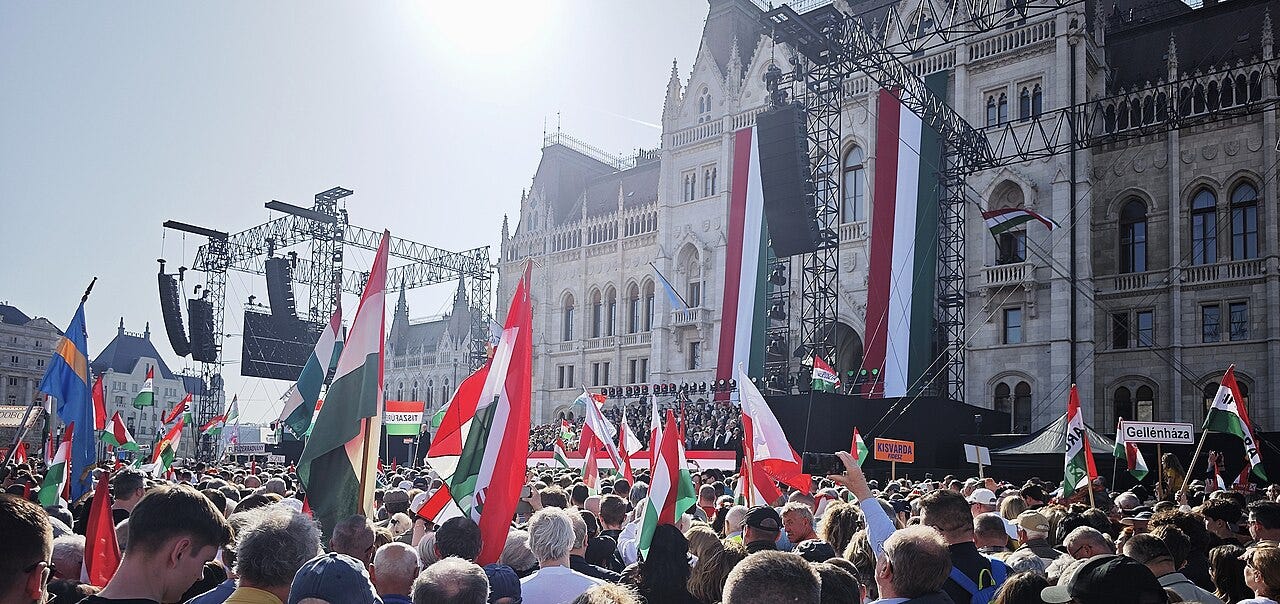
On April 12, Hungary votes. Ask an independent pollster who is winning: Tisza. Ask a government-aligned pollster: Fidesz. That divide previews what this article is about.
Péter Magyar’s Tisza party has tightened the race. Fidesz now campaigns with an urgency not seen in a decade. The rival Budapest rallies on March 15 made that clear. A system confident in its own architecture does not campaign this hard.
A close race in a structurally tilted system proves only the system’s flexibility. The better question is: what does winning mean when the rules are set by those who keep winning?
The method
Hungary still holds elections. Parties still compete. Votes still get counted. Yet the result is rarely seen as genuinely open. That is by design.
What Orbán built has no clear name. Dictatorship is too simple. Democracy is too generous. The system is tough and tenacious because it keeps democracy’s appearance while gutting its substance. Enough competition remains to suggest legitimacy. Enough uncertainty endures to make each election feel real. The contest is never quite equal. No one ever admits it. That is the point.
The distance between a country that holds elections and one that is still genuinely open has no formal declaration, no single date, no one decision you can circle in red. It accumulates. Hungary has been accumulating it for sixteen years.
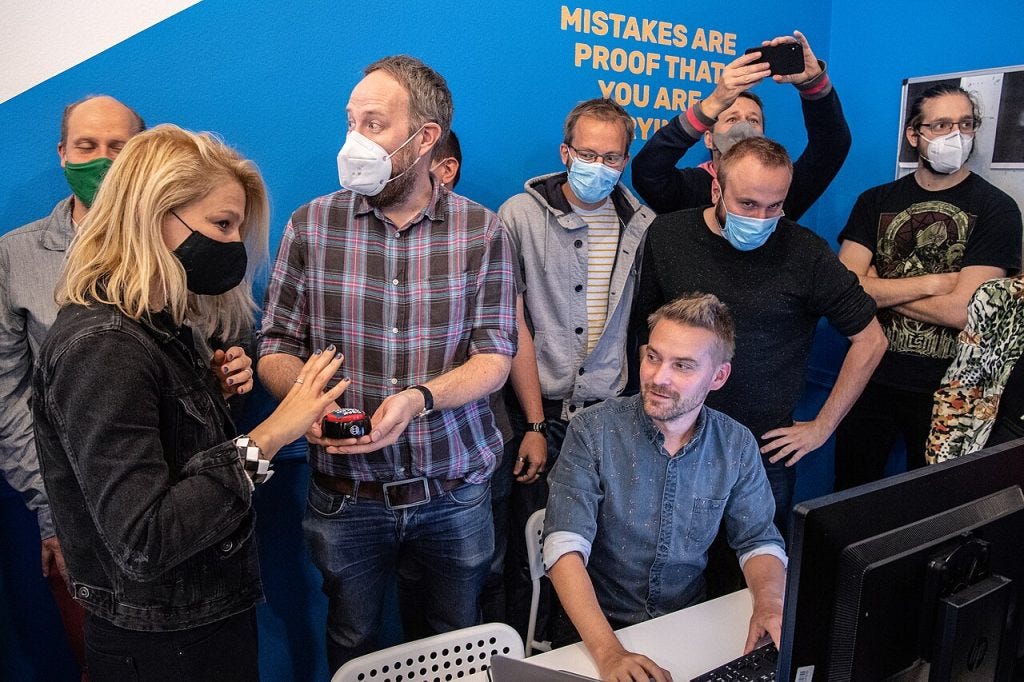
Media control best illustrates Orbán’s model. The mechanism is gravity, not prohibition. Ownership concentrates. Licensing favours loyalty. Advertising follows power. Access is reserved for those who cooperate. In March 2026, two Telex journalists were removed from a Fidesz event. Press-freedom groups condemned it. Fidesz moved on.
That exchange is worth holding onto. In isolation, it looks like a bad day for press access. Zoom out sixteen years, and it looks like something else entirely: state media is government-controlled, private outlets are under pro-government influence, and the line between editorial independence and political loyalty disappeared so gradually that most people did not notice it leave.
Orbán and his loyalists built the architecture behind it in stages. In 2018, Orbán exempted a vast pro-government media conglomerate from competition scrutiny. No confrontation. No public fight. No defining moment anyone could point to later. A process was skipped. A decision was filed. By 2021, Klubradio was off the air after losing its licence. The EU’s top court later ruled Hungary had broken the law. The station did not come back. The ruling arrived after the point. That is how the method works: legal, procedural, and effectively irreversible by the time anyone rules on it.
No single act is decisive. That is the design. Each move is small enough to be defensible. Each decision comes with a procedural explanation. But they compound. Critical voices quietly lose reach. Access slowly narrows. The information environment tilts, degree by degree. Soon, the governing party has the field, and nobody can quite identify when it happened. By the time someone asks whether any of this is fair, the question already sounds unreasonable. That is when you know the baseline has moved.
Beyond the press
The media is only the most visible front. The same logic reaches any institution capable of producing an authoritative counter-narrative, that is, any institution worth controlling.
The Central European University case made the logic explicit. In 2018, the government withheld the guarantees that would have let CEU stay. That forced it to move U.S.-accredited courses to Vienna. The EU’s top court later ruled Hungary had broken EU law. The university was already gone. The legal finding came after the political goal. This is another lesson in how the method works.
The instinct has spread. In March 2025, the Trump administration reviewed roughly $9 billion in federal contracts and grants tied to Harvard. Harvard professors sued in response. The legal outcome is one question. The pressure was the point, as it was in Budapest in 2018. You do not need to win the case if the institution is already busy defending itself.
The digital age
Orbánism endures by adapting, updating its machinery to meet each new constraint. When major platforms tightened rules on paid political advertising ahead of the April vote, Fidesz did not complain about the problem. It solved around it. Reuters reported that the party turned to ‘digital fighters’: coordinated online supporters, influencers, and AI-generated content.
This is governance built for the platform age. Institutions still matter. So does the feed. What people see, what they scroll past, and what registers as normal without them noticing is now a political resource. Orbán has been mining it deliberately. Winning the vote matters. Controlling what feels real matters more.
Keep the emergency permanent, and the rest writes itself. The opposition is reckless. A vote for the opposition is a vote for war. Not a different policy. War. In Orbán’s framing, the frame does the work. The argument does not have to.
In February 2026, Secretary of State Marco Rubio said Trump was committed to Orbán’s success ahead of the April vote. Not neutral. Not merely diplomatic. Committed. Days later, Reuters reported that JD Vance was planning a visit to Budapest to show support. The trip was thrown into doubt by the Iran war. The visit may or may not happen. The message has already landed. Washington is watching Budapest with interest.
The export
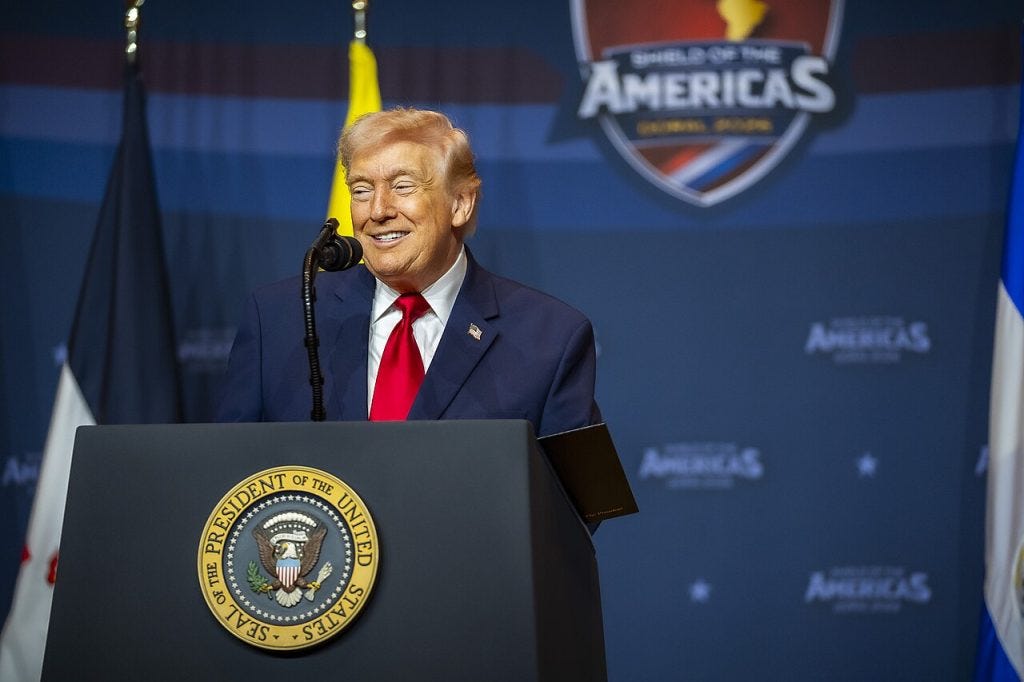
In July 2024, Orbán’s political director welcomed Vance as Trump’s running mate and praised Vance’s view of Orbán’s university policy. The admiration is professional respect: one political operation recognising the results of another.
What Trumpism sees in Budapest is a system that keeps winning while making the next win easier to secure. The United States is larger, more institutionally resilient, and harder to move. But the sequence is familiar. Attack neutral institutions. Pressure universities. Delegitimise judges. Turn the media ecosystem into a loyalty machine. Make the opposition feel like a national threat, not just a political one. The country is bigger. The playbook is recognisable.
In the U.S., what holds the system together is alignment, not command. Fox amplifies. Administration figures appear. Messaging circulates and soon becomes common sense for millions. Reuters had already reported that Defence Secretary Pete Hegseth, a former Fox host, attacked CNN’s coverage while backing a Trump ally’s bid for its parent company. The same political gravity is doing similar work in a different country.
The deepest parallel sits in the judiciary, where the real question is what happens when institutions designed to check power stop doing so. Orbán’s system endures not because opposition has been eliminated, but because the referees have been progressively sidelined. Hungary shows how much authority can accumulate in that gap before democratic forms visibly crack.
The American version is already underway. In March 2026, the Trump administration went to the Supreme Court repeatedly with the same complaint: judges were getting in the way. Reuters reported that 97% of its emergency appeals argued that lower-court judges had improperly interfered with presidential power. Ten days later, Chief Justice John Roberts warned that hostility toward judges is dangerous. “It has got to stop.” A Chief Justice should not have to say that. The fact that he did tells you where things are.
The sequence is familiar. Reduce trust in the referees first. Recast institutional checks as political obstruction next. Then teach the public to read judicial resistance as sabotage, not constitutional balance. Each weakened institution lowers the threshold for the next. Hungary is instructive because it shows how far this process can run inside a system that never formally abandoned elections. What remains still looks like a democracy. The substance has been quietly removed.
Hungary is where the method has run longest and reached furthest. Sixteen years of refinement span multiple election cycles. Each one extends the model into new terrain: media, universities, courts, the digital environment. Its significance lies in being designed to be repeatable.
Defeat Orbán on April 12, and a question remains. What exactly has been defeated? The man, perhaps. The architecture endures. Institutional erosion does not reverse simply because the architect exits. It compounds. Each round of adaptation has already lowered the bar for the next. What Hungary has built is load-bearing infrastructure. Remove the figurehead. The system can still hold.
Across Europe and the United States, others have been taking notes. Some are borrowing selectively. Some are admiring the model openly. What Orbán has demonstrated is modern authoritarianism’s central trick: win democratic legitimacy, then use it to make future losses less likely.
That is why April 12 matters beyond Hungary. An Orbán defeat would be significant, but not a refutation. The model does not require its author to survive. It requires only that the institutions it has weakened remain weak, and that the playbook remain legible to anyone willing to use it.
Hungary’s experience crystallises one lesson above all others: the reshaping happens long before the failure is visible. By the time it looks like a crisis, it has already been a process.
This article was first published on The Hungary Report.
Peter
Your core argument is difficult to dismiss.
What Orbán has done in Hungary is not the sudden destruction of democracy, but its gradual reconfiguration. Institutions still exist, elections still take place, and laws are still passed — but the balance has shifted.
Over time, key checks and balances have been weakened:
the judiciary has been brought under political influence,
large parts of the media landscape have been consolidated,
and the electoral system has been redesigned in ways that favour the incumbent.
This is what makes the model effective. It does not abolish democracy — it hollowes it out from within.
At the same time, the system is reinforced through patronage and control over economic resources, creating a structure where political loyalty and access to state benefits become closely linked.
Orbán himself calls this an “illiberal democracy”. In practice, it is a system where democratic legitimacy is maintained formally, while political competition becomes increasingly constrained.
The important point — and the reason the article matters — is that this model is not unique to Hungary. It is a template.
Peter
The piece captures something essential about Viktor Orbán’s system: it is not an outright dictatorship, but a gradual reshaping of democratic institutions from within.
What stands out is the method. This is not about abolishing elections, but about tilting the playing field — through control of media, pressure on civil society, and legal changes that favour the ruling party. Over time, this creates what many analysts describe as an “illiberal democracy” or even an electoral autocracy.
The key point is therefore not whether Hungary still votes — it does — but whether the system remains genuinely competitive. That is where most of the concern lies.
At the same time, Orbán’s durability should not be underestimated. His model combines nationalism, economic patronage, and political centralisation in a way that still resonates with a significant part of the electorate.
So the real question is less how democracy is bent — and more why it continues to command enough support to endure.