

America Is Still There
What Zohran Mamdani’s New York reveals about the America Donald Trump cannot erase.

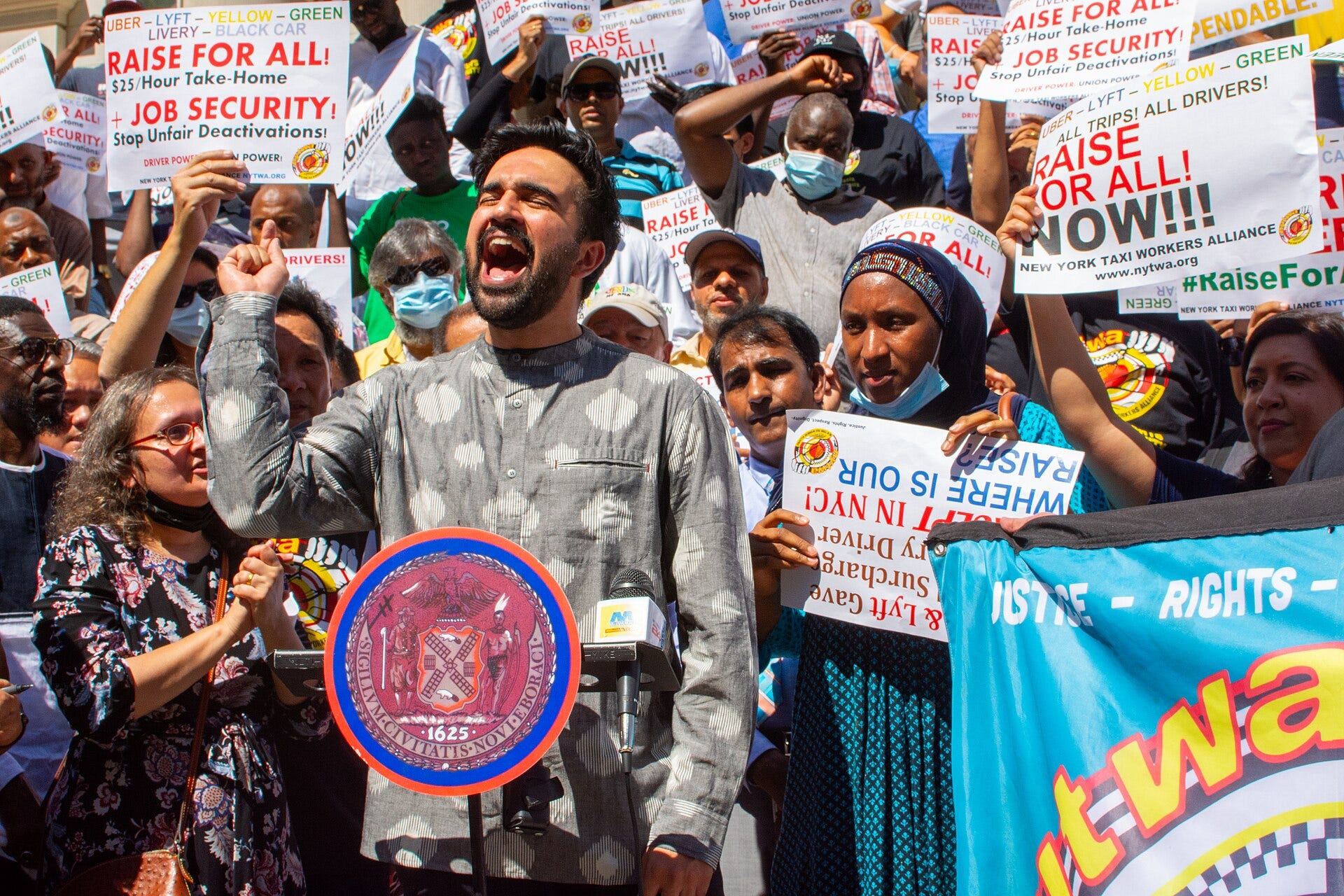
On the eve of America’s two-hundred-and-fiftieth birthday, Zohran Mamdani sat behind George Washington’s desk at New York City Hall. Recently naturalised Americans stood around him. The desk belonged to the first president. The people beside it had crossed the slow terrain of visas, interviews, declarations and official stamps, and emerged with the right to help decide what the country would become.
“The truth, my friends, is that America is exceptional because here, nothing is fixed into place,” Mamdani said.
He turned towards the new citizens and spoke of their “power to determine what America means.”
From Barcelona, those words landed with surprising force.
For far too long, the US has reached me through scenes organised around Donald Trump: a motorcade cutting through empty streets, a ballroom of gold surfaces and fixed smiles, pardons signed with theatrical impatience, immigration agents moving through neighbourhoods with covered faces. Billionaires piling behind him with the vacant expressions of men standing over a butchered republic. In that imagery, America is not a shared project but a stage on which Trump performs ownership, while the rest of the country is reduced to an audience as he claims the right to define the nation.
To my American readers, I should be honest. I have watched Trump with dread, anger and disgust.
The vulgarity catches the eye. The political project beneath it is even more repellent. Trump has turned the presidency into an extension of his grotesque appetite. Federal authority becomes a loyalty test, with agencies and officers pushed to perform submission in public; cruelty is treated as spectacle, law as personal property, and humiliation is directed at people with far less power.
His government has made domination look like a national purpose. Every raid, threat and pardon carries the same message: the powerful may act freely, provided they remain useful to the man at the centre.
From Europe, Trump has made America look smaller, meaner and exhausted. He occupies so much of the frame that the country behind him can disappear.
Then, at Washington’s desk, came Mamdani.
He spoke about immigrants, workers, tenements, hospitals and public institutions. His America remained open to revision. The new citizens beside him had entered its history with full voices.
I had nearly forgotten that an American politician could describe the country without first reciting a litany of enemies.
The speech carried weight because its language was grounded in concrete policies and administrative outcomes. America has produced enough noble sentences to carpet continents. Mamdani’s words lead towards childcare applications, rent renewals, unpaid wages, bus routes and the cost of remaining in New York. His patriotism has a municipal address. It passes through a school form, a housing inspection, a labour settlement, and the morning journey to work.
Watching him, I recognised a political shape I had seen closer to home.
I wrote earlier this year, in The Mayor Who Kept Budapest Open, that Budapest under Gergely Karácsony became “what Hungary looked like when the system failed to completely shut down a place.”
City Hall gave Karácsony no means to dismantle Viktor Orbán’s political order. Instead, his work became one of preservation: keeping part of the country open.
That became unmistakable during Budapest Pride in June 2025. Orbán’s government had rewritten the law to make the march bannable and authorised the use of facial-recognition technology against participants. Police prohibited the event. In the face of all this, Karácsony declared Pride an official municipal celebration, invited people to attend and walked at the front.
Hundreds of thousands filled the streets. The march became the largest Pride gathering in Hungarian history and one of the clearest public refusals Orbán’s government had faced.
For several hours, the state looked smaller than the crowd.
Prosecutors later charged Karácsony and sought a fine. He called himself a “proud defendant.”
“It seems that in this country, this is the price you pay if you stand up for your own freedom and the freedom of others.”
The charges were finally dropped in June 2026, after the European Court of Justice found that the legislation behind the ban violated European Union law.
Pride changed something in me, too. I watched for hours, unable to look away. For the first time in years, pride in Hungary no longer felt absurd. I began writing again soon afterwards. Observation no longer felt sufficient.
Karácsony had turned the city into a form of counter-power. Budapest showed that Orbán’s state could menace, prosecute and bluster without gaining complete control over public life.
Before Hungary could change, some part of it had to remain open enough to imagine change. Budapest kept me open, too. I have lived away from Budapest as well, but sometimes distance can give you clarity. It has always been a home for me, even during the years when Hungary itself became harder to recognise.
Mamdani’s New York carries a related possibility. Budapest preserved democratic space beneath a hostile national government. New York is using municipal power to fill that space with services, organisers and candidates.
The material is aggressively ordinary.
Mamdani’s campaign spoke through the arithmetic of urban life: a rent notice slid beneath a door, a childcare invoice opened at the kitchen table, a bus crawling through traffic, a grocery receipt inspected twice, a wage payment that never arrives.
He won the 2025 Democratic mayoral primary with 573,169 votes in the final round. Andrew Cuomo received 443,229. A margin of 129,940 votes made the familiar description of a lucky insurgent slipping through a crowded field difficult to sustain.
The campaign’s field operation resonated as much as its message. More than fifty thousand people volunteered. Canvassers knocked on 1.6 million doors and held 247,000 doorstep conversations. The videos gave Mamdani visual confidence, and the conversations gave him a city.
I recognise something here from Hungary. Tisza also built political momentum through town squares, railway stations, village halls, handshakes and the slow accumulation of people who realised that their private frustration was shared.
Politics begins to move when it leaves the screen.
The campaign invited ordinary New Yorkers into politics. City Hall now has to repay that invitation in daily life.
New York has opened applications for its first 2,000 free childcare places for two-year-olds. Most will operate from eight in the morning until six in the evening, 260 days a year. The programme has crossed the boundary between a proposal and a public service. It now has providers, opening hours, and a date by which parents can expect an answer.
Suz Kroeber, a mother from Washington Heights, had previously described spending roughly $29,000 a year on childcare after her family failed to receive a public 3-K place.
“Instead of pinching every penny just to cover daycare, we can start thinking about saving for college or retirement,” she said.
Childcare policy lives in quiet territory. It determines whether a parent returns to work, accepts more hours, plans another child or watches a salary dissolve into invoices.
It returns time.
Mamdani’s administration has also completed bus-lane projects serving more than 150,000 daily riders. The plans had stalled before he entered City Hall. His team restarted and completed them.
A few minutes saved on a commute will never dominate cable news. Repeated twice a day, those minutes become meals eaten at home, children collected without panic and sleep recovered from the failures of the city.
Labour enforcement returns something equally concrete.
In January, New York announced settlements worth $5.195 million involving Uber Eats, Fantuan and HungryPanda. The violations affected more than 49,000 delivery workers. Uber also agreed to reinstate workers who were improperly removed from the platform, potentially affecting 10,000 people.
The investigations began before Mamdani took office. Governments inherit laws, civil servants and unfinished cases. Leadership is evident in the decision to move that bureaucracy, especially when the people waiting for it have little money, weak bargaining power, and no easy route into City Hall.
Delivery workers carried New York through storms and a pandemic as app companies controlled their pay, their access to work and their dismissal through a screen. The settlements gave rights written into legislation, the more persuasive form of money returned.
Housing provides the most physical measure of this governing instinct.
Diana De La Pava has lived with her daughter for more than thirteen years in a rent-stabilised building in Jackson Heights. She described failing heat and hot water, termites, collapsing surfaces and an elevator that remained broken for months. Elderly and disabled residents were effectively trapped inside their homes during one outage.
Her building became part of a settlement covering fourteen properties. The owner was required to correct more than four thousand violations and pay $2.1 million.
For De La Pava, public power reveals itself through the temperature of an apartment in winter and whether the lift reaches her floor. A landlord can reshape a person’s life by declining to repair a boiler. A city earns authority when its orders carry enough force to make the boiler work.
The rent freeze approved by the independent Rent Guidelines Board carries this policy into approximately one million rent-stabilised homes. Its effects will arrive with leases beginning in October. For millions of tenants, the largest monthly household expense has entered the realm of democratic choice.
Care in government requires power. It reallocates road space, compels landlords to make repairs, recovers stolen wages and raises money for childcare. It depends on inspectors, contracts, databases and public servants whose work rarely attracts a camera.
Mamdani called this “defiance through compassion” at an interfaith breakfast in February. His executive order protecting immigrant New Yorkers used the phrase 'an administrative shape.' It directed city agencies to examine their dealings with federal immigration authorities and promised protection “regardless of immigration status.”
The order described federal tactics as creating a “culture of fear” around city services. That fear is the intended product of Trump’s immigration policy.
The administration’s revived public-charge rule gives immigration officers broad discretion to consider an applicant’s use of public assistance when deciding permanent residency cases. The uncertainty enters ordinary life, where a parent hesitates before visiting a clinic and a food-assistance form remains unfinished, until a hospital, school or city office begins to feel dangerous.
That same governing morality appears in Trump’s use of presidential power. On his first day back in office, he granted clemency to more than 1,500 people charged in connection with January 6, including defendants convicted of violent attacks on police officers. He called them “hostages.”
That decision captures what I find most repellent about Trumpism. Clemency becomes the payoff for loyalty, law becomes a weapon for enemies and institutions are humiliated in public so that one man can prove that they exist at his pleasure and can be degraded at will.
Mamdani’s first city budget revealed another use of authority.
He campaigned for higher taxes on millionaires and corporations, measures requiring approval from Albany. Governor Kathy Hochul rejected those proposals. The final $125.8 billion budget preserved services, avoided a broad property-tax increase and added $350 million to the general reserve. A narrower tax on expensive second homes replaced part of the revenue he had originally sought.
Mamdani failed to secure his preferred tax system. He protected the direction of his programme and accepted a compromise whose durability will be tested in later budgets.
New Yorkers appeared willing to grant him time during his first hundred days. A Marist poll found 48% approval and 30% disapproval. An Emerson College survey found that 59% believed he was focusing on issues important to them. The same share said the city remained on the wrong track.
That combination feels recognisably democratic. People can value the direction of a government and remain angry about the city they encounter every day.
Mamdani’s influence is spreading beyond City Hall, showing how endorsements can turn electoral success into a political infrastructure that keeps a movement durable.
In June, all three congressional candidates he endorsed won Democratic primaries. Brad Lander defeated Representative Dan Goldman. Claire Valdez won an open-seat contest. Darializa Avila Chevalier defeated five-term Representative Adriano Espaillat.
A movement becomes durable when it produces more people capable of winning. Alexandria Ocasio-Cortez contributes national attention, fundraising strength and congressional experience. Mamdani contributes City Hall, an electoral mandate and an organising network built through millions of conversations. Tenant groups, unions and allied local organisations provide much of the patient infrastructure beneath them.
The appetite for political independence extends beyond New York. Amish Shah defeated a candidate backed by the Democratic Congressional Campaign Committee in an Arizona battleground. In California, Randy Villegas overcame the committee’s preferred candidate. The DCCC later welcomed him into its Red to Blue programme, an institutional manoeuvre sometimes known as joining the parade after locating the front.
These candidates belong to different ideological traditions. Their victories express a common impatience with political choices that arrive from Washington already packaged and approved.
The United States has seen this municipal politics before. Milwaukee’s early twentieth-century socialists became known as sewer socialists because they concentrated on sanitation, clean water, public housing and honest administration. Their doctrine acquired authority through functioning drains.
Mamdani belongs to that American tradition. His tools are childcare portals, labour settlements, housing courts and bus lanes. Their political meaning grows from their use.
From Europe, this America feels familiar and newly visible.
Gergely Karácsony remains central to my understanding of Mamdani. Budapest preserved another idea of Hungary as the national government tried to narrow the official one. Karácsony kept streets open and insisted that people targeted by the state retained a claim on the city.
Mamdani is giving that municipal defence an economic shape. New York tells immigrants, tenants and workers that they belong, then begins the more formidable work of making belonging useful.
Budapest became a shelter that Hungary's Orbán could not erase. New York may be becoming a workshop for the America that Trump cannot swallow.
The choice facing the United States is visible in how these men use public power.
Trump asks Americans to admire domination. His government rewards allegiance, cultivates fear and turns public institutions into extensions of one personality.
Mamdani asks New Yorkers to examine what government returns to their lives: time, wages, security, mobility and a place in the city. His work is unfinished; nevertheless, its direction is clear.
Trump remains President. I cannot pretend that his grip on the country is either superficial or fleeting. He commands immense power, a loyal following and an administration willing to convert his instincts into policy. The damage is real. Some of it will outlast him.
My hope comes from the America he has failed to consume.
I see it in people knocking on doors, workers recovering wages, parents applying for childcare and tenants organising inside buildings that powerful owners assumed they could neglect. I see it in candidates winning without backing from Washington and in cities insisting that citizenship should be experienced through something more substantial than a flag and less frightening than an immigration file.
Many of you reading this live inside that America. You know its failures, cruelties and contradictions more intimately than I ever could from Barcelona. You also know the neighbourhood groups, unions, teachers, organisers, public defenders, civil servants and local candidates who keep it alive when the national picture becomes unbearable.
From across the Atlantic, Mamdani has made something visible that Trump works constantly to obscure.
The United States remains capable of political invention, generosity and collective effort.
Budapest taught me that a country can remain alive inside a city as national politics solidifies around it. New York suggests that a city can organise that life and transmit it outwards.
America is still there.
At street level, it is getting to work.
I wish that I knew who taught you how to write ; I should like to congratulate her, or him, or them. She / he / they did lovely work.
Yes. A thousand times, yes.