

After the Throne, the Locks
Viktor Orbán has lost office. Now begins the struggle over what can finally be inspected.

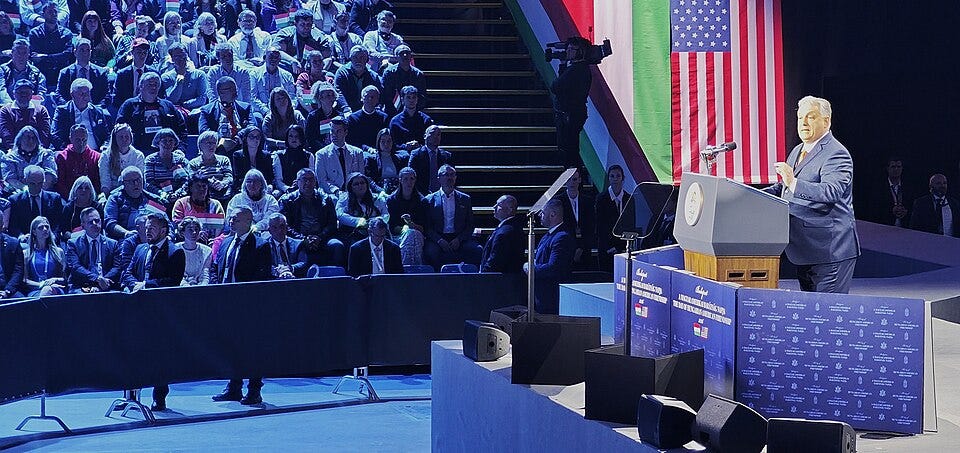
Viktor Orbán’s defeat hit with unmistakable force. One night changed everything. Péter Magyar and Tisza handed him a democratic knockout, breaking the illusion that his rule could last forever. Even his loyalists recognised it; something had shifted, and the old order was finished.
But real change is rarely announced in speeches. It becomes visible in the smallest betrayals of certainty, chairs scraping back, furtive glances at phones, the quick calculation of exits, the silent weighing of loyalties. For sixteen years, the system had rehearsed permanence. Now, in a single night, everyone remembered the oldest rule in politics: power lasts only as long as people pretend it does.
Orbán is not gone. That would be too simple, and Hungary is rarely generous enough to offer simplicity. But he has made a revealing choice. After Fidesz’s landslide defeat, he said he would not take his seat in the new parliament, choosing instead to focus on reorganising what he calls the “national side.” “Our task now is not in parliament,” he said.
That sentence belongs near the centre of the post-Orbán story.
On paper, it sounds strategic. In reality, it sounds more like avoidance. Parliament is where a defeated prime minister becomes visible as a former prime minister. It is where the man who once bent the state around himself would have to sit in opposition, wait his turn, and be reminded by the very furniture that the country has moved on.
Orbán does not intend to become a parliamentary figure. He wants to remain a gravitational force.
Orbán will not simply disappear. The real question is what he’s determined to protect as power drains away. Defeat was never his greatest vulnerability.
Exposure was.
For years, the system worked because certain things could be seen but not touched. The stadium in his hometown, Felcsút. The oligarchs rising from obscurity into impossible wealth. The family networks. The captured institutions. The strange little miracles by which people close to power became very rich while the prime minister himself remained officially modest.
Everyone could see Hatvanpuszta.
That was always the point, and the insult.
The estate near Alcsútdoboz is officially connected to Orbán’s father, Győző Orbán. Átlátszó has reported that Orbán’s father acquired the 13-hectare Hatvanpuszta manor in 2011 through his real estate company, and that the former agricultural complex has since been transformed into what the outlet described as a “kingly estate,” complete with a massive mansion and exotic animals.
The official story has always leaned toward rustic innocence: a family farm, a restored estate, a private matter. Nothing to see here, citizen. Admire the sheep—or, if you’re lucky, spot a zebra. Ten zebras, according to reports. Four, according to the latest drone footage. The rest, reportedly hidden in pens or vanished entirely. In a twist almost too on-the-nose, the zebras have become a local legend and a national meme, their stripes turning into a banner for the opposition: proof that in Hungary, even the livestock knows how to go missing when the questions get uncomfortable.
But Hatvanpuszta was never really about whether there are zebras, antelopes, palm houses, tunnels, pools, garages, libraries, or whatever new absurdity happens to wander into the frame. Those details matter because they are grotesque, and Hungarian politics has always had an unfortunate talent for producing satire by accident. But the deeper question is simpler.
How did this world pay for itself?
That is why Hatvanpuszta matters more after defeat than it ever did before. While Orbán held power, it symbolised arrogance. After defeat, it becomes something more dangerous: a test of whether the country can turn visible excess into evidence that can be inspected.
Not necessarily evidence of one crime, one transaction, or one smoking gun. The question is larger. What was the architecture around it? Family wealth. Public contracts. Friendly businessmen. Land. Construction. State-backed opportunity. A careful distance between Orbán’s official declarations and the comfort that always seemed to surround him.
This is what Orbán has to fear now. Not merely humiliation but also close inspection for the first time in almost two decades.
Átlátszó has reported more broadly on the enrichment of Orbán’s family circle over the last decade and a half, including land acquisitions in Felcsút, the development of Hatvanpuszta, family businesses, and publicly funded contracts. AP also reported last year that Hatvanpuszta had become a symbol of alleged corruption, with Orbán denying that the estate was a luxury retreat and calling it a “half-finished farm.”
A “half-finished farm” is a revealing phrase. It asks the public to distrust its own eyes. It is not only a denial. It is a command: do not compare what you see with what you are told.
That command worked for years because the system held tight control over every institution that might dare to challenge it. A captured prosecutor is more than a legal shield; it’s the regime’s barometer and its bodyguard, quietly signalling when to speak up, when to fall silent, when to forget, and when to recognise that some doors in Hungary are painted on for effect, never meant to open.
Now those doors may become functional.
That is why Orbán’s immediate post-defeat strategy is likely defensive before it is ideological. He has to keep Fidesz together, yes. He has to explain defeat, yes. He has to stop the national camp from turning into a blame convention with catering. But beneath all that, he has to preserve the protective shell around the old order.
That means several things at once.
Orbán must keep loyalists calm enough so they do not defect. He must keep oligarchs close enough not to talk. He must keep bureaucrats nervous enough not to cooperate too eagerly with the incoming government. He must turn every investigation into revenge, every audit into persecution, every legal reform into foreign control. He must make accountability look like chaos before accountability has time to produce documents.
This is not fear talking. It is a calculation. Orbán knows every bolt in the house because he helped design it.
The style of denial is already familiar. When Telex pressed Orbán about Hatvanpuszta and the wealth of Lőrinc Mészáros, he offered no explanation, no clarification, not even the ritual show of outrage. Instead, he replied with three words: “Ask the owners.”
This answer is telling, not because it reveals the facts, but because it embodies the era’s governing logic, a deliberate distance from visible wealth, unwavering faith in formal ownership, and the expectation that the public will accept the gap between power and property as a recurring coincidence.
Here is the old system’s entire strategy in a phrase. The estate exists, the wealth exists, the network exists, yet responsibility is always elsewhere: with the owner, the company, the friend, the father, the paperwork. Orbán’s genius was not just in gathering power, but in arranging things so that power was everywhere while accountability stayed one step further away.
But coincidences become less persuasive when power changes hands.
The Guardian has reported that, after Fidesz’s defeat, Orbán-linked associates have allegedly begun moving wealth abroad, with Péter Magyar accusing figures connected to Fidesz of trying to shield assets from accountability before his government takes power. The same report said Magyar alleged large-scale document destruction in ministries, affiliated institutions, and companies close to Fidesz, while the outgoing foreign ministry rejected the accusations as “nonsense” and “outrageous.”
This does not mean every rumour is true. It means the incentives have changed.
For sixteen years, the safest bet in Hungary was loyalty to Orbán. Now the safest bet may be distance.
That is a historic reversal. Not because Fidesz suddenly has no voters, no media, no money, no judges, no habits of intimidation. It still has many of these. But it has lost the one thing that made all the others feel inevitable: command of the state.
That is why Orbán’s future role will be so strange. He cannot simply retire; retirement would invite succession. He cannot fully lead from parliament; parliament would shrink him. He cannot admit defeat; the mythology depends on him being larger than ordinary democratic outcomes.
So he will likely become something else: party patriarch, grievance manager, keeper of the old flame, and unofficial coordinator of a defensive war against scrutiny.
The politics will be theatrical. The real battle will be administrative.
Who controls the archives? Who controls the prosecutor’s office? Who controls procurement records? Who controls state companies? Who knows which contracts were signed, which emails were deleted, which foundations own what, which relatives appear where, which businessmen were fronts, which public tenders were miracles, and which miracles had invoices?
Reuters has reported that Magyar’s incoming government plans to open Hungary’s communist-era secret police archives and establish an office to recover funds lost to corruption. Orbánism was never only about money, although money was never exactly absent from the scenery. It was about controlling knowledge: who knew what, who could prove what, and who could be blackmailed into silence.
The end of Orbán’s power, then, is not a single event. It is a process: the slow, reluctant conversion of secrets into evidence.
That is why Hatvanpuszta belongs at the centre of the story. It is not just a mansion, estate, farm, retreat, or whatever phrase is currently on duty in the vocabulary of denial. It is the regime’s self-portrait: grand, fortified, officially innocent, visibly excessive, and surrounded by explanations that collapse the moment ordinary standards are applied.
For years, Orbán’s answer to every question was power.
Now the questions remain, and the power has moved.
This is the fragile moment Hungary has entered. The old regime has not disappeared. Its people are still there. Its money is still somewhere. Its habits remain inside the walls of the state. Its media will scream. Its lawyers will work. Its loyalists will discover the language of martyrdom with impressive speed.
But something essential has changed.
People are no longer only asking what Orbán will do next.
They are asking what he was so determined to keep behind the gates.
And once a political system reaches that point, the spell is already broken. The leader may still speak. The party may still march. The slogans may still echo. But the room is emptying.
Somewhere behind the speeches, behind the fences, behind the family farm that never quite looked like a farm, the doors are beginning to open.
What lies behind them will define what comes next.
Sources: Telex on Orbán, Hatvanpuszta and “Ask the owners”; AP on Orbán not taking his parliamentary seat; Átlátszó on Hatvanpuszta; Átlátszó on Orbán family wealth; Reuters on alleged blocked transfers abroad; Reuters on opening secret-police archives.
Perhaps Hatvenpuszta will go the way of Ceaucescu's palace and become a repository or museum of cautionary tales.
In a recent interview, Anne Applebaum stated that Orbán's daughter and son-in-law are in the United States now. I presume they feel protected by Trump. Does it seem likely that Orbán himself will move there, and let the chips fall where they may in Hungary?