

Why Péter Magyar Chose Judit Polgár
Hungary’s greatest chess player would offer the new government a source of authority earned beyond party politics. Her possible presidency would stretch the limits of that authority within the state.

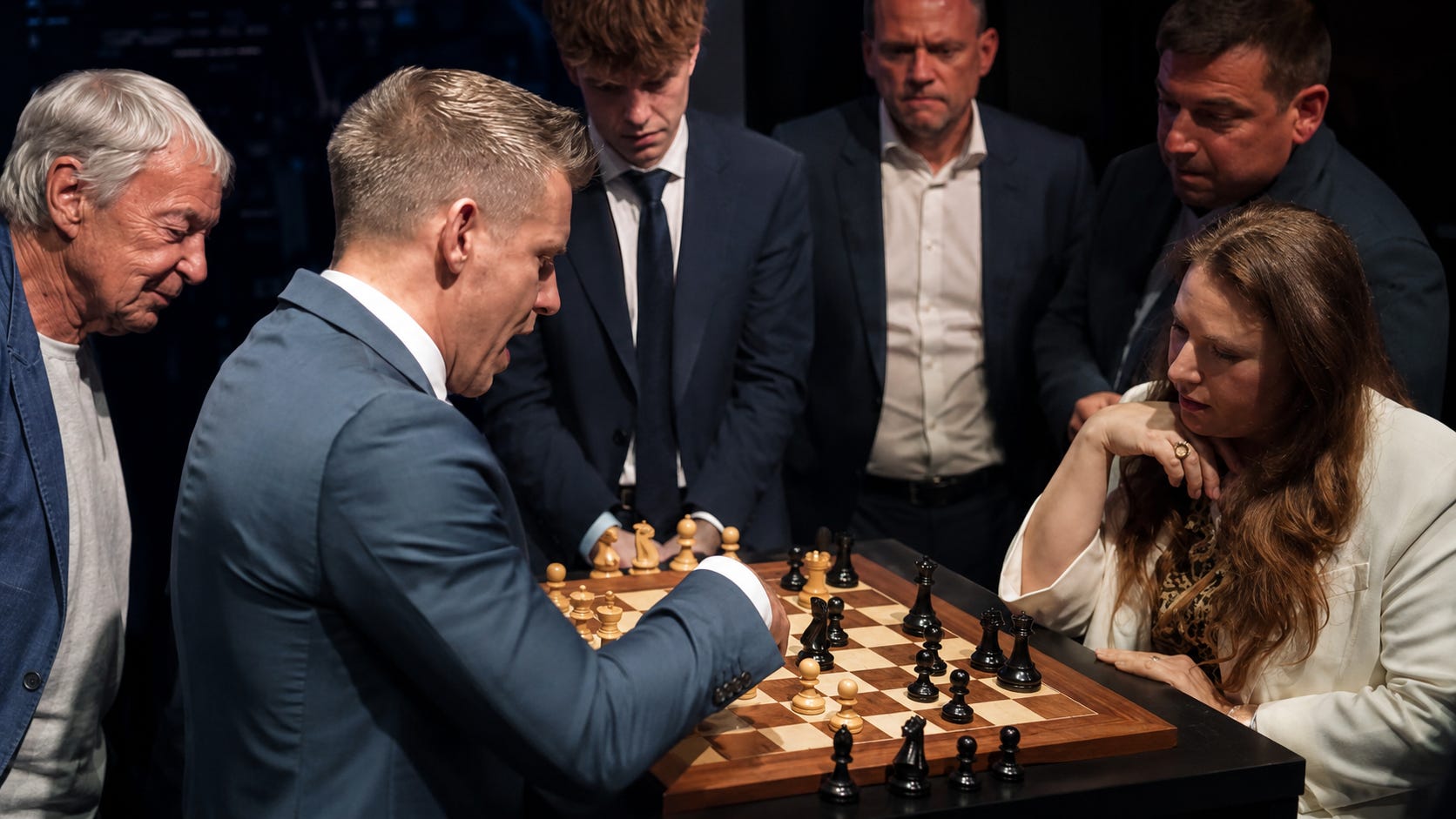
A photograph of Péter Magyar and Judit Polgár at a chessboard acquired a second life on Sunday evening.
Magyar had posted it earlier in July. At the time, it appeared to record an encounter between Hungary’s new prime minister and its most famous chess player. Once sixteen figures from Hungarian science, culture and sport proposed Polgár as the country’s next president, the image began to look like a clue.
Magyar endorsed the proposal on July 19. Hungary needed “unity, peace and a president of whom every Hungarian can be proud,” he wrote. He described the presidency as “the highest form of service” and said he would ask Polgár to serve until Hungary adopted a new constitution.
The following day in parliament, Magyar enlarged the argument. The next president, he said, should belong to the whole country, guard national unity and constitutionalism, listen to opposing views and understand the weight of public language. A career in law or party politics was unnecessary. Polgár emerged as the clearest expression of that idea.
Her authority predates Tisza and Magyar’s political ascent. It was accumulated through achievement rather than appointment. She belongs to no obvious faction, carries little of the bitterness attached to Hungary’s established political class and is immediately recognisable abroad. Polgár offers Magyar something rare in Hungarian politics: public authority he can borrow without having created it.
That makes her a persuasive symbolic choice, but it opens another reflection: whether the presidency might actually benefit from a newcomer. Hungary knows Polgár’s achievements in unusual detail, yet her constitutional instincts have no precedent. Could inexperience be an advantage?
A career beyond the categories
Polgár’s public life began with a refusal to accept the category assigned to her.
Born in Budapest in 1976, she was raised with her sisters, Susan and Sofia, inside the educational experiment devised by their father, László Polgár. He believed exceptional ability could be cultivated through intensive education. Chess became the family’s chosen field, and the daughters became its evidence.
Judit soon moved beyond women’s competition. She won the boys’ under-twelve world championship in 1988 and the boys’ under-fourteen title two years later. At twelve, she entered the world’s top hundred players. In 1991, at 15 years and 4 months, she became the youngest grandmaster in history, surpassing the record once held by Bobby Fischer.
According to FIDE’s career profile, she became the only woman to enter the overall world top ten. She reached eighth in the rankings and a peak Elo rating of 2735. Her official press materials record that she remained the highest-ranked woman for 26 years.
The usual language of female exception understates the record. Polgár entered the same tournaments, rankings and title system as the male elite. FIDE lists victories over eleven current or former world champions, including Anatoly Karpov, Magnus Carlsen and Garry Kasparov.
The Kasparov victory came in Moscow in September 2002 during the Russia versus the Rest of the World match. The game used rapid time controls, and Polgár won in forty-two moves. It was a competitive victory over the reigning world number one, though it was not a classical game. Even so, the result carried lasting pride in Hungary, then and now.
Its cultural force exceeded the format. Kasparov had once spoken dismissively about women in elite chess. Polgár later said: “Suddenly, it was clear it is possible for a woman to beat the world champion.” Of the resistance she faced more broadly, she recalled: “I had to play against each of these players and beat them so that they would admit that I was one of them.”
Kasparov endorsed her possible presidency on Monday. He praised her “outstanding intellectual ability,” her worldwide recognition, and her capacity to represent Hungary abroad. He has known her for thirty-eight years and called her an ideal candidate for the transitional period.
His intervention captures the appeal of the choice. Polgár has spent decades representing Hungary before audiences that may know little about Hungarian politics. She carries national prestige without requiring the government to manufacture a biography around her.
Chess also has clear limits as political evidence. It tells us something about her discipline, competitiveness and composure under scrutiny. Though it gives little guidance on how she would handle a dispute between parliament and the Constitutional Court, use presidential powers during a crisis or respond to pressure from the government that nominated her. Her temperament is well documented. Her temperament is well documented, but her constitutional judgment remains untested.
The public figure after chess
Polgár’s work since retiring from competitive play in 2014 bolsters the case that she brings more than celebrity.
She founded the Judit Polgár Chess Foundation in 2012 and became its professional leader. The foundation developed educational programmes, trained teachers and established the annual Global Chess Festival. The foundation says its methods reach more than 50,000 children each year, involving more than 4,000 trained teachers and more than 1,000 institutions. Those figures describe an operation with far greater substance than the usual post-career foundation.
Polgár became a UN Women Planet 50-50 Champion in 2016 and an honorary vice-president of FIDE in 2018. Her public work has concentrated on education, youth and the structures that narrow girls’ ambitions before their abilities can be tested.
“You’re talented, so why not become the best you can?” she has said, summing up the message adults should give girls. She has also called for “a safe environment where girls can feel comfortable among boys and men.”
This is a serious civic record. It shows institution-building, international representation, and a sustained interest in public education. But it leaves unanswered the questions that most divide Hungarian politics: executive power, constitutional limits, the EU, Russia, minority rights, and the design of the state. That absence is not incidental but is part of her usefulness.
The political value of an unwritten record
Polgár has rarely spoken at length about Viktor Orbán, Tisza, Hungary’s conflicts with the European Union, Russia’s war against Ukraine, minority rights or the design of the state. Her public arguments concern education, gender and opportunity. Political doctrine was never part of her job.
The absence allows several versions of Polgár to coexist. Conservatives can recognise discipline, family and individual excellence. Liberals see a woman who dismantled one of international competition’s most persistent gender hierarchies. International audiences encounter a Hungarian success story detached from Orbán’s political brand. Tisza supporters see a public figure with no history in the old opposition.
Each reading is based on her life. Each also fills the space that Polgár has left open.
The presidency would narrow some of the space that Polgár has occupied, but it would also reveal strengths that her public life has only hinted at. Returning a law to parliament, referring legislation to the Constitutional Court, or signing a disputed amendment are all acts that require not just caution, but judgment, restraint, and a sense of constitutional proportion. Even silence in an institutional conflict can be an act of discipline if it preserves the office’s credibility.
Polgár’s distance from politics has protected her independence; the presidency would test whether that independence can become a source of authority. Far from disqualifying her, the office could show that she is capable of defining it in a way that commands respect across political lines.
The office Magyar has in mind
Hungary’s Fundamental Law says the president “expresses the unity of the nation” and “guards the democratic operation of the state organisation.” Polgár fits the first duty with unusual ease. The second would reveal capacities that her public career has not yet required.
The president may return legislation to parliament, refer laws and constitutional amendments to the Constitutional Court, initiate legislation and referendums, and propose or appoint several senior office-holders. A determined parliamentary majority can often prevail, though a president can impose delay, scrutiny and political cost.
Public standing changes the force of those acts. An objection from Polgár could carry unusual weight because her reputation does not depend on Tisza. The same independence that makes her attractive to Magyar could give her greater room to disappoint him.
Magyar has invoked Árpád Göncz, Hungary’s first post-communist president, to argue that the office need not belong to a lawyer. Göncz’s public authority grew from his life as a writer, translator, former political prisoner and participant in the democratic transition. László Sólyom supplied another model: the constitutional lawyer who treated the presidency as an active legal office.
Polgár resembles neither man exactly. She could bring Göncz’s civic legitimacy without his political biography. She lacks Sólyom’s jurisprudential record. Her nomination suggests that Magyar values character, judgment, and national standing as sufficient foundations for learning the constitutional part of the role.
The transitional setting strengthens that case. Magyar has framed the appointment as lasting until a new constitution is adopted, while the current legal framework provides a five-year term. Any earlier conclusion would depend on the transitional provisions of the future constitution. The arrangement could give Hungary a respected figure during a period when the permanent rules remain unsettled.
Magyar’s outsider wager
Polgár’s nomination fits a more expansive ritual in Magyar’s approach to public office. Tisza brought many professional newcomers into national politics, including doctors, teachers, lawyers, businesspeople and public administrators. Its 2026 victory delivered 53.18 per cent of the party-list vote and 141 of parliament’s 199 seats. Voters gave a dominant majority to a movement whose claim to renewal depended partly on people formed outside the established party system.
Polgár would be the most visible expression of that philosophy. Her standing exists independently of the governing party. She could broaden the symbolic reach of the new order and represent Hungary abroad with an ease that few political nominees could match.
Polgár’s symbolic independence is part of what makes the choice compelling, but it also raises questions about how quickly she emerged. Tisza’s MPs were elected to carry out Magyar’s programme. A president may need to delay a law, request constitutional review or force the government to defend a decision publicly. The office gains substance through its capacity to create friction.
The discussion over the speed of Polgár’s emergence should be recorded without swallowing the article. Magyar asked the public for recommendations, then embraced Polgár within hours of the sixteen-person letter. He later said that Tisza had requested names rather than promised a formal consultation, adding that at least ten serious candidates had been proposed. That clarification is constitutionally sound: parliament chooses the president. A brief, transparent consideration of the alternatives would still strengthen a candidate intended to represent the whole country.
Tisza has no electoral need to seek opposition support. It has a political reason to do so. A president whose authority reaches beyond the governing majority would enter office with more room to use it.
The first costly decision
The photograph of Magyar and Polgár across a chessboard now invites more interpretation than the facts can bear. It may have recorded an ordinary game. Its significance may have emerged only later, when a group of prominent Hungarians transformed Polgár from an admired public figure into a plausible constitutional candidate.
The image still captures the logic of the choice. Magyar entered politics by breaking with the system that produced him. Polgár accumulated her authority beyond that system. He is now asking her to carry it into the state.
Her achievements explain the proposal’s instantaneous sway. They offer limited guidance about the decisions that would define her tenure. Presidents face few constitutional tests while receiving ambassadors or representing the country abroad. The difficult moments arrive when a government with a strong mandate wants speed, loyalty or silence.
Polgár would enter office with unusual public admiration, and that standing would matter only if she used it to slow, question, or complicate the majority’s wishes. That is the real trade-off: Magyar wants a president with no political allegiance, and that independence could make the office a more credible check on power. Without partisan baggage, she may have more room to act with judgment and restraint, which would make that independence a strength rather than a weakness. In that sense, Polgár’s appeal may be less a liability than the very source of her authority and exactly what Tisza has long promised.
Source: Telex; HVG; FIDE; Judit Polgár and the Judit Polgár Chess Foundation; UN Women; Hungary’s Fundamental Law; National Election Office.
Mr. Dosa, I read your posts whenever they appear and I take Hungary's situation and challenges very seriously. Nevertheless, I'm irresistably tempted to relate what happened in my own household this morning. I was reading enthusiastically aloud to my husband about Judit Polgar when he turned to me, rolled his eyes and asked, "Can you imagine what would happen if our U.S. president was looking over a chess game in progress?" Then, without skipping a beat and, in a creditable vocal imitation, he said, "Oh, look at all the little horsies!" After I regained control over my laughter, I went back to reading today's post - simply excellent!
Hungary can claim among her children two recent Nobel laureates, neither of whom has, to my knowledge, been active in politics, and Magyar might have played with requesting one or the other to agree to serve. Unlike Polgár, both are based principally abroad. Asset or detriment ? -- Yes, to weigh in public discussion the merits of several candidates would be good. Will press and pundit commentary sum up to such a discussion ?
Mr Dósa, speaking of pundits and their commentary, how about a bit of prophecy from you ? What constitutional conflicts do you anticipate into which Polgár might have to step, in which she might find it necessary to exert presidential influence ?