

What Netanyahu Built in Budapest
Over two decades, Viktor Orbán turned Hungary into Netanyahu’s veto and sanctuary in Europe, and new reporting suggests Budapest also gave official cover for Mossad’s cultivation of Ahmadinejad.

The explanation that stayed secret
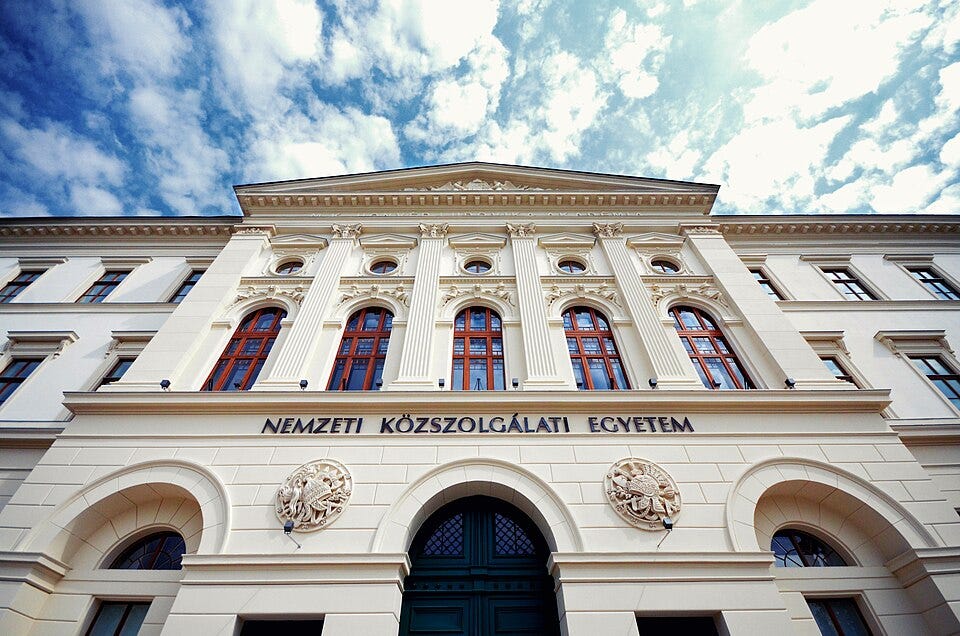
In May 2024, Mahmoud Ahmadinejad arrived in Budapest to speak at Hungary’s National University of Public Service, commonly known as Ludovika.
The invitation was peculiar from the outset. Iran’s former president, who repeatedly denied the Holocaust while in office, had supposedly voyaged to Hungary to discuss “common values in the global environment.” The university offered little public information about the event and excluded journalists.
The choice carried particular weight in Hungary. Between May and July 1944, approximately 437,000 Jews were deported from the country, most of them to Auschwitz-Birkenau. The Israeli Embassy condemned Ahmadinejad’s appearance, saying that it “gravely insults and tramples” the memory of Hungarian Jews murdered during the Holocaust, according to HVG’s contemporary account.
Hungarian reporters suspected that the lecture was a cover for a more consequential meeting. Ahmadinejad and his entourage reportedly used government VIP facilities at Budapest Airport. Diplomatic sources told HVG that Budapest may have been selected as a nominally neutral venue for an Iranian-Israeli matter. They considered it implausible that Hungary’s political leadership had been unaware of the visit.
The government’s response only exacerbated the mystery.
Gergely Gulyás, the minister overseeing Viktor Orbán’s prime ministerial office at the time, initially said that he would ask Ludovika’s rector, Gergely Deli, why Ahmadinejad had been invited. Two weeks later, Gulyás announced that Deli had given him a reassuring explanation but refused to disclose it.
“You should be reassured too,” Gulyás told reporters, according to HVG’s account of the press conference.
Two years later, that withheld explanation lies at the epicentre of a huge story.
A New York Times investigation by Mark Mazzetti, Julian Barnes, Farnaz Fassihi, and Ronen Bergman reported that Ahmadinejad’s visits to Budapest in 2024 and 2025 formed part of a multiyear Israeli effort to cultivate him as an intelligence asset and possible leader of Iran after the collapse of the existing government. The report drew on American and Iranian officials familiar with the operation, former American officials, Israeli defence officials, members of Iran’s Revolutionary Guards, and an interview with Deli.
According to the investigation, a senior Hungarian government official asked Deli to organise a climate conference and invite Ahmadinejad. The event would provide a public explanation for his presence while Israeli intelligence officers met him privately.
David Barnea, then the director of Mossad, reportedly travelled to Budapest in 2024 to meet Ahmadinejad personally. Mossad later informed the CIA that it had established contact with the former Iranian president. American officials also told the Times that Israel paid some of Ahmadinejad’s housing and travel expenses and met him in several countries.
Deli acknowledged that he understood the conference’s hidden purpose. He said that he accepted the risk to his own reputation because he believed that facilitating contact between enemies might save lives.
“You have two enemies, and if these enemies want to talk with each other, then it’s best to do what you can to make them talk,” he explained.
The operation’s precise ambition remains difficult to gauge. Israeli officials may have viewed Ahmadinejad as a source of intelligence, a means of dividing Iran’s leadership, a possible figure in a future political transition, or some strange combination of these. The reporting establishes sustained cultivation and high-level contact. It provides less certainty about how realistic Israeli officials considered the plan to install him in power.
Ahmadinejad returned to Budapest in June 2025 for an event reportedly titled “Sustainability in a Changing World.” His Iranian bodyguards later reported that he escaped their supervision on at least two occasions and disappeared into prolonged meetings. When confronted, he said that he had been meeting university professors.
Ahmadinejad’s office has rejected the Times investigation. It described the allegations as “completely false,” accused the newspaper of trying to fuel divisions inside Iran, and also denied reports that he had been placed under house arrest.
Mossad and Israeli officials presented no public confirmation, and public evidence still does not show who initiated the Ludovika arrangement or whether Orbán or Hungarian intelligence approved it.
The published reporting still places the Hungarian state inside the operation. A senior official appears to have arranged the academic cover, Deli understood what it was for, and Gulyás later received an explanation he found reassuring enough to keep secret.
Budapest had become a city for such meetings.
The Mossad contacts have a long history. Over two decades, Orbán made Hungary increasingly useful to Netanyahu through campaign networks, diplomatic obstruction, security cooperation, and legal protection.
The political method
During a 2005 visit to Israel, Orbán met Netanyahu for approximately 45 minutes at Jerusalem’s King David Hotel. Both men were attempting political returns after losing office. According to Direkt36’s reconstruction, the meeting produced an immediate personal connection.
Netanyahu discussed his political recovery, his economic program, and his plans to return to office. Orbán appeared particularly interested in Israel as a country whose politics were organised around national survival, territorial defence, and security.
Several years later, according to political consultant George Birnbaum, Netanyahu introduced Orbán to Birnbaum and Arthur Finkelstein, two strategists from his political circle. They entered Orbán’s orbit as Fidesz prepared for Hungary’s 2010 election.
Their method combined extensive polling, disciplined repetition, and aggressive negative campaigning. Political fear worked best when attached to a recognisable person.
Institutions were too abstract to hate, whereas a face could be printed on a billboard.
After Orbán returned to office in 2010, his government developed a politics of permanent mobilisation. Brussels, migrants, foreign-funded organisations, independent journalists, and George Soros were presented as participants in an external effort to weaken Hungary. Each campaign supplied a new target while preserving the same structure.
Birnbaum later spoke openly about the construction of Soros as a political enemy.
“Soros was the perfect enemy,” he told journalist Hannes Grassegger in an account of the campaign’s development.
The contractual record remains incomplete, though. Birnbaum said that the consultants’ formal relationship ran through the Fidesz-linked Századvég Foundation. Fidesz later denied that he had advised the party. Public contracts, invoices, and internal campaign documents have never supplied a complete account of their work.
The political influence is easier to trace. Netanyahu’s world gave Orbán access to strategists who understood how to organise elections around a personalised threat. Orbán developed that approach into a system of government.
The relationship also helped him contain a recurring political liability.
Fidesz faced sustained criticism over its proximity to parts of the Hungarian right where antisemitic language and historical revisionism remained common. Orbán’s praise for Miklós Horthy intensified those concerns after he described Horthy as an “exceptional statesman.” The truth is that Horthy’s regime allied Hungary with Nazi Germany, enacted anti-Jewish laws, and participated in the persecution of Hungarian Jews.
The government’s campaign against Soros carried its own historical charge. It portrayed a wealthy Jewish financier as the hidden organiser of migration, civil society, and foreign political pressure.
Netanyahu’s public friendship gave Orbán a powerful defence. The Hungarian prime minister could invoke his close relationship with Israel’s leader while continuing to cast Soros as the embodiment of a foreign conspiracy.
The contradiction became visible before Netanyahu’s July 2017 visit to Budapest. Israel’s ambassador, Yossi Amrani, condemned the anti-Soros billboards and warned that they could encourage hatred. Israel’s Foreign Ministry then issued a clarification defending criticism of Soros, who funded organisations opposed to Netanyahu’s policies.
The clarification preserved the visit. Netanyahu’s arrival then gave Orbán high-level Israeli validation amid international criticism over Soros and Horthy.
The friendship reduced the diplomatic cost of those controversies, and hence Orbán could present Hungary as one of Israel’s closest European allies while attacking Jewish figures and organisations he classified as liberal, globalist, or politically hostile.
Netanyahu also benefited. Soros funded organisations that challenged Israeli policies concerning settlements, the occupation, and Palestinian rights. Orbán’s campaign targeted many of the same civil-society networks that Netanyahu regarded as adversarial.
The alliance converted a liability into a shared political resource. Orbán gained protection from international isolation over antisemitism. Netanyahu gained a European leader willing to attack institutions and organisations that opposed his government.
A veto in Brussels
Netanyahu initially offered Orbán political access and legitimacy. Hungary’s value to Netanyahu grew from its position inside the European Union.
The relationship became an overt state alliance during Netanyahu’s July 2017 visit to Budapest, the first by an Israeli prime minister in approximately three decades. Israeli cybersecurity and surveillance companies joined the business delegation, although NSO Group itself did not attend, according to Direkt36.
During Orbán’s visit to Jerusalem the following year, he promised that Hungary would work for “fair, balanced and unbiased decisions” concerning Israel in international organisations.
Hungary thereafter became a dependable obstacle to common European positions critical of Netanyahu’s governments.
In May 2018, Hungary joined the Czech Republic and Romania in blocking an EU statement opposing the transfer of the United States Embassy to Jerusalem, according to Axios.
In November 2019, Budapest blocked a European statement criticising the Trump administration’s decision to stop treating Israeli settlements as inherently illegal, as reported by the Times of Israel.
The relationship became more direct during the Gaza war. In February 2024, Israeli Foreign Minister Israel Katz personally called Hungarian Foreign Minister Péter Szijjártó and asked Hungary to block two European statements concerning Israel’s planned military operation in Rafah, as reported by The Jerusalem Post. Hungary prevented the consensus statements and resisted proposed sanctions.
The call indicated that Israeli officials understood precisely how to use the relationship. They could approach Szijjártó directly when European consensus threatened Israeli interests.
Several months later, Katz and Szijjártó discussed convening an EU-Israel Association Council during Hungary’s rotating presidency of the Council of the European Union. Israel’s Foreign Ministry presented the presidency as an opportunity to strengthen Israel’s standing within Europe.
Many significant European foreign-policy statements and sanctions require unanimity. Hungary could prevent the European Union from speaking collectively without persuading another government to support Israel’s position. A single member state could stop the other 26 from speaking as one.
Orbán’s government also resisted European sanctions against violent Israeli settlers. The measure passed only after Péter Magyar’s incoming government removed Hungary’s veto following Orbán’s electoral defeat.
Netanyahu later described Hungary’s service with unusual clarity.
“It defends us in the European Union and the UN,” he said after his April 2025 visit, according to the Israeli government’s transcript.
The arrangement extended to Washington. Direkt36 and Axios reported that Netanyahu’s associates helped Orbán regain access to the first Trump administration after years of strained relations under Barack Obama. Netanyahu’s office denied lobbying Washington on Orbán’s behalf.
By the end of the 2010s, Hungary had become an institutional asset, a kind of veto rental agency. Netanyahu could rely on Orbán’s government to intervene at the point where European unity depended on the consent of every member state, and Moscow had reason to appreciate the same service.
The spyware channel
The political alliance heightened when Hungary acquired Pegasus.
On October 11, 2017, the Hungarian Parliament’s National Security Committee approved a classified request from the Special Service for National Security to purchase advanced phone-hacking technology outside the ordinary public-procurement system. Direkt36 later identified the system as Pegasus, developed by the Israeli company NSO Group.
The transaction passed through Communication Technologies Ltd., a Hungarian intermediary, and an NSO-linked entity registered in Luxembourg. Sources familiar with the procurement placed its net price at approximately €6 million. Operational use began around 2018.
Pegasus can retrieve messages, emails, photographs, and other data from a compromised phone. It can activate the device’s microphone and camera. NSO sold the system to states and state agencies, while exports required approval from Israel’s Ministry of Defence.
Hungary gained access to a tightly controlled surveillance weapon during the same period in which Orbán and Netanyahu were establishing formal national security channels.
In February 2018, Orbán adviser József Czukor met Netanyahu and Israeli National Security Adviser Meir Ben-Shabbat in Jerusalem. According to Israel’s official account, the discussions covered regional developments, counterterrorism cooperation, and the deepening of bilateral diplomatic and security relations. Ben-Shabbat afterwards travelled to Budapest.
Public evidence does not establish an exchange of Pegasus for Hungarian diplomatic protection, even though Hungary's approval to receive one of the country’s most sensitive cyber capabilities came as relations between the two governments were rapidly deepening.
The Pegasus Project identified more than 300 Hungarian telephone numbers selected as possible surveillance targets. Inclusion in the leaked database did not prove that every device had been infected. Amnesty International’s forensic work confirmed successful infections in several cases.
The selected numbers belonged to investigative journalists, lawyers, media owners, opposition figures, former state officials, and people connected to conflicts within Hungary’s security apparatus.
The phones of Direkt36 journalists Szabolcs Panyi and András Szabó showed forensic evidence of infection. Numbers belonging to opposition mayor György Gémesi, Hungarian Bar Association president János Bánáti, and former government official Attila Aszódi also appeared in the selection data, according to Direkt36’s investigation.
The pattern indicated that Pegasus had become a tool for monitoring people whose work created political or institutional risks for the governing system. Direkt36 reported that the system’s cost and limited capacity meant deployments in priority cases required approval from senior officials.
The cybersecurity relationship extended further. An Israeli surveillance company that joined Netanyahu’s 2017 delegation later trained Bangladeshi intelligence officers in Budapest to use telephone-interception equipment. During testing, calls from people using Hungarian networks were reportedly intercepted, as per Direkt36.
The security relationship also expanded into conventional defence. Hungary ordered Israeli-developed radar systems in 2020 and placed a major order for Israeli loitering munitions in 2023.
Pegasus was part of a larger security ecosystem. Hungary became a regular customer for Israeli-controlled technology. Orbán’s government acquired surveillance and military capabilities that strengthened the state and concentrated sensitive powers close to the political centre.
Sanctuary
The relationship became publicly unambiguous in April 2025.
The International Criminal Court had issued an arrest warrant for Netanyahu over alleged war crimes and crimes against humanity in Gaza. Hungary remained a party to the Rome Statute and was required to cooperate with the court.
Orbán invited Netanyahu to Budapest and promised that the warrant would have no effect in Hungary. Netanyahu arrived during the night of April 2 and 3 and received full state honours.
As it happened, I was in Budapest that week for my brother’s bachelor party, staying in Buda a few hundred meters from some of the official venues. Security was unusually visible, and several streets had gone quiet.
At the time, the visit looked like another Orbán confrontation with an international institution. The geography now seems equally important: Budapest had become a place where Netanyahu could arrive beneath the protection of ceremony, remain beyond the court’s reach, and leave without consequence.
The visit had been prepared in advance. ICC records show that the court contacted Hungary in March after reports indicated that Netanyahu might travel there. The Registry attempted to arrange consultations with Hungarian authorities before his arrival.
On April 3, several hours after Netanyahu landed, the court transmitted a formal request for his provisional arrest. Hungary did not respond and requested no consultation while he remained in the country until April 6.
That same day, Orbán’s government announced that Hungary would begin withdrawing from the ICC. The withdrawal could take effect only in June 2026, leaving Hungary bound by its treaty obligations throughout Netanyahu’s visit.
The court later found that Hungary had “failed to comply with its international obligation” by allowing Netanyahu to leave without arrest. The July 2025 decision referred to Hungary’s noncompliance with the Assembly of States Parties.
Netanyahu used Budapest to demonstrate that the warrant had failed to isolate him. Orbán used the visit to challenge an institution he had portrayed as politically compromised.
Hungary granted a protected territory within the European Union to a leader facing an international arrest warrant.
The visit retained the economic and security dimensions of the relationship. Netanyahu met Szijjártó and Hungarian business leaders to discuss economic, technological, and security cooperation. He also said that the governments had discussed cooperation in munitions production.
Netanyahu acknowledged Hungary’s value directly. He praised the country for defending Israel in the European Union, the United Nations, and the ICC. Hungary’s withdrawal announcement, he said, “greatly assists the State of Israel,” according to his official statement.
Orbán had previously protected Netanyahu through votes and vetoes. In April 2025, that protection became physical and legal. Budapest provided a European territory where the Israeli prime minister could travel, receive honours, and depart despite the warrant attached to his name.
The Ludovika cover
Netanyahu visited Ludovika during the April 2025 trip, where the university honoured him. The institution had hosted Ahmadinejad the previous year and would receive him again several months later.
At the time, the appearances seemed to belong to separate stories. Later reporting placed both men inside the same institutional setting and political relationship.
The alleged Mossad meetings required more than a convenient city. Ahmadinejad needed an invitation that could explain his travel to Europe. His arrival required protocol, security, and advanced awareness. The conversations required a setting where movement could be controlled and questions could be limited.
Ludovika was particularly suited to the purpose. The university has close connections to Hungary’s public administration, military, police, and national security institutions. An academic conference could supply legitimacy, facilities, and a public program from which Ahmadinejad might temporarily disappear.
The Israeli Embassy’s condemnation of Ahmadinejad’s first appearance remains an intriguing complication. The embassy may have known nothing about the operation. Mossad may have worked through a separate channel into Hungary’s political leadership. Intelligence services routinely restrict sensitive information, including from their own diplomatic institutions.
The stronger finding concerns the Hungarian state. The Times reported that a senior official requested the conference arrangement. Deli understood that the event would facilitate Israeli contacts with Ahmadinejad. Gulyás later said that Deli had given him a reassuring explanation and refused to disclose it.
Deli subsequently described his own role to the Times with a German word: “Strohmann,” meaning a frontman or puppet.
At least one senior Hungarian official appears to have played an active role in making the meetings possible.
The role’s boundaries remain unclear. The official may have provided little more than the invitation and institutional access. Hungarian services may also have handled protection, transport, counter-surveillance, or liaison with Israeli operatives. The published evidence cannot resolve these possibilities.
Budapest remained a logical venue. Orbán had demonstrated exceptional loyalty to Netanyahu. His government maintained close relations with Israeli security officials and defence companies, repeatedly protected Israel within European institutions, and acquired some of Israel’s most sensitive security technology.
The Ahmadinejad operation exposed another dimension of that trust. Hungary could offer an official setting where an avowed enemy of Israel might meet the head of Mossad under the cover of an academic discussion about climate change.
Retrospectively, the episodes resemble a system of reciprocal political services.
Netanyahu’s governments received a partner embedded within the European Union. Hungary could undermine consensus, weaken collective pressure, and serve as a friendly stage during periods of international isolation. Its defence purchases created commercial opportunities for Israeli companies. Its government could provide political cover, legal protection, and, according to the Ahmadinejad reporting, institutional assistance for a sensitive intelligence contact.
Orbán gained access to political consultants connected to Netanyahu’s world, public validation from an Israeli leader, assistance within conservative networks in Washington, and control over security technologies. Israel also offered an example of national politics organised around borders, external danger, military strength, and executive authority.
Orbán and Netanyahu shared ideological instincts, domestic adversaries, and strategic interests. Each government may have acted independently rather than under a standing agreement. Commercial contracts can arise from procurement needs. Vetoes can reflect foreign-policy conviction. Intelligence contacts often develop below the level of political leaders.
That interpretation explains part of the relationship. The cumulative pattern shows something more durable. Hungary repeatedly used scarce institutional assets on Israel’s behalf, while Israeli political networks and controlled technologies became available to Orbán’s government. The relationship functioned through services even without a written agreement describing it as such.
Direkt36’s reporting suggests that Orbán felt a deeper personal and ideological attachment to Netanyahu than Netanyahu felt toward Hungary. Israel’s interest appears more instrumental. Hungary possessed a vote in Brussels, access to European institutions, and a government willing to deploy those assets.
The alliance’s value can be measured in deeds: a blocked declaration, an approved export, an unenforced arrest warrant, and an invitation to a conference whose public subject concealed its true purpose.
After Orbán
The arrangement began to change immediately after Orbán lost power.
Netanyahu contacted Prime Minister-elect Péter Magyar on April 15, three days after the election. During what Israel’s government described as a warm introductory conversation, Magyar promised to maintain close relations and invited Netanyahu to attend the October 23 ceremony marking the 70th anniversary of the 1956 Hungarian uprising, which Netanyahu accepted.
Five days later, Magyar clarified the limits of the invitation. Hungary would remain a member of the International Criminal Court and would carry out valid warrants, meaning Netanyahu could visit Budapest while still facing the possibility of arrest. Israeli diplomats offered no immediate public response.
Hungary then halted Orbán’s attempt to leave the court. Parliament revoked the withdrawal before it could take effect. On May 29, the government formally withdrew its notification from the United Nations. Hungary’s membership of the Rome Statute remained uninterrupted. The ICC welcomed the decision on June 1.
The sequence preserved the bilateral relationship while ending the sanctuary Orbán had created. Under Magyar, an invitation to Budapest no longer carried an assurance that Hungary’s international obligations would be suspended for the guest.
The new government also removed Hungary’s veto on European sanctions against violent Israeli settlers. The speed of these changes shows how heavily the earlier arrangement depended on Orbán’s political choices and personal relationships.
The bilateral relationship has survived, but under Magyar, it looks less like a privileged channel. Hungary will continue cooperating with Israel, yet the automatic diplomatic shield and ICC sanctuary that Orbán once offered have faded.
Another Fidesz-era secret
The new government has inherited records that may reveal who approved Pegasus, protected Netanyahu from arrest, and arranged Ahmadinejad’s visit to Ludovika.
It is another strange, opaque chapter of the Orbán years: spyware, vetoes, legal sanctuary, and an academic conference reportedly used to conceal a Mossad meeting.
Gergely Gulyás said the explanation should reassure the public. Instead, it should be taken as a sign of how far this web of political loyalty, secrecy, and state power has spread, and why Tisza needs to uncover everything before democracy can be fully repaired.
Source: The New York Times; Haaretz; Direkt36; HVG; New Lines Magazine; the International Criminal Court; the United States Holocaust Memorial Museum; Israeli and Hungarian government records; European Union and United Nations records; Rheinmetall; Associated Press; Channel 12; The Times of Israel.
Fantastic article, Péter.
Holy mother of God, Peter. Every day is a school day. Absolutely epic.