


By the standards Hungary has set since April, this was a quiet week. I also took a few days off to recharge and get myself ready for an undoubtedly busy September. This article is a bit shorter than my usual weekly round-up, but I hope you learn something new.
It is late August, the national holiday weekend slowed the political tempo, and Hungary avoided another major confrontation in Parliament. Yet Péter Magyar apologised to the grassroots movement that helped put him in office. Fidesz circulated an internal questionnaire asking members to evaluate Viktor Orbán and contemplate scenarios that include replacing Fidesz itself. One of the government’s biggest new accountability institutions moved closer to becoming operational. And the prime minister spent part of Sunday in a boat on the Danube, livestreaming engineers, enormous piles of rock and something called an “octopus-armed excavator.”
Perhaps we have simply adjusted to an abnormal amount of political change.
“Be a mirror”
The week began to take shape on Margaret Island.
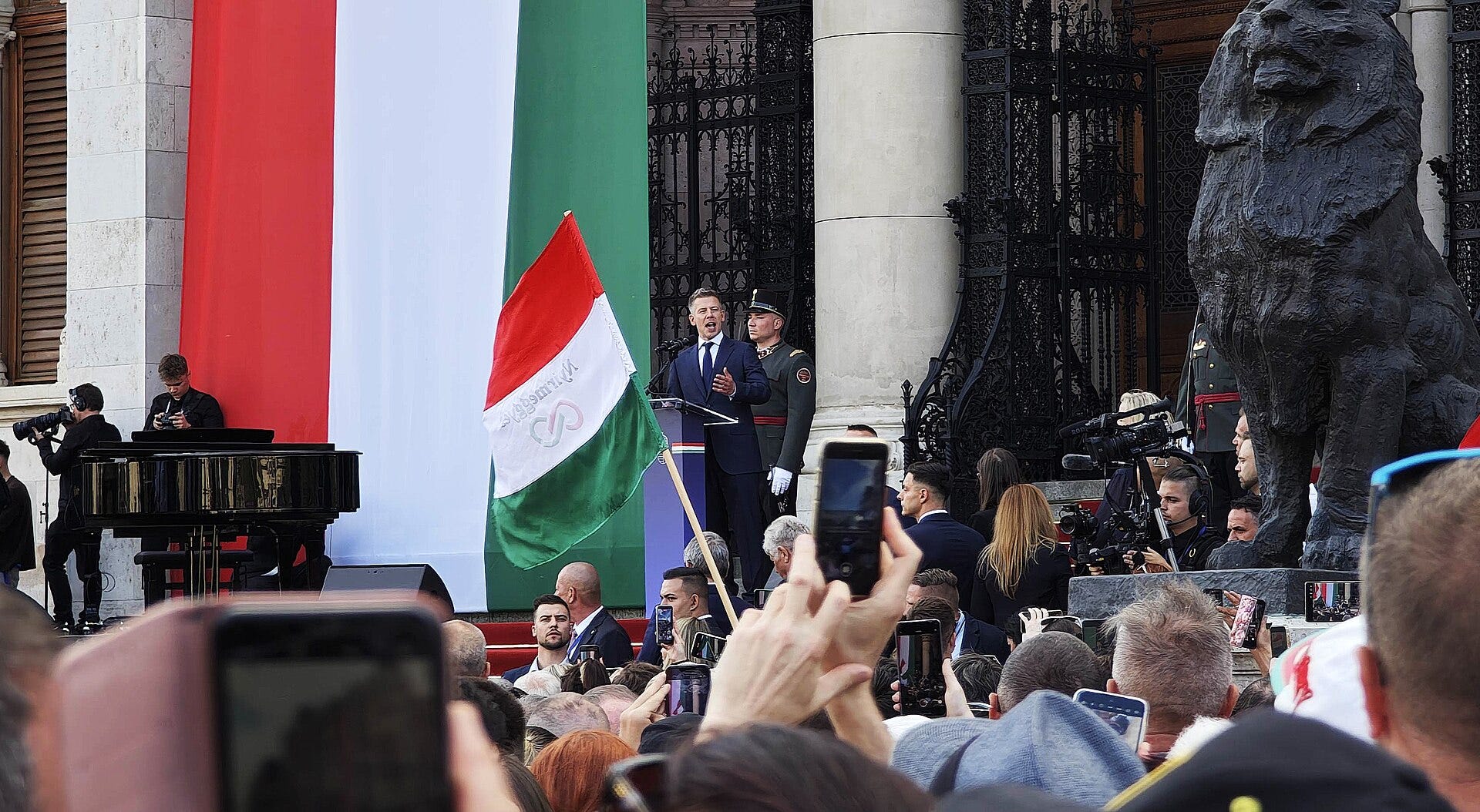
The Tisza Islands, the grassroots network that helped build Magyar’s movement across the country, gathered nationally for the first time since the election. They arrived with an uneasy backdrop.
Activists had complained that communication became increasingly one-way once Tisza entered government. Some said they had little involvement in preparations for governing, while others had expected a greater role after victory. Senior Tisza figures acknowledged that there was a problem.
Magyar went further.
“There is no point governing without you.”
He also apologised directly to Islands whose members felt abandoned after the election.
I found that refreshing.
The apology itself was small, but in Hungarian politics it bore remarkable weight. I struggle to remember Viktor Orbán apologising to his own political base for an organisational failure of this kind.
And these people deserve credit. Tens of thousands of volunteers spent months building communities, organising events and campaigning because they wanted to fight for Hungary and make it better. Without them, I doubt we would be where we are today.
Once a movement wins, however, its volunteers do not suddenly disappear.
Tisza now has to find a useful place for a huge number of people who care about their country and still want their voices heard. Connecting such a large grassroots network to a government is complicated, but it is also potentially very valuable to Hungarian democracy.
There are concrete plans. Tisza is putting HUF 200 million into the Islands through an application system, creating eight regional coordinator positions, expanding training and internship programmes, and preparing the network for a more extensive role in local politics. Members also overwhelmingly rejected a more vertically organised “Sziget Parliament,” preferring to preserve much of their bottom-up structure.
Magyar’s best instruction was only two words:
“Be a mirror.”
Governments eventually begin to see statistics, while local communities continue to see people. He wants the Islands to warn ministers when the government begins to lose contact with reality.
I like that idea a lot.
Still, there is already a small tension here. Magyar remains extraordinarily accessible to his public audience, while some of the people who helped create that audience were simultaneously asking for better access to his political organisation.
The government wants you to talk back
There is also Közhang, roughly “Common Voice,” Tisza’s new public-participation platform.
Instead of another government questionnaire, participants receive background material on an issue, contribute their views and proposals, and artificial intelligence is supposed to identify common patterns across the responses. Independent experts then interpret the material, the results are published, and recommendations eventually reach decision-makers. People can participate anonymously.
The first exercise concerns public media, making it an excellent place to begin after years in which Hungarian state broadcasting became one of the central instruments of government propaganda.
Közhang would allow people to contribute knowledge and opinion, but participants receive no formal decision-making power. Their recommendations still end up with politicians who decide whether to use them.
The show factory
Political analyst Gábor Török gave Magyar’s governing style a name this weekend: műsorgyár, roughly a “show factory.”
His argument is that Magyar’s government has become excessively focused on keeping government and its leader continuously visible.
I think he is partly correct.
The wrinkle is that Magyar built the show factory before he became prime minister.
He livestreamed constantly during the campaign. He travelled everywhere, talked for hours and carried people with him from town to town through his phone. He never fully changed that style once campaigning became governing.
And I don’t really mind the show politics as long as things keep happening.
Paks is where that criticism becomes more complicated, because the performance has been attached to something measurable.
Ten days before Sunday’s visit, production at the Paks Nuclear Power Plant had fallen to just 240 megawatts. By Sunday it was back around 1,000 MW, with Magyar saying the plant should reach roughly 2,000 MW by Wednesday, equivalent to close to 40 per cent of Hungarian electricity consumption.
Around 33,000 tonnes of stone had meanwhile raised the water level at the plant’s cooling-water intake by roughly 15 to 20 centimetres.
Magyar put it rather well:
“We’re no longer only in God’s hands.”
At Paks, things actually happened.
And Magyar has turned the response into strangely compelling television.
At one point on Sunday, he decided that the Hungarian term for the riverbed sill being built across the Danube was simply too ugly and asked for a better name. Whereas, nearby, specialists were discussing an “octopus-armed excavator.”
Then the boat carrying Defence Minister Romulusz Ruszin-Szendi and Energy Minister István Kapitány suffered engine trouble and started drifting.
When they eventually reached shore, Magyar observed that “the defence minister’s smile isn’t sincere.”
This is a government with episodes now.
The prime-ministerial vlog
I spent some time reading the comments under Magyar’s videos from inside Paks, because they help explain why this style appeals to his supporters.
One viewer simply wrote that Hungarians had never seen anything like it. Another said that three videos had taught them more about Hungary’s nuclear plant than they had ever understood before.
My favourite may be the person who wrote:
“Paks is amazing from the inside. I understand about every second word, which makes it even better.”
Another viewer praised Magyar’s “genuine curiosity” and the feeling that people were being taken into places they would otherwise never get to see. Someone else suggested turning the whole format into a series explaining how Parliament and the Hungarian state function so ordinary people could better understand the machinery around them.
And because it is 2026, somebody celebrated the arrival of an entirely new political genre:
“A prime-ministerial vlog before GTA 6 is CRAZY!”
For these viewers, Magyar’s videos seem to provide something closer to access than ordinary political communication.
Engineers get to explain things. Workers appear on camera. The prime minister asks basic questions that viewers themselves might ask. Even when people understand half of it, they feel they are being shown how their country works.
I can see why people like that.
There are limits, of course. An official livestream remains curated access. Magyar decides where the camera goes. His government decides who stands beside him. A viewer can leave a comment, but they cannot cross-examine a minister.
Visibility can also become deceptive if people begin treating what they can see as the full measure of government.
While thousands of people watched Magyar walk through Paks, the government introduced new rules covering board structures, executive salaries, and bonuses across majority state-owned companies, including MVM, MÁV, Magyar Posta, MNV, and Paks II.
Some problems will simply refuse to become good television. Magyar is already promising climate legislation covering water retention, reservoirs and energy management, alongside an increase in electricity-storage capacity from around 1,000 MW to at least 3,000 MW.
The cameras can stay. I’ll be watching for the progress.
Fidesz fills out a questionnaire
Across Hungarian politics, the organisational problem now runs in the opposite direction.
Tisza is trying to preserve a movement while governing. Fidesz is trying to learn how to function after losing the state.
Its confidential internal questionnaire asks members why the party lost, what sort of opposition they want, how they rate senior politicians including Viktor Orbán, and eventually reaches some fairly existential options for the organisation itself.
Those include wholesale restructuring and rejuvenation, creating another right-wing movement, or even dissolving Fidesz and founding a new conservative party.
Fidesz press chief Bertalan Havasi confirmed the document with a response that deserves preservation:
“It’s real. I filled it out too.”
To me, Fidesz looks increasingly lost in opposition.
But I’m not particularly surprised by their struggles.
Fidesz has spent years organising almost every part of its political life around governing. Its politicians now need an opposition identity, and much of what they have produced so far consists of attacking the new government over standards they themselves spent years ignoring.
Suddenly lecturing everybody about clean government, public spending and political overreach requires a fairly impressive suspension of memory.
The party leadership is supposed to evaluate the internal review in September. That should give us something more concrete than another questionnaire.
Hungarians want their money back
Meanwhile, one of Tisza’s more consequential new institutions is about to gain personnel.
There are 96 applicants for president of the National Asset Recovery and Protection Office and another 68 applications for deputy-president positions. Hearings begin this week.
And because Hungary remains Hungary, the process has already produced one bizarre episode.
Committee chair István Hantosi initially announced that TASZ, the Hungarian Helsinki Committee and K-Monitor would participate with consultative rights in selecting the office’s leadership.
Also on the list, reportedly at Mi Hazánk’s request, was the Hungarian World Federation.
That was an unusual fit beside three prominent rights and anti-corruption organisations. The World Federation has hosted anti-vaccination events, while its president has appeared alongside Mi Hazánk and other far-right groups.
After, the post was deleted. *
About half an hour later, Tisza issued another statement without the Hungarian World Federation.
The office could eventually employ around 200 people, with separate leadership covering public finances, investigations, prosecutions and appeals.
Magyar has promised an exceptionally powerful anti-corruption institution.
This coming week we begin finding out who is supposed to build it.
Next week
The calendar gets busier again almost immediately.
The asset-recovery hearings begin, while the Hungarian National Bank holds its next rate-setting meeting on Tuesday after cutting the base rate to 5.75 per cent in July.
Four local contests follow on August 30, with Hajdúböszörmény giving us another small indication of how April’s national political shift is filtering into local Hungary.
The date I would circle is August 31.
That is the EU-wide legal deadline for completing milestones and targets that can count under the Recovery and Resilience Facility. Hungary is still racing through EU-linked reforms and funding decisions, so another late-August burst of government action would hardly be surprising.
And after a week spent discussing a government that puts almost everything on camera, this feels rather fitting.
The most consequential development next week may arrive without a livestream, a ministerial boat or a comment section.
It may simply appear late at night in the Magyar Közlöny.
By the standards of the past four months, Hungary finally had something approaching a quiet week.
It still produced a prime-ministerial apology, an internal Fidesz survey on life after Fidesz, a drifting ministerial boat, 164 applications for the leadership of a new asset-recovery institution, and a prime-ministerial vlog before GTA 6
Apparently, this is what quiet looks like these days.
Update, August 23: After publication, the selection process changed again. The Hungarian World Federation will participate after all, having been nominated by Mi Hazánk to serve in an advisory role during the parliamentary selection of the NVVH’s leadership, including the candidate hearings. Its involvement had initially been announced, then withdrawn by Tisza as an error, before being confirmed again later on Sunday.
I’m still running my 50% off membership deal, so if you’ve been thinking about supporting The Hungary Report, now is a great time to join.
Paid subscriptions directly support the reporting, research and writing that goes into this newsletter every week, and they help me keep more of this work independent and reader-funded.
If you can, please consider becoming a paid subscriber while the offer is still running. And if you already subscribe, sharing The Hungary Report with someone who might enjoy it helps enormously too.
Get 50% off a paid subscription
Source: Telex, 444, HVG/HVG360, Index, 24.hu, Magyar Közlöny, Tisza and public YouTube comments.
The levels of destruction, over the years, will take committed time & efforts, to repair and/or restore. On the other hand "Connecting such a large grassroots network to a government is complicated" may appear complicated; however, effective communication is a key, in rebuilding/ restoring local governments & elected representatives, to the central gov., employ townhall meetings etc.. However, all connections require effective systems of communications.☘️