

The Symbolism of Democratic Repair
Péter Magyar’s first gestures suggest that after Orbán, democracy must be made visible before it can be trusted.

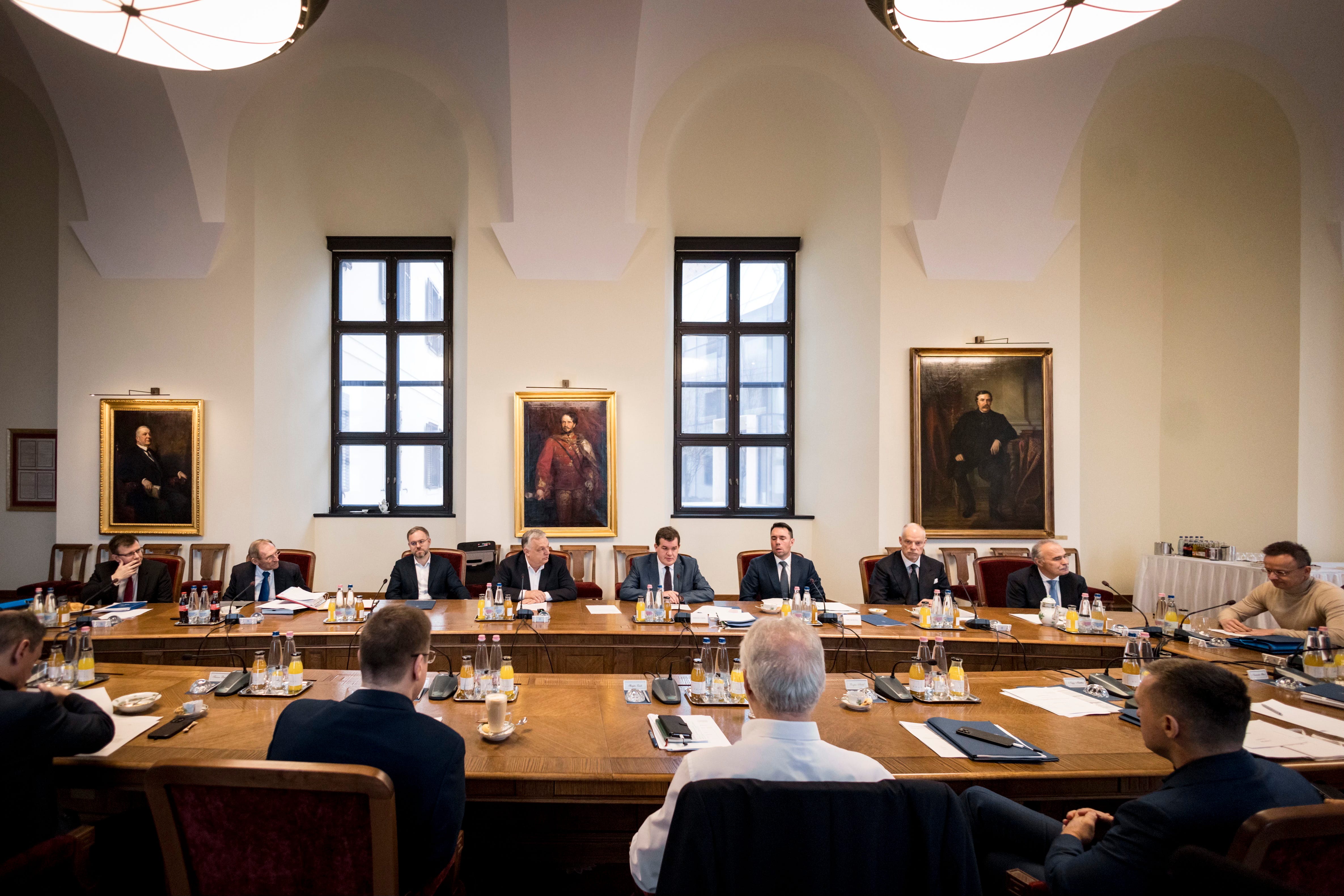
Around the Karmelita, the fence had become part of the building’s meaning. It marked the edge of Viktor Orbán’s power around the former Carmelite monastery where he had placed the centre of government, high above the Danube, inside the restored theatre of Budapest’s Castle District. Below it was the city. Around it were police lines, cameras, tourists, opposition stunts, legal disputes, and the quiet daily instruction that power lived above the public, close enough to be seen and far enough to be unreachable.
On 15 May 2026, Péter Magyar personally removed fencing around the building that had served as Orbán’s office and announced that the Karmelita would be opened to the public while authorities decided on its future role, according to AP. The line he gave reporters was spare enough to survive the moment: “There is no place for cordons in Hungary after the change of regime.” It was a sentence designed to be seen as much as heard.
The act worked because the object already had a history. The former monastery had become a symbol of Orbán’s rule after being cordoned off in 2021. By the time Magyar touched the fencing, it had acquired the emotional weight of a small monument. A barrier came down around the old seat of power. A building that had long suggested distance was turned, at least for a while, into something closer to an exhibit. No captured institution had yet been rebuilt. No public contract had yet been untangled. But the new government had chosen to introduce itself through the same language Orbán had used for years: space, access, height, ritual.
Magyar seems to understand something uncomfortable about political recovery. Before people believe power has changed, they need to see it standing somewhere else.
Orbán governed Hungary through laws, loyalists, prosecutors, contracts, media ownership, emergency decrees and electoral engineering, but also through atmosphere. His power had a geography. It looked down from Castle Hill. It travelled in armoured cars. It spoke through state television studios, billboard campaigns and “national consultations” that filled the country with the government’s own questions. It rebuilt history in stone, marble and myth, then placed itself inside the scenery.
Orbán’s greatest symbolic achievement was the way public buildings came to feel as if they had owners. The monastery, the ministries, the broadcasters, the billboards, the commemorations and the stadiums carried the same quiet message. The state was not a shared instrument, but rather an estate.
The move to the Karmelita monastery gave that message architectural form. Viktor Orbán’s office moved into the former Carmelite monastery in the Buda Castle in January 2019, after leaving the Parliament building, as Átlátszó reported at the time. The building spoke before any government statement did: elevated, historic, monastic, removed from the ordinary traffic of Pest. It allowed the Orbán state to appear less like an administration than a court, settled into the old stone of national destiny.
The Castle District surrounding it became part of the same visual argument. The official National Hauszmann Programme describes the reconstruction of the Buda Castle Palace District as an effort to restore its old splendour and display the greatness of Hungarian architecture. Such language is never innocent in a country where history is so often asked to perform political labour. Restoration became more than preservation. It became a way of teaching citizens which past was authorised, which rooms mattered, and who had the right to speak from them.
In Orbán’s Hungary, architecture became political grammar. Power performed continuity, grandeur and ownership. The nation’s past had an authorised interpreter, and he worked from the hill.
Magyar’s first gestures derive their force from their placement inside that older visual system. The blue Škoda Superb, which he continued using as prime minister after his campaign tour, signalled a refusal of coronation, as reported by Brussels Signal. The car itself is not the story. Its political use is. It carries the campaign road into government and suggests that the office has not yet swallowed the man who won it. In a country where power spent years armouring itself against proximity, even a vehicle becomes part of the sentence.
The refusal to move into a government residence worked in the same register. Magyar said he would continue living in his Buda family home, according to 444. The claim was personal, since he framed the home as the place where his children live, but it also denied the palace logic of office. It suggested that becoming prime minister did not require vanishing into the private architecture of state privilege.
The Karmelita cordon remains the strongest image because it addressed Orbánism at the site where its style had become easiest to grasp. Opposition politicians had tried to dismantle the barrier before. Access restrictions had provoked legal and political fights. Protesters and police had turned the site into a recurring stage. When Magyar removed the fencing as prime minister, the act resonated because people already knew the prop, the place and the meaning.
The same logic runs through Magyar’s tours of government interiors. After showing the Karmelita and other official spaces, he posted video from the Interior Ministry building and framed it as “Pintér Sándor’s hidden 100 billion-forint luxury ministry,” according to 444. A separate report by Híradó also noted that Magyar had shown the Interior Ministry’s internal spaces in a video using the same 100 billion-forint framing.
These videos changed the meaning of the gaze. Chandeliers, staircases, restored rooms, polished corridors and expensive fittings were no longer presented as national restoration. They became evidence. This is one of Magyar’s sharper instincts: public money becomes politically volatile when it takes on a form. A number is abstract. A corridor is not. Budgets can be debated, while rooms confess. When the public sees the staircase, the wood, the doors and the furniture, the money ceases to be invisible. It takes form, and with it, consequences.
This is also where the danger begins. A palace tour can become spectacle, with each room turned into a provocation and each detail curated for effect. Transparency can harden into performance when exposure becomes a ritual rather than a discipline. Yet the gesture retains force because Orbán’s system often relied on excess becoming ordinary. Magyar’s answer is to make excess visible enough to become embarrassing again.
His first cabinet meeting at Ópusztaszer was the more complex gesture, and therefore the more revealing one. On 13 May, Telex reported that the Tisza government’s first meeting would be held at the Ópusztaszer National Heritage Park, at the Feszty Panorama. The location was chosen partly for its symbolic meaning and partly because of the drought emergency.
Ópusztaszer is one of the country’s heavy rooms of national memory. The National Memorial and Tribute Committee describes it as a national historical memorial site that preserves Árpád Feszty’s monumental panorama, The Arrival of the Hungarians, and as a place connected to Hungarian national belonging through the Árpád memorial and the memory of the millennium, according to its official description. The place is charged precisely because its history is layered with legend, painting, commemoration and politics.
A post-Orbán government could have avoided such sites, as if national memory itself had been contaminated by Fidesz. Magyar chose a harder route. He entered that symbolic terrain and treated it as contested public property. The gesture suggested that the country’s founding myths do not belong to one party, even if one party had spent years speaking through them.
That choice carries risk. National symbolism is never clean in Hungary, where history has often been refashioned as grievance, costume and weapon. Ópusztaszer can easily become another mythic stage, another attempt to dress politics in ancient scenery. Yet the decision reveals Magyar’s deeper method. He is not trying to strip Hungarian politics of symbols. He is trying to rewrite their meaning, and their connection to ordinary Hungarians.
His early symbolism works through reversal without needing to announce itself as such. The hill is answered by movement back toward the city. The fence is answered by access. Heritage interiors are answered by public inspection. State messaging is answered by state exposure. The national past is answered by an attempt to reopen its ownership.
If these gestures are to become more than a rearrangement of images, they need to be followed by institutions that can survive without choreography: public media that can criticise the government without punishment, prosecutors who do not wait for political permission, contracts that remain legible after the lights are off. The first acts of visibility matter. The harder task is to build a state that does not depend on one man’s livestream to prove it belongs to the public.
Dismantling that system is essential, but the method will matter as much as the result. A government that moves too personally or too theatrically risks replacing one executive habit with another. The test is not whether Magyar can denounce propaganda or stage cathartic reckonings. The test is whether he can build rules that would restrain him, too.
This is the difficult part of democratic repair. Symbols open a path that institutions must then make safe. They give politics the shape of a scene, a gesture, a photograph. They let people feel change before they know whether it has settled into law. Sometimes that feeling is necessary, the first breath after suffocation. It can also become a substitute for patience, procedure and the institutional tedium democracy requires in heroic quantities.
Magyar’s early strength is that he appears to understand the symbolic grammar of Orbánism better than most of Orbán’s opponents did. For years, many critics described the system in legal, economic or moral terms, all of which were true. Yet Orbán’s rule also worked on the body. It taught citizens where to stand, where to stop, what to look at, what to ignore, which buildings were theirs only in theory, and which version of history they were expected to inhabit.
Power is most effective when it stops looking like power and starts looking like the natural arrangement of the world. That kind of rule cannot be undone by law alone. It also has to be interrupted visually.
A democracy must be felt as public before it can be trusted as legal. People need to see the door open, the files on the table, the room where decisions were made, the hill losing some of its height. Politics should not be reduced to aesthetics, although Hungary’s recent history shows how thoroughly aesthetics had already become politics.
The direction of Magyar’s gestures gives these first days their charge. Orbán used symbolism to elevate power, protect it, surround it with history and make it feel inevitable. Magyar is using symbolism to lower power, expose it, return it to public view and make it feel answerable. The open question is whether answerability can survive after the first images have done their work.
Magyar understands that power must be made visible again, and that the state must be seen before it can be trusted. Visibility, however, is only the beginning. The records still have to be opened. The money still has to be followed. The institutions still have to learn how to breathe without waiting for a signal from the hill.
A democracy is restored when public access is no longer a performance, but a reality. The room belongs to the public when transparency is embedded in practice, not staged for the camera.
Yet the first images matter. They have returned to Hungarians something withheld for years: the sense that the state can be approached, not as a distant authority to be deciphered or endured, but as a place that can be entered, questioned, claimed. No longer worshipped from below or glimpsed behind police lines, the state stands open to scrutiny. Magyar’s promise remains provisional, but the atmosphere is unmistakably hopeful. Crowds have cheered him, and many Hungarians are embracing his openness and candor. It will be measured by law, by institutions, by the slow tests of money and time. For now, the direction is clear. Power is descending from its height, and Hungarians are moving to meet it with genuine enthusiasm.
Wow you speak so clearly of the obstacles and how Péter Magyar is dealing with them. All my hope & good wishes is with the people of Hungary.
Many have made initial gestures towards openness: Theodore Roosevelt; his cousin, Franklin; Dwight D. Eisenhower; John F. Kennedy; Jimmy Carter; Barack Obama. Each one could go only as far as his personal views about executive power, and about who should be included in the democratic process, took him. Every one, except Carter, ascribed to government by Executive Session, to some degree. Peter Magyar will go beyond showmanship , to the extent he trusts the wisdom of the average Laszlo and Erszebet.