

The State of Hungary: The Spell Is Breaking
Orbánism has lost the luxury of being invisible.

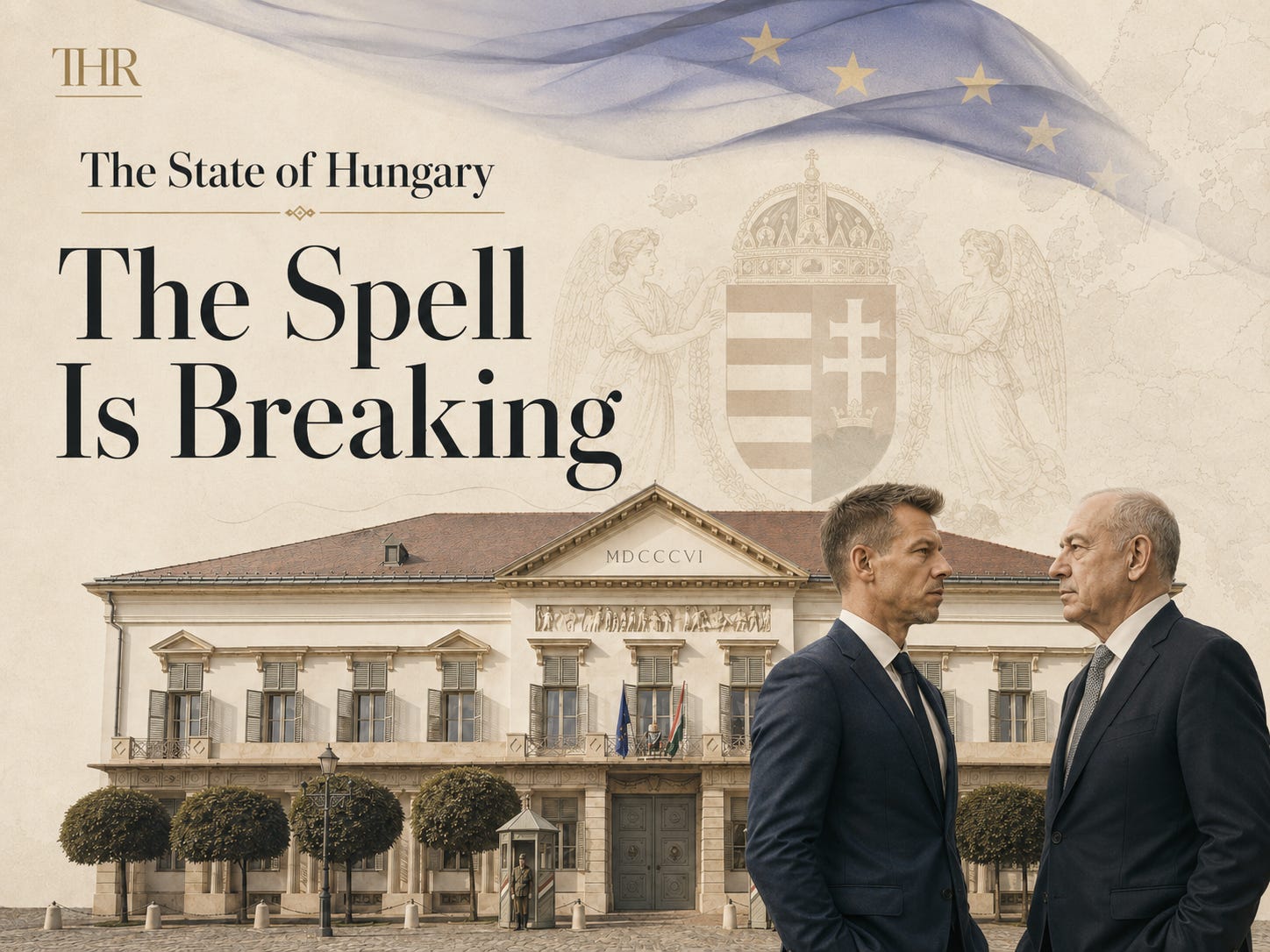
The first month after the fall of Orbán’s regime was marked by a strange quiet. The ordinary returned almost immediately.
The trams ran, the shops opened, and Brussels did not arrive as an occupying force. Ukraine did not, in fact, invade Hungary. Then, almost rudely, the new government travelled to Brussels and began retrieving the money.
Orbán’s longest-running trick was to make dependency sound like protection: without him, Hungary would be exposed to Brussels, disorder, humiliation, and every threat his politics needed to keep alive.
This month, that argument bled profusely.
Orbánism has moved from the podium into the shadows, where the old regime always did its most patient work. Yet something essential has shifted. The spell of inevitability has cracked.
In a captured political system, the first democratic victory often happens in people’s heads. A country stops mistaking power for fate.
Orbán’s power once felt like the architecture of daily life. You learned its angles, joked about its absurdities, avoided its pressure points, or built a life in the narrow spaces it allowed. It felt permanent, and even resistance became exhausting.
That architecture has begun to shift. The old voices still speak, yet people are listening with suspicion, dark humour, impatience, and the dangerous realisation that the sermons from above were written by men with unimaginable salaries, old scripts, and sometimes Russian instructions.
The first month was real
The first month produced tangible results.
The European Commission has agreed to release €16.4 billion in previously frozen funds to Hungary after rapid reforms by Péter Magyar’s government. The details give the deal its force: €10 billion from the NextGenerationEU recovery facility, €4.2 billion in cohesion funds, and a further €2.2 billion tied to reforms including academic freedom. The money had been frozen under Orbán because of rule-of-law and corruption concerns. Magyar’s meeting with Ursula von der Leyen changed the central fact of Hungary’s relationship with Brussels: the European Union is dealing with a government that has begun replacing permanent bad faith with reform.
In a country where Brussels was turned into a permanent stage prop for domestic fear, that reversal cuts deep. The institution Orbán used as an enemy is now being treated as a negotiating partner, and the money is beginning to move.
Hungary has also moved towards joining the European Public Prosecutor’s Office. EPPO is precisely the body Orbán refused to allow near Hungarian EU money cases. The refusal to join was one of the system’s most revealing habits. A government that constantly said there was nothing to see worked very hard to make sure the European prosecutor could not see it.
EPPO accession would put European prosecutors inside the fraud cases that Hungarian institutions spent years avoiding. The application is only the first move; the test comes when actual EU money starts crossing actual desks.
The ICC reversal was even cleaner. Hungary’s parliament voted 133 out of 199 to remain a member of the International Criminal Court, undoing Orbán’s attempted withdrawal before it could fully take effect. The symmetry is almost too perfect: in 2025, Orbán’s side had pushed the withdrawal through with 134 votes in favour, 37 against and 7 abstentions. One year later, the new parliament reversed the direction. That vote told the world something simple: Hungary was done treating international law like a restaurant menu.
Erasmus is also coming back. Erasmus may sound like a soft student-exchange issue. In Hungary, it became something harder: one of the clearest examples of how Orbán’s system punished ordinary Hungarians for institutional capture they did not create. Students were made smaller because the state had been made dirtier.
Together, these developments have reopened a public space that Orbán spent long, dark years narrowing. A space where facts can travel without first asking permission from power.
The propaganda press is still speaking. The audience has changed.
Orbán built one of the most sophisticated propaganda ecosystems in Europe: public television, regional papers, KESMA, friendly oligarch-owned outlets, state advertising, Facebook pages, Megafon-style influencers, and the daily discipline of repeating the same political script until it felt like common sense. International reporting has repeatedly described the dominance of Fidesz loyalists in Hungary’s media environment.
That network still reaches deep into the country. State television still speaks into kitchens and village living rooms. Regional papers still carry the same central script in local ink. State advertising still gives friendly outlets oxygen that independent media can only dream of.
And yet the election revealed something brutal: the editors, strategists, presenters, and paid online warriors no longer understand the country as well as they thought they did.
Its monopoly on inevitability has slipped.
Orbán’s media empire survived by creating enough noise, suspicion, disgust, exhaustion, and alternative reality that no shared democratic conversation could survive. It rarely needed people to love Fidesz. It needed them to believe everyone was equally filthy, equally bought, equally ridiculous, and therefore nothing could ever really change.
Magyar broke that spell by becoming undeniable. Public media treated him as an intruder until he became the main event. The propaganda press cast him as a Brussels puppet, a traitor, a narcissist, a temporary scandal, then watched him become prime minister. Fidesz had spent years teaching the country to expect chaos without Orbán. Orbán lost, and the sun came up.
For a mythology built on indispensability, that is ruinous. The day after a supposedly irreplaceable leader lost power, ordinary life has a way of carrying on, and the real humiliation for the old mythology came when a different government walked into Brussels and got the money moving.
No state-funded chorus survives that comparison unscathed.
Independent Hungarian media now lands differently, too. Telex follows the mechanics of government; G7 and Válasz Online show where money has settled; Direkt36 traces hidden ownership and protected business circles. HVG, 444, Magyar Hang, Átlátszó, and Klubrádio kept public reality alive while the state tried to replace it with endless theatre.
Until now, Hungarian journalism could reveal a great deal and still watch power continue as if nothing had happened. That silence is no longer as secure. A documented ownership chain should lead somewhere. A procurement story should not vanish after two news cycles. A Telex explainer should not have to compete with a publicly funded alternate universe pretending to be news.
The propaganda press is losing force because Hungarians have begun to hear the penmanship behind the headline. Once the wires are visible, the magic cannot return unchanged.
The same lesson applies to public media. Magyar has pledged to suspend state media news broadcasts until public service standards are restored. Replacing Fidesz television with Tisza television would only repaint the old habit. Public media has to recover a more basic democratic instinct: viewers are citizens, not material to be processed. The point is not to make public television recite kinder lines. The point is to break the habit of speaking to the country from above.
Orbán, posting from the afterlife of power
Orbán has not yet found the right size for himself.
He still writes with the muscle memory of a man who expects the state to echo back.
That is why his posts now feel spectral. When he warns of democracy, betrayal, Brussels, hidden pacts, and traps, he sounds like a ghost haunting his own former office. The language is familiar. The pose is familiar. The suspicion is familiar. The authority has diverted.
One of the most revealing scenes of the month was Orbán, the man who spent years hollowing out checks and balances, posting anxiously about what Magyar might be doing to democracy.
His “free cheese is only in the mousetrap” line about the EU funds deal did the old work in miniature: take a material achievement, wrap it in folksy suspicion, and make relief sound like danger. It landed differently because the factual situation had changed. The money was frozen because Orbán’s own system created corruption and rule-of-law concerns serious enough for the European Union to withhold billions.
Magyar’s Brussels trip made Orbán’s mousetrap line look ragged: the country had been trapped by corruption conditions of his own making, and the first bars were finally being loosened.
This is why Orbán’s opposition style may become increasingly bizarre. He can still perform victimhood, now as the man whose system left the unpaid bills. Every warning now drags its own record behind it: the courts, public television, frozen EU funds, the Russian embrace, Chinese loans, secretive deals, and the endless Brussels fights that made Hungarians poorer in the name of being proud.
Orbán remains dangerous from a diminished position: a politician with a record to defend, a smaller party behind him, and a media empire scrambling to explain why reality ignored the script.
Tomorrow’s showdown at the Sándor Palace
Tomorrow morning, at 8 a.m., Magyar says he will go to the Sándor Palace with his newly appointed justice minister, Márta Görög, to confront Tamás Sulyok, the president who has refused to leave.
The deadline expires at midnight today. Magyar’s warning also applies to a wider circle of Orbán-era office-holders: the chief prosecutor, the Constitutional Court, the Kúria, the judicial administration, the State Audit Office, the competition authority, and the media authority. Resign by 31 May, or face legal removal.
This is where the velvet part of the transition ends and the constitutional knives come out.
Magyar says voters chose regime change on 12 April. Sulyok says his mandate runs until March 2029, that there is no constitutional ground for his resignation, and that he has asked the Venice Commission to intervene. A fresh 21 Kutatóközpont poll cited by Telex says 64% of Hungarians want Sulyok to leave office. The politics favours Magyar. The legal route is much narrower.
Tomorrow brings the first major collision between democratic mandate and constitutional discipline. Orbán’s people were placed in offices designed to outlive democratic defeat; removing them requires more than majority force. Constitutional repair has to look like repair.
The old system protected itself with time: five years for the president, nine for the chief prosecutor and several top judicial and media posts, twelve for Constitutional Court members and the head of the State Audit Office. These mandates were time capsules planted inside the future.
Tomorrow will show whether Magyar can open them without shattering the glass around the whole institution.
The NER is fraying
The Sulyok confrontation is the live version of the larger problem. The old order governed by embedding itself.
The word NER needs to be spelt out for readers outside Hungary. It stands for Nemzeti Együttműködés Rendszere, the “System of National Cooperation”, Orbán’s post-2010 name for his political order. The blandness was part of the trick. In practice, it became the operating code for a party-state: loyal businessmen, loyal media, loyal prosecutors, loyal regulators, loyal foundations, and public money moving through private hands with the calmness of something that had stopped expecting consequences.
That order was built to survive exactly this moment: four supermajorities, a rewritten constitution, thousands of public contracts, and offices with five-, nine- and twelve-year mandates.
It is fraying.
The men who built fortunes and influence beside Orbán no longer operate under the same political roof. That changes behaviour before a single verdict is handed down. Magyar has repeatedly claimed that figures from the old world are already trying to make contact, explain themselves, or distance themselves from the people they once served. No guilt is proven by that. The nerves are visible. In the NER, proximity to power was an asset; in the first month after Orbán, proximity has begun to look like exposure.
The financial numbers are no longer abstract. Hungarian reporting has traced around 1,452 billion forints, roughly $4.6 billion, in private-equity funds linked to major NER circles, before the less visible layers are counted. Reuters has reported that prosecutors seized around 92 billion forints, roughly $294 million, in funds and securities in the central-bank foundations investigation, a case linked to public assets placed into structures around the Pallas Athene Domus Meriti and Neumann foundations. The same report said the probe involves 97 individuals, 36 businesses, 11 private-equity funds, and searches or document seizures across 17 legal entities.
This is the kind of detail that changes the mood in boardrooms. Asset recovery sounds abstract until prosecutors start seizing securities.
The NER economy still represents enormous embedded power through Mészáros, Tiborcz-linked interests, Matolcsy-era networks, Szíjj, Garancsi, Jellinek, the private-equity world, university foundations and state-connected business circles. The old world lived through ownership, concessions, advertising flows, construction contracts, bank relationships, media holdings, and the quiet beauty of proximity to power turning into wealth with almost devotional regularity.
The legal incentives are changing, too. Magyar has promised to establish six parliamentary investigative committees into Orbán-era abuses and alleged corruption, including the Central Bank Foundations affair. EPPO accession, EU conditionality, the proposed asset recovery office, prosecutors already moving on the Matolcsy-era foundations, and parliamentary committees all change the risk profile for people who previously assumed the state would protect them. Justice has barely packed its bag. Impunity has started to lose its relaxed facial expression.
The old emotional formula is weaker, too. Orbánism lived on a loop of fear, enemy, protection, loyalty. There was always someone allegedly coming for Hungary, and Orbán was always standing at the border of the imagination. After sixteen years, the country looked tired of being permanently rescued from invented emergencies while hospitals, schools, prices, wages, and futures deteriorated in plain sight.
The optimism this month is earned. A political order that loses power, part of its audience, part of its protection, and part of its immunity is no longer whole.
