


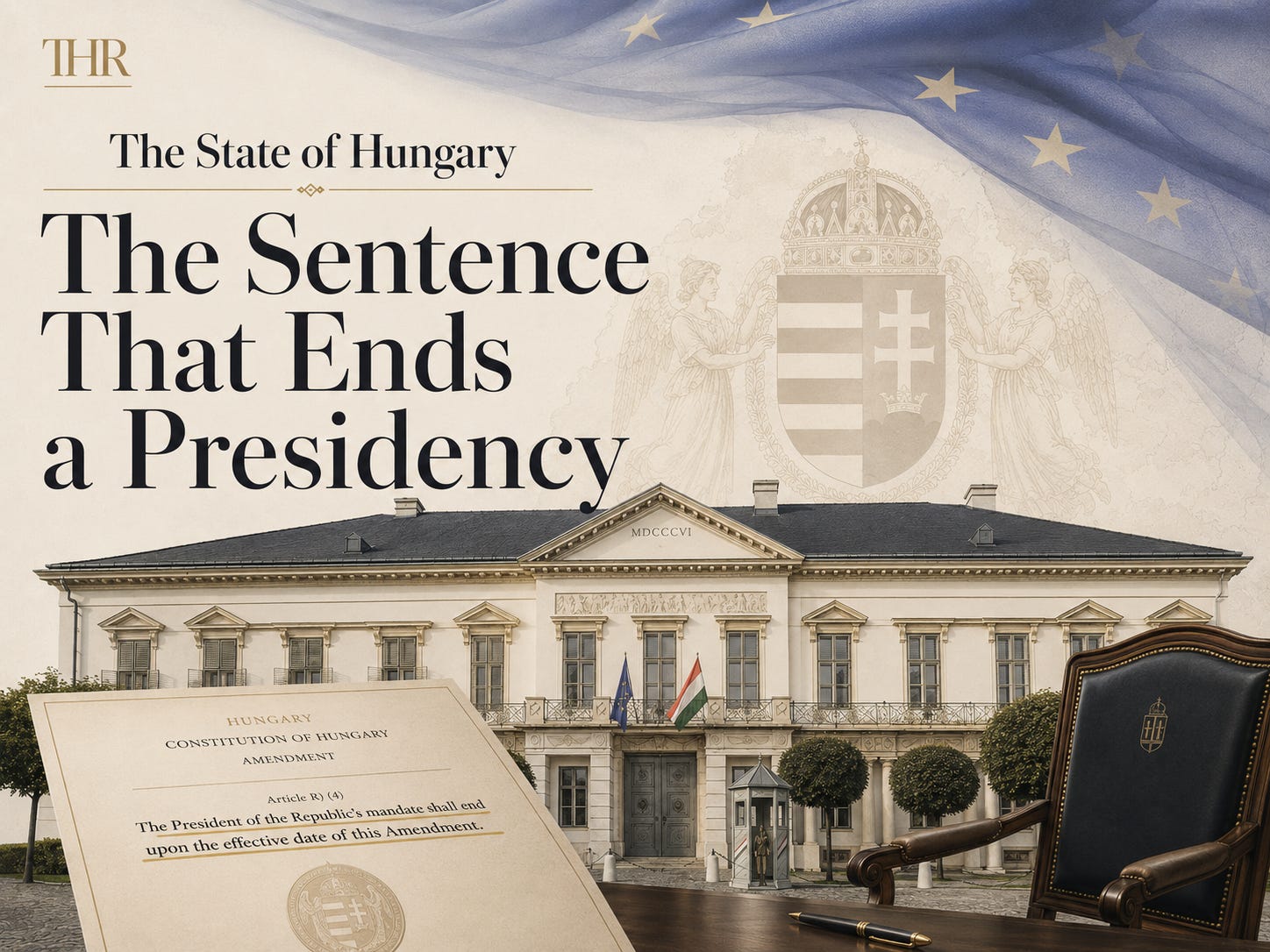
On 4 July, Péter Magyar’s government submitted the 17th Amendment to Hungary’s Fundamental Law, the Orbán-era constitution adopted in 2011.
Its most important sentence is also the simplest.
The mandate of the sitting president shall cease on the day after the amendment enters into force.
The sentence leaves Tamás Sulyok unnamed. It does not need to name him. In this amendment, the office itself identifies the target.
Hungary’s new government is pushing to exit a captured constitutional order through the legal channels left by that order. That is the central dilemma of this month.
The amendment is written as a transitional instrument: immediate repairs now, a new Constitution later, after broad social and professional consultation. The government’s consultation page says citizens were invited to submit opinions on the draft, and Magyar has argued that this process already marks a break with the constitutional habits of the Fidesz era.
Hungary was evidently captured by spectacle and paperwork.
The 17th Amendment is therefore doing several jobs at once. It restores full Constitutional Court review over budget and tax laws. It broadens the constitutional understanding of public money. It narrows the reach of cardinal laws, the two-thirds laws that Fidesz used to shield ordinary policy from ordinary democratic change. It removes the Budget Council’s veto over the central budget. It creates a new National Asset Recovery and Protection Office. It also ends the mandate of the sitting president and affects Constitutional Court judges over 70.
These are not identical measures. Some restore scrutiny. Some clear blocked offices. Some create new instruments for accountability. Together, they show a government trying to make the state governable again after a system designed to survive electoral defeat.
That is the right starting point. Hungary elected a government into a state still populated, shaped and fenced by the previous order. Like a weed, it needs to be pulled out by the roots for a full removal.
A brief note, before I go on.
This work is slow. It means analysing hundreds of pages of legal texts in Hungarian, following the language of parliament, and monitoring for the small changes in how a government speaks about itself. It means translating not just words, but the logic behind them. Most of what appears here is the result of weeks, sometimes months, spent tracing the lines between law, institution, and daily life.
If you find value in this work, please consider subscribing or sharing this piece with someone who should be paying closer attention to Hungary. A paid subscription is $5 a month. Your support allows for deeper research, added context, and more time dedicated to covering the people and institutions shaping Hungary after Orbán. Your action makes a direct difference - join now.
Free subscriptions and shares are powerful ways to expand this community. Help bring this work to those who need it. Subscribe for free or share today.
Thank you for your support.
The president as proof
Tamás Sulyok is not an accidental figure in this story.
He was elected president by the previous Fidesz-dominated Parliament after Katalin Novák’s resignation. His mandate, like so many high offices in Orbán’s Hungary, was built to outlast the political moment that produced it. That was the point. Orbánism placed people and powers beyond the reach of the next election.
So when Magyar’s government looks at Sulyok, it sees more than a president. It sees what remains of the old constitution.
The amendment’s solution is candid. Once it enters into force, the sitting president’s mandate ends. Parliament then elects a new president, whose term lasts until the new Constitution enters into force, for no more than five years.
Magyar is already speaking in dates. He has said he expects the amendment to enter into force in roughly a month, and that Sulyok will “certainly” no longer be president around 20 July. He has also promised a new president before 20 August. If Sulyok refuses to sign the amendment after Parliament passes it, Magyar says a deprivation procedure could be launched against him. In that case, Sulyok would temporarily lose his powers, and the Speaker of Parliament, Ágnes Forsthoffer, would exercise them.
This is a removal schedule aimed at the republic's most symbolic office.
There is a political logic here. A president elected by the previous order may slow a government elected to dismantle it. He can send legislation for review, shape appointments and give the transition a hostile constitutional face. If the office is meant to represent national unity, Sulyok’s position has become difficult to sustain.
Sulyok has given the objection its cleanest form. In an interview with the Polish conservative weekly Do Rzeczy, he said he had no reason to resign and that Magyar had not found a public-law basis for removing him. His point is textual: the amendment deals with the sitting president in one sentence, and because it applies to the current office-holder, he called it person-specific legislation.
That objection deserves a response. It should also be set alongside Sulyok’s own conduct.
Sulyok told the public that he had asked the Venice Commission, the Council of Europe’s constitutional law advisory body, to assess his removal, and that the Commission would examine the matter under an urgent procedure. TASZ, the Hungarian Civil Liberties Union, then asked Sándor Palace to release Sulyok’s request and the Venice Commission’s reply. The president’s office refused.
The National Authority for Data Protection and Freedom of Information has now opened an investigation. More importantly, it has already indicated its legal view: the question of Sulyok’s resignation and the surrounding circumstances are of high public interest, the documents are public-interest data, and there is no future presidential decision that these papers could be said to prepare.
That gives the Sulyok case a more competent advantage. If the president invokes European constitutional expertise as part of his defence, the public should know what he asked and what answer he received. Constitutional restraint and constitutional transparency go hand in hand.
The Hungarian Helsinki Committee has offered the most useful standard. In its opinion on the draft amendment, it says the removal of certain constitutional office-holders can be acceptable for the restoration of the rule of law, while asking the government to provide fuller reasons and stronger justification. Amnesty International Hungary’s submission makes a similar point on due process.
That should not freeze the reform but should strengthen it. The stronger the reasons, the smoother the transition.
People inside the rules
The president clause is the most unmistakable example, though it is not the only one.
The amendment speaks in general terms, yet many of its provisions land on specific people, offices and veto points.
It restores a 70-year age limit for judges serving on the Constitutional Court, Hungary’s highest body for constitutional review. Sitting judges who have already reached that age would lose their mandate once the amendment enters into force. According to 24.hu, this would affect Péter Polt, the former Prosecutor General who now serves on the Court, as well as three other judges over 70.
Péter Polt was one of the most important figures in the legal insulation of the Orbán era. His move from the prosecution service to the Constitutional Court showed how the old system converted office into endurance.
The submitted text also improves on Magyar’s earlier design. He had spoken of six-year Constitutional Court terms with one possible re-election. The filed bill sets a nine-year non-renewable term for the 15 judges.
That is a superior constitutional design. Judges should not have to think about pleasing the majority that may later re-elect them. A single long term creates more distance between the Court and the governing party of the day.
This is where the appointments that follow become decisive. The amendment can open the Court. The new majority must then prove that it wants judges, not replacements with a different party's memory.
Captured institutions are captured through people. A serious transition has to touch appointments, mandates and veto points, or the election changes the government while the state’s deeper wiring remains intact.
The point is simple: appointments made to survive voters are now meeting voters.
The moral centre: public wealth
The National Asset Recovery and Protection Office is the part of the transition most Hungarians will understand instinctively.
They do not need a seminar on constitutional design to understand asset recovery. They have lived the consequences of public wealth drifting into protected private hands. They have seen hospitals struggle, schools weaken, wages lag, public services deteriorate, and friendly fortunes grow with astonishing calm.
The government has presented the office as a central instrument of recovery. According to the official government description, the office would receive powers to recover national wealth acquired through power, unlawful means or morally questionable arrangements, and to prevent similar abuses in the future. The draft legislation reported by Telex gives the office-wide access to information, including bank account data and official registers, with assistance from the police, prosecutors, and the tax authority.
This is a major constitutional step, and politically, it may be the most comprehensible.
Orbánism was also an economy. It was contracts, land, foundations, media holdings, construction firms, concessions, banks, private equity structures, advertising flows, and public procurement. The political order created a business order around itself. If that money is not followed, the transition remains partial.
A country can remove a prime minister and still leave his system alive in the records of ownership.
Magyar’s language around this has been deliberately severe. He has spoken of the “janissaries” of the Orbán system, those for whom Hungary’s common wealth had been war booty. The heat of that language is understandable. The office will need technical competence equal to the public anger.
This is where the new government’s promise becomes concrete. Millions of Hungarians voted on whether public wealth could be returned to the public.
Public money, public speech
Orbánism understood the usefulness of boring law.
A poster fades. A slogan expires. A two-thirds threshold waits. A budget veto waits. A narrow definition of public money waits. A captured board with a long mandate waits. By the time voters arrive, the decision has often moved somewhere else.
The 17th Amendment goes after several of those places.
It narrows parts of the cardinal-law system. Cardinal laws are two-thirds laws, meaning they require a two-thirds parliamentary majority to pass or amend. Used carefully, they can protect constitutional essentials. Used excessively, they make elections more diminutive than they should be.
It restores the Constitutional Court’s full ability to review budgetary and tax laws. One of the early acts of Orbán’s constitutional order was to restrict the Court’s fiscal-review powers. That placed parts of public finance beyond normal constitutional scrutiny.
It also removes the narrow constitutional definition of public money. In Hungary, that phrase is anything but dry. Public money was repeatedly routed through structures designed to blur public and private control. Narrow the definition, and money becomes easier to hide.
These are among the strongest parts of the amendment. They return scrutiny to public finance and give the elected government room. They also show how much of Orbán’s system lived in clauses that sounded too dull for ordinary politics.
The media account belongs here because it reveals the same principle in full public view.
Orbán’s public media created a daily discipline of political reality, repeated through public television, regional papers, state advertising and friendly outlets until dependence felt like common sense.
One exchange on Hír TV said more than a month of commentary. When the presenter Stefi Déri asked who should keep the right-wing media ecosystem alive if Fidesz no longer saw it as its task, Bertalan Havasi answered: the owners. “We are on the market,” he said. Déri replied: “It is very hard to live from the market.”
There it was, almost too honest. A press system trained on state advertising had just met market gravity.
TASZ’s June proposal on restoring public speech shows how wide the repair has to be. The group’s media-freedom plan points to arbitrary restrictions on journalists’ physical access, police obstruction, weak remedies for parliamentary reporting, GDPR-based pressure on reporting, missing journalistic exemptions, the delayed implementation of EU anti-SLAPP rules, and the need to rebuild the independence of the media authority and public broadcaster.
That is the right scale. Public media will not be repaired by changing the voice from above. It will be repaired when institutions, funding, access and legal remedies no longer point in one party’s direction.
The old media ecosystem is learning what remains when the state stops issuing purchase orders.
The first month of repair
Fidesz will cast this as retribution. That is the easiest label for a party discovering procedural restraint.
After years of long mandates, loyal appointments, constitutional shortcuts and institutions built to survive elections, Orbán’s party now wants to speak as the injured custodian of legal continuity. The performance is brutal, and, even by Fidesz standards, polished.
The more serious reading is that Hungary is in the first month of constitutional repair. Early repairs are rarely elegant. They occur within the legal structures that enabled the damage. They require speed because entrenched offices can still act. They require care because every new instrument teaches the state how power may be used.
That is why the next decisions will carry more weight than the slogans around them.
Who replaces Tamás Sulyok? How are new Constitutional Court judges chosen? Who leads the asset-recovery office? How transparent will the constitution-making process be? How independent will public media be once ownership, funding and regulation change?
These are the substance of the transition.
The 17th Amendment should be judged as the opening act of a larger settlement. Much of it moves in the right direction. It restores public scrutiny of public money, weakens legal entrenchment, confronts offices built to outlast voters, and begins to translate the election result into state capacity.
That is no small thing for us Hungarians.
Hungary now has to show that the dismantling of a captured state can produce a freer one. The standard is clear enough: build rules that can withstand power outages. Recover public wealth without creating selective justice. Repair public media without building a new microphone for the winners. Replace entrenched office-holders through processes that make the next offices stronger.
There is no clean exit from a captured constitutional order. There is only method, evidence and restraint.
The first act is a sentence. The work ahead is a republic.
Wow, positive action. I approve, but we will have to see how it all works out. This is a delicate time as you have expressed so well. Thank you for reading all the data, condensing it & expressing it so well.
"A nation of laws, not of men". Hungary once was and will be again just as America once was and hopefully, will be again.