

The State at Low Water
Paks, Paks II and the country Péter Magyar inherited.

The Danube keeps falling
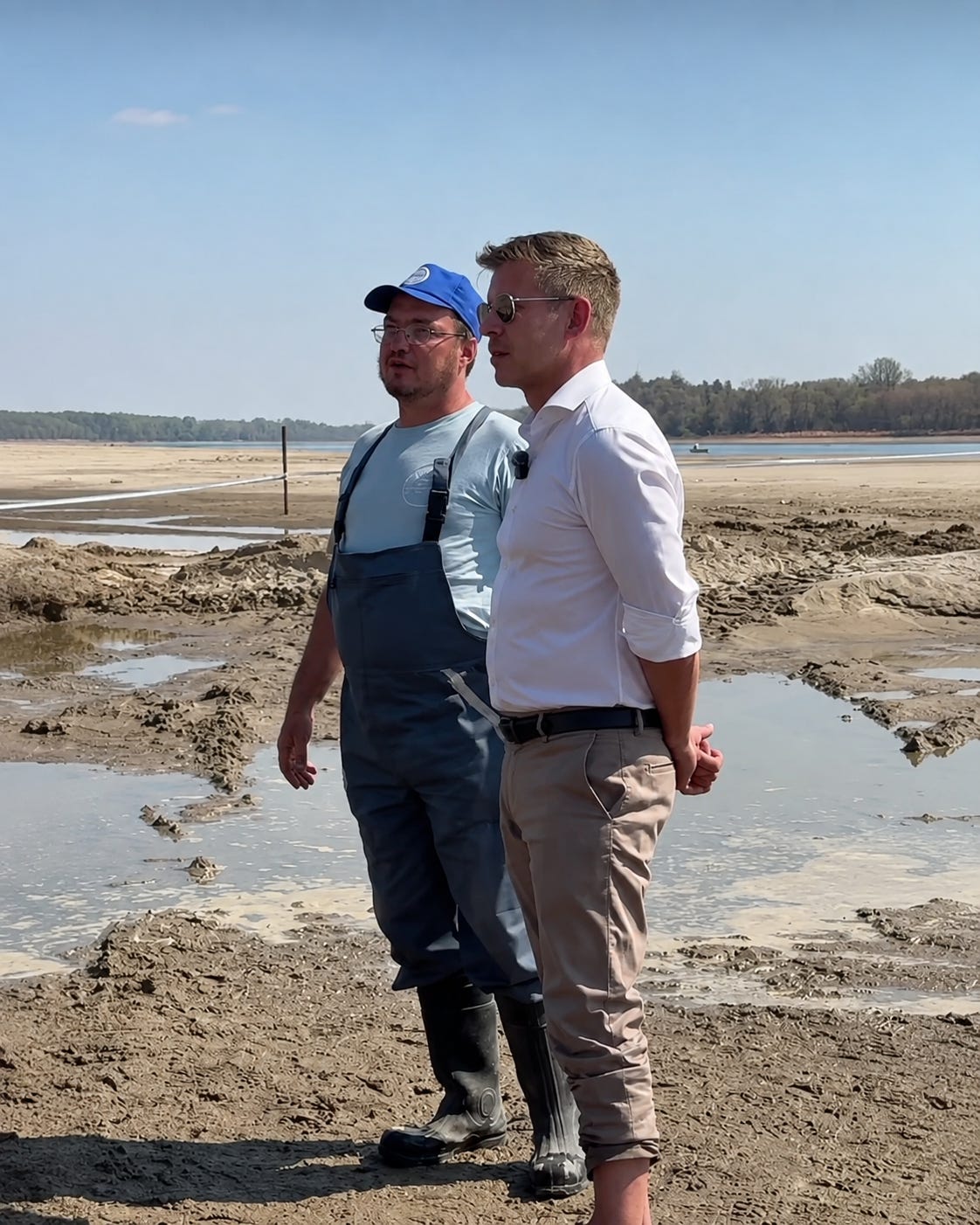
On Saturday, two 80-metre barges were deliberately lowered into the Danube near Paks. Thousands of tonnes of stone have been arriving day by day. Eight deep anchor piles have gone into the riverbed, more than a hundred trucks have been moving around the site, and the new Tisza government is preparing a much larger structure that will eventually require around 145,000 cubic metres of stone. The first intervention raised the water level at the nuclear plant’s intake by roughly one centimetre.
Meanwhile, the level of the Danube keeps falling.
Paks normally provides roughly half of Hungary’s electricity. At the worst point of the crisis, output had fallen to little more than 10 per cent of its roughly 2,000 MW nominal capacity. Later in the week, Unit 2 had recovered to around 500 MW while the other three reactor units remained offline.
Hungary’s political transition since the election has mostly involved paperwork. The new government has been going through the files. Contracts are being opened, Orbán-era appointments are being removed, foundations are being untangled, companies are being audited, and spending decisions are being brought back into daylight. Almost every week brings some new detail about where public money went or how another part of the Hungarian state was wired together during Viktor Orbán’s years in power.
Then came the heat.
The drought and the falling Danube forced Péter Magyar’s government into a very different part of its inheritance. Suddenly, the problem was more physical: water levels, cooling pumps, electricity imports, engineers, barges and tonnes of stone. You cannot audit your way out of that. You cannot hold a press conference and make the river rise.
Magyar has spent much of the crisis blaming Fidesz, and I comprehend why. Earlier this month, he accused the previous government of “many omissions and deliberately bad decisions” that had left Hungary’s energy system vulnerable. He attacked its record on wind power and energy storage and said Paks had been left unprepared for the water levels Hungary was experiencing. By Thursday, as the emergency works accelerated, his language had become even stronger. Paks and MVM, the state-owned energy group, had had the money to prepare, he argued. Yet his government had been forced to “start everything from zero, or minus ten.”
Magyar is now responsible for the response. The decisions that left the permanent adaptation unfinished were made during the Orbán period. For sixteen years, Orbán’s governments controlled national energy policy, the relevant ministries and the state companies responsible for critical infrastructure. They governed through the previous record low on the Danube and remained in office as the need for longer-term adaptation became increasingly obvious.
That is where responsibility for the state of preparedness begins.
The engineers already knew
European researchers have been warning for well over a decade that nuclear and other thermoelectric power stations dependent on rivers face increasing exposure to hotter water and declining streamflow. A 2017 Nature Energy study found growing vulnerability to water stress across European electricity generation. Earlier research had already modelled how warmer rivers and lower flows could constrain power stations that depend on river water for cooling.
Hungary knew about the problem too. In a 30 July warning, MVM Paks said the Danube was already 28 centimetres below the 2018 low-water record and more than a metre below the 100-year minimum incorporated into the plant’s original design assumptions. The plant had four low-water operating stages. It had reached stage three, while stage four required all units to stop. Engineers were already working on modifications intended to improve the intake system’s low-water capability, and a broader adaptation programme was underway.
So the engineers knew. Procedures were in place, and technical work had begun. Hungary still reached the summer of 2026 with the power station responsible for around half of its electricity exposed to exactly this kind of event.
That does not make the record of the Orbán governments easier to defend. It makes it harder.
They had been in power since 2010. They controlled the ministries, energy policy and the state-owned companies. They governed through the 2018 low-water record. They remained in office while the longer-term vulnerability of the intake system became clearer. Ultimately, they left power in 2026 with the permanent adaptation still unfinished.
Magyar’s claim that Paks had simply been left “unprepared” flattens some of the technical history. Still, what Hungary lacked when the Danube reached this level was a permanent, complete solution.
That is the part I want explained. When was such a solution first proposed? What did engineers recommend? What did it cost? Which work was funded? What remained unfinished? Who decided what could wait? Where did the money go instead?
When I say autocratic government damages competence, I mean something very practical. Hungary has been through years of brain drain. Young, educated Hungarians have left for countries where they can earn more, build careers more easily, enjoy greater freedoms and often access fairly basic things with less frustration. Anyone my age in Hungary knows people who left. Entire friendship groups have scattered around Europe.
Then there is what happens inside the country. In an increasingly autocratic political system, loyalty can become more valuable than expertise. People learn who needs to be pleased. Promotions become political. Companies learn that access can be more useful than competition. Officials learn that bringing inconvenient information up the chain may not be good for their careers.
You can follow that logic quite far down through a state. If the person running an institution is there primarily because they are politically trusted, eventually that has consequences. If the same pattern replicates across ministries, state companies, and regulators, a country gradually loses something much harder to capture in a corruption report. It loses the ability to turn knowledge into well-informed, sound decisions.
A state can retain excellent engineers and still become worse at listening to them. Infrastructure carries those failures for years. Maintenance gets delayed, and often adaptation projects move too slowly. Procurement priorities drift as someone signs off on another year.
Then the river falls, and a decision that once existed somewhere inside an engineering report becomes thousands of tonnes of stone being rushed towards the Danube.
The Russian inheritance next door
Then there is Paks II, which makes the whole story more uncomfortable.
For me, this is one of the most important pieces of the inheritance because Paks II is among the largest and most durable ties to Russia that Orbán left behind. Governments change, ministers disappear, and political relationships can unravel quickly.
Nuclear power stations are built to sit there for decades.
Orbán signed Hungary into a Russian-built nuclear project whose components are now being manufactured, whose construction is finally underway and whose financing includes a Russian state credit facility of up to €10 billion. Whatever Magyar eventually decides, Hungary cannot simply wake up one morning and decide that this relationship with Russia is over.
Rosatom says things are going well. Its chief executive, Alexey Likhachev, said this week that the company was proceeding according to the agreed plan. Magyar has a rather different understanding of what “according to plan” means. As Telex reported in its account of the dispute, Magyar points to the original timetable and argues that the project should already be producing electricity, while Rosatom points to the current construction schedule.
Rosatom can point to actual construction. The first concrete for Unit 5 was poured in February. The reactor building is advancing, excavation for Unit 6 continues, and components are being manufactured. Still, if you signed a deal more than a decade ago for a nuclear power station that was supposed to be producing electricity by now, I can understand why the new prime minister is unimpressed by being told that everything is proceeding according to schedule.
The financial side is even stranger.
The original agreement provided for a Russian state loan of up to €10 billion, covering as much as 80 per cent of the original €12.5 billion construction contract. Yet the last precise public figure I could verify for the amount actually drawn was a little over €28 million, disclosed in a 2023 parliamentary answer.
I have not found a more recent official figure showing exactly how much Hungary owes Russia under that sovereign loan today.
That surprises me. We are talking about one of the largest infrastructure projects in Hungarian history, built by a Russian state company under a financing agreement with the Russian state, and I cannot find a current public figure who can tell me exactly what Hungary owes.
At the same time, Hungary has increasingly been paying for Paks II out of its own funds. Reporting put the Hungarian state capital committed to the project company at around HUF 780 billion, roughly $2.5 billion, by the beginning of this year, using the Hungarian National Bank’s official exchange rates.
So the familiar €10 billion figure tells us only part of the story. There is the maximum Russian credit facility, whatever Hungary has actually drawn from it, the Hungarian budget money already spent and the potential cost of trying to change direction now that concrete is finally in the ground.
And now the plant next door is struggling because the Danube fell too far.
Magyar has raised questions about whether the cooling arrangements for Paks II remain sensible in light of what Hungary is currently experiencing. Rosatom’s answer is that major changes could bring further delays and force a different financial model.
I can understand why Magyar is worried. He inherited a Russian nuclear project he did not negotiate, under financing he did not design, with a Russian contractor he clearly does not completely trust. Cancelling it could cost Hungary a fortune. Redesigning it could delay the project for years. Continuing without reopening some of these assumptions could produce its own problems later.
There is no painless option waiting for him.
This is one of the nastier features of succeeding an autocratic government. You inherit its decisions long after you inherit its offices.
When the Paks II audit is published, I want two figures immediately: how much Hungary owes Russia today, and how much changing course would cost.
Governments change faster than supply chains
There was another strange feature of this week. While Magyar was dealing with Paks, his government was also opening files across the Orbán economic system. It ordered a comprehensive review of the state’s relationship with 4iG, covering ownership, financing, economic relations and contracts. The audit examines some of the largest defence and technology arrangements established during the Orbán period, although there are no substantive findings yet.
The government also reopened the proposed M6 arrangement with MKIF, arguing that competition could save public money. The decision reopens an Orbán-era motorway arrangement involving interests associated with Lőrinc Mészáros and László Szíjj. MKIF disputes the government’s cost comparison.
Meanwhile, at Paks, some very familiar companies were arriving with barges and stone.
Magyar publicly thanked KÉSZ and Strabag for offering help, then complained that several of the NER's great beneficiaries — the Orbán-era political-economic system — seemed strangely absent. He named László Szíjj, István Garancsi, and Lőrinc Mészáros. Market Építő subsequently offered 10,000 tonnes of stone and its own transport capacity.
The chronology with Szíjj’s Duna Aszfalt is more complicated. One of its barges from the Mohács bridge project was already travelling towards Paks before Magyar publicly called him out. A second followed, and Duna Aszfalt also offered specialist river stone and transport. We still do not have a complete ledger that separates donations from paid work or identifies every contractor and procurement route.
But the image tells us something anyway.
Governments can change faster than supply chains.
Orbán losing power did not make the companies that expanded during his rule disappear. They still have the trucks, barges, quarries, machinery, construction workers, engineers and experience. Some of them will likely be needed by the government, which is now investigating how they became so powerful.
You can replace a minister in a day, but you cannot replace a country’s industrial capacity in a day.
Paks made that quite visible.
Something unfamiliar
There is another part of this week I do not want to lose among all the investigations, Russian contracts and arguments about who failed to prepare Paks.
Hungary already feels slightly different.
The divisions in society have obviously not disappeared. One crisis will not undo years of political hostility. But for the first time in a long time, I have had the feeling of Hungarians going through a difficult moment together.
The electricity system moved to a heightened state of readiness before the engineering intervention. MVM asked electric-vehicle users to avoid charging between 5pm and 10pm while grid operators worked with neighbouring systems and examined import capacity. At Paks, private companies have supplied materials and equipment, while soldiers, engineers, water-management officials, and government staff have worked on the same operation. Hungary has also been coordinating with its neighbours as part of the wider energy response.
The reaction underneath Magyar’s own social-media posts has been interesting to watch, too. I would obviously never present Instagram comments beneath the prime minister’s account as representative of Hungarian public opinion. His followers are a self-selecting audience, and many of the people commenting are clearly supporters. Still, they capture a mood.
“This is how problems should be handled, with teamwork, effort and good spirits,” one commenter wrote. Another described it as “the better face of Hungary, where everyone works for the country.” Someone else simply thanked everyone involved in the operation.
I recognise that feeling.
For years, Hungarian public life seemed organised around conflict. Institutions, companies, artists, universities, and eventually almost every public issue acquired a political colour. Everything became another argument about which side you belonged to.
The Danube does not care how anybody voted.
But the comments also contain another political instinct that Hungarians know very well. “Where was anything like this for sixteen years?” one person wrote. “He is present!” Another called Magyar “the only real superhero”. Others talk about him as if Hungary has finally discovered what a prime minister is supposed to look like.
And there it is again: personality politics.
Magyar understands the visual power of Paks extremely well. He has spent much of the week there, appearing in videos, inspections, and live broadcasts, surrounded by workers, barges, stone, and military helicopters. In one video, he is barefoot beside the Danube with his trousers rolled up. In another, he is standing on the exposed riverbed beside workers.
There is a heroic amount of Péter Magyar content coming out of Paks.
His opponents have noticed. Magyar invited the other parliamentary party leaders to Paks, but none of them came. Fidesz communications director Bertalan Havasi later said his party had been right to stay away from what he called Magyar’s “self-promotional Facebook clowning”, while Mi Hazánk leader László Toroczkai accused the prime minister of caring more about “the show than the actual work”.
And yes, Péter Magyar loves a photo shoot. Put him in a rolled-up shirt on a boat at sunset, and he is unlikely to complain.
But there is a fairly easy way to judge this. Behind the photographs, is the work getting done?
So far, a serious operation has moved quickly. Two 80-metre barges formed the immediate intervention, while the larger riverbed sill requires around 145,000 cubic metres of stone. The barges were deliberately sunk while concrete blocks and stone were moved into position, and the government has mobilised engineers, soldiers, water-management officials and private companies. The reported gross cost is roughly HUF 6.1 billion, around $19 million. The government says a complete Paks shutdown would cost the budget at least HUF 50 billion, around $159 million, every month.
That is why I am relatively fine with the photographs as long as he keeps working.
I probably give Magyar more benefit of the doubt than I would give a prime minister governing under ordinary circumstances. Hungary has not been in this position for a very long time. He is trying to govern after sixteen years of autocracy while rebuilding institutions, examining the financial consequences of the previous government and operating a state whose bureaucracy, companies and political culture were shaped by that period.
Hungary also became deeply accustomed to personality politics under Orbán. Almost every political argument eventually came back to one man. Magyar has not escaped that culture either. He is intensely present and sometimes almost excessively enthusiastic. He wants to be at the briefing, on the boat, in the helicopter and in the video afterwards explaining what happened.
That can become a problem.
I am much more interested in what happens to the institutions around him. If Hungary ends up with competent ministries, independent courts, professional regulators and officials who can tell the prime minister he is wrong without fearing for their careers, then Magyar eventually becoming less central would itself be evidence that something worked.
For now, I cannot ignore what this week looks like. People have been asked to reduce pressure on the electricity system. Companies have offered equipment and materials. Soldiers, officials and engineers have worked beside the Danube. Hungary has coordinated with its neighbours. Some Hungarians watching all this appear genuinely relieved to see the country doing something together.
That feels new.
Build first, regularise later
Government Decree 122/2026 created a permissive legal regime around the Paks intervention. Environmental use can begin before the relevant process has been completed. The normal prior water-law construction permit was dispensed with and can be obtained afterwards. Certain conservation proceedings cannot halt construction while work is underway, and the decree also allows a special procurement procedure without the usual separate justification. The decree and the other emergency measures can be followed through the 2026 issues of the Magyar Közlöny, Hungary’s official gazette.
The government has changed the normal sequence. Construction begins, and parts of the legal regularisation follow later.
Given the circumstances, I understand why. A nuclear plant supplying roughly half of Hungary’s electricity was moving toward shutdown while the river continued to fall.
But emergency logic has a habit of becoming attractive to governments.
Paks gives Magyar an unusually strong reason to move quickly. It also gives us an early look at what this government does when ordinary procedure becomes an obstacle.
That is why the institutions around it become so important.
The institutions push back
This week produced one useful example. Investigators examining suspected offences involving roughly HUF 17 billion (around $54 million) in grants from the National Cultural Fund (Nemzeti Kulturális Alap, NKA) searched a data centre housing Fidesz’s servers. Fidesz complained.
The Prosecutor General’s Office ruled that the searches were lawfully ordered but found that investigators had seized electronic material too broadly. That part of the process now has to be repeated under a narrower evidentiary scope. The criminal investigation continues.
I think that is a good sign. Fidesz can be investigated and retain legal rights. The people investigating the previous governing system have rules to follow, too.
On Monday, the Constitutional Court will consider some of Tisza’s most consequential constitutional changes. One challenge concerns the provision used to end Tamás Sulyok’s presidential mandate. Parliament has since elected András Baka as president of the republic. Baka is the former president of the Supreme Court who was removed from that office during Orbán’s judicial restructuring.
The court will also consider the new twelve-year limit on service as a member of parliament and the age limit of seventy for Constitutional Court judges. Both apply to people already serving, and the parliamentary limit would prevent Viktor Orbán from continuing as an MP. Monday’s full session will therefore address some of the most aggressive constitutional changes Tisza has made since taking office.
Meanwhile, János Lázár has another job
There is one more development from the week that deserves a slightly less apocalyptic note.
Viktor Orbán and the Fidesz presidency have given János Lázár a new assignment: find out what remains of Fidesz around the country.
More formally, Lázár has been commissioned to carry out a nationwide assessment of the party’s local infrastructure and report back in September. Fidesz communications director Bertalan Havasi has confirmed the assignment. According to reporting on the review, Lázár is looking at local leadership, membership, morale and whether individual party organisations remain viable. Office closures are reportedly being considered in some places.
Oh, how the mighty have fallen.
Fidesz governed Hungary for sixteen years with the party, government, state communications system and enormous networks of public resources increasingly wrapped around one another. Then it lost power, and Orbán essentially sent Lázár out to establish how much of the party still exists when it has to function as a party again.
The internal language is more dignified. Fidesz politicians have spoken about renewing the structures needed to perform the work of “constructive opposition”. Reporting on the internal reorganisation suggests Lázár is assessing which local organisations still function, which leaders retain authority and where the party needs to rebuild.
I have an image in my head of Lázár travelling across Hungary with a clipboard, knocking on the doors of Fidesz offices and checking whether anyone answers.
The assignment says something serious, too. Under the past government, it was difficult to separate Fidesz’s organisational strength from the state resources surrounding it. Losing government means discovering what the party can still do without ministries, state advertising, public institutions and the gravitational pull of power.
Apparently, János Lázár will tell Orbán in September.
What Hungary did not build
And that brings me back to Paks.
Hungary did not discover this vulnerability during the summer of 2026. The engineers knew. Procedures existed. Adaptation work had begun. European researchers had been warning about this category of climate risk for years.
The unresolved part is why the permanent work was still unfinished when the Danube reached these levels. The vulnerability predates Tisza; contingency procedures existed, and the long-term intake adaptation remained incomplete throughout the period in which Orbán’s governments controlled Hungarian energy policy and the state companies responsible for it.
That does not mean every technical failure at Paks can simply be attributed personally to Viktor Orbán. Sixteen years of governing does, however, come with responsibility for the condition of the country you leave behind.
We already know an enormous amount about what the Orbán state built and what it bought. We know about politically connected contractors, foundations, office complexes, media companies and state deals. We know how loyalty shaped appointments and how a political-economic network grew around the government.
We know much less about what Hungary did not build.
Which technical warnings waited too long? Which maintenance and adaptation programmes moved too slowly? Which investments never became politically urgent because success would simply have meant that nothing happened?
I think this may be one of the more revealing ways to account for the Orbán years. Corruption becomes visible once somebody finds the contract. A bad acquisition eventually appears in the accounts. A ridiculous building can be photographed.
The infrastructure somebody failed to strengthen is harder to see.
Until you need it.
That is where my concern about competence returns. A political system changes incentives. It affects who advances, which companies prosper, what information travels upwards and which investments receive attention. Over enough time, those choices become part of the physical country.
Paks provides us with a place to investigate that precisely.
Two barges are now sitting in the Danube while trucks carry stone towards the plant. For the first time in a long time, I also see something hopeful in the response. Hungarians are dealing with a difficult moment together. Engineers, soldiers, officials, private companies and neighbouring countries are working on the same problem. The government is communicating constantly, and people can see some of the work being done.
It is early. The emergency is still unfolding. I have no intention of declaring a national rebirth because people managed to work together for a week.
But Hungary already seems to be functioning differently.
A few kilometres away, concrete is simultaneously being poured into one of the largest remaining Russian projects in the country while its costs, financing and cooling assumptions are being reconsidered.
What a week. Hungary sank barges into the Danube to keep Paks running, reopened questions around its Russian nuclear deal, leaned on companies that prospered under the NER, and watched institutions begin to push back against the new government too. Magyar was everywhere, occasionally too much so, but the state was working.
I am not drawing grand conclusions from a single week. Still, Hungary felt different.
If you found this valuable, please consider sharing it with someone who follows Hungary or subscribing to The Hungary Report. Paid subscriptions are what give me the time to dig through documents, follow stories like Paks beyond the daily headlines and keep this publication independent. I know not everyone can pay, and that is completely fine. Reading, sharing and recommending the work genuinely helps too.
Source: Primary documents and independent reporting are linked throughout the text. Social-media comments were taken from public comments beneath Péter Magyar’s posts and saved by the author.