

The Same Illness, a Larger Body
I grew up in Orbán’s Hungary. What I see in Trump’s US is not imitation, but acceleration.

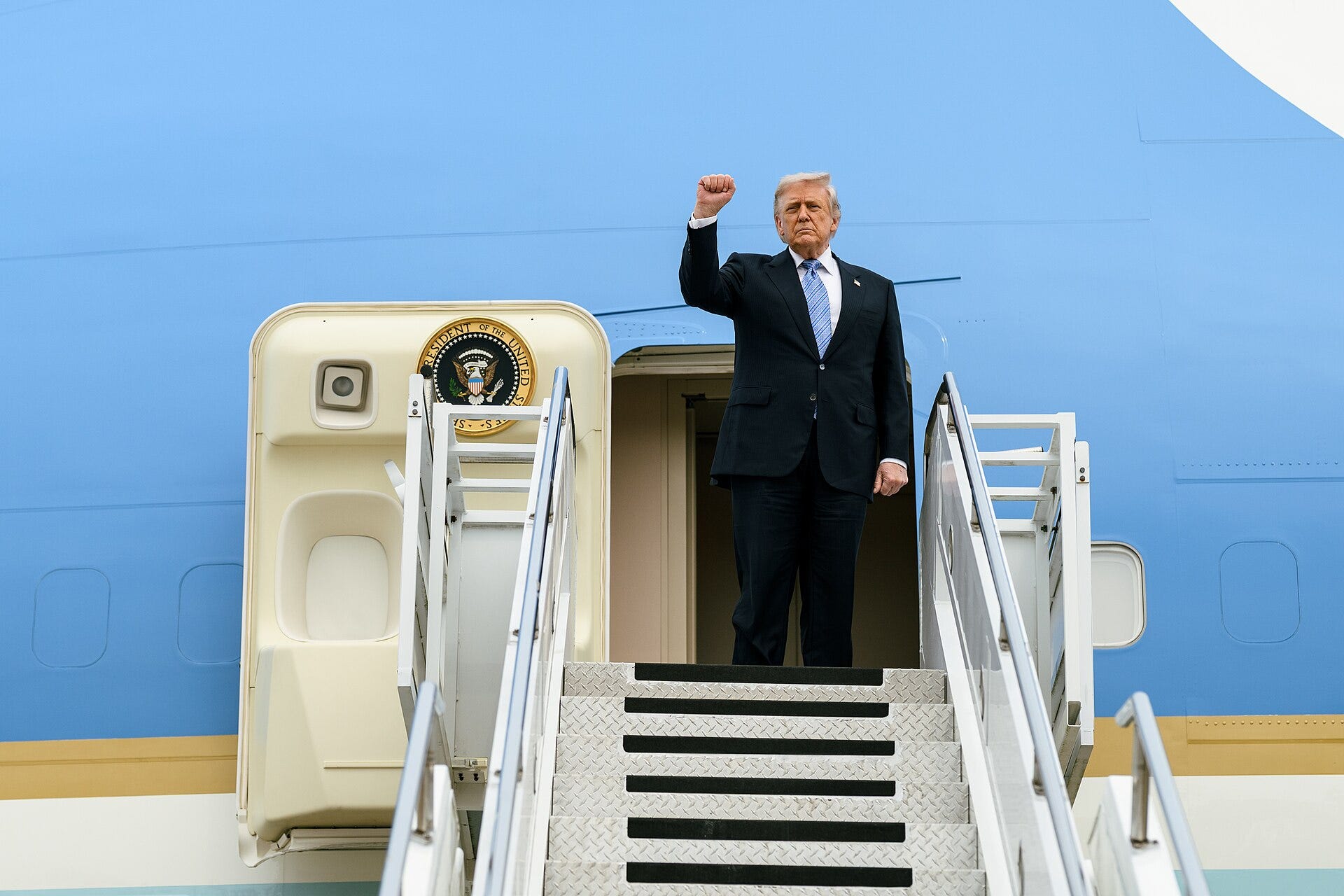
Trump is not the US’s Orbán. Orbán is often invoked as the template for democratic backsliding, but Trump is something else, an evil force that moves with a velocity and unpredictability that outpaces the system’s ability to recognise, let alone restrain, what is happening.
There is no distance here. The collapse that shaped me was intimate, not theoretical. Growing up in Orbán’s Hungary meant watching public life contract, institutions wear their emptiness behind official facades. Corruption was not an event but a plague, inescapable, ordinary. Each memory threads into the next, forming the fabric of what is now recognisable elsewhere.
Expertise in US law or electoral arithmetic is not my claim to fame. Technical knowledge is not what I offer. Even at a distance, the thread of attention held firm. For many Europeans, the United States stood as the reference point for democracy itself. Over time, that sense of wonder calcified into a kind of urgency. Horror sharpens when the unthinkable becomes routine. Not a scholar of constitutions, but a witness; what remains is what erosion leaves behind.
To live through this is to lose the luxury of detachment. Innocence is replaced by vigilance. Every new headline, every constitutional twist, arrives with the force of memory and reminds me how quickly vigilance becomes necessity.
For sixteen years, Orbán has demonstrated how democracy can maintain its rituals while its core is carved out. Rituals persist, but substance recedes. Elections are held, courts convene, newspapers appear on doorsteps, ministers invoke the people, and the system continues, hollow. Around these forms, rules are altered until competition is emptied of force. Districts are redrawn, courts stripped of independence, media transferred to friendly hands. State advertising becomes a reward for loyalty, public procurement a tool for consolidating power. Look closely, and resilience is often just a habit, one that can be sharpened into a weapon.
Orbán’s innovation was managed legality: the slow conversion of democratic procedure into permanent advantage.
The comparison to Donald Trump is tempting, but it misleads. The American story is not a simple echo. Armed with the global power of the presidency, Trump transforms the threat, stretching adversaries and distorting institutions at a pace and scale Orbán could never command. The effect is amplified, and the stakes are global and even more devastating.
The phrase “America’s Orbán” once carried the weight of a warning, echoing dangers already visible in Hungary. But what once echoed now reverberates. The American landscape has shifted, and the old warning is too narrow to contain what comes next.
The year Fidesz took power is vivid: the city changed, conversations shifted. The constitution was rewritten, the courts filled with loyalists, and the media silenced or bought. The press became a tool for the party; corruption slid from scandal into background routine. Each new index, each international report, made official what was already felt: Hungary was now only “Partly Free”.
The language of democracy became a shield. Every move justified as reform or sovereignty, every loss of freedom reframed as protection. The circle of real choice shrank, even as promises multiplied. That sequence would become hauntingly familiar elsewhere.
Orbán was unambiguous. In his 2014 Tusnádfürdő speech, he promised Hungary would become “an illiberal state, a non-liberal state.” Democratic rituals persisted, but the substance was quietly dismantled. There was no pretence of secrecy. The consequences travelled, spilling beyond Hungary’s borders and shaping ambitions elsewhere.
Daily life changed in ways that pressed close. A neighbour complained about a contract lost to a party official’s cousin, her voice dropping when I drew near. A friend paused before a political joke, scanning for unfamiliar faces. Expectations shifted quietly. Public money vanished to insiders, and only silence followed. Names on buildings remained, but rooms shrank, and staff became guarded. The loss was legal and personal, a slow surrender visible in my family’s warnings and hushed conversations, and in the clear sense that outside the powerful, rules no longer offered protection.
Through this lens, US events come into focus. Recognition arrives with a jolt, followed by confusion. The rhythm is unfamiliar, the scale overwhelming. Hungarian instinct reaches for a parallel, but the comparison slips. Trump does not replay Orbán’s script. He adapts it to a larger stage, amplifies it, accelerates it. The same illness enters a new body, and the pulse grows wild.
From afar, pressure arrived in unpredictable waves. Headlines tracked the tempo. Executive orders, dismissals, loyalists rewarded, lawsuits multiplying. Friends in the US described the exhaustion of never knowing which institution would be targeted next. Universities, law firms, prosecutors, civil servants, and state governments all became targets. That sense of permanent response, once so familiar in Hungary, now stretched across a continent.
I watched the headlines pile up and felt the pace quicken. Twenty-six executive orders on Trump’s first day, 143 within his first hundred. Reuters tallied at least 470 targets, people, institutions, and agencies marked for retribution. Legal battles multiplied. Lawsuits, injunctions, reversals, and emergency rulings stacked one atop another. Among friends and colleagues, fatigue settled in. Resistance, once sharp, became ritual and then habit. Some measures were blocked, others slipped through. Every independent centre felt the pressure. No one’s footing was sure.
This is governance by saturation, a method I recognise from Hungary, but executed at a different pace and intensity. The ultimate goal is exhaustion.
Orbán relied on gradual normalisation. Trump relies on overload. Orders land before the last is absorbed. Targets are named before the previous one has finished defending itself. Legal fights overlap, each unfinished before the next begins. Public attention slides from outrage into exhaustion. Bureaucrats learn that legality may not protect them. Opponents spend their energy reacting; the ground beneath them always shifts.
Trump performs domination in public. Legal limits are recast as corruption. Institutional independence becomes a conspiracy. Prosecutors are enemies, judges obstacles, journalists liars, universities ideological nests, civil servants agents of a hostile state.
At a 2023 rally, Trump told supporters: “I am your retribution”. In a Fox News town hall the same year, he was asked whether he would abuse power, and he answered no, “except for day one”. Democracies treat such lines as performance until they become policy. Political language gives permission. It tells supporters what may be done in their name, officials what loyalty will be rewarded, and opponents what kind of state they face.
Orbán gave illiberalism a doctrine, a strategy for democratic backsliding in Hungary. Trump gives it velocity and reach, using US power to amplify the risk far beyond its origin. The danger is not imitation but an escalation.
I have watched democratic erosion unfold in Hungary, seen its lessons misread as provincial until they returned in amplified form from Washington. My friends in Budapest felt the sting as Orbán blocked EU measures; in Brussels, diplomats whispered about the shifting tide.
Hungary’s influence is bounded; the US’s is not. The decisions of its president ripple across continents.
For Hungarians, distant power is never distant. Unease settled quickly in Budapest whenever Washington’s posture changed, uncertainty trickling down to everyday life.
When Trump turns diplomacy into barter and grievance into policy, reverberations are felt in real time. Warning sirens sound in NATO, in Kyiv, in Budapest alike.
America’s systems are stronger, but not immune. Technicalities — district maps, court rulings — shape the field long before the public arrives. Waking up to find the contest already decided elsewhere is a familiar experience.
The world is improvising its defence, but history records what happens when vigilance lapses. The differences are real, but so are the dangers.
Courts can block unlawful orders while absorbing repeated attacks. Judges issue rulings but face intimidation. Law firms win cases yet still receive warnings that representing the wrong client may trigger government retaliation. Universities defend academic freedom while fighting funding pressure. Stories from civil servants, those who upheld the law and still found themselves purged, sidelined, or quietly replaced, do not fade. Plaques and titles on doors remained, yet the air in the corridors grew cautious, voices lower, trust thinner. Each assault left institutions standing in name, but something essential slipped away: the quiet faith that a boundary could still be held. There is always a moment when belief gives out.
Now, the US is viewed through the prism of those memories. Freedom House still calls the United States Free, but the decline is visible to anyone who has learned to read the signs. The V-Dem reports reveal the same patterns: indicators of liberal democracy falling sharply, numbers that trace a direction all too familiar.
Electoral manipulation, often dismissed as technical, remains one of the most consequential moves in the silent unravelling of democracy. In Hungary, district maps became the province of specialists, even as they quietly tilted the contest. Boundaries were redrawn, campaign rules adjusted, public media leaned toward the government, and state resources amplified one side. When voting day arrived, outcomes felt preordained. That morning-after feeling of futility, the realisation that the loss came long before the ballot, became all too familiar.
Across the Atlantic, the United States has not yet reached that level of distortion. Elections remain genuinely competitive; direct comparisons risk simplification.
By 2025, escalation forced itself into the open. News from Texas, Missouri, and North Carolina reported that Republican officials were pushing new maps to lock in power, while California Democrats responded in parallel. Representation became a technical battlefield. Voters, once the heart of democracy, became obstacles to be arranged and neutralised. The feeling was all too familiar.
Texas is the proof. Officials redrew the map to flip five Democratic seats. Watching the Supreme Court allow Trump’s objectives to advance through redistricting, I felt horror and disgust. The decision revealed how easily a pillar of democracy can be weakened through procedure. The Court let the map stand, citing timing. The language was procedural. The effect was unambiguous: district lines shift before a vote is cast.
I know why the Hungarian example matters. I lived through the slow realisation that the greatest damage to democracy often comes from instruments that sound procedural until the moment they decide everything. I remember conversations after elections, friends, neighbours, parents, realising that the rules around the vote had determined the outcome before a single ballot was cast. A map, I saw, could be an act of political force. A timing rule could decide who was heard. The rituals of democracy continued, but fairness slipped further away with each cycle. This lesson became personal long before it became theoretical.
The $1.8 billion Anti-Weaponisation Fund sits at the heart of this new logic. Even Senate Republicans worry it will become a slush fund for loyalists. Accountability is recast as persecution. Prosecution becomes victimhood. Political loyalty becomes a claim on public money.
Retaliation moves from rhetoric into institutional design. “Lawfare” ceases to be a slogan and becomes an account line. The state begins to create mechanisms through which loyalists, defendants, allies, and self-described victims of government can be compensated for their proximity to the leader’s grievance.
Hungary is the earlier version. I watched enrichment become routine, the legal system drift into sleep. Impunity was engineered through loyal prosecutors, captured press, state advertising, and public procurement. Under Trump, the forms differ: settlements, funds, commissions, lawsuits, grievance media. The principle is unchanged. Power defines who is a victim, who is owed, and which acts of accountability must be called abuse.
Law remains visible, its moral force under attack. A conviction becomes proof of persecution. A prosecution becomes evidence of conspiracy. A person punished by the legal system is recast as someone owed money by the state. The leader is defendant and accuser at once, citizen and exception in the same body.
This is the US variant: impunity through loyalty, legal spectacle, grievance converted into public money.
Trump’s power also operates through the party remade around personal loyalty. The defeat of Thomas Massie in Kentucky, orchestrated by Trump’s endorsement, served as a warning to other dissenters.
The lesson is unmistakable. Dissent carries a price. Independence can be made electorally fatal. The party does not require formal purges when the primary system, campaign money, presidential endorsement, and public humiliation do the work.
Orbán’s party discipline operated through state media, public contracts, party hierarchy, and access to patronage. Trump operates through a looser but ferocious ecosystem of endorsements, money, media attention, and threats. The effect converges: legislators learn to anticipate the leader’s anger, and ambition adjusts before coercion is required.
Authoritarian politics requires enemies. Enemies simplify the moral universe. They turn complexity into threat, loyalty into duty.
Groups targeted as threats shift with circumstance: journalists, academics, and election officials. This is not mere negative campaigning. It is the reorganisation of public life around threat.
Once retaliation becomes a governing principle, independence begins to look like sabotage. Journalism is recast as conspiracy. Courts become traps. Prosecutors become enemies. Civil servants become traitors in waiting. Universities become hostile territory. Migrants become proof of invasion. Political opposition becomes evidence that the nation has been stolen.
The leader then occupies every role at once: victim, ruler, prosecutor, witness, judge, redeemer. Every investigation proves persecution. Every court order proves corruption. Every protest proves treason. Every defeat proves that the system itself must be cleansed.
I have listened as the language of democracy is turned upside down. I remember hearing friends of mine, once supporters of independent courts and journalism, suddenly accused of betraying the nation. I saw how those who defended the guardrails of democracy were recast as enemies, while the leader who attacked those limits spoke as if only he could embody the will of the people. Each speech, each slogan, twisted meaning until it became hard to tell the difference between democracy and its opposite. I felt the confusion and anger that came when words lost their weight.
Orbán’s version is ideological, state-centred. Trump’s is personal, theatrical. Both point toward the same destination: pluralism is rendered illegitimate, and only the leader’s side is permitted to stand for the nation.
Trump and Orbán should not be treated as identical figures. Orbán is disciplined. Trump is chaotic. Orbán’s system is complete. Trump’s project is unstable. Orbán used a parliamentary supermajority to embed loyalists across the state. Trump uses executive force, spectacle, party submission, and constant conflict. Orbán’s Hungary is the mature form of illiberal capture. Trump’s America is the stress test of a much larger system.
These differences sharpen the comparison.
Orbán shows how democratic capture hardens over time. Trump shows how quickly a leader can test a system’s strength when every restraint is treated as an enemy. One offers the architecture of consolidated illiberalism. The other delivers the shockwave of attempted domination inside a superpower.
The old phrase no longer fits. It cannot contain what has happened.
Trump is not simply the US’s Orbán. He is what happens when similar instincts are fused with the American presidency: more speed, more power, more visibility, more instability, and consequences that travel at the speed of a tsunami.
Orbán is alarming as a model. Trump is alarming as an event.
Orbán taught the world that democracy could be dismantled without abolishing elections. He showed that law could be used against legality, media capture could be disguised as market change, public money could buy political loyalty, and a ruling party could turn the state into its own extension while still speaking in the name of the people.
Trump is testing whether democratic resistance can be overwhelmed by speed, noise, retaliation, and scale. The test is not over.
The danger is not that the US will simply become Hungary. It lies in treating Hungary as a local abnormality rather than a working demonstration. The techniques were visible. The vocabulary was visible. Mutual admiration was never hidden. What was missing was a state powerful enough to turn the experiment into a global shock.
The US has not fallen into Orbán’s world. The question is whether a larger and more powerful democracy can recognise the method before speed and scale do their damage. I recognise enough of it to distrust reassurance, and enough to know that recognition alone, however clear, is useless unless it galvanises judgment and action.
Hungary showed how far democratic forms can be emptied while still standing. Trump is testing how much faster the process can move when the office at the centre commands the world’s attention, its markets, its alliances, its weapons.
A small country taught the method. A superpower is testing the speed. The world is watching.
One thing is clear to me, though: if Hungary can achieve regime change after sixteen years, then no captured democracy is too far gone to fight back.
I know readers will see this differently. I hope to collect more experiences of democratic erosion for a follow-up essay.
Thank you for writing such insightful analysis. Chilled to my core. It reads a incredibly accurate.
A superb analysis! Orban allowed elections. perhaps out of smugness; perhaps out of an odd reverence for process. Trump may yet try to postpone or cancel the November elections or station his paid-off thugs at select polling places. If he does, things will get very ugly, very fast. The Far Right is not the only element in the United States that possesses firearms and the willingness to use them.