

The Judge Fidesz Forced Out Is Set to Become Hungary’s President
András Baka knows what a two-thirds majority can do.

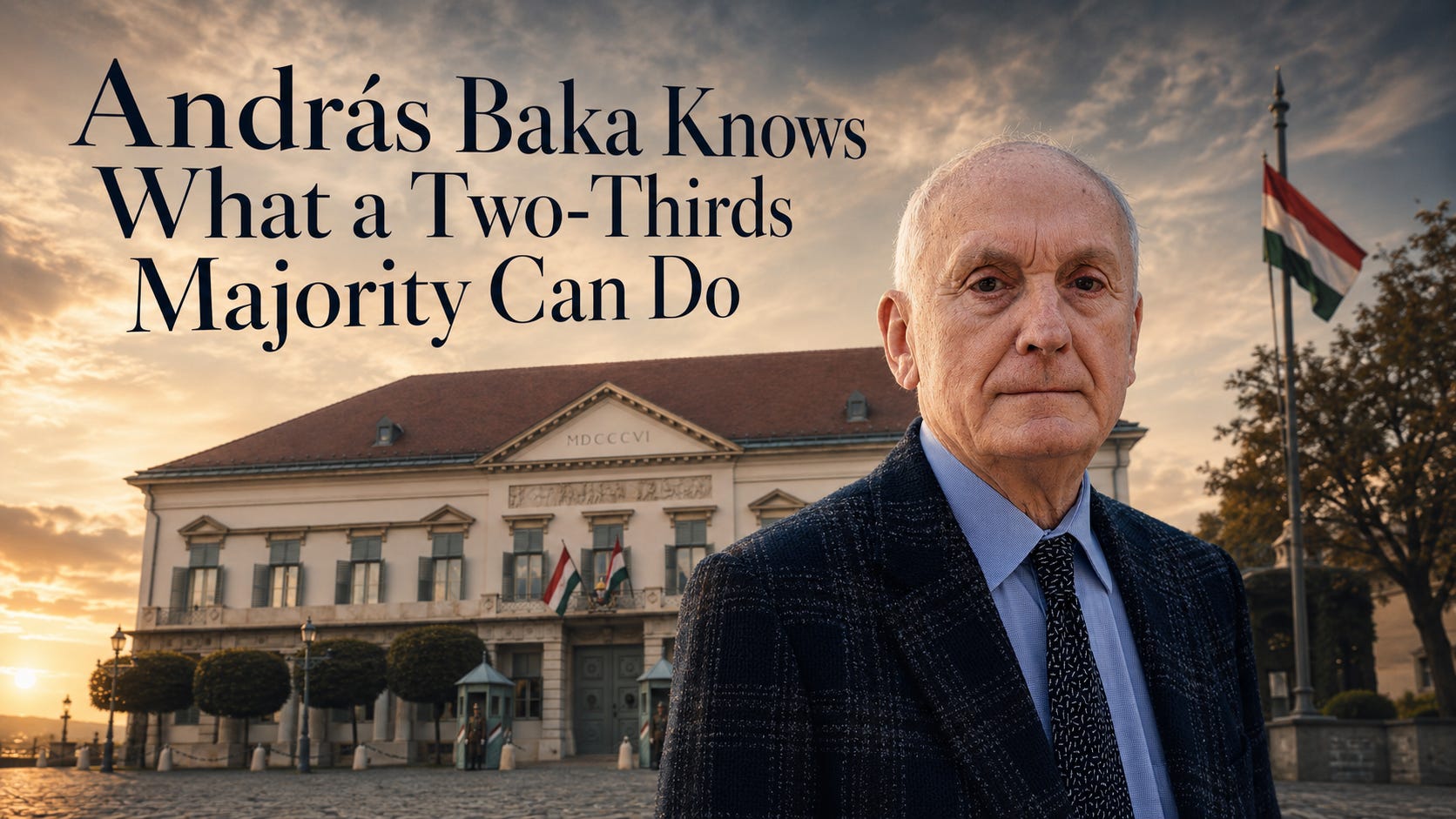
Fidesz ended András Baka’s Supreme Court mandate after he criticised its judicial reforms. Tisza is readying to elect him president through an amendment that terminated Tamás Sulyok’s term early. His record offers the clearest guide to how he may use the office.
In February 2025, judges and court employees marched from Kossuth Square to the Justice Ministry in Budapest. Organisers kept party politics off the stage as the crowd filled Nádor Street. András Baka, the former president of the Supreme Court, stood before them with a question.
“Who should speak out against the dismantling of the rule of law, if not judges?”
Eighteen months later, Baka is preparing to enter the presidency. On Tuesday, 11 August, the National Assembly is expected to elect him head of state. Péter Magyar’s Tisza party controls 141 of Parliament’s 199 seats, eight above the two-thirds majority required for the vote. The ballot will be secret, though the arithmetic leaves little latitude for suspense. Baka could take office on 19 August under a mandate lasting until Hungary adopts a new constitution or, at most, five years.
The words he delivered to those judges carried the weight of an older conflict. In 2011, Parliament ended Baka’s six-year mandate as president of the Supreme Court roughly three and a half years before its expiry, following his criticism of Viktor Orbán’s judicial reforms. The European Court of Human Rights later found that his removal followed protected judicial speech and deprived him of access to legal review.
His return harbours its own constitutional difficulty. The amendment that created the mandate awaiting Baka also ended Tamás Sulyok’s presidency early. Parliament altered a fixed constitutional term through a provision written for the incumbent.
Baka distinguishes the two removals through purpose, procedure, and legal record. Strasbourg subsequently disclosed violations of his rights; Sulyok’s removal has produced no comparable judgment. Baka also believes that narrowly confined interventions against senior officeholders can be justified during the dismantling of institutions entrenched under Fidesz.
That reputation will pursue him into the Sándor Palace. Baka constructed much of his public authority by arguing that parliamentary supermajorities remain subject to legal limits. The first disputed Tisza law to reach his desk will require him to apply those limits to the government that elected him.
The judge who spoke
Born in Budapest in 1952, Baka studied law at Eötvös Loránd University before joining the Hungarian Academy of Sciences’ Institute for Legal and Administrative Sciences. His academic work covered constitutional law, human rights, and minority rights, fields that would go on to shape much of his career.
During the final years of communist rule, he helped draft the rules of an independent trade union for scientific workers, then briefly travelled abroad. On his return, his colleagues informed him that they had elected him president. Baka later recalled their greeting in a 2009 profile: “We really got you. You became president.”
The anecdote offers one of the few glimpses of his temperament in the public record. In the same profile, Baka described himself simply.
“I am not the political type.”
He said difficult decisions did not frighten him. Asked why he had declined to answer attacks on his record from Strasbourg, Baka replied that some criticism fell below the level at which a response remained useful. The portrait suggested a man comfortable with formal authority, sparing with public emotion and disinclined to prolong arguments he considered unserious.
In 1990, Baka entered Hungary’s first freely elected Parliament as a non-party member on the Budapest list of the Hungarian Democratic Forum, the centre-right party that led the first post-communist government. The following year, his career moved decisively towards the judiciary. He resigned his parliamentary seat after being elected Hungary’s judge at the European Court of Human Rights in Strasbourg, where he would remain until January 2008.
Following almost seventeen years at the court, Baka returned to the Hungarian judiciary and joined the civil division of the Budapest Regional Court of Appeal. His brief domestic judicial career gave some MPs grounds to resist President László Sólyom’s attempts to place him at the head of the Supreme Court.
Parliament rejected Baka twice. Sólyom submitted his name again in June 2009, when Fidesz and the governing Socialists both indicated their support. Parliament finally elected him by 309 votes to 36. The result delivered Baka support across a parliamentary divide that would soon become far harder to cross.
As president of the Supreme Court, Baka likewise chaired the National Council of Justice. Hungarian law required him to comment on legislation affecting the judiciary. During 2011, he repeatedly exercised that responsibility.
One dispute concerned the Nullification Act, which annulled final convictions linked to the police handling of the autumn 2006 protests. Baka argued that Parliament was reopening completed cases and substituting legislation for judicial evaluation of evidence.
Another disagreement concerned Fidesz’s decision to reduce the compulsory retirement age for judges from 70 to 62. The change affected 274 judges, around one-tenth of the judiciary. Baka joined other senior court presidents in warning that the measure would remove experienced judges from ongoing cases, weakening the protections surrounding judicial tenure. In a letter to Viktor Orbán, he described the proposal as professionally indefensible and incompatible with judicial independence.
His criticism also reached changes in criminal procedure and the creation of a court-administration system centred on the National Office for the Judiciary, whose president would receive extensive authority over judicial appointments, court leadership, and case allocation. The sequence is set out in the Grand Chamber judgment in Baka v. Hungary.
None of this initially appeared likely to cost Baka the presidency of the court. In April 2011, Gergely Gulyás, who was closely involved in drafting the new constitution, said the Kúria would be the legal successor to the Supreme Court and that Baka would continue as its president. Baka himself argued that changing the court’s name supplied no lawful basis for terminating a fixed mandate.
By October, his professional standing abroad appeared secure. On 13 October, the presidents of the European Union’s supreme courts unanimously elected him to lead their network for the next two years.
Barely three weeks later, on 3 November, Baka addressed the Hungarian Parliament during the debate over the restructuring of the judiciary. Six days after that speech, the legislation governing the Kúria formulated an additional eligibility requirement. Candidates for its presidency would need five years of judicial service inside Hungary. Time served on an international court no longer counted.
The new rule excluded almost seventeen years of Baka’s judicial service from the eligibility calculation. By 28 November, Justice Minister Tibor Navracsics was telling Parliament that Baka could not become president of the Kúria because he failed to meet the requirement.
At the end of 2011, his mandate expired approximately three and a half years before its scheduled conclusion. Parliament had changed the formal identity of Hungary’s highest court, terminated the serving president’s term through constitutional provisions, and then introduced a qualification that prevented him from seeking the successor position.
Baka remained in the judiciary, continuing at the Kúria before later leading one of its civil-law chambers. In March 2012, he filed an application against Hungary at the European Court of Human Rights.
The judgment that still carries his name
Two years after Baka filed his application, a seven-judge chamber ruled unanimously in his favour. The Hungarian government requested a rehearing before the court’s seventeen-member Grand Chamber.
The final judgment came on 23 June 2016. By fifteen votes to two, the Grand Chamber found Hungary in violation of Articles 6 and 10 of the European Convention on Human Rights, protecting access to a court and freedom of expression, respectively.
The judges found that Baka had a legal right to complete his six-year mandate under the rules in force at the time Parliament elected him. Constitutional legislation had then placed any early termination of that term beyond domestic judicial review.
The chronology weighed heavily. His final parliamentary speech took place on 3 November 2011. The eligibility condition excluding his Strasbourg service appeared six days later. No allegation of incompetence, misconduct, or professional failure had been made against him.
The European Grand Chamber found prima facie evidence linking Baka’s criticism of the judicial reforms to his removal. It also warned that dismissing the country’s most senior judge in these circumstances could discourage other judges from speaking publicly about legislation affecting the courts. Hungary was ordered to pay Baka €70,000 in damages plus €30,000 in legal costs. Regardless, the judgment did not restore him to office.
Hungary paid the compensation, but in contrast, the safeguards required by the ruling remain incomplete, leaving the case under the Council of Europe’s enhanced supervision procedure. Official supervision documents describe Baka’s removal as an “ad hominem legislative measure”.
Eight years after the Grand Chamber judgment, the unresolved effects could still be measured inside the judiciary. In a voluntary 2024 survey completed by 285 judges, around 11 per cent of Hungary’s judiciary, 82 per cent said judges could not participate effectively in public debate about judicial reform and independence. Among respondents who had remained silent, 78 per cent cited fear of retaliation, pressure, or discrimination. Half considered the chilling effect strongly present; another 36 per cent detected it to some degree.
By March 2026, the case was still open. The Hungarian government submitted another action plan that month, followed in April by further observations from the Hungarian Helsinki Committee, the Hungarian Association of Judges, and Amnesty International. The Committee of Ministers is expected to return to the case in December.
Baka may therefore enter the presidential palace with the effects identified in the judgment, carrying his name still visible among Hungarian judges. He has said that European judgments should be implemented promptly, describing compliance as a legal obligation and a condition for rebuilding confidence in Hungary’s legal system. As president, he would represent a state that still owes the reforms identified in his case.
The jurist behind the Strasbourg case
This significant ruling made Baka an international symbol of judicial independence. His seventeen years on the Strasbourg bench also reveal a cautious jurist with a recurring deference to state authority.
In 2008, legal scholar Dániel Straub examined Baka’s separate opinions, a narrow sample that Baka later argued could not represent the thousands of decisions in which he had participated. Within that sample, the pattern was consistent. Across more than sixteen years, Baka attached to or joined roughly 45 separate or concurring opinions. He dissented at least partly in nineteen cases decided by the Grand Chamber or the court’s former plenary formation. Every one of those nineteen dissents favoured the state, according to Straub’s study in Fundamentum.
In Open Door and Dublin Well Woman v. Ireland, Baka supported restrictions on organisations providing information about abortion services abroad. In Goodwin v. United Kingdom, he opposed the majority decision protecting a journalist from being compelled to reveal a confidential source. Elsewhere, his opinions often granted national authorities considerable discretion in criminal procedure, security, and family-law disputes.
Straub described a judge who frequently accepted government arguments in contentious cases, sometimes reasoning from a firmly conservative position. Baka objected to attempts to define his judicial philosophy through a small collection of dissents, pointing to the hundreds of judgments and thousands of other decisions in which he had participated. His record also includes a longstanding opposition to the death penalty, a position held before his Strasbourg appointment and maintained throughout his career.
Baka’s Strasbourg record suggests a president deeply protective of judicial autonomy and cautious in some disputes over individual rights. His reasoning repeatedly returns to the same institutional concerns: who possesses legal authority, which decisions can be reviewed, and whether constitutional rules have insulated power from challenge. Those instincts make his support for Tamás Sulyok’s removal especially revealing.
The exception Baka is willing to permit
By June 2026, Baka was already discussing how far Tisza could go in restructuring the state following its election victory. He welcomed the government’s two-thirds majority, arguing that dismantling an authoritarian political order required powers unavailable to an ordinary parliamentary majority. He also warned of the danger contained in that mandate.
“The mandate can be used, but it must not be abused.”
For Baka, exceptional intervention could be legitimate during a transition, provided that it remained narrow, temporary, and directed at a clearly identified institutional obstruction. He also warned that the process “cannot become a distribution of political spoils”, according to his account of the limits on two-thirds power.
A month later, on 13 July, Parliament adopted the seventeenth amendment to the Fundamental Law. Its scope extended well beyond the presidency. The amendment imposed a twelve-year limit on parliamentary service and restored a compulsory retirement age of 70 for Constitutional Court judges. It also restructured the appointment of the leaders of the Kúria and the National Office for the Judiciary. In addition, the National Asset Recovery and Protection Office formed another part of the package.
Therefore, one transitional provision ended Sulyok’s presidential mandate the day after the amendment entered into force. The same provision created the special term Baka is expected to assume, lasting until the adoption of a new constitution or for a maximum of five years.
Before the amendment, Baka had said that resignation would have better protected the dignity and standing of the presidency. Once Sulyok remained in office, he accepted constitutional removal as part of what he called the liberation of a captured state.
The ordinary deprivation procedure would eventually have placed the decision before the Constitutional Court. Baka argued that appointments made under Fidesz had left the court incapable of reaching an independent decision on Sulyok’s future. For him, that justified temporary recourse to extraordinary measures.
Taken together, Baka’s statements describe the conditions under which he believes a new majority may break with rules inherited from the previous government. Tisza’s election victory supplies democratic authority to dismantle structures that entrenched Fidesz’s control. Exceptional intervention becomes permissible where a defined obstruction cannot be removed through procedures that remain compromised. In Baka’s account, the permission expires when the circumstances that justified it no longer exist.
International law and an independent president provide two restraints on that majority. Enforcement remains unresolved before Hungary adopts a new constitutional settlement.
Baka is hardly alone in accepting that the transition may require exceptional measures. Some rule-of-law organisations disagree over where those measures should stop. The Hungarian Helsinki Committee accepts that some fixed mandates may be ended where no less restrictive route exists. However, it criticised Tisza’s five-day consultation period, the amendment’s limited justification, and several elements of the procedure.
Amnesty International Hungary reached a different conclusion on Sulyok. It argued that his conduct supplied grounds for deprivation and insisted that the government should have used the existing procedure, preserving its fair-process guarantees.
Baka therefore occupies one position within a serious constitutional dispute among organisations that share much of Tisza’s stated objective. His view gives greater latitude to exceptional transitional action, with an independent presidency serving as one restraint on its future use.
The dispute evolves as the institution that would ordinarily police presidential removal. In June 2025, Parliament elected former chief prosecutor Péter Polt to the fifteen-member Constitutional Court. He was subsequently made its president. Former ombudsman Ákos Kozma, another Fidesz nominee, filled the final vacancy.
Baka has described the court as effectively controlled by one party. The characterisation is polemical, though Fidesz’s parliamentary majorities determined the membership of the body. Tisza’s seventeenth amendment restores a retirement age of 70, ending Polt’s mandate alongside those of several other judges. It also returns the selection of the Constitutional Court’s president to its members.
The correction itself relies on rules that terminate fixed mandates. This is the institutional setting in which Baka defends Sulyok’s removal, and the comparison with his own case remains unavoidable.
Strasbourg linked Baka’s removal to protected judicial speech and found that he had been denied access to review. Sulyok’s removal has produced no comparable judgment. The means remain familiar: Parliament used constitutional text to end a fixed mandate, placing the decision beyond ordinary review.
Fidesz has seized on that resemblance. New parliamentary leader János Bóka says the party will boycott Tuesday’s vote and continues to regard Sulyok as Hungary’s last legitimate president. He also offered a prediction.
“András Baka will remain in office only until Péter Magyar removes him with a comment.”
Fidesz’s treatment of Baka weakens its standing as a defender of fixed mandates. The constitutional flaw it identifies in Tisza’s procedure remains, as the party’s boycott argument makes clear.
The more emphatic evidence of Baka’s independence comes from his own criticism of Tisza. He rejects the new rule preventing anyone who has served twelve years, or three terms, in Parliament from standing again.
“I consider this arrangement unacceptable.”
Baka argues that voters and political competition should decide when MPs leave Parliament. He predicted that Strasbourg would examine such a restriction closely in light of international standards protecting free elections. His support for prime-ministerial term limits rests on a different legal view: parliamentary eligibility concerns the rights of candidates and voters, whereas a restriction on prime-ministerial tenure regulates access to a single executive position.
A second source of friction is visible in Tisza’s approach to asset recovery. The new National Asset Recovery and Protection Office can conduct risk analyses before criminal proceedings and access bank records, public registries, and official documents. Moreover, its investigators may enter business or administrative premises, inspect electronic systems, and copy records. The office can then initiate public-asset-protection or criminal proceedings across government bodies, municipalities, publicly owned companies, state subsidies, and EU-funded projects.
Baka has said that he cannot estimate the value of assets he believes were stolen under the previous government. He has also insisted that recovery proceed through investigation and prosecutorial review before charges are filed and final court judgments are rendered. Limitation periods and ordinary procedural protections, he argues, must remain intact. In his account, the new office can uncover evidence and prepare cases; courts must decide whether assets can ultimately be confiscated. These views appear in his extended interview on constitutional reconstruction.
Those disagreements clarify what Baka meant when he described the president Hungary now requires. Sulyok’s successor, he said, should be independent of Tisza, free from party attachments, and capable of guarding the lawful functioning of state institutions during the preparation of a new constitution.
By August, Tisza was searching for someone to occupy precisely that role. The process had begun rather awkwardly. Magyar initially endorsed chess grandmaster Judit Polgár before the promised public consultation had produced a candidate. Polgár declined. A subsequent Medián survey found that only 43 per cent of Tisza voters considered her a good choice; 60 per cent said they overlooked the consultation Magyar had promised.
After this fiasco, Tisza Party leaders subsequently interviewed ten possible candidates before submitting three names to the parliamentary group. On 8 August, MPs chose Baka by secret ballot. According to Magyar, Baka accepted the nomination “out of service to the nation” and expressed a willingness to work for national unity and a democratic, European Hungary. Public reporting has yet to produce a substantial statement in Baka’s own name explaining why he accepted or whether he attached conditions.
The office he will inherit
Hungary’s president has limited executive authority. Though the office retains several ways to slow legislation or force Parliament to reconsider a decision. It can furthermore move a constitutional dispute into the courts.
Once an ordinary law reaches the president, the head of state has five days to act. The president may sign it, return it to Parliament once with written objections, or refer it to the Constitutional Court before signature. Parliament can pass a returned law again. A referral requires the court to issue a judgment, creating a formal legal record of the dispute, as the National Assembly’s guide to presidential powers explains.
Baka’s leverage narrows when Parliament amends the Fundamental Law. The president may ask the Constitutional Court to examine whether the procedural requirements for adoption were followed. The court cannot assess the amendment’s substantive content through that procedure under the current Fundamental Law.
During Tisza’s constitution-making period, Baka may retain considerable public authority. On the other hand, his legal power to block constitutional text remains limited. His remaining tools are procedural objection and public argument; an open disagreement could itself impose a political cost on the government.
The historical record shows how differently presidents have used these powers. László Sólyom returned 31 laws to Parliament during a single five-year term and sent 16 to the Constitutional Court. Pál Schmitt used none of them. Across two terms, János Áder returned 37 laws and sought constitutional review eight times. Katalin Novák recorded three returns and two referrals.
Political significance depends on the legislation involved, the reasoning supplied, and the president’s willingness to confront the governing majority. In his discussion of the presidency, Baka praised Árpád Göncz, Ferenc Mádl, and Sólyom as figures who embodied national unity and guarded the constitutional functioning of the state. His assessment of Áder, Novák, and Sulyok was far more critical.
Sólyom provides the clearest precedent for Baka. He repeatedly nominated him for the Supreme Court presidency and used the legal powers of the head of state more actively than any other post-communist Hungarian president. Baka’s comments suggest a similar conception of the office, grounded in legal intervention, independent judgment, and a willingness to force Parliament to reconsider legislation.
The presidency will also give Baka a direct role in rebuilding the judiciary. Under the seventeenth amendment, judges will select up to three candidates for president of the Kúria. The head of state will choose one name for Parliament to consider. A similar process will apply to the president of the National Office for the Judiciary.
Using those powers will address only part of his task. The presidency itself has lost much of the authority it once carried. Political Capital’s historical index placed average trust in the institution at 69 points during Árpád Göncz’s first term and 73 during his second. Under Ferenc Mádl, the average stood at 66. Göncz’s personal popularity reached 85 when he left office. Keep in mind, these figures come from an older index and reflect the status the presidency once enjoyed, without providing a direct comparison with current polling.
Recent presidents rarely created sustained political distance from the governments that elected them. The resignations of Pál Schmitt and Katalin Novák, following separate scandals, further weakened the institution. Political Capital argues that Baka’s more challenging task will be political: rebuilding the standing of the office.
The uncertainty extends to the method of presidential selection. In a 2025 Medián survey, 29 per cent of respondents supported Parliament continuing to choose the head of state. Roughly two-thirds preferred direct election. Among Tisza supporters, backing for the parliamentary model stood at 12 per cent.
The next president will therefore enter an office whose powers, method of election, and public standing are all under discussion. Baka’s own mandate will end when a new constitution takes effect or after five years. Tisza has left open whether his successors will be chosen directly by voters.
Baka’s record partly indicates how he handles legal conflict. His capacity to speak to the country remains largely unrecorded. Most of his professional life has unfolded among judges, academics, and administrators, where authority rests partly on office and expertise. The presidency will also require public consolation after national tragedies, diplomatic representation abroad, and language capable of reaching citizens with little interest in constitutional doctrine.
Tisza presents Baka as capable of embodying national unity. The 309 parliamentary votes he received in 2009 establish the breadth of his professional standing at that moment. But present-day Hungary offers a harsher political setting.
In April, Tisza won 53.18 per cent of the national list vote and secured 141 seats. Fidesz retained 38.61 per cent, around 2.46 million list voters and 52 MPs. Its supporters remain a substantial part of the country, and their party plans to boycott Baka’s election and reject its legitimacy.
His biography may lend him legal legitimacy as one of the least partisan candidates available to Tisza, but it does not make him politically acceptable to all. Fidesz’s boycott underscores that current political conditions offer no basis for calling him a consensus figure.
Fidesz’s opponents will see a precise historical reversal in Baka’s election. The party that ended his Supreme Court presidency will watch him become head of state under the majority that replaced it. His decisions will determine what remains once that symbolism fades.
Within months, perhaps sooner, a Tisza bill will reach the Sándor Palace carrying the confidence of 141 government MPs. Baka will have five days to sign it, return it to Parliament, or request constitutional review.
That first consequential decision will show how Baka intends to use the presidency, and whether the limits he defended from the bench also apply to the government that elected him.
It appears that Fidesz's boycott of a nonpartisan figure's election to the Presidency is little more than sour grapes. Those who supported Fidesz in April may,or may not be doctrinaire conservatives. Many may just be people who saw the status quo as "the devil we know". They will not care what Judge Baka does unless it affects their wallets. I doubt, furthermore, that Peter Magyar will be so feckless as to remove Judge Baka,"with a comment". That is more something that Viktor Orban would have done.