

The Hungarians Between Ukraine, Hungary and Europe
In Transcarpathia, language rights, wartime loyalty and EU accession meet in the lives of a shrinking Hungarian community.

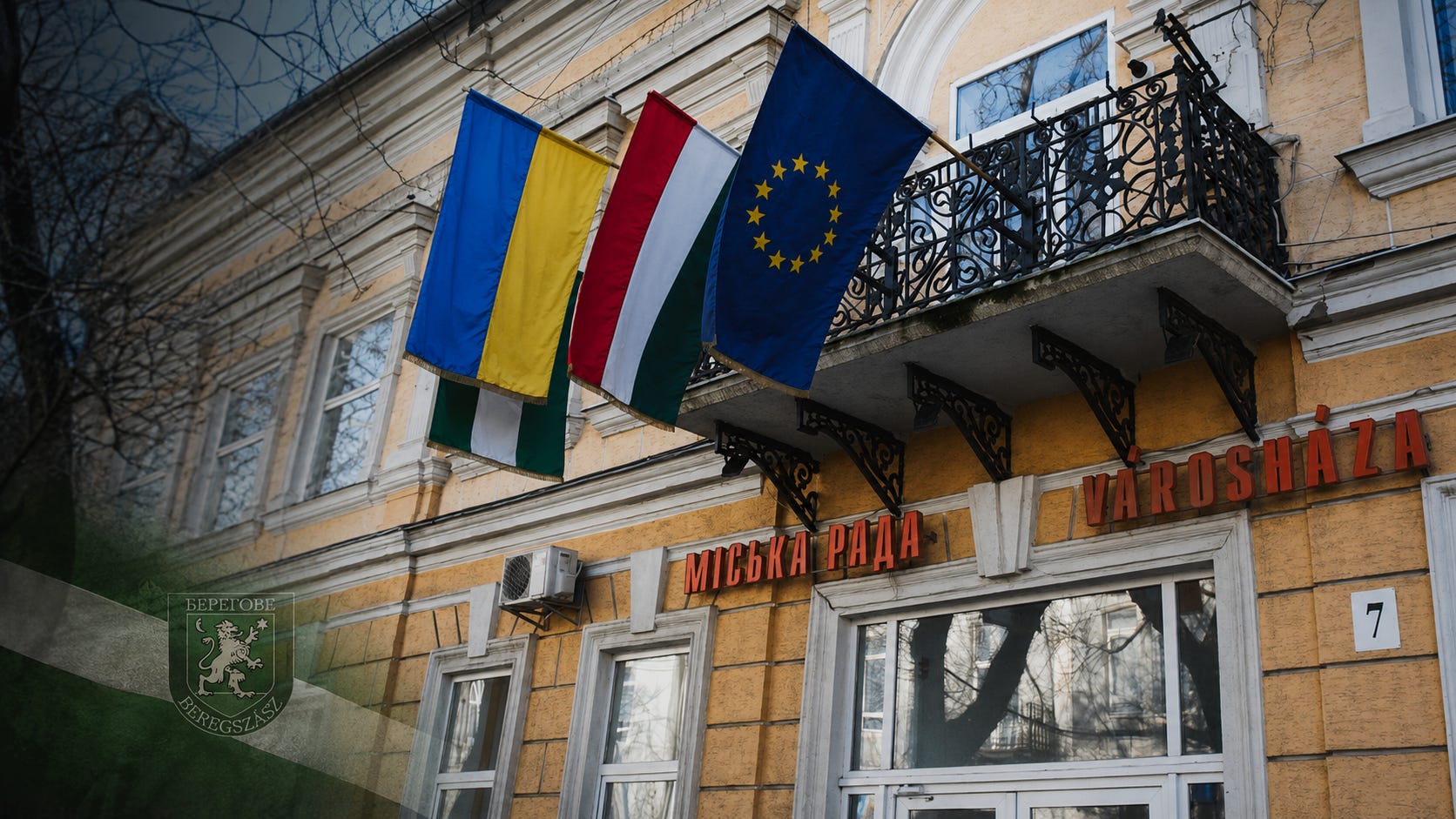
Three flags hang above Berehove’s town hall. One is Ukrainian. One is Hungarian. The third belongs to the European Union. Together, they describe the argument this town has been forced to live inside.
In Budapest, the flags are claims. In Kyiv, they are loyalties to be balanced within a country under strain. In Brussels, they become lines in a file. In Moscow, a fracture to be widened.
For those who live beneath them, abstraction is a luxury. The questions are immediate. The consequences are personal.
They keep schools open even as war empties villages and pulls families apart, the front line drawing men away and leaving parents to weigh what language their children will need to survive, whether for university, for work, for the chance of staying, or the necessity of leaving. In this uncertainty, they learn to speak Hungarian without drawing suspicion and Ukrainian without surrendering themselves, raising children in a place where history is never safely behind you.
I have not stood beneath those flags during this war. Like most Hungarians outside Transcarpathia, I know the region at a distance, through second-hand accounts and official narratives. Transcarpathian Hungarians are spoken about more often than they are heard, and their daily realities resist easy understanding.
For years, Transcarpathian Hungarians have lived inside several political stories.
In Budapest, they have been presented as proof that the Hungarian nation extends beyond Hungary’s borders and that the state has a duty to defend them. In Kyiv, they have become part of the effort to strengthen Ukrainian statehood after decades of Russification and, since 2022, a full-scale Russian invasion. In Brussels, they have appeared as one of many unresolved questions on Ukraine’s path toward European Union membership. In Moscow, they have been watched for any fracture that can be widened.
None of these stories begins where the people themselves do.
Their questions are not theoretical. Can a child learn Hungarian without losing the future that Ukrainian offers? Will a school have enough pupils to survive another year? Will the next generation remain after the war, or scatter to Budapest, Vienna, Prague? Can someone be fully Hungarian and fully Ukrainian, or must they always be asked to choose?
As we all know, Viktor Orbán claimed to defend this community from Kyiv’s language policies. He used classrooms and minority rights as tools to oppose Ukraine’s integration with NATO and the EU. While some grievances were real, Orbán ultimately turned them into instruments of his own political agenda.
The classroom he used as an argument may be better protected by the process he resisted.
The inheritance Orbán used
I grew up in a Hungarian political culture where places like Transcarpathia rarely existed on their own terms.
Zakarpattia. Transcarpathia. Kárpátalja. Even the names suggest a place claimed through different maps.
The area has had Hungarians for centuries, and borders that moved more often than most people’s homes. In 2001, around 150,000 people in the region declared themselves ethnic Hungarians. Current estimates are much lower. OSW, the Centre for Eastern Studies in Warsaw, has put the remaining Hungarian community at around 60,000 to 70,000. The Kyiv Independent has reported a broader estimate of roughly 70,000 to 80,000.
No one knows the exact number as there has been no recent census, and the war has made counting harder still, as people leave, families divide, and the sense of permanence erodes. What Budapest often treats as a fixed, symbolic community is in reality ageing, thinning out, and uncertain about what comes next.
You see the decline in schools.
Berta Katona-Mironova, principal of a Hungarian school in Nagydobrony, said in 2024 that Russian aggression had significantly reduced the Hungarian population in Transcarpathia. The war, she said, was affecting family life, private life and the local economy. Her hope was practical: peace, legal security and the possibility that those who remain would not leave after the war.
“If there is legal security,” she said, “people will feel they have a future in Transcarpathia.”
For a minority community, that can mean the difference between a school that survives and one that closes. Between Hungarian remaining a language of the classroom or retreating to kitchens, churches, and grandparents’ voices.
Orbán used this terrain. He saw that Hungarians beyond the border could be mobilised through memory, money, institutions and fear. He saw how the language of protection could slip into the logic of ownership.
I do not want a liberal Hungary that simply reverses the old reflex and treats Transcarpathian Hungarians as embarrassing leftovers from Fidesz nationalism. That is another way of not listening. They deserve better than to be owned by one side and ignored by the other.
Ukraine’s language laws brought the issue into focus.
The dispute began in earnest with Ukraine’s 2017 Law on Education. The law expanded Ukrainian-language instruction in minority schools after the early grades. The dispute continued with the 2019 state-language law, which strengthened Ukrainian in public life. Kyiv argued that minority students needed full proficiency in Ukrainian to succeed as citizens. Hungarian organisations argued that the laws narrowed Hungarian-language education, especially in secondary schools. International bodies broadly accepted Ukraine’s right to strengthen the state language. They also urged Kyiv to protect minority schooling.
Too much Hungarian commentary treated Ukraine’s language policy as if it existed only to injure Hungarians. The truth is that it did not. The same laws affected Romanians, Poles, and Russian speakers. Ukraine’s language policy after 2014, and especially after 2022, was shaped by Russian imperial violence. In a country fighting for survival against a neighbour that weaponises language, culture and passports, the state language becomes a tool of governance and national cohesion.
Wartime sovereignty does not erase minority rights, and Ukraine can defend Ukrainian while also recognising that loyal minorities should not feel squeezed out of their own schools.
Orbán left little room for balance, turning it into something that could be used for political ends.
He distilled genuine anxieties within a complex legal context into a single, simplified narrative: Hungarians in Transcarpathia were victims whose rights had been stripped away, Budapest was their only defender, and everyone else, Kyiv, Brussels, the accession process, became adversary or obstacle until Hungary’s demands were met.
Some grievances were real; the louder the politics grew, the harder they were to resolve.
One of the most explicit sentences from the region came from Zoltán Babják, the mayor of Berehove, speaking to The Guardian in 2023.
“We are citizens of Ukraine, but we want to be able to speak our native language,” he said. “We are not tourists here.”
The sentence pushes back against the roles others keep assigning. It speaks to something personal and more familiar, the feeling of belonging to more than one place at once. That kind of belonging needs space to exist without being forced into a single, simplified identity.
The school timetable is politics
A school timetable reflects political decisions in concrete form.
In Mukachevo, Pál Popovics, a teacher at the II Rákóczi Ferenc Hungarian Secondary School, described the school’s struggle under new Ukrainian-appointed leadership in stark terms. He said that after a timetable initially acceptable to staff, a new version “accidentally” omitted all Hungarian history lessons. The school pushed back. A new timetable followed. Then another dispute. The tug of war continued for weeks.
“We constantly fight, there is no cooperation,” he said, accusing the new leadership of carrying out the school’s “death sentence.”
The account came through Magyar Nemzet, a pro-Fidesz government Hungarian outlet, and should be read with that in mind. The paper has long had its own political mission, and in 2026, its daily print edition was discontinued and folded into a weekly format under Mediaworks. But even allowing for the source and its dramatic language, the dispute points to where the argument becomes real: inside a timetable, inside a school, inside decisions about which language carries history, authority and future opportunity.
It is also worth remembering that these tensions do not exist in a vacuum. Ukraine is trying to hold together a state under immense pressure, while also reshaping institutions that were long uneven and sometimes exclusionary. That does not excuse every decision, but it helps explain why implementation can be inconsistent, and why minority communities sometimes feel the strain. Hungary, too, has its own unresolved struggles with minority inclusion, including the treatment of Roma communities, where rights on paper do not always translate into equal experience in daily life.
This is why the issue has always been more serious than Orbán’s use of it allowed. By turning Transcarpathian Hungarians into a tool, he made it harder to address their concerns honestly. The politics made honesty expensive.
Under Orbán, Hungary poured money into Hungarian communities abroad, including in Zakarpattia. VSquare reported that between 2011 and 2019, the Gábor Bethlen Fund approved at least €1.1 billion in grants to Hungarian minority organisations abroad. This money supported cultural organisations, churches, schools, kindergartens, media outlets and football clubs. Some support helped real institutions survive. It also built a political infrastructure that tied minority life to the ruling party in Budapest. National solidarity became a form of control.
For Transcarpathian Hungarians, this was never cost-free. Orbán’s Russia-friendly posture heightened Kyiv’s suspicions about Hungary’s role. The Guardian reported in 2023 that there were fears in Kyiv that the Hungarian community in the west could become a smaller mirror of the Russian-speaking community in the east, with a hostile foreign power using rights claims to undermine Ukrainian sovereignty.
That fear is unfair when applied to ordinary Hungarians. It is not difficult to see why Ukraine carried it.
Orbán gave Kyiv reasons to mistrust Budapest. Local Hungarians then had to live with the suspicion.
He took people with genuine concerns and wrapped them in a geopolitical project that served him first. He did not protect them by fostering Ukraine’s distrust of Hungary. He did not protect them by making Hungarians in Zakarpattia look like leverage. He did not protect them by building a politics in which every real grievance had to pass through Fidesz loyalty before it could be heard.
A community that needed careful protection became a prop. Its complexities flattened into a single, useful story.
A reset, with caveats
Péter Magyar’s government has a chance to do something different.
In June 2026, Hungary and Ukraine reached what OSW called a “comprehensive agreement” on expanding minority rights. Reuters reported that, according to the agreement, Ukraine would restore a system of schools for ethnic minorities and allow children to use their native language in all school settings. The agreement also reportedly covers the use of Hungarian symbols and flags during celebrations, Hungarian-language exams, translation of legal acts and broader public use of minority languages.
It is progress, but the kind that only matters once it reaches schools.
The text of the agreement has not been fully published. According to OSW, while certain provisions would permit minority languages in educational settings, Ukrainian law currently mandates that core subjects such as history and geography must be taught in Ukrainian, and existing legislation allows students to take final exams in a minority language only until 2030. Further legal amendments are required to fully implement the agreement’s provisions, both by integrating them into Ukrainian domestic law and reflecting them in the country’s EU accession action plan. The Ukrainian parliament may alter or dilute specific measures.
Some rights already existed. That slightly complicates Magyar’s victory line. But more so exposes how far Orbán stretched the truth when he claimed Transcarpathian Hungarians had been left entirely without basic rights. The reality is more measured: specific educational, language, cultural and administrative rights were restricted, contested and unevenly applied, then repeatedly inflated into political symbols, most aggressively by Budapest.
For the first time in years, Budapest appears to be using the minority issue to open a door rather than slam one shut.
The strategic shift is real. Hungary is no longer treating Ukraine as an enemy to be blocked by default. Minority rights are now a problem to be negotiated inside Ukraine’s European future.
That is promising, but it should not be romanticised. It is still early days, and the gap between announcement and implementation in Ukraine can be wide. Magyar is a politician. He will want a victory line. If this becomes another Budapest slogan before it becomes a legal reality in Ukrainian schools, then nothing fundamental has changed, and the people in Transcarpathia will have been used again, only with better manners. Ukraine needs the European Union, but the European Union needs Ukraine more than it admits. That imbalance should translate into leverage for real, enforceable minority protections, not another round of symbolic politics.
The European frame
Orbán spent years pretending that Ukraine’s European future threatened Hungarians in Transcarpathia. The opposite may be closer to the truth. The future he warned against may be the one that protects them.
Without Europe, their rights depend on what Budapest can extract from Kyiv. Inside accession talks, those rights return again and again: in school law, language rules, Commission reports, Venice Commission opinions, and, finally, the instructions that reach a classroom. In practice, that can shape the subjects taught in Hungarian, the exams a child is allowed to take in her mother tongue, and whether Hungarian history is treated as a normal subject or a concession.
Ukraine does not yet meet all EU standards. It still has profound work to do on corruption, courts, media freedom, wartime civil liberties, and minority protections.
Accession also creates pressure.
That is what Orbán’s politics obscured. If Hungary wants to protect Hungarians in Ukraine, Ukraine’s European future is one of the strongest tools at its disposal. It will not save every Hungarian school in Berehove or Mukachevo or reverse demographic decline, but it can anchor minority rights in a process that demands clear commitments and real consequences.
For a child in a Hungarian school, that may sound distant. It is not. It determines whether history and geography are taught in Ukrainian or Hungarian, whether final exams can still be taken in Hungarian after 2030, whether Hungarian-language textbooks are approved, and whether a school director can schedule Hungarian history as a regular subject rather than squeezing it into optional hours.
This is one of the measures by which Magyar will be judged. He has inherited a relationship with Kyiv corroded by years of antagonism, saturated with anti-Ukraine rhetoric, and burdened by a genuine dispute over minority rights. His caution is therefore intelligible. Yet caution, if allowed to harden into timidity, risks becoming merely a more polished iteration of Orbán’s trap.
If the goal is to improve the lives of Transcarpathian Hungarians, Ukraine’s European path must be treated as part of the solution. Orbán claimed to protect them while blocking the process that could make their rights more enforceable. Magyar has a chance to break that logic.
The measure is not Budapest’s ability to claim a diplomatic victory but whether Hungarian children in Ukraine find themselves in safer schools, with clearer rights, and a credible chance to build their lives at home. The future hinges on whether departure remains the only horizon for the next generation. No speech will decide it. The outcome is decided in everyday lessons and lived experience.
Ukraine’s case for Europe should not rest on suffering alone. Nonetheless, it is a remarkable case, a country that has been fighting on behalf of Europe for many years now, resisting a larger aggressor while attempting to reform itself. That reality warrants recognition and support, but it cannot come at the expense of rights, standards or accountability. Accession should still rest on whether it can make rights, reforms and obligations harder to evade, even as Europe continues to support and strengthen Ukraine in that role.
Ukraine has not earned automatic membership, but has earned a serious path free of cynical obstruction.
Hungary shows the flaw from the inside: a member state can weaken courts, prosecutors, media regulation and public money controls at home, then use its EU seat to bargain over Ukraine’s future.
In Transcarpathia, this contradiction plays out not in Brussels debates but in classrooms, where it takes the form of a timetable in Berehove.
The Hungarians inside Ukraine’s war
Transcarpathian Hungarians are not peripheral to Ukraine’s war; they are deeply enmeshed within it.
Transcarpathian Hungarians have also served and died in Ukraine’s army. In April 2023, Telex reported that eighteen families from Transcarpathia had received emergency aid from Hungary’s foreign ministry after a relative of Hungarian nationality or Hungarian roots died while fighting in Ukraine.
This cuts through years of cheap talk. It is the cost, counted in lives.
It is easy in Budapest to use Transcarpathian Hungarians as a symbol of national grievance. It is harder to listen to a Hungarian Ukrainian soldier talking about the dead. It is easy to say “this is not our war,” as some older villagers in Zakarpattia told The Guardian. It is harder to hold that sentence beside the fact that other Hungarians from the same region have served, fought, and died in Ukraine’s army.
Both realities exist.
Some Transcarpathian Hungarians feel remote from the war in the east. Some resent Kyiv. Some admire Orbán. Some distrust Volodymyr Zelenskyy. Some want only to be left alone. Others identify strongly with Ukraine. Some fight for it. Some want their children to learn good Ukrainian because they know that without it, their future will be smaller. Some fear that too much Ukrainian in school will make Hungarian disappear. Some want Hungary’s support. Some fear becoming Hungary’s excuse.
Taken together, this is what a plural community in the 21st century should and could look like, layered, contradictory, capable of holding more than one loyalty without collapsing into suspicion. If Hungary truly wants to secure rights for Hungarians in Ukraine, it should recognise that their future is tied to Ukraine’s European path. With so many Hungarians living there, supporting Ukraine’s accession to the EU is not a concession but a practical way to anchor those rights in a system that makes them harder to ignore.
Karolina Darcsi, editor of the Kárpátalja weekly, said in a 2022 interview that many Hungarians were serving in the army and that estimates of Hungarian casualties were approaching one hundred, though no precise figure was available. In the same interview, she described Transcarpathian Hungarians as a strong community with faith and identity, one that had survived border changes, forced labour and the Soviet system.
Survival here is not a museum piece. It is not Kárpátalja embalmed in subsidies, church plaques, and speeches from Budapest. It demands a harder, less comfortable truth: Hungarians in Ukraine are not relics to be preserved but people who live, change, and claim their place without asking permission.
Budapest must stop treating every Hungarian community abroad as an extension of its own politics. Protecting minority rights cannot mean inflating numbers, spreading unverified claims, or turning local teachers and children into pieces in a fight with Brussels. It certainly cannot mean using Transcarpathian Hungarians to justify a policy that weakened Ukraine while Russia bombed it.
A Hungary that supports Ukraine’s sovereignty and defends Hungarian minority rights is what Hungarian policy should have been from the beginning.
Three flags again
In Berehove, the flags still hang above the town hall.
Ukrainian, because Transcarpathian Hungarians are citizens of Ukraine.
Hungarian, because their language and history are not foreign to the land beneath their feet.
European, because that is the future they have chosen, rightly, rather than capitulating to Russia, and they deserve respect for it, even admiration, the kind that makes you want to go there, to see it for yourself, and meet the heroes who are living that choice every day.
The ethnicity of the US is as varied as that of any other nation, or, if I may, any other "area". The Declaration of Independence and the Constitution were written in English because the majority of colonists were British. During the debates in drafting the Constitution, there was some debate about adopting a common language, but it received little attention.
There are areas in the US where Spanish is an accepted language, and with the language goes a degree of ethic "sense" and community. The current administration has unleashed a " Christian, White Man's" screed that has divided us; on the other hand, it has made many realize that we must do more to ensure equality.
There has never been a nation that is hermetically sealed from its neighbours. Even North Korea has Chinese, Japanese and Russian minorities. In the United States, Spanish, French and all manner of First Nations languages are spoken widely. Persian-speaking refugees and east Asians have cohered together in tight-knit communities, mostly in urban areas. A hundred other ethnicities have done the same.
There is, of course an apples and oranges distinction between the US and just about any European country, but the needs of any given minority inside the borders of a country that neighbours its homeland are pretty much the same. Everyone deserves a sanctioned outlet to preserve his/her identity-and that should include native language. It doesn't necessarily require a massive investment from the national government-but it should not be squelched, either.