

The Five Illusions That Kept Orbán in Power
Orbán, for years, ran on a promise of stability and reliability. After sixteen years in power, he has proved true to that promise: reliably corrupt and consistently useful to the Kremlin.

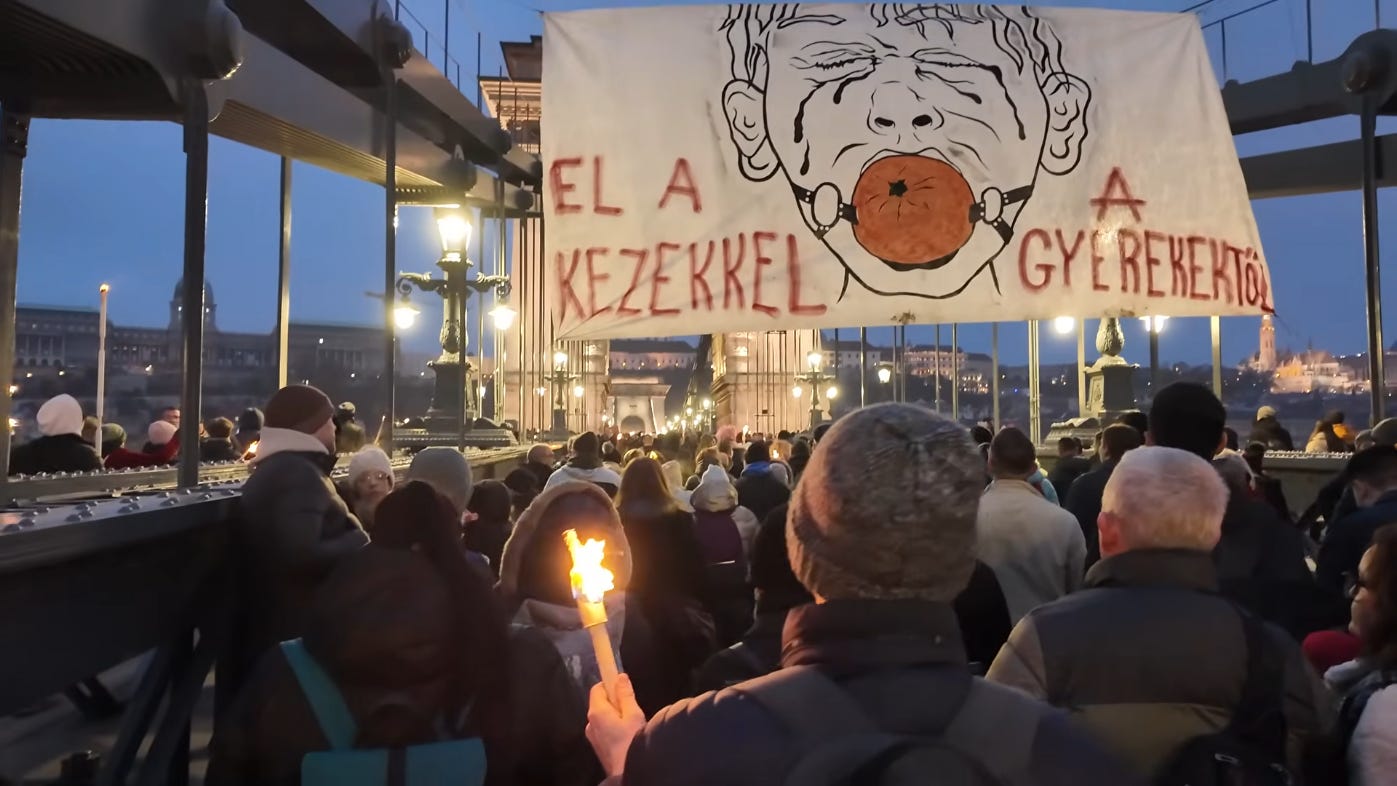
Most Hungarians never loved the regime. They believed in enough of it.
Five things, specifically. That Orbán was competent. That he stood for moral order. That he defended sovereignty. That his rule meant stability. That no realistic alternative existed.
Remove one, and the system holds. Remove all five at once, and the whole architecture comes down.
Sixteen years in power. One election left.
Tisza is polling at 58 per cent among decided voters. Fidesz is at 35. Three years of stagnation, a pardon scandal that gutted the moral brand, frozen EU billions, and crumbling public services. And a challenger who has made the unthinkable feel possible.
All five are breaking simultaneously. That is something Orbán’s system was never built to survive.
1. The illusion of competence: the trade that stopped working
Orbán survived scandal after scandal on a single argument: the corruption was real, but the results were too. That trade held for a long time.
Hungary enters this election after three years of near-stagnation. Reuters reported this week that the deficit had already reached nearly 40 per cent of the full-year target in the first two months of 2026. S&P warned that without fiscal correction, Hungary could face another downgrade.
Orbán’s whole model was a trade. Ignore the corruption. Overlook the cronyism. Tolerate the decay. In return, you get a government that knows how to run the country.
When daily life tells a different story, political theatre cannot close the gap.
Inflation and stagnation have done what years of opposition moralising could not. Hungarians are asking a question Orbán has no clean answer to: if the system works, why does the country feel stuck?
When competence no longer convinces, corruption stops looking like a byproduct. It becomes the explanation. The trade was always unfair. They just stopped noticing what they were paying.
2. The illusion of moral order: family values, until they weren’t
Orbán never sold himself as just another conservative politician. He sold himself as the defender of moral order.
Family. Christianity. Child protection. National values. Civilisational seriousness. This was not window dressing. It shaped the regime’s self-image.
Then came the pardon scandal.
In February 2024, it emerged that Katalin Novák had pardoned a man convicted of helping to cover up child sexual abuse inside a state home. With no public explanation. When the story broke, she was gone within days. Former justice minister Judit Varga, who had countersigned the pardon, also resigned from the legislature. Two resignations. One pardon. No explanation, then or since. This was the system that had built its entire moral identity around protecting children.
Voters will forgive corruption if the economy holds. They will not forgive a government that made child protection part of its political theology, then protected the man who covered for an abuser, only for further cases to surface from state-run institutions that suggest not an aberration but a pattern. With fresh revelations of abuse in juvenile detention and child-protection facilities, and child-rights groups warning of systemic violence and accountability failure, the original pardon scandal now looks less like a one-off disgrace than the first glimpse of something deeper.
The pardon affair embarrassed Orbán’s system. More usefully, it exposed fractures inside it.
3. The illusion of sovereignty: independence, built on dependency
No word did more work in Orbán’s Hungary than sovereignty.
For sixteen years, he trained Hungarians to hear it as a warning. Brussels. Migrants. Liberal NGOs. Foreign money. Outside hands on national life. He built an entire political identity around a single claim: that he alone stood between Hungary and control from elsewhere.
The contradiction is sharpest in Europe. In December 2022, the EU suspended about €6.3 billion in cohesion commitments under the rule-of-law mechanism. Orbán framed it as an assault on national independence. It was a consequence of how he had chosen to govern.
For years, Orbán tried to sell his Russia line as realism rather than alignment, but that balancing act now looks darker than before. Reuters reported this month that he had blocked a major EU loan package for Ukraine and linked his position to oil flows through the Druzhba pipeline. The Associated Press reported on Péter Magyar’s accusation that confidential EU Council discussions had been passed to Moscow, while Donald Tusk said Poland had long held the same suspicion.
Péter Magyar recently equated Hungarian Foreign Minister Szijjártó’s alleged action to “treason”, claiming he had, for years, used breaks in EU meetings to call Sergei Lavrov with live reports on what had just been discussed. At that point, the language of realism begins to collapse. What remains is a government accused of carrying Moscow quietly into the room.
The leader who built his career railing against foreign influence now stands accused of serving one. He denies it. The accusation alone is enough to corrode the brand he spent thirty years building.
4. The illusion of stability: order at the top, decay underneath
Orbán’s most consequential move was to redefine stability itself.
In Orbán’s system, stability no longer meant healthy institutions or functioning services. It meant one thing: Fidesz in charge. Everything else was secondary. Anyone who threatened that arrangement could be painted as the source of chaos.
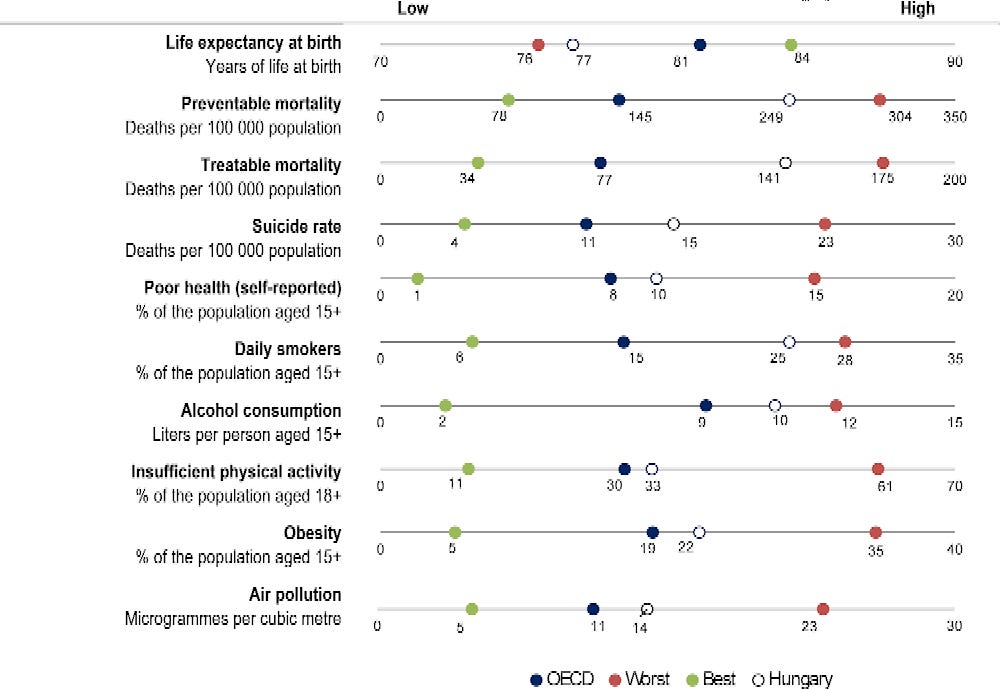
The real scandal of Hungary’s healthcare system is visible in life expectancy. Hungarian life expectancy is 4.4 years below the OECD average. Diseases go undetected. Treatment arrives too late. Hospitals face closure and collapsing ceilings. Conditions that should have been managed become fatal. After sixteen years, the body count is the policy record.
Education tells the same story. Hungary spends 3.4 per cent of GDP on education, well below the OECD average. Degree attainment remains among the lowest in the EU. The result is a generation with narrower options, thinner preparation, and lower expectations, produced by a system that was still expected to call itself strong.
Sixteen years of Orbán’s stability produced a diminished country, running below what it should be, and told that the gap was always someone else’s fault.
He presided over managed decline and called it strength. For years, that was enough. Now the hospitals, the schools and the mortality statistics are revealing the truth.
5. The illusion of invincibility: the spell that is breaking
Orbán’s greatest asset was inevitability.
For years, his system fed on a single belief: that he could not be beaten. The opposition was too fragmented, too demoralised, too broken by its own failures. Fidesz was too deeply woven into the state. Removal felt not just difficult but structurally impossible.
For a long time, the facts fed the same exhausted conclusion: that Orbán’s rule might frustrate, anger or humiliate, but it could not truly be broken. That was not apathy. It was a rational response to sixteen years of evidence.
Then Péter Magyar came knocking on the door. He was not a seasoned opposition figure. He was a former insider, the ex-husband of former justice minister Judit Varga, who walked out of the system and rebelled against it.
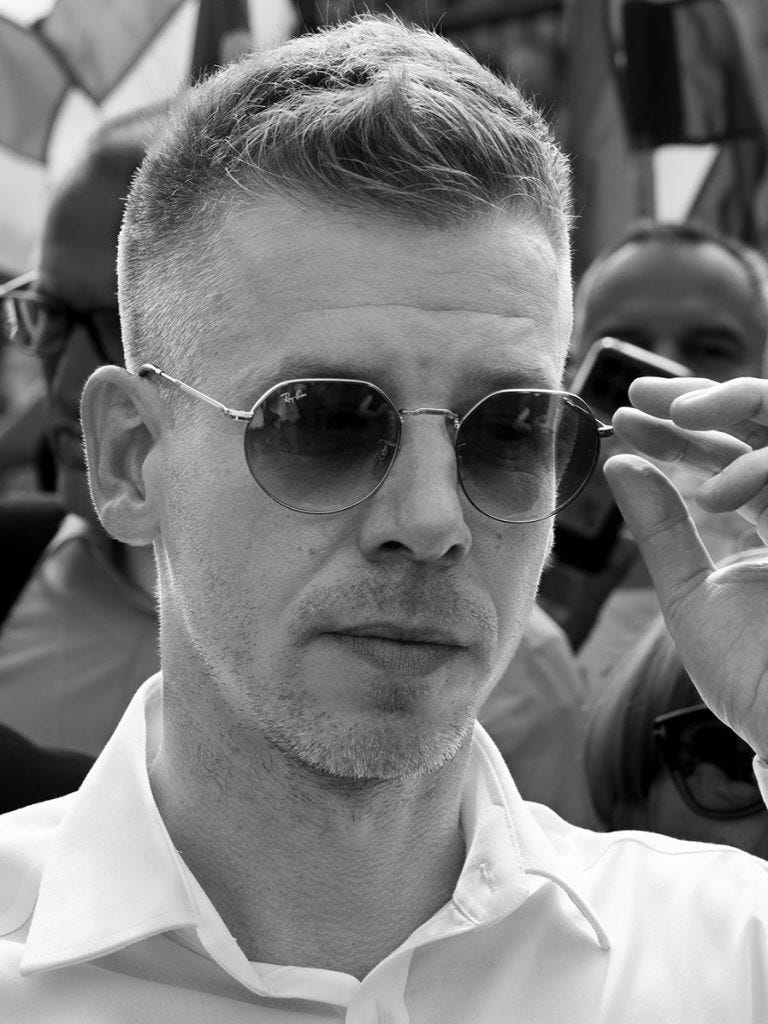
The rallies came first, in Budapest and across provincial Hungary. Established opposition parties had spent years trying to crack those places, but had failed. Magyar walked in and filled the squares. To this day, he livestreams his packed rallies across villages, towns and cities. Every previous challenger had been ground down, absorbed or dismissed. Magyar was harder to place. He was not running a party so much as channelling something the party system had never managed to reach.
In June 2024, Tisza received 30 per cent of the vote in the European Parliament election. That is not a winning number. It is something more useful: proof that the system could be pushed, that the numbers were not fixed, that the story Fidesz had been telling for sixteen years had a crack running through it.
Orbán’s machine did what it always does. It attacked. It “investigated”. It briefed against him. Leaked recordings. Personal smears. Magyar kept moving through the manufactured fog.
For the first time in sixteen years, a challenger had taken the full force of the system and was still standing. That, for a system built on the appearance of invincibility, was enough.
Orbán has survived crises before. His system is still fortified. But the thing that held it together is gone.
Authoritarian systems rule through power and through prediction. They convince everyone that the outcome is already written. Once that spell breaks, politics changes fast. Fear recedes. Tactical voting rises. Ambitious insiders start hedging their bets. The machine does not stop. But it loses something that power alone cannot replace: the certainty that it will win.
The question Hungarians were trained never to ask is now openly in the air: What does the country look like without him?
The foundation beneath all five illusions
Each illusion has a different surface. Underneath, the structure is the same.
The record does not require interpretation. Only reading.
On Transparency International’s 2025 Corruption Perceptions Index, Hungary ranked last in the EU, level with Bulgaria. In 2024, one in three public procurement procedures attracted a single bidder. The European Commission’s 2025 Rule of Law report found no progress on high-level corruption cases. Not some progress. None. Kaput.
Zero progress in sixteen years. That is a choice.
Corruption was the architecture. Every illusion was built on top of it, and every illusion eventually collapsed because of it.
It weakened competence, because loyalty replaced performance. It poisoned moral seriousness because insiders were protected. It undermined sovereignty, because frozen EU money became the price. It hollowed out stability, because no public system can be drained forever.
Corruption could not have survived this long without a second structural advantage: time. Time before the consequences land. Time before the public connects what it feels in daily life to the decisions being made at the top. Orbán built a media infrastructure designed to buy exactly that. Reporters Without Borders said in 2022 that Fidesz had seized de facto control of 80 per cent of the country’s media. State television became a production house for the government’s preferred reality. Independent outlets were starved of advertising, bought out or driven under. The strategy was never to convince everyone. It was to blur things enough, for long enough, that the full weight of the record never landed all at once. For sixteen years, it worked. In 2026, it no longer does.
The morning after
Orbán’s crisis runs deeper than the risk of losing on 12 April. For sixteen years, the story was simple: Hungary needed him. The alternatives were too dangerous, too weak, too divided. The system, whatever its flaws, held. One by one, the chapters have closed. Not because the opposition finally got its act together. Because the evidence became too large to contain.
What remains is a system running on inertia, facing a country that has started, quietly and then all at once, to imagine the morning after.
This article was first featured on The Hungary Report.