

The First Outline of Power After Orbán
Tisza’s first governing press conference was about whether Hungary can become a state again.

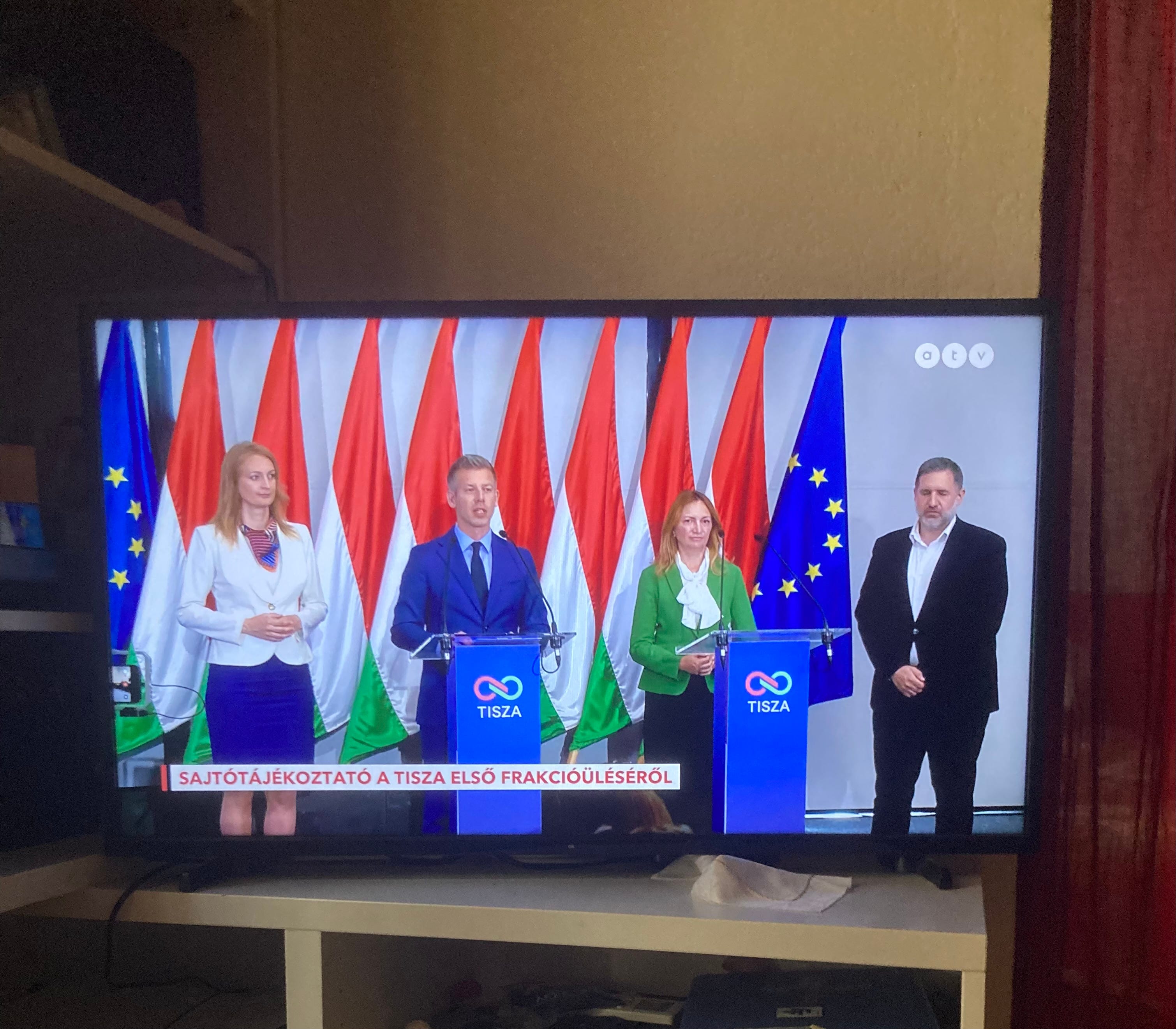
I watched Monday’s press conference in full.
It came after the first meeting of the Tisza parliamentary faction at Hungexpo in Budapest, the first time its 141 MPs had sat together as an incoming governing force. That shift from insurgency to institution is one of the hardest in politics, and Magyar was already navigating it. He used the event to announce seven ministers and a 16-ministry structure for the government he expects to form in early May, the first concrete outline of what Tisza actually intends to do with power.
On paper, it was procedural: ministers named, ministries mapped out, and an inaugural sitting projected for around 9 to 10 May. In practice, it was something rarer. For the first time in sixteen years, a Hungarian press conference was not a performance of dominance. Magyar was accounting for himself, and the answers told us more than the names.
A state that looks like a state again
The core of the announcement was the decision to scrap the Orbán-era super-ministry model, and it matters more than it sounds.
Over sixteen years, Orbán reshaped the Hungarian state to serve political loyalty rather than functional governance. Ministries were merged and reassigned according to control, convenience and patronage, leaving a state that still looked intact on paper while operating like a political distribution network. Magyar’s sixteen-ministry blueprint is a direct rejection of that model, with separate portfolios for interior, justice, education, social affairs, transport and investment, rural development, digital affairs, and a broader cultural portfolio.
“Under a Tisza government there will be no super-ministries. Every important field will have its own minister and ministry.”
When one man effectively oversees policing, education, social affairs, health and child protection, as Sándor Pintér did for years, responsibility blurs, expertise gets buried, and failure always belongs to someone else. Dividing portfolios is a statement that the state should be legible again.
Then came the names. Magyar read them out one by one, each followed by the same phrase: “and they have accepted the appointment.” The repetition was deliberate. These were presented as professionals being installed: András Kármán for finance, István Kapitány for the economy and energy, Anita Orbán for foreign affairs, Zsolt Hegedűs for health, Romulusz Ruszin-Szendi for defence, László Gajdos for the environment, and Szabolcs Bóna for agriculture and food policy.
The most important line in that section was not a name at all.
“Real professionals are being entrusted with these posts. Our MPs will be real representatives, not button-pushers.”
That line mattered because under Orbán, politics became a system for concentrating discretion and dispersing blame. Magyar was describing a government that can be read from the outside and judged.
A different political style
The institutional argument was only half of it.
Authoritarian consolidation does not happen only through laws, decrees and appointments. It happens through the normalisation of contempt, through the replacement of political conflict with ritual humiliation. Orbánism was as much a structure of manners as of power, and the manners were appalling.
That is why it mattered that Tisza nominated two women for the top parliamentary posts: Forsthoffer Ágnes for Speaker and Bujdosó Andrea for faction leader. Forsthoffer would become only the second female Speaker since 1990; Bujdosó, who noted that 44 women will sit in the Tisza faction, is set to lead the largest parliamentary group.
The strongest line from this part came from Forsthoffer:
“Debate should not be warfare, but a reconciliation of positions.”
In another country, it would sound mild, even forgettable. In Hungary, after years of parliamentary thuggery dressed up as confidence, it sounded like a manifesto.
Magyar broadened the point.
“We believe in a different style of government and a different style of parliament.”
He promised an end to night-time lawmaking, rule by decree, and legislation tailored to oligarchic interests. Within minutes, he was asking the outgoing government to extend a decree. The war emergency powers expire on 13 May, and Tisza wants them held until 31 May — not because they are useful, but because roughly 140 to 160 legal provisions are knotted around them and cannot be cut without pulling everything else loose. That is the texture of what comes next. Not liberation. Disentanglement.
How they won
Before the policy questions closed, campaign chief Péter Tóth took the floor, and the scale of what had just happened came properly into focus.
His figures demolished one of the central assumptions of Orbán-era politics: that Fidesz’s rural dominance was immovable. Tisza won 96 constituencies to Fidesz’s 10. Tóth said every internal battleground seat had gone to Tisza, that the party outpolled Fidesz in 44 per cent of Hungary’s villages, and that it won 81 per cent of the settlements visited during Magyar’s country tour, backed by roughly 50,000 volunteers and turnout close to 80 per cent.
Fidesz’s rural hold was maintained, not permanent. It collapsed when someone finally showed up. Tóth also raised the question of vote-buying and argued that many of the ten seats Fidesz retained would have flipped in a clean election. Formal complaints would not be filed because that would delay the formation of the new government, but criminal proceedings were already underway in several constituencies.
The sharpest line from this part was the simplest:
“It is not a luxury in a normal democracy that people do not cheat in elections.”
That is a serious claim and one that deserves scrutiny. Politically, it enlarges the meaning of Tisza’s victory and delegitimises what remains of Fidesz’s map without sacrificing momentum. Even in defeat, Orbán’s party is denied the comfort of a clean result. More broadly, 96 constituencies to 10 is not a swing but a realignment. The political geography that sustained Fidesz for sixteen years no longer exists.
The reckoning he is preparing
This was where the register changed.
Most post-authoritarian transitions face the same structural danger: move too slowly and the old system reconstitutes itself through the institutions it still controls; move too fast and justice starts to look like revenge. Magyar’s answer was to frame accountability as a form of restoration.
He warned that papers were being shredded and that digital records were being erased or hidden — the oldest reflex of a government that knows it has lost. Magyar urged civil servants to resist. These documents belong to the state, he said, not to the men who are leaving it. The new government would take stock of what survives, open what can be opened, and move quickly on a national asset-recovery body. What cannot be recovered cannot be prosecuted. He knew that. So did the people doing the shredding.
The line that landed hardest was this:
“Industrial-scale document destruction is under way.”
Then came the harder edge. The heads of key institutions, including the President of the Republic, the Constitutional Court, the Curia, the National Office for the Judiciary, and Attila Péterfalvi of the data protection authority, should resign by 31 May or face removal by every legal means available.
He put it this way:
“I ask them, in the interest of what remains of the rule of law and of their own reputations, not to wait for that date.”
That is cold language, and it is meant to be. Magyar is preparing the public for a transition that will not end with a handover ceremony. It will move through files, appointments, budgets, prosecutors, and institutions designed to outlast an electoral defeat.
The Bicske case sharpened the point. Magyar tied the release of the former head of the Bicske children’s home to a broader promise: that a Tisza government would investigate crimes committed against children in state care over the past two decades and examine how the outgoing system enabled them, evidence of a state that had ceased to defend the vulnerable and instead protected itself.
The line he used to mark the boundary was one of the most important in the whole press conference:
“Our task is not to exchange messages with alleged criminals, but to ensure the independence of the judiciary and the investigative authorities at all times.”
That sentence reassures, threatens, and defines: accountability is coming, and it is supposed to arrive through institutions. In sixteen years of Orbán, that last clause would have been the strange part.
Europe, the ICC, and legal seriousness
The sharpest exchange of the day came when a journalist asked whether Magyar had invited Benjamin Netanyahu to the 70th anniversary commemoration of the 1956 revolution, and how that squared with Tisza’s intention to keep Hungary in the International Criminal Court. It was a precise question, and a test of whether legal seriousness was a slogan or a principle. Orbán had invited Netanyahu while defying the ICC warrant against him, then moved Hungary toward withdrawal from the court altogether. The journalist was asking, in effect, whether Magyar meant what he said about the law — or whether the law was something that applied to other people’s enemies.
Magyar said Tisza would stop that withdrawal before the June deadline. Then came the line that cut through the room:
“If a country is a member of the International Criminal Court and a person subject to an arrest warrant enters its territory, that person must be taken into custody. I do not think I need to explain that further.”
He said he had made Hungary’s position clear to the Israeli prime minister.
He did not say Netanyahu would be unwelcome. He said Hungary would meet its legal obligations if he came. Under Orbán, foreign policy became a theatre of personal relationships in which legal frameworks were treated as irritants. Magyar offered a different theory of statehood: rules that apply even when inconvenient.
Elsewhere in Europe, that would barely register. In Budapest in 2026, it was news.
What was really announced
The press conference ended with questions on Paks II, a possible new constitution, EU funds, the budget hole Fidesz is leaving behind, media pluralism, the Druzhba pipeline, and the future of the state media system Orbán built to keep himself insulated from reality. Magyar’s answers were brief but pointed: Paks II contracts and financing would be reviewed; EU affairs would sit under the Prime Minister’s Office; media pluralism, including outside Budapest, would form part of the larger reset. The most telling line was the simplest: anyone in the civil service or business world who obeyed the law had nothing to fear. The implication being that those who had not should.
By then, the real subject had become clear: this was not a press conference about seven ministers.
It was the first public outline of how Magyar intends to govern after Orbán: with a more legible state, a more restrained tone, a promise of consultation, and a warning that the old system will not simply be inherited intact. He was speaking like a man who had inherited something damaged and was already taking stock of what was missing.
The ministers named on Monday will not fix Hungary, and neither will sixteen ministries. But what appeared in that room was the first serious attempt in sixteen years to describe a state that answers to something other than one man’s preferences. It marks the beginning of something absent from Hungarian public life for far too long: governing in public, on the record, with names attached, and with enough clarity that failure can also be named.
The organization and the accounting are the "unsexy" parts of the process, so it is good to see that Magyar and Tisza are taking the bull by the horns, so readily.
Excellent summary. Very hopeful. Thank you