



Today Hungary celebrates St Stephen’s Day, the national holiday marking the foundation of the Hungarian state.
It is also the hundredth day of the Tisza government.
Magyar’s ministers formally took office on 13 May. Count that as Day One and August 20 lands exactly on Day 100.
Exactly one year ago today, Magyar stood at Pannonhalma and described the country he hoped to govern. His Szent István Programme set out his plans for Hungary’s place in Europe and its energy security. Healthcare and education were central to it too.
One year later, he has been prime minister for one hundred days.
August 20 gives this assessment a frame I could not have planned better. Hungary is celebrating the founding of the state on the same day we can begin judging what Tisza has done with the state it inherited.
A hundred days gives us a limited kind of evidence. We can judge what the government chose to do first and whether its early commitments have begun moving beyond legislation. The long-run performance of institutions belongs to a later assessment.
Even within those limits, a surprising amount has happened.
Hungary has joined the European Public Prosecutor’s Office. The Sovereignty Protection Office has been abolished. Public media is operating under a new legal structure, while billions of euros in European funding are within reach again. Contracts signed under Fidesz have been reopened, and parts of the public-interest foundation system are being dismantled.
I have spent the past few months reporting on many of those changes individually. Put together, they amount to a substantial first hundred days.
But the change I keep noticing most is somewhere else.
Hungary feels less resigned.
I would hesitate to describe happiness as a measurable national condition without evidence to support it. What I can see is a country paying attention to itself again. People criticise appointments and sometimes the appointment changes. Government agencies publish uncomfortable figures, and suddenly there is something real to argue about. Supporters of Tisza complain when they think the party is ignoring them and expect an answer.
Politics feels possible again.
For me, that may be the greatest success of the first hundred days.
The state Tisza received
Tisza walked into government with 141 seats in Parliament, enough to amend the constitution without opposition votes.
That gave Magyar enormous power inside Parliament. Beyond it stood institutions shaped during sixteen years of Fidesz government, with senior appointments designed to survive changes of political control.
Public property had been moved into public-interest asset-management foundations with structures intended to outlast elections. Hungary remained outside the European Public Prosecutor’s Office, while disputes with Brussels had put enormous amounts of European money at risk.
The Sovereignty Protection Office was still operating.
The fiscal inheritance gave the new government little space to manoeuvre. By the end of April, before Tisza controlled the budget, the central-government deficit had already reached HUF2,930.5 billion, roughly $9.4 billion at today's exchange rate. More than 71 per cent of the planned full-year deficit had accumulated before Magyar’s ministers took office.
Public services revealed another side of the inheritance once the new ministries began looking through their own systems.
A national review found adequate cooling in only 48 per cent of the critical hospital rooms surveyed. The government initially identified 32 urgent cooling projects, then added another 25 institutions when the June heatwave exposed further failures. By mid-July, 11 projects had been completed, and new equipment was operating at another 10 hospitals. Work had begun elsewhere.
Education produced a different kind of warning. School districts had been drawing on money intended for wages and personnel costs to meet ordinary operating expenses. More than HUF27 billion, around $87 million, in additional support was required for utility bills in 2025, while thousands of teachers already at or beyond retirement age remained in the system because schools needed them.
Over the past few months, my reporting has repeatedly returned to this inheritance.
Files that had been difficult to obtain are appearing. Contracts signed under Fidesz are being opened.
Public institutions are also releasing information that previous management had resisted publishing.
That is the baseline I am using here. Tisza should be judged against the state it received on 13 May and what it has actually done with it.
What changed in one hundred days
Magyar moved on the European Public Prosecutor’s Office almost immediately.
Within two weeks of taking office, Hungary formally notified the European institutions of its intention to join. By August, accession had been completed.
That deserves significant credit, as EPPO membership had been one of the clearest dividing lines between Fidesz and those demanding greater protection for European funds.
The Sovereignty Protection Office followed. Parliament abolished it in June and its substantive functions ended on 1 July.
The government then began opening structures around public assets.
It withdrew from the Élvonal Foundation agreement associated with Nobel laureate Ferenc Krausz, which had involved HUF261.7 billion, roughly $839 million, in state funding. Other contracts have been suspended or placed under review.
The government has also ordered a broad review of 4iG’s relationships with the state.
Parliament increased transparency around private-equity funds and changed asset-declaration rules. A National Asset Recovery and Protection Office was created to investigate suspected losses of public property.
I am reserving judgement on the new office because, as of Day 100, it has no recovery record of its own. Its open leadership process attracted 96 candidates, which is encouraging, but the evidence I want next comes from actual cases.
The same discipline should apply to corruption more broadly.
Magyar campaigned with aggressive language about a “Road to Prison”. I would never grade democratic government according to the number of political opponents behind bars. The government’s role is to make records available to independent investigators and remove political obstruction. Criminal responsibility belongs to prosecutors and courts.
Tisza has filed complaints involving inherited contracts and opened several state relationships to scrutiny.
Some transparency promises have also slipped. Important documents connected to decisions of the previous government remain unavailable, while parts of the MNB asset-management record have yet to appear. Some state-security material will stay closed longer than Tisza initially suggested.
Progress is being made, but the disclosure record remains unfinished.
The European record is more transparent.
Within weeks of taking office, Budapest reopened negotiations with the European Commission over resources endangered during the Orbán period. The agreement reached at the end of May created a route towards as much as €16.4 billion.
Hungary has not yet received the full €16.4 billion.
Around €10 billion is connected to the Recovery and Resilience Facility, while another €4.2 billion concerns cohesion money held under the conditionality mechanism. The remainder depends on fundamental-rights and academic-freedom requirements.
Large sums still depend on reforms being completed.
Even with those conditions, the change since May is considerable. Hungary entered Tisza’s first hundred days outside the EPPO and facing deadlines that threatened permanent financial losses. By July, the Commission had approved the revised recovery plan and was recognising improvements in judicial governance.
The government has also begun addressing the foundation arrangements that helped exclude Hungarian universities from parts of Erasmus and Horizon Europe.
Relations with Budapest City Hall offer a smaller example of the same change.
Under Orbán, the national government and the capital spent years locked in fiscal conflict. In June, Tisza postponed immediate solidarity-contribution payments while negotiations continued, prompting Gergely Karácsony to thank the government publicly for treating the capital as a partner.
The financial dispute remains unresolved, but the relationship itself has changed.
My July reporting also followed the return of the M3 metro extension as a government-backed project with identified European financing. Karácsony called the announcement a historic day for public transport. The planned route is shorter than Budapest has wanted for decades, and construction remains some distance away, but the project now has financing attached to it.
At Pannonhalma last August, Magyar placed Hungary’s future firmly inside Europe.
One year later, that part of his programme has advanced furthest.
Rebuilding public media with the people who are there
Public media has clearly shown me that changing the law cannot resolve an institutional dispute.
The morning after the election, M1 suddenly began citing independent outlets it had spent years treating as hostile.
There was no new government or new law. The newsroom itself had barely changed.
What disappeared was the political command above it.
That moment stayed with me because it suggested that at least some journalists inside public media had always been capable of producing different coverage once direct political direction weakened. My reporting from the days after the election showed how quickly the tone changed before Tisza had even taken formal control.
We now know far more about the system in which those journalists had been working.
This week, the new management published the 482-page Narancs csíkos, or Orange Stripe, archive compiled by MTI journalists. The documents record more than a decade of internal political intervention, including stories being blocked and vocabulary being prescribed from above. Government press offices could intervene directly in coverage, while legitimate outside sources could simply be prohibited.
That is the organisation Tisza inherited.
The old M1 news operation stopped broadcasting on 7 July. Senior management changed, and internal reviews began.
Personnel now sits at the centre of the reconstruction, as many people working inside public media today also worked there under Fidesz.
I do not think firing everybody would solve that problem. My own reporting after the election showed that some of the same journalists produced visibly different coverage once political direction weakened, and an indiscriminate purge would strip the broadcaster of professional knowledge it still needs.
Management now has to identify the people who imposed political control and distinguish them from those who worked inside the institution without directing it. It also needs editors capable of establishing different professional standards.
That process has already produced mistakes.
M1 initially selected Hajdú Gábor as editor-in-chief. He had previously worked at Hír TV and Echo TV before later joining Lőrinc Mészáros’s Talentis Group.
The appointment was withdrawn rapidly after criticism.
I give Tisza credit for changing the decision. I also think the original choice showed how easily the previous media environment can reproduce itself through personnel.
Today gave us the first real piece of evidence from the rebuilt broadcaster.
The relaunched M1 Híradó included opposition positions and criticism of the government.
That is worth recording.
Today also saw an embarrassing error when President András Baka’s first presidential speech was missed live and shown later.
One broadcast tells us very little about long-term editorial independence. At least we now have output to judge.
The true standard will be revealed when the new broadcaster reports stories that could harm Tisza itself.
Politics feels possible again
The institutional changes explain only part of why I am more optimistic at Day 100 than I expected to be.
The public mood has changed too.
People who had spent years assuming that the same government would remain indefinitely are watching what happens next. Parliament attracts attention again. Public appointments can become arguments while the decision is still live.
Tisza supporters have also shown little interest in behaving like a disciplined government fan club.
Today gave us a good example.
Members of the Tisza Szigetek, the local communities that supplied much of the movement’s volunteer network, had begun complaining that communication from the party weakened once the election was over.
Márk Radnai accepted the criticism publicly. Magyar later apologised to members who felt left behind.
The response went beyond the apology.
Tisza is opening leadership positions inside the Szigetek to applications, after which members will have a role in choosing who runs the organisation. The party is also investing in local organisations and says it wants communities to provide a direct channel between government and local problems.
That sequence interests me because criticism produced an admission and is now changing how the organisation will operate.
Supporters are beginning to expect influence after election day.
Radnai described the change today in terms very close to what I have been seeing. He argued that the political transition began when citizens recovered the feeling that they themselves could influence history.
I think he is right about that much.
For a long period under Orbán, many Hungarians learned that anger rarely altered the eventual decision. Independent media could expose something serious, and the state would often continue as planned.
That certainty has weakened.
Journalists can press ministers while decisions are unfolding. People who voted for the government can criticise it and still expect to be heard.
The change is visible in public data too.
The new leadership of the National Ambulance Service released five years of response-time information that the previous management had claimed was unavailable in usable form. The figures showed that the slowest ten per cent of the most urgent responses commonly took around nineteen minutes, significantly worse than the picture previously presented to the public.
Publishing that data did not enhance any ambulance journeys.
Still, it gave Hungarians a baseline.
From here, we can see whether the service improves.
I count that as political progress because a public institution has made itself easier to judge.
That is also why I am reluctant to separate hope from governance entirely. Hope becomes politically useful when people believe their attention can produce consequences.
That belief appears to be returning.
Changes people can actually feel
I was too cautious about public services in my first assessment.
The problems remain enormous, but there is more implementation than I initially gave the government credit for.
I wrote in July about four air-conditioning units installed at the Jávorszky Ödön Hospital in Vác. They cooled the emergency waiting area and triage room.
I liked that story precisely because it was small.
Hungarian politics spent years producing enormous declarations while patients sat inside overheated hospitals. Here was something ordinary that people inside the building could immediately feel.
The national cooling programme has since moved much further. Hospitals around the country have completed projects or begun operating new equipment, while work continues at other sites.
This will not rescue Hungarian healthcare. It is still a visible improvement.
The Health Ministry has removed facial-recognition cameras that had been used to monitor hospital employees. Restrictions on journalists speaking to healthcare workers have also been loosened.
Hospital-infection data is due to become public from September.
That will give the public another benchmark against which performance can be judged.
Education has moved beyond the creation of a separate ministry as well.
Teachers have regained stronger strike rights, while school heads are being given greater authority over employment decisions.
Leadership positions across the tankerület school-district system are being opened to competition with fixed terms.
The Klebelsberg Centre will remain, although its role is shifting toward supporting schools instead of directing more of their daily operations.
There is still a great deal left undone.
The promised HUF500 billion, around $1.6 billion, in additional annual healthcare spending has yet to appear in full. Several social-support commitments have moved beyond Day 100, with the supplementary budget now expected in the autumn.
The early record is therefore mixed, although some of the first changes are already reaching hospitals and schools.
That deserves more credit than I gave it a month ago.
The first national crisis
Then Hungary ran out of rain.
June was the second-hottest June recorded in the country since national measurements began in 1901. Rainfall was 45 per cent below average, and Hungary recorded a new national temperature record of 42 degrees at Szécsény. By late July, the Danube had fallen far enough to threaten normal electricity production at Paks.
Climate change created the wider conditions.
The Paks Nuclear Power Plant inherited this vulnerability, although the plant was not wholly unprepared. Low-water procedures existed, and engineers had already begun adaptation work.
The troubling fact was that a facility responsible for such a large share of Hungarian electricity remained exposed to river levels that climate projections had made increasingly plausible.
Tisza then had to govern the situation in front of it.
Magyar repeatedly travelled to Paks and eventually moved a cabinet meeting there. MAVIR coordinated electricity imports and the wider grid response.
Water engineers worked with nuclear specialists, while military personnel and private contractors joined the operation later.
The government ordered an emergency riverbed sill near the plant and prepared two 80-metre barges.
Then the public became part of the response.
Households shifted electricity use away from the evening peak as companies rearranged production after being asked to reduce demand.
Some businesses offered materials for the work at Paks.
For several days, Hungary behaved as though the energy shortage was a shared national problem.
That was genuinely good to watch.
By August 20, the engineering intervention had produced a measurable result. Economy and Energy Minister István Kapitány said the riverbed sill had raised the local water level by around 15 centimetres.
Magyar said the idled generating capacity should begin returning from Sunday, with full capacity expected the following Thursday if conditions develop as forecast.
That makes my assessment fairly straightforward.
The first national infrastructure crisis of Magyar’s premiership threatened a much deeper electricity shortage. The system held, and the government coordinated the response well.
The public response was just as revealing.
People believed their participation could help, so they acted.
That is another reason I keep coming back to the return of political agency.
Sulyok, Baka and the people who run the state
I have reconsidered how heavily to penalise Tisza over Tamás Sulyok.
The Seventeenth Amendment ended his presidential mandate before its scheduled expiry.
Civil-rights organisations raised legitimate concerns about the procedure and the safeguards surrounding such removals. I agree that four days of consultation was too short.
Nevertheless, the circumstances were also extraordinary.
Tisza inherited senior offices whose terms had been structured to survive changes in government. The ordinary procedure for removing a president would eventually have placed the issue before a Constitutional Court overwhelmingly shaped during the Fidesz period.
I therefore treat Sulyok’s removal as a transitional intervention justified by an unusual institutional situation. The four-day consultation still damaged the government, albeit slightly.
András Baka provides a useful standard for what follows.
He has argued that exceptional measures can sometimes be justified during a democratic transition when ordinary procedures have themselves been compromised. He has also warned against using those circumstances to fill the state with loyalists.
That is close to where I land.
I think Sulyok had to leave, although the procedure could have been better.
Baka’s appointment gives me more confidence in the outcome. He is a former president of Hungary’s Supreme Court whose mandate was cut short under Fidesz, a removal that the European Court of Human Rights later ruled violated his rights.
His first public remarks as president emphasised constitutional limits and broader consultation around future reform.
One of his first personnel choices was also revealing. Baka retained István Szilveszter Timár, who had served under Sulyok, as head of the presidential office.
I like that decision because changing governments should not require replacing everybody who worked under the previous administration.
Competence should survive elections.
Magyar set out a similar principle today for the wider state administration.
Speaking to the Tisza Szigetek, he said membership of the movement should give nobody an advantage when applying for a ministry or state-company position. The government is preparing a public careers portal.
I want to hold him to that.
Hungary does not need a Tisza version of Fidesz patronage.
The appointments that follow will tell us whether the principle survives government.
Magyar also said today that Hungary will have a new prosecutor general and a new president of the Constitutional Court within days.
My first report card
I have graded Tisza against what I think a government could reasonably accomplish by Day 100. Promises tied explicitly to the opening period receive the greatest weight, while implementation counts once money has been allocated or work has begun.
Fourteen weeks cannot tell us whether the institutions created this summer will work five years from now. I have therefore graded what can actually be judged today.
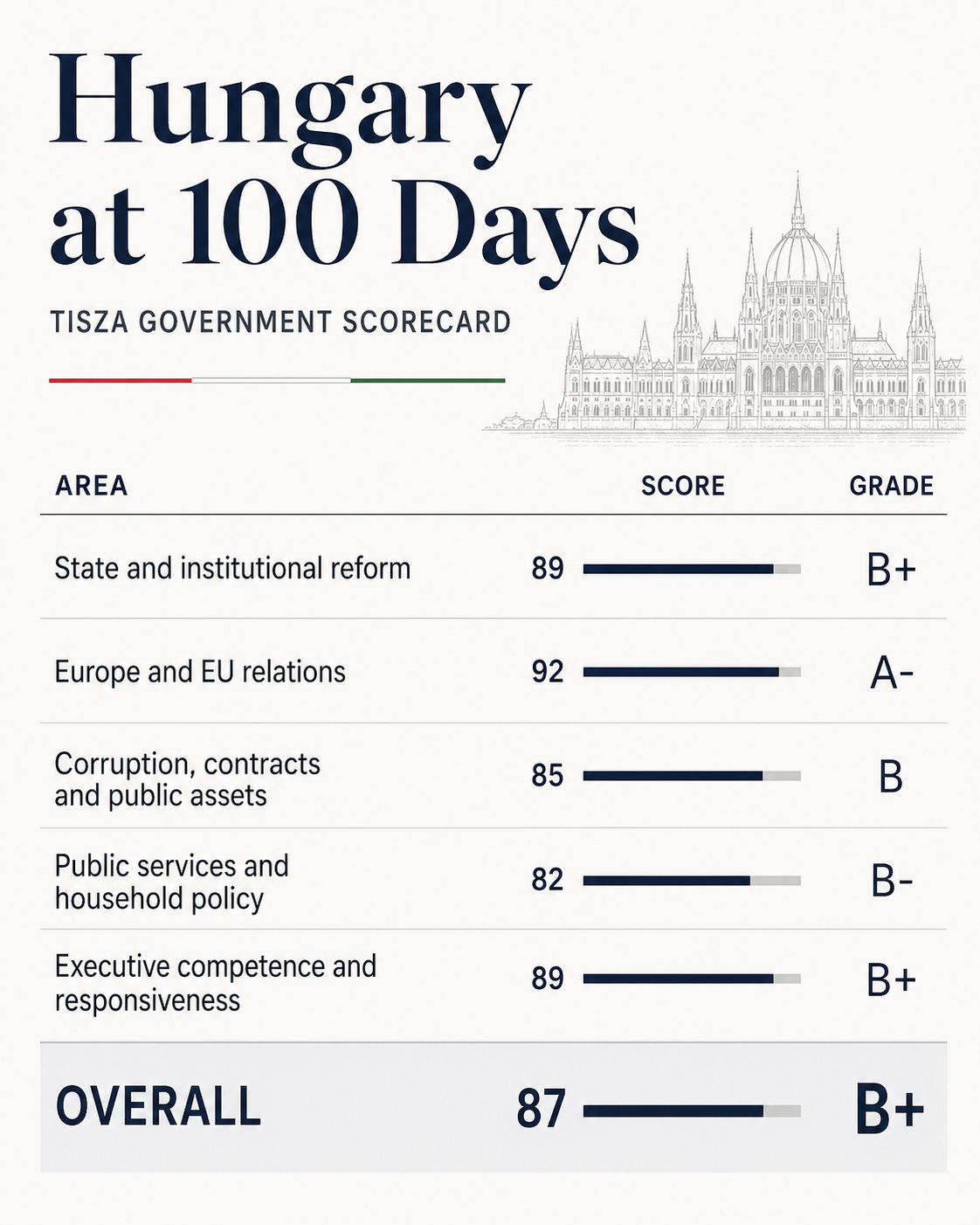
The strongest part of the record is Europe. A 92, or A-, reflects how quickly Hungary joined the European Public Prosecutor’s Office and reopened a realistic route towards €16.4 billion in European funding. The remaining conditions on that money keep it below an A, while Hungary’s EPPO membership still has to take effect within the domestic prosecutorial system.
I give state and institutional reform 89, a B+. The Sovereignty Protection Office is gone, and parts of the foundation system are being unwound. Public media is operating under a different framework as well. The Orange Stripe archive shows how deeply political control had entered the broadcaster, which is why I am reluctant to judge the reconstruction from legislation alone.
Corruption, contracts and public assets receive 85, a B. Tisza has begun reopening inherited contracts and removing barriers around public assets. Joining the EPPO strengthens that record, but the National Asset Recovery and Protection Office still has to produce its own cases. Several disclosure promises also remain unfinished. The next movement in this grade has to come from results.
The lowest score is 82, a B-, for public services and household policy, although this is the category where my view has improved most since the government took office. Hospital cooling projects are physically being completed, and ambulance performance data is finally public. School heads are regaining authority over employment decisions, with district leadership being opened to competition. The larger healthcare funding commitment remains outstanding, and several social measures have moved beyond the first hundred days.
For executive competence and responsiveness, I give Tisza 89, a B+. Paks changed my assessment here. The government encountered its first national emergency during extreme weather and kept the electricity system stable, with the engineering intervention now producing measurable results. I also give the government credit for changing decisions after criticism. The rushed constitutional consultation and today’s restrictions on press access keep it from a higher score.
Taken together, that gives the first hundred days 87 out of 100, a B+.
I think that is a strong opening record, especially given what the government inherited and how little time has passed.
But the score does not capture the change I have noticed most.
Hungary feels more interested in its own future.
People are watching the government because they increasingly expect their attention to have consequences. When Tisza supporters felt neglected after the election, they complained and received an apology. The movement is now changing how its local organisation will work.
The same instinct appeared during the energy crisis. People altered their electricity use because they believed their participation could help the country through it. Companies responded too.
None of this proves that the optimism will last. Hospitals remain under enormous pressure, and the fiscal position is ugly. Institutions rebuilt on paper can fail once political pressure returns.
Nonetheless, something has changed in the relationship between Hungarians and politics.
For much of the late Orbán period, political resignation became familiar. Scandals could be reported without changing the outcome, while institutions often seemed insulated from the people watching them.
That sense of inevitability has weakened.
Hope has therefore returned before institutional repair is complete. That seems entirely plausible after sixteen years of Fidesz government. Political damage can happen quickly, while public trust depends on seeing institutions behave differently over time.
Exactly one year ago today, Péter Magyar stood at Pannonhalma and described the state he wanted to govern.
Today, on the holiday marking the foundation of the Hungarian state, his government reaches Day 100.
Some of the laws are already different. Some public services are beginning to change with them.
The greater achievement is visible outside government.
Hungarians seem to believe again that what happens next is partly up to them.
For the first hundred days, that is the success I would value most.
Overall grade: B+.
Hungary’s Birthday Offer
August 20 is Hungary’s birthday, so I wanted to do something a little different.
I know subscriptions add up, especially when everything else has become more expensive. I also know that supporting independent writing is something people choose to do with their own money, and I never take that for granted.
So I’ve opened a 50% discount on your first year of The Hungary Report.
If you enjoy what I’m building here and want to help me keep reporting independently on Hungary, I’d be very grateful to have you as a paid reader.
Source: Magyar Közlöny; Hungarian Parliament; Tisza Party programme material and the 2025 Szent István Programme; European Commission; European Public Prosecutor’s Office; Hungarian Helsinki Committee; Amnesty International Hungary; Telex; 24. hu; 444; HVG; The Hungary Report archive and reporting since April 2026. Approximate US-dollar equivalents use the 20 August 2026 rate of HUF311.88 to USD1.