

The Fifth Floor Went Quiet
For two days after Viktor Orbán lost Hungary’s election, the political instructions stopped arriving at the state broadcaster. The journalism changed immediately.

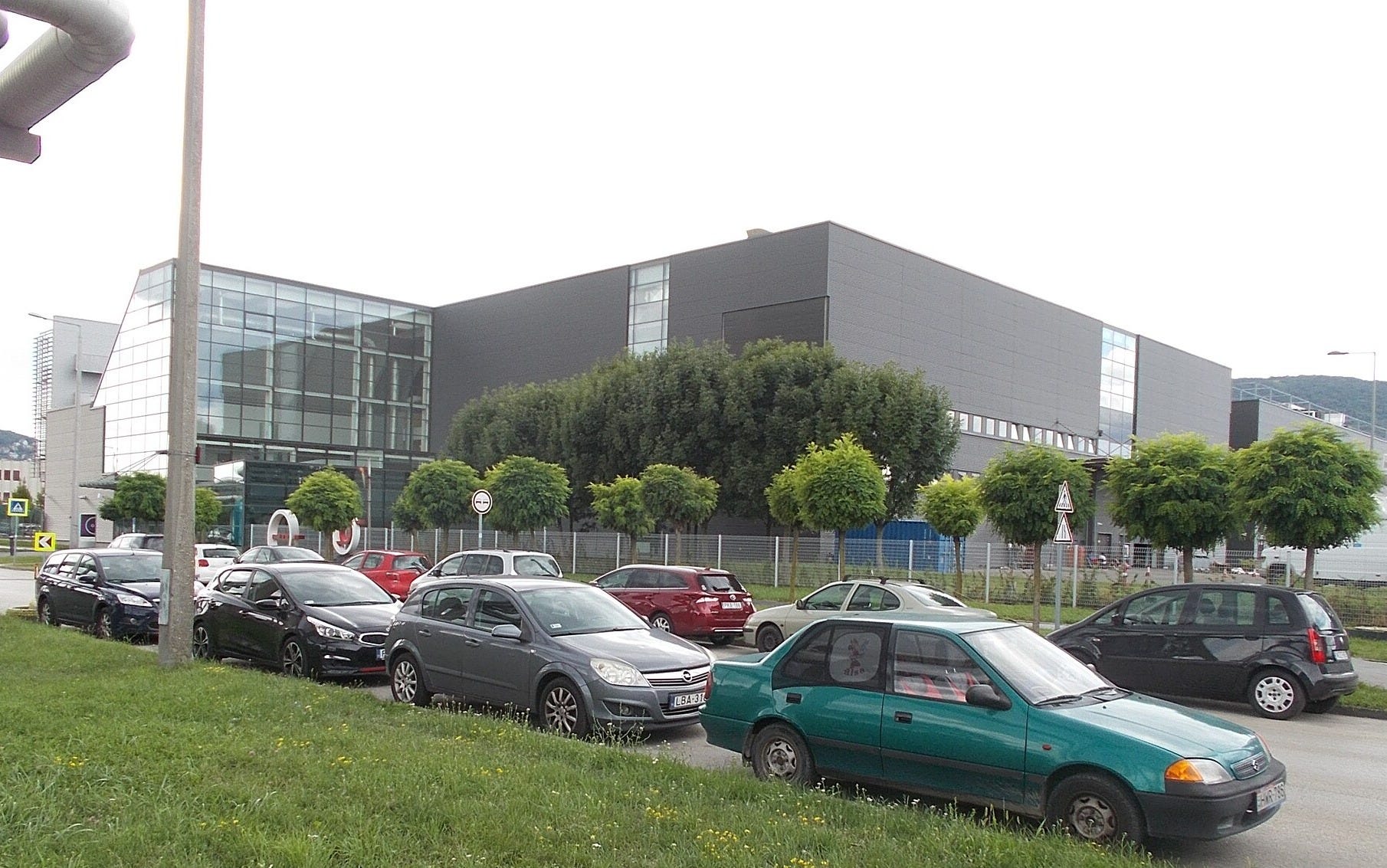
The missing floor
On Monday, April 13, the day after Viktor Orbán lost Hungary’s parliamentary election, the country’s main public television channel began citing independent news organisations.
M1 referred viewers to Telex, 444, HVG, 24.hu and Partizán, publications it had spent years ignoring, denouncing or citing only when their reporting could damage one of the government’s opponents. It carried Péter Magyar’s international press conference with unfamiliar restraint. Political statements appeared without immediate correction from a government-aligned analyst. Reports had sources. Editors seemed to be deciding what belonged in the programme.
Inside the Budapest headquarters of Hungary’s public-media organisation, employees had a name for the unseen command layer above them: the “fifth floor.”
The building has four.
According to several MTVA employees interviewed by Telex, Zsolt Németh, the director of M1, known internally as “Pitbull,” left the control centre on election night. Senior managers also disappeared. Németh was reportedly unreachable until Wednesday.
For the next two days, the usual instructions failed to arrive.
Editors who had spent years working under close political supervision found themselves choosing which stories were newsworthy and which publications could be cited. Telex reported that the confusion became so severe that outside contributors were asked to help assemble programmes.
Hungary’s public broadcaster had acquired no new management, journalists or editorial charter. The people who normally told it what to do had simply gone missing.
The programmes changed at once.
The guest
On Wednesday, April 15, Magyar arrived at the public-media headquarters on Kunigunda Street.
At 7:33 a.m., he entered the studio of Kossuth Radio, where Orbán had spent years delivering his Friday interpretation of Hungary to a largely accommodating interviewer. At 8:10, Magyar appeared live on M1.
He had last been permitted to appear on public media on September 26, 2024. During the 2026 parliamentary campaign, the broadcaster did not interview him once, despite Tisza becoming the largest opposition party and the only organisation with a serious chance of defeating Fidesz.
“There is something strange about the fact that I was last here a year and a half ago,” Magyar told the radio presenter, Tamás Kakuk L. “It took the votes and authorisation of three million people for you to let me back in.”
He then told the broadcaster what his incoming government intended to do with it.
“One of our first steps after forming the government will be to suspend the news service of this propaganda media.”
The interviews carried a peculiar tension. Orbán’s appearances had generally followed the rhythm of a government statement read aloud. Magyar faced presenters suddenly determined to demonstrate their independence, at the precise moment when aggression towards the opposition had stopped protecting the governing party.
On M1, the presenter, Bea Csete, challenged Magyar’s plan to suspend the news service. The media law, she said, required public broadcasting to provide news. Magyar replied that the same law required balanced coverage, an obligation the institution had spent years ignoring.
He accused the presenters of reading questions delivered through their earpieces and repeating allegations from government-aligned media.
Csete replied with the morning’s most revealing line.
“I have been a reporter for thirty-three years,” she said. “A reporter, do you understand?”
Her indignation exposed the problem that would soon confront the entire organisation. MTVA had operated as a coordinated political institution. Its employees continued to understand themselves as individual professionals.
Some had designed the system. Some had enforced its instructions. Some had presented its claims on air. Others edited cultural programmes, operated cameras, produced weather forecasts or remained because leaving would have cost them their livelihoods.
A broadcaster can issue a collective apology. Responsibility is not shared evenly among the people involved.
“There is no resentment in us,” Magyar told Csete, “but this factory of lies will end after the government is formed. We will suspend its news service.”
The interview produced M1’s largest audience in years. Nielsen figures published the following day showed that 5.6 per cent of Hungary’s total population watched it. Among people watching television at the time, the channel’s audience share reached thirty-six per cent. Médiapiac said M1 had not recorded a comparable result in sixteen years.
The public broadcaster had spent the campaign refusing Magyar an interview. Three days after his victory, he delivered one of its strongest ratings in more than a decade.
Afterwards, approximately half a dozen employees applauded him in a corridor. The footage circulated as evidence that the institution had welcomed its liberation. Six employees in an organisation employing thousands offered a narrower picture. Their motives remain unknown.
Magyar later claimed that a manager had filmed those present so disciplinary proceedings could follow. The allegation has not been independently confirmed.
By then, the fifth floor had returned.
Rest your objectivity
Several MTVA employees told Telex that Németh returned to work on Wednesday morning and said Magyar had to be “destroyed” so that the incoming government would collapse quickly.
The same internal accounts reported that the presenter who had covered Magyar’s Monday press conference with relative neutrality was removed from the screen and instructed to pihenje ki az objektivitást.
Rest your objectivity.
The phrase was mordant enough to sound invented. The broadcaster’s output soon supported the substance of the account.
After airing Magyar’s interviews, M1 summarised his appearance under the headline:
“Péter Magyar threatened public media inside public media.”
The institution had briefly permitted him to speak. It then converted his criticism of propaganda into a story about his hostility towards journalists.
That afternoon, Németh held a staff meeting. He reportedly told employees that nothing would change during the month before the formal transfer of power. Anyone unable to contain their feelings about the election result could take leave or reduce their workload.
A recording obtained by Telex captured employees challenging him over censorship. One journalist said government officials had discussed whether particular reports could be published and that “helpful suggestions” sometimes arrived from the level of a deputy state secretary.
Another asked why the names of Antal Rogán, Orbán’s communications minister, and Attila Várhegyi had been removed from a report that morning.
The discussion described an editorial system of names removed, stories approved, phrases prescribed and officials consulted.
More than a hundred employees of MTI, Hungary’s national news agency, then signed a letter demanding the restoration of independent and impartial reporting and the removal of Németh’s supervisory authority.
They asked to choose subjects based on news value, determine the structure of their own reports, and stop submitting copy outside the newsroom for approval.
Their demands formed an inventory of the freedoms they had lacked.
How the orders travelled
Orbán’s public media system had been built through legislation, funding, and personnel.
After returning to office in 2010, Fidesz concentrated public television, radio, the national news agency, production, assets and much of the workforce within a central structure dominated by MTVA. Duna Media Service remained the formal public-service provider. MTVA controlled most of the operational substance.
By 2026, the public media system had an annual budget of roughly 155 billion forints, or around $430 million. It operated within a much larger political media economy that included the KESMA foundation, national and regional newspapers, commercial television, radio, websites, and government-funded online personalities.
Reporters Without Borders estimates that Fidesz-linked interests still control around eighty per cent of Hungary’s media landscape.
The public broadcaster occupied a paramount position because it could give political messages the authority of the state. Private outlets repeated and expanded them.
The process was neither abstract nor especially subtle.
In November 2019, Orbán’s press chief, Bertalan Havasi, emailed Németh and asked MTI to write an article from information he had provided, with Havasi cited as the source.
“Hi, could you write an MTI news item from this, citing me as a source? Thanks!”
Documents obtained by Direkt36 showed that internal guidance also required ministry statements and announcements from companies associated with Orbán ally Lőrinc Mészáros to be published with minimal alteration. Sensitive stories were passed to senior managers who maintained contact with the government’s communications operation.
During the 2026 election campaign, emails obtained by RTL showed Németh selecting major subjects and telling colleagues to find “right-wing analysts” to discuss turnout data because, as he wrote on election morning, “only the left-wing narrative is running.”
He supplied the name and telephone number of an analyst at the government-aligned Center for Fundamental Rights who would be “definitely available.”
Another chain of messages concerned a document presented as Tisza’s energy plan. Editors were told to make it a central subject and use the phrase “Tisza energy plan” consistently. The resulting coverage associated a future Magyar government with fuel shortages, rationing, the end of household energy subsidies and economic damage.
Analysts were then invited to discuss the consequences of a premise generated by the same political communications system that arranged their appearance.
The mechanism was circular and effective. A political claim became a news subject. The public broadcaster gave it official weight. Aligned analysts confirmed its seriousness. Private government media repeated the conclusion.
The system also controlled attention through silence.
Magyar received no public media interviews during the campaign. Opposition events were reduced or excluded. Government scandals disappeared quickly. According to internal sources, independent publications could be placed on lists requiring special permission to cite, then quoted freely when their reporting could be turned against Tisza.
The government’s account arrived first and returned most often, backed by public money.
The private network
Orbán’s defeat disturbed the wider propaganda economy before Magyar’s government passed a media law.
Megafon, the lavishly financed operation that trained and promoted pro-Fidesz online personalities, assured employees on election night that its work would continue. It soon carried out a group redundancy affecting close to sixty people, emptied its offices and sold its furniture. Media1 reported that the organisation’s final employee was due to leave at the end of June.
Mediaworks announced that Magyar Nemzet and twelve county newspapers would stop appearing as daily print publications and become weeklies from August 1.
Prominent staff left Mandiner. Origo replaced its editor-in-chief. TV2 announced that it would retire the name of its long-running news programme, Tények, meaning “Facts”, and replace it with a new format.
The precise financial picture remains incomplete. Existing contracts, allied owners and Fidesz-controlled foundations may sustain parts of the network for years. The speed of the cuts was consistent with a system facing the loss of political protection and state-directed revenue.
Hír TV continued broadcasting throughout the transition. When M1 later suspended its news service, Orbán directed supporters there.
The public broadcaster could be reorganised through legislation. The private network would have to be confronted through ownership, competition and money.
The slow shutdown
Magyar’s promise of an immediate suspension proved harder to carry out than it had sounded in the studio.
On May 18, the government began a full audit of MTVA, examining its contracts, finances, procurement, management decisions, employment practices and editorial operations. Magyar later acknowledged that restructuring public media could take weeks or months.
Dániel Papp, MTVA’s chief executive, resigned on June 5.
On June 23, Parliament adopted a fifty-four-page amendment to the media law. The legislation ended the mandates of the existing public-media leadership and Media Council and began replacing the MTVA-Duna structure with a new Hungarian Radio and Television company and a separately constituted Hungarian News Agency.
It also established an Independent Public Media Board. Government parties would nominate three members, opposition parties another three, and professional media organisations the remaining three. The board would supervise editorial independence, finances and high-value contracts.
The architecture improved on the structure it replaced. It also left political parties responsible for selecting six of the board’s nine members. The president of Hungary’s main journalists’ association argued that professional representatives would need a majority to provide a credible guarantee of independence.
The process had another weakness. The government had promised broad professional consultation. The legislation arrived before that consultation took place. Judit Grósz, the commissioner responsible for the reform, described the law as a rapid and necessary institutional measure and promised a wider consultation before further changes in the autumn.
The European Media Freedom Act requires transparent, objective procedures for appointing public-service media leaders, protection against arbitrary dismissal, and adequate, predictable funding. The permanent Hungarian structure will eventually be judged against those requirements. For now, the transitional process has depended heavily on the authority of the new parliamentary majority.
On July 2, Parliament’s cultural committee appointed the lawyer András P. Horváth as interim chief executive of MTVA and Duna Media Service. Horváth had no public media experience. His task was legal and financial: to audit the organisation and prepare its replacement.
The committee voted without questioning the candidates in person. Tisza members said the appointment had to proceed quickly because the organisation and its broadcasts needed functioning leadership. Fidesz and Mi Hazánk members criticised the speed and lack of scrutiny.
The following day, Horváth centralised external communications and halted most payments and investments beyond everyday operations pending review.
On Tuesday, July 7, Horváth arrived at the headquarters with an interim management team. Németh was relieved of his duties. Other senior executives, editors, and presenters were summoned to human resources or removed from their roles.
Public reporting identified several of those affected. No individual criteria were published alongside the announcements.
The apology
At four o’clock that afternoon, the advertising block before M1’s scheduled news bulletin ended.
The news did not begin.
The screen turned black. White text appeared:
“Public media must not lie. We apologise for having done so for many years.”
The message promised that the broadcaster would be renewed as an independent and credible service. News programming, it said, was temporarily suspended.
The same notice appeared on Hirado.hu. Kossuth Radio began carrying classical music from Bartók Radio.
Magyar called it a historic day.
“They lied at night, they lied during the day, they lied on every wavelength. That is now over.”
Orbán called the suspension another example of “Tisza tyranny” and told anyone interested in “the truth” to watch Hír TV.
The screen remained black until 7:56 p.m. M1 then resumed broadcasting Péter Bacsó’s The Witness, a 1969 satire of Hungary’s Stalinist dictatorship that remained censored for years after its release.
The choice appeared intentional, preserving just enough plausible deniability to pass for programming.
One of the film’s best-known lines is uncomplicatedly relevant:
“The facts are stubborn things.”
Who was “we”?
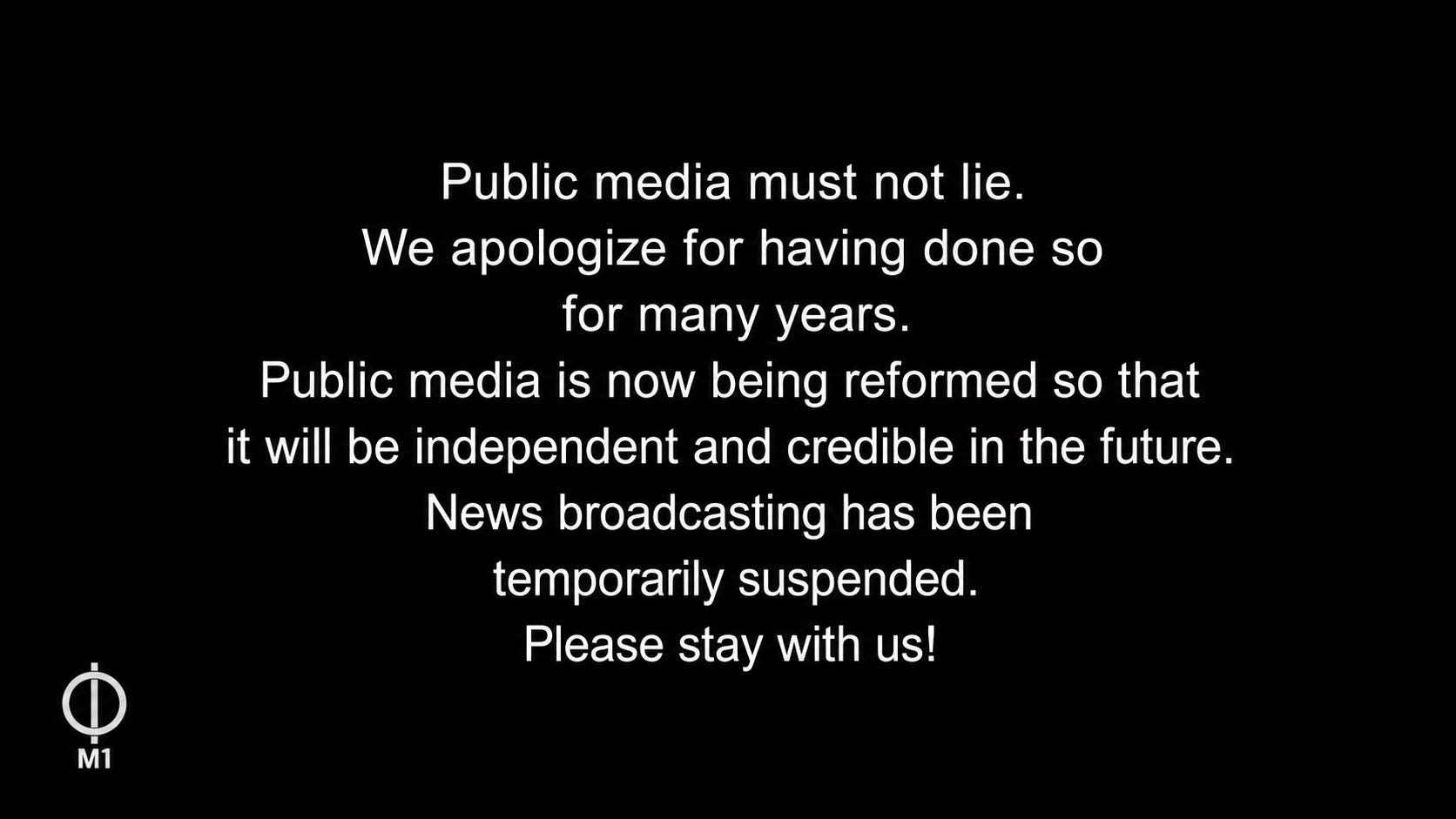
The black screen offered a clean image of rupture.
“We apologise.”
Who was included in that pronoun?
The managers who transmitted political instructions? The editors who converted them into running orders? The presenters who delivered them? The MTI employees who demanded editorial independence? The technicians and cultural producers who had little influence over political coverage?
The apology spoke for thousands without explaining who wrote it, who approved it or what evidence would guide the treatment of individual employees, even as the Hungarian public yearns for specifics of the propaganda machine.
Within days, news began returning in limited form. M1 carried a text ticker, and short radio bulletins resumed. Live political programming and Kossuth Radio’s established schedule remained suspended.
The transition was still operating through temporary instructions.
When the picture returns
The most revealing episode came before the audit, the legislation, the dismissals and the apology.
It came during the two days when the fifth floor disappeared.
The same journalists remained at the same desks. They used the same cameras, studios and editing systems. No new board had been appointed. No editorial charter had been written.
The instructions stopped arriving, and the journalism changed.
Hungary now has to build a public broadcaster capable of preserving that freedom when the fifth floor is occupied again.
All translations from Hungarian are the author’s.
I wonder when America will have unedited free news again? I have not watched local media for years. Waiting to see what happens after November’s elections.🇺🇸🇭🇺
The same internal accounts reported that the presenter who had covered Magyar’s Monday press conference with relative neutrality was removed from the screen and instructed : Pihenje ki az objektivitást.
Rest your objectivity.
Maybe -- "Give objectivity a rest".