

The Etiquette of Appeasing Trump
How Europe learned to manage Trump by flattering him.

I am Hungarian, but I have always felt perhaps more European than anything. For me, that identity has never been primarily about nationality or symbols. It has meant escape and freedom. Escape from the daily strongman politics, freedom from the language of resentment, from the demand that citizens mistake obedience for patriotism.
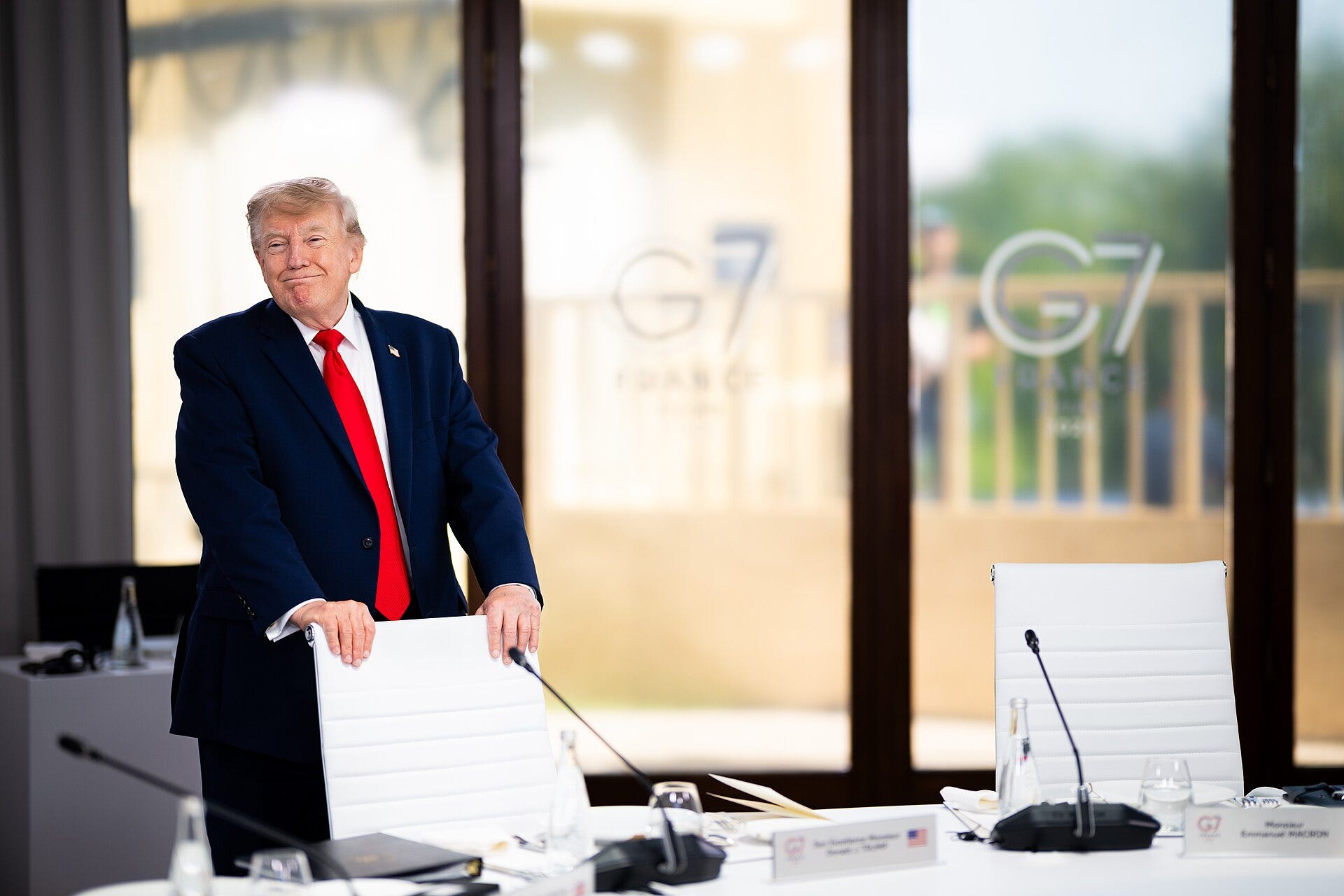
So when I watched the G7 gather in Évian this week and speak in the name of the democratic world, I expected to recognise something of my Europe in it.
I did not. What I witnessed was a Europe performing with confidence while accommodating a man whose politics embody many of the dangers it claims to oppose.
The G7 is supposed to be many things. It is an informal club of the world’s leading advanced democracies, Canada, France, Germany, Italy, Japan, the United Kingdom and the United States, with the European Union at the table as well. It has no charter, no permanent headquarters, no grand constitutional mechanism. Its authority comes from something more fragile, the idea that the world’s richest democracies can coordinate policy, confront crises and defend a shared political model.
Its mission sounds straightforward enough. The G7 presents itself as a forum where the world’s leading democracies can work together to preserve stability, respond to crises and uphold the political values they claim to share.
In theory, it is where democratic powers gather to demonstrate that democracy can still govern itself.
In Évian, it often felt more like a support group organised around the emotional needs of one participant.
The summit was presented as a display of democratic confidence. When leaders gathered in France from 15 to 17 June, they moved through an agenda crowded with the crises and challenges shaping the international order, from Ukraine and Iran to economic security, artificial intelligence and migration. Yet the message was less about any individual issue than about the image of control itself. Everything about the setting was designed to reassure. Power appeared composed. Cooperation appeared effortless. The democratic world appeared capable of absorbing every shock pressing against it.
Then the scene narrowed around Donald Trump.
The contrast was almost comically sad, the kind that leaves you shaking your head in disbelief.
I watched a forum designed to coordinate the world’s leading economies become increasingly occupied with managing one man’s moods. What was supposed to be a gathering of democratic leaders defending democratic norms seemed reluctant to speak openly about attacks on those norms when they came from the most powerful person in the room. Sitting there as an observer, I often had the impression that an institution founded on collective leadership had accepted a supporting role in someone else’s one-man show.
I do not expect European leaders to insult a US president to make people like me feel better. Diplomacy is not therapy. The reality is that Ukraine still relies on military assistance, while Europe’s security architecture remains deeply intertwined with US power. Across the Atlantic, trade routes, energy networks and defence commitments have been woven together over decades, creating a relationship that cannot simply be set aside because one man is troubling or unpredictable. Foreign policy unfolds within these constraints, where governments are often forced to navigate uncomfortable realities rather than act on principle alone.
What troubled me was something else.
I watched European leaders bend themselves around Trump in ways that felt deeply familiar and deeply unsettling. As a Hungarian, I have seen what happens when powerful people become the centre of political life, and everyone else starts adjusting their behaviour accordingly. What unsettled me in Évian was the choreography of it all. Conversations, statements, even the symbolism seemed to orbit around one man’s moods and reactions. I know that atmosphere. Hungary has lived in it for years. It is the feeling that settles over politics when people stop asking what is right and start asking what will keep the dominant figure satisfied.
I know I sound like a broken record on this point, but authoritarian politics rarely arrive through a dramatic break. They creep in. Behaviour that once shocked people becomes familiar. Conduct that once would have been condemned is now attracting explanations and excuses. Institutions adjust. Public language becomes more careful. People learn which truths are costly to say aloud.
After a while, adaptation stops feeling like adaptation.
That was what made Évian uncomfortable to watch. Trump did not arrive as an unknown quantity or a difficult partner whose character was still open to interpretation. His approach to power has been visible for years. He has repeatedly treated courts, elections, journalists and constitutional limits not as essential democratic safeguards but as obstacles to be overcome. Loyalty to him has often mattered more than loyalty to institutions, while public humiliation has become a tool of political dominance rather than an occasional excess. The leaders gathered in France knew all of this. The question hanging over the summit was not who Trump was, but how much of that reality would be confronted and how much would simply be folded into the rituals of diplomacy.
From where I stand, that felt familiar.
I am not claiming that the US is Hungary or that Trump is Orbán. Comparisons become useless when they are stretched too far. What I recognise is a political style.
Orbán understood Trump immediately because he recognised something he already knew. For him, Trump represented the arrival of a political language that had already reshaped much of Hungary. The idea that institutions exist to serve power rather than restrain it no longer seemed confined to Europe’s margins.
Most European leaders in Évian do not share Orbán’s worldview. Their approach to Trump comes from a different place. They are dealing with a president who controls resources Europe still needs. From the perspective of an ordinary citizen, the distinction can be difficult to see. Motives differ. Public performances often look remarkably similar.
Versailles seized that sensation for me.
After the summit, Macron hosted Trump for dinner there. AP reported that Trump signed the Iran agreement at Versailles and later remarked, “We signed in Versailles.”
Again, the symbolism was difficult to ignore here.
The G7 is supposed to be a forum where democracies coordinate collective action. Instead, one of Europe’s most famous palaces became the backdrop for a story about Trump celebrating a deal after his own policies helped destabilise the region, after a confrontation with Iran that brought the Middle East to the brink of a wider war, and after a conflict that left civilians dead, including children. Many argue the region is now less stable than before. The spectacle in Versailles focused overwhelmingly on Trump and the agreement itself. The attention centred on his role in signing the deal, discussing its significance, and highlighting the setting in which it was concluded.
One almost expected the final communiqué to thank gravity for continuing to orbit around him.
The dinner itself was not the issue. Diplomacy depends on meetings, ceremonies and personal relationships. What lingered was the impression that Europe still believes the safest way to handle Trump is to elevate him.
The language surrounding the summit reinforced that impression. Reporting from Évian said G7 leaders credited the Iran breakthrough to the “strong leadership of President Trump” and referred to progress because “President Trump has delivered a deal” on Hormuz.
Such phrases are never accidental.
The G7 exists partly to demonstrate that democratic governance is larger than any individual leader. Whereas the communiqué often seemed to place disproportionate emphasis on Trump’s role rather than presenting the outcome as a collective achievement of seven governments.
Trump embraced the role immediately.
There was a smaller scene at Évian that captured the same dynamic almost too neatly. Friedrich Merz presented Trump with a German national football shirt bearing his name and the number 47, a reference to his position as the forty-seventh president of the United States. The gesture was dressed up as friendly diplomacy. Perhaps that is all it was. I find myself increasingly tired of watching European leaders discover, again and again, that Trump can be wooed with gifts, flattery and small symbolic offerings to his self-image.
According to the Guardian’s live coverage from Évian, Trump described the summit as an opportunity to discuss what he called his historic Iran agreement. He suggested Europe should “find its way” on immigration and energy. He warned that the United States could resume bombing Iran if the agreement failed. Speaking about Ukraine after conversations with Volodymyr Zelenskyy and Vladimir Putin, he offered only the vague assurance that “something is going to happen.”
Listening to him, it was difficult to escape the sense that the summit had become another stage on which he could perform his preferred role.
After the summit, Giorgia Meloni’s response to Trump made me wonder, even to someone like me who agrees with very little of her politics. After Trump reportedly claimed that she had begged him for a photo and that he agreed out of pity, Meloni called the story false and said that neither she nor Italy begs. Fair play to her. Perhaps it was a small moment, but a revealing one. Around Trump, many leaders behave as though the safest course is to smile through the lie and move on. In this instance, Meloni did not. She refused the humiliation ritual. In the middle of all the careful choreography, that refusal had more dignity than much of the summit diplomacy around it.
The word appeasement inevitably enters discussions like this. Évian was not Munich, and Europe was not handing territory to a dictator. Still, it is hard not to smile grimly at warnings against historical comparisons when Trump himself, after being compared to Hitler and Mao, recently replied, “Sounds good to me,” while remaining the elected president of a country on which Europe still depends in important ways.
Still, the discomfort behind the term should not be dismissed. What happened in Évian reflected a habit of accommodation that has become increasingly visible whenever European leaders deal with Trump. Europe has seen this instinct before. For years, many governments convinced themselves that engagement with Putin could moderate his behaviour, that economic ties would encourage restraint, and that difficult realities could be managed through careful diplomacy. The result was not stability but a growing willingness to overlook warning signs until they became impossible to ignore. I am not implying that Trump and Putin are the same; it’s like picking between two rotten apples. But the underlying temptation feels familiar, the belief that uncomfortable truths can be softened through accommodation. Each individual concession may appear reasonable in isolation. Over time, however, they begin to form a pattern that is harder to dismiss.
The diplomats involved can point to tangible achievements. They should. The summit produced stronger commitments on Ukraine. AP reported that G7 leaders pledged additional support for Ukraine’s air defences, energy resilience and economic pressure on Moscow. Macron argued that engagement with Trump had helped move Washington closer to Europe’s position. The Iran agreement may also have reduced the risk of another crisis in the Gulf.
Those outcomes cannot simply be brushed aside. If praise helped secure greater support for Ukraine, more air defences, more funding, and greater pressure on Moscow followed. If diplomacy reduced the likelihood of conflict around Hormuz, that meant fewer risks for a region capable of sending economic and security shocks far beyond the Gulf. International politics often involves choosing among imperfect options.
However, successful tactics can reveal deeper problems.
My worry after Évian is not whether Europe should work with Trump. It has little choice. From my perspective, the deeper concern is what repeated accommodation does to Europe’s own political language. A continent that spends years warning about authoritarian tendencies cannot indefinitely soften its public vocabulary whenever those tendencies appear inside the Western alliance itself.
What struck me most while researching this article was how far the summit seemed from public opinion.
Across Europe, views of Trump are bleak enough that the summit’s tone felt detached from the public mood. A 2025 Pew survey across 24 countries found that only 34 per cent of respondents had confidence in Trump to do the right thing in world affairs, while 62 per cent had little or none. Hungary was one of the few countries where a majority expressed confidence in him, which says something about the political exception I come from.
Europeans do not need persuading that Trump poses a problem.
Other European polling points in the same direction. A nine-country survey found that nearly half of respondents saw Trump as “an enemy of Europe,” even though 48 per cent still believed the EU should pursue compromise with the United States. Europeans are not asking for a childish rupture. They recognise the need for cooperation while refusing to pretend that Trump is a conventional ally.
The deeper shift is about the United States itself. Guardian coverage of ECFR’s 2026 polling reported that only around one in ten Europeans surveyed still saw the United States as an ally sharing Europe’s interests and values. Many still viewed it as a necessary partner.
A necessary partner is not the same thing as a trusted ally.
That is the gap Évian exposed.
European publics seem more willing than their leaders to speak plainly about Trump. They understand that cooperation may be necessary. They also understand that necessity does not require admiration, celebration or carefully choreographed displays of deference.
Public opinion should not dictate foreign policy. Democratic leaders still need to remain connected to the political realities their citizens can plainly see.
That connection felt absent for me in Évian.
What bothered me was not a single statement or photograph but the atmosphere surrounding the summit. The praise felt calculated, the criticism subdued, and the overall impression was that Europe had accepted the need to translate Trump’s impulses into something manageable before presenting the result as stability.
I recognise that atmosphere excessively well.
It emerges when people become accustomed to living around a dominant political figure, as language slowly shifts, expectations adjust, and what began as accommodation gradually acquires the respectable label of realism.
Europe should stop treating Trump’s ego as a condition of cooperation.
The deeper issue is dependence.
Europe is not powerless. It is wealthy, technologically advanced and home to hundreds of millions of people. Yet much of its security architecture still runs through Washington. NATO reports that European allies and Canada spent more than 574 billion dollars on defence in 2025 and that every ally met the old 2 per cent spending target. Even so, Europe continues to rely heavily on US capabilities. Deterrence, intelligence, logistics and strategic coordination remain deeply intertwined with the United States.
The same reality appears in Ukraine. Europe dramatically increased its support in 2025, largely compensating for a reduction in US involvement. EU institutions and member states have committed around 200 billion euros, including more than 75 billion euros in military assistance. The European Commission has already disbursed over 43 billion euros in macro-financial support and plans a further 90 billion euros in loans for 2026 and 2027. These commitments are substantial. They also illustrate why European governments remain reluctant to risk a complete break with Washington.
Trade reinforces the same caution. The EU-US economic relationship remains enormous. Goods and services worth around 1.7 trillion euros crossed the Atlantic in 2024, an average of 4.6 billion euros a day. Against that backdrop, Europe’s restraint becomes easier to understand.
For years, leaders spoke confidently about strategic autonomy. Trump has exposed how incomplete that project remains.
The summit revealed a Europe that still hesitates to act on its own judgment when dealing with Trump. The hesitation is understandable. It is also damaging. Every time democratic leaders dilute their language to accommodate someone whose politics openly challenge democratic norms, they weaken the credibility of their own warnings.
For me, that concern is personal.
I have watched institutions retain their formal structures while their purpose quietly changed. I have watched citizens encouraged to accept domination as a matter of pragmatism. I have watched democratic language survive long after democratic confidence had faded.
Europe was supposed to offer something different.
What Europe now needs is the capacity to act with greater confidence. That means investing seriously in defence, sustaining support for Ukraine and reducing vulnerabilities that make deference seem necessary.
Above all, it means speaking honestly.
Trump represents a political tradition that treats democratic limits as inconveniences and views public life through the lens of personal power. If European leaders recognise that reality in private but avoid acknowledging it in public, the problem extends beyond Trump himself. It begins to shape Europe’s own understanding of democracy.
Évian was presented as a summit of democratic coordination. What I saw was a continent struggling with the consequences of its dependence. Its leaders know who Trump is. Their citizens know who Trump is. Still, the summit seemed organised around the need to keep him cosy.
That is not the Europe I want to belong to.
The Europe I believe in can be cautious and pragmatic. It can work with difficult partners. It can recognise constraints without surrendering its voice. Democracy is not defended only through declarations and communiqués. It is also defended through the willingness to describe power honestly.
The G7 did not leave me thinking that Europe had embraced Trump.
It left me wondering whether Europe has become too accustomed to accommodating him.
Europe knows what Trump is. Évian showed that it still does not know what to do with that knowledge.
And perhaps that is the most unsettling irony of all.
The G7 was created because democracies believed that, together, they could shape events rather than merely react to them. It was supposed to be a forum for collective leadership, not collective management of a single leader. It was supposed to defend democratic values, not tiptoe around attacks on them. It was supposed to demonstrate confidence in liberal democracy, not reveal how dependent that confidence remains on Washington’s approval.
The summit discussed economic stability, geopolitical crises, artificial intelligence, migration and security.
Contrarily, for me, the strongest impression it left was that seven advanced democracies and the European Union had gathered in one of Europe’s grandest settings and spent much of their energy ensuring that one man left feeling respected.
That may be diplomacy.
But it leaves a sour taste behind.
From across the Atlantic, it looked a little different. I saw Trump isolated and ignored as business was conducted around him, challenged in his misogynistic lie that the Italian PM "begged" for a photograph. In the choreography of the conference room, what I felt I was witnessing was a collapsed power being sidelined, ignored, and left behind.
Jesus GOD, you write well