

The Audition to Become Europe’s Next Orbán
Orbán gave Europe’s nationalist right proof that its politics could govern. His defeat leaves a more awkward question: who can make the trick work now?

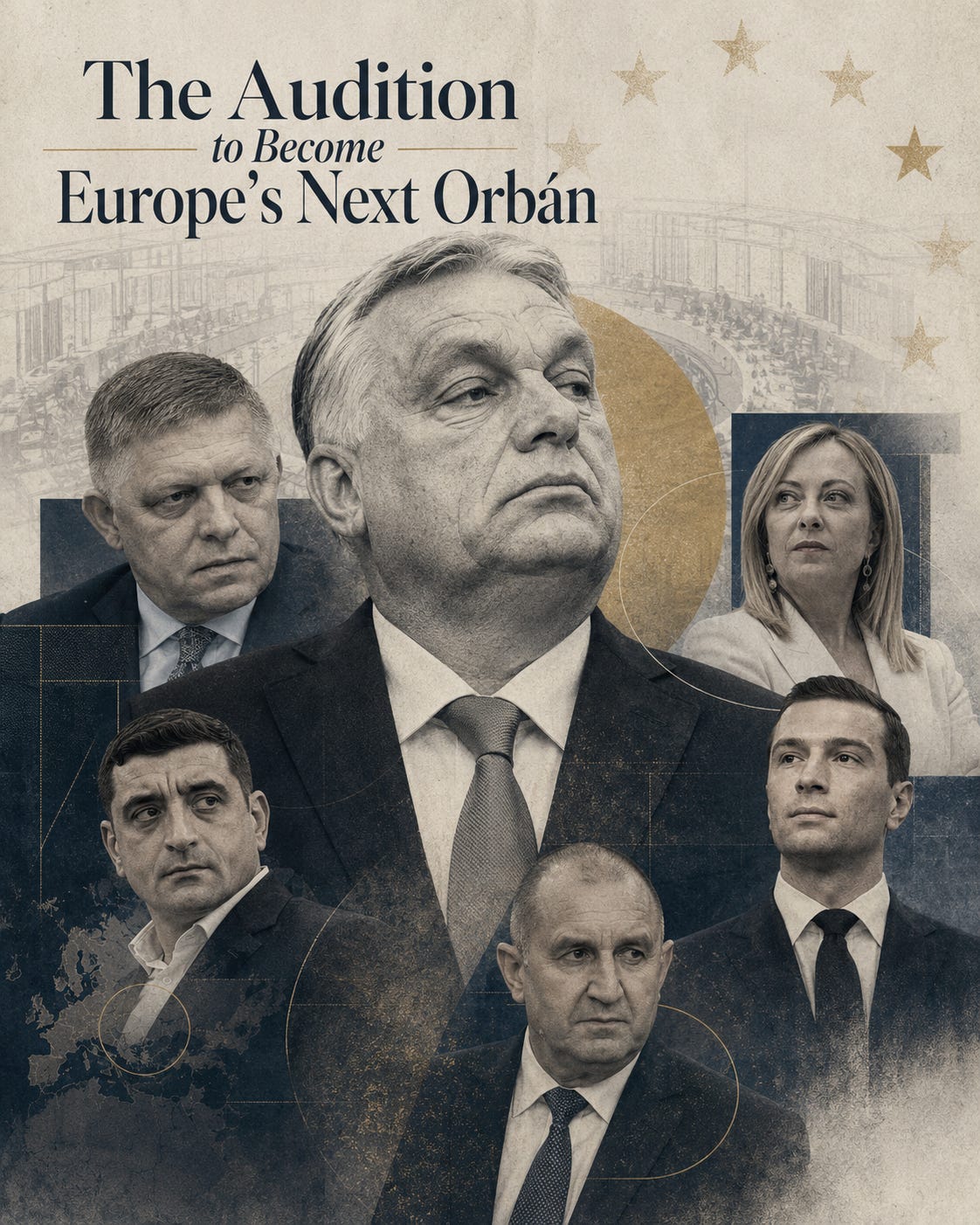
Europe’s nationalist right faces an unexpected problem. The man who served for years as its most successful governing example has been eliminated dramatically by Hungarian voters, and the movement he helped legitimise is looking for a new heir to the illiberal throne of Europe.
For an unduly long time, Viktor Orbán occupied a peculiar place in European politics. To his critics, he was a democratic vandal with a gift for turning EU summits into hostage situations. To his admirers, he was something more valuable, proof of concept. Plenty of politicians could rage against Brussels. Plenty could denounce liberal elites, immigration, judges, journalists, and modernity itself. Orbán accomplished something rarer. He built a state that appeared to make those complaints governable.
Over sixteen years in power, he gave Europe’s nationalist right a functioning showroom. Hungary became the place where sympathisers could point and say, “See? It works.” Elections could be won repeatedly. Institutions could be bent without quite breaking. Opposition could be contained. Loyalists could be rewarded. Brussels could be denounced while its money continued to arrive. The trick was not merely to survive within the European Union, but to learn how to utilise membership itself as part of the system.
His central insight was that the European Union’s strengths could become vulnerabilities. Consensus, designed to foster cooperation, became leverage. Legal caution, intended as a safeguard, created space for delay. Funding disputes became theatre. In Orbán’s hands, a small state could cast a much larger shadow, provided its leader was willing to turn every negotiation into a test of endurance.
His power also rested on something beyond Brussels. Orbán became Vladimir Putin’s most useful political partner inside institutions designed to contain Russian influence. Hungary repeatedly delayed or diluted EU measures against Moscow, resisted assistance to Ukraine, and became a frequent source of uncertainty inside Western alliances. Moscow had every reason to treasure him. He was not simply another nationalist leader with a weakness for Kremlin atmospherics. He sat inside the EU and NATO, where delay was essential for Putin.
Orbán’s domestic project, European leverage, and geopolitical usefulness reinforced one another. Each clash with Brussels fed his authority at home. Each new layer of domestic control made him harder to discipline abroad. Each dispute over sanctions, Ukraine, energy, or NATO cooperation increased his value to outside actors eager to weaken European unity. He turned conflict with the Union into a source of legitimacy, then used that legitimacy to deepen the system that made the conflict possible.
Now the proprietor has vanished.
Péter Magyar’s Tisza party did more than end sixteen years of Fidesz rule in April 2026. By dethroning Orbán, it removed the EU’s most experienced internal antagonist, the leader who showed Europe’s nationalist right how to govern from within the Union while attacking it as an oppressor. It also removed Moscow’s most dependable ally inside the EU’s decision-making process. His defeat raises a question larger than Hungary. Who, if anyone, can fill his specific position as both model and obstacle?
No single figure now carries the whole inheritance. Orbán’s position required state control, veto power, ideological skill, patronage, media dominance, external backers, foreign admirers, and an instinctive understanding of where the EU hesitates. It also benefited from a geopolitical environment in which Russia saw strategic value in keeping him in office. Many potential successors have some of these assets. None possesses them all.
The search, therefore, leads away from the fantasy of a single successor and toward a more worrisome vista. Orbán’s old functions are being scattered across Europe’s right. Obstruction has a home in Bratislava. Respectability has a base in Rome. The brand runs through the European Parliament. The transaction returns in Prague. Old alliances survive in Ljubljana. Strategic ambiguity gathers force in Sofia. Warning lights keep flashing in Bucharest.
Robert Fico is the closest operational heir because he understands the first rule of Orbán’s method. A leader does not need to dominate Europe to make Europe wait. The Slovak prime minister has what many louder nationalists lack: a government, a seat in the Council, and a willingness to turn European consensus into a bargaining exercise.
Fico has halted Slovakia’s military aid to Ukraine, rejected the EU’s plan to phase out Russian gas, and threatened to assume Hungary’s obstructive role on Ukraine financing. At home, his government has pressured watchdogs and media institutions, while protests have followed his moves against the whistleblower office, the penal code, and voting rules. He also has a sympathetic president in Peter Pellegrini and a political style built around welfare nostalgia, resentment, and suspicion of Western liberal authority.
If Brussels were seeking a new specialist in summit prolongation, Fico would be around the top of the list.
Slovakia gives him a narrower instrument. Its institutions have deteriorated, though they have not been reshaped over sixteen years under a single ruling party. Its economy, size, and exposure give Fico less room than Orbán enjoyed. He can delay, trade, and complicate. He cannot yet offer Europe’s nationalist right proof that state capture inside the EU can be made durable.
Giorgia Meloni presents a more elegant problem for Brussels. She is the most powerful hard-right leader in the Union, which makes her a poor fit for the role of anti-Brussels insurgent. Italy is too central, too indebted, too exposed to markets, and too important to NATO for its prime minister to behave as Orbán did.
Meloni’s essence lies in her ability to win without sounding permanently insurgent. On migration, she has helped move Europe toward externalisation, offshoring, detention, and deals with third countries. Her Albania migrant-centres scheme has faced legal obstacles, although the broader achievement is political. She has made once-fringe proposals sound like items on a Council agenda.
Orbán shouted from the edge of the room. Meloni has learned how to shift the room’s assumptions.
That may prove more durable than defiance. Meloni remains aligned with Ukraine, operates inside NATO consensus, and has been among the strongest supporters of sanctions against Russia among Europe’s nationalist leaders. For that reason alone, she differs fundamentally from Orbán. She also faces courts, coalition politics, fiscal pressure, and Italy’s dense institutional life. She is unlikely to become the EU’s leading spoiler. She has already become the figure who makes policies once associated with the fringe feel available to the centre-right and negotiable to Brussels. Orbán made Brussels listen to the hard right by blocking things. Meloni has made Brussels borrow its vocabulary.
France poses the greatest future threat because it would change the scale of the problem. Marine Le Pen’s judicial position remains unresolved before her appeal ruling, and Jordan Bardella stands as the obvious substitute if she is barred from the 2027 presidential race. Bardella already chairs Patriots for Europe in the European Parliament, the political family Orbán helped build. He has the youth, the discipline, the parliamentary network, and the polished surface of a radical politics conditioned for television and coalition respectability.
The missing piece is executive power. Orbán supervised ministries, budgets, public media, universities, prosecutors, borders, and vetoes. Bardella has the brand. Le Pen has the mythology. National Rally has the larger opportunity because France is a founding EU state, a military power, a permanent member of the UN Security Council, and one of the Union’s central political engines.
A French nationalist government would give Orbán’s language a state far more powerful than Hungary. Budapest could twist obstruction into leverage. Paris could bring that politics into the centre of the European project.
Romania supplies the sharpest warning from the eastern flank. George Simion lost the 2025 presidential rerun to Nicușor Dan, but his defeat settled less than it appeared to settle. Simion dominated the first round and carried a large nationalist electorate into the runoff. His politics combines anti-elite fury, suspicion of Brussels, national grievance, religious imagery, digital mobilisation, and a shifting line on Ukraine and Russia.
That shifting line deserves attention because it is not simply confusion. Simion has said Romania should be compensated for its aid to Ukraine. He has claimed Russia is not a major threat to NATO. He has also described the war as Russia’s war against Ukraine. Ambiguity is part of the method. It allows different audiences to hear reassurance, resentment, and defiance simultaneously.
Romania carries real strategic weight. It borders Ukraine, faces the Black Sea, borders Moldova, and plays a central role in NATO’s eastern posture. A nationalist government in Bucharest would touch the Black Sea, Moldova, NATO logistics, Ukraine policy, and the EU’s eastern security architecture at once. For now, Simion remains a warning. The warning is audible enough.
Bulgaria shows a slower drift. Rumen Radev’s new political vehicle won an outright majority in April 2026, and his government has already said it will stop further weapons supplies to Ukraine. Bulgaria also joined the euro area on January 1, 2026, which makes the case more interesting than a simple story of anti-EU rupture. The country is moving deeper into the Union’s monetary core while warming up to Russia.
That combination is sinister. Radev points to the possibility of a government deepening formal integration with Europe in one field while weakening the Union’s strategic line in another. The EU is built to recognise open confrontation. It is less equipped to respond to the gradual withdrawal of commitment.
The remaining figures are less likely to inherit Orbán’s place, but they show how divisible his politics has become. Andrej Babiš offers the transactional version. His return in Czechia, ANO’s links to Patriots for Europe, and his business background place him inside the post-Orbán field. He has money, media instincts, anti-migration appeal, and a long habit of treating public life as a negotiation over advantage. In his version, ideology arrives with an invoice attached.
Janez Janša offers a different fragment. The Slovenian leader is one of Orbán’s long-standing fellow travellers, a combative right-wing politician whose previous period in office drew criticism over media freedom and democratic standards.
Herbert Kickl and Geert Wilders mark the outer edge of the field. The FPÖ helped launch Patriots for Europe and won Austria’s 2024 election, though Austria’s coalition system kept Kickl out of office. Wilders reached influence in the Netherlands, then brought down his own government and saw Rob Jetten sworn in as head of a new Dutch minority coalition. Both show reach without command. They move some weight around European politics, but they do not currently hold the instruments that made Orbán dangerous.
By this point, the inheritance has begun to look less like succession than distribution.
The rhetoric is easy to export. The full system is much harder. It requires time, constitutional revision, disciplined party organisation, loyal business networks, media dominance, weak opposition, EU money, unanimity rules, and a leader willing to turn every Brussels dispute into domestic proof of persecution. It also requires circumstances that made Orbán unusually valuable to outside powers, particularly Russia. European nationalists admire the finished product. Few possess the materials.
That should give the Union little comfort. A single antagonist can be watched. Brussels learned Orbán’s habits. It could bargain with him, sanction him, flatter him, condemn him, and occasionally use him as the explanation for its own paralysis. A dispersed method is harder to manage. It moves through habits rather than commands.
The uncomfortable part for Brussels is that these tactics grow from inside the European system. Unanimity gives delay a price. EU funds give resentment a purse. Rule-of-law procedures move slowly enough for captured institutions to harden. The Union’s caution, one of its civilising virtues, becomes a resource for governments willing to abuse time.
The EU may discover that a single adversary was easier to understand. Orbán gave Brussels one face, one capital, one familiar seat at the summit table. The next phase offers habits instead: the veto threat, the migration bargain, raids on public broadcasting, patriotic invoices, hesitations over Russia, attacks on judges, and complaints of Brussels arrogance issued just before the next request for European funds.
Orbán’s fall weakens the centre of European illiberalism. It also removes the Kremlin’s most effective advocate inside EU and NATO decision-making. Regardless, it leaves many of the incentives that made him powerful intact. The EU still rewards unanimity games. It still struggles to prevent elected governments from becoming entrenched before institutional damage becomes permanent. It still sends funds into political systems it later discovers it cannot discipline. It still depends on consensus in areas where a determined government can extract value from delay.
Orbán’s real legacy may be that he made the EU’s internal vulnerabilities legible. His successors do not need his longevity, charisma, or control over Hungary. They only need to copy the parts that traverse.
Orbán has lost power. The weaknesses that made him useful to his allies and to Europe’s adversaries remain, even if his defeat has made them less easy to exploit.
Sources include The Guardian, Associated Press, Financial Times, Le Monde, the European Central Bank, official EU materials, Freedom House, V-Dem, ECFR, Carnegie Europe, Chatham House and IISS.
It is likely that none of the above will be a successful Orbanist, any more than all those imitating Hitler never quite made that odious grade. Nor, in a milder sense, has any Peronista reached the level of Juan Peron, nor have any of the Castroists been more than a faint glimmer of Fidel Castro.
The pretenders can, however, cause considerable mayhem. Witness Edi Rama and the weird mash-up of Orban, Trump and Enver Hoxha that he is trying to impose on Albania.
It seems to me the real way to defeat the bad right, is to heavily tax the richest people & destroy their power. When these authoritarians gain power it is through the very rich.