


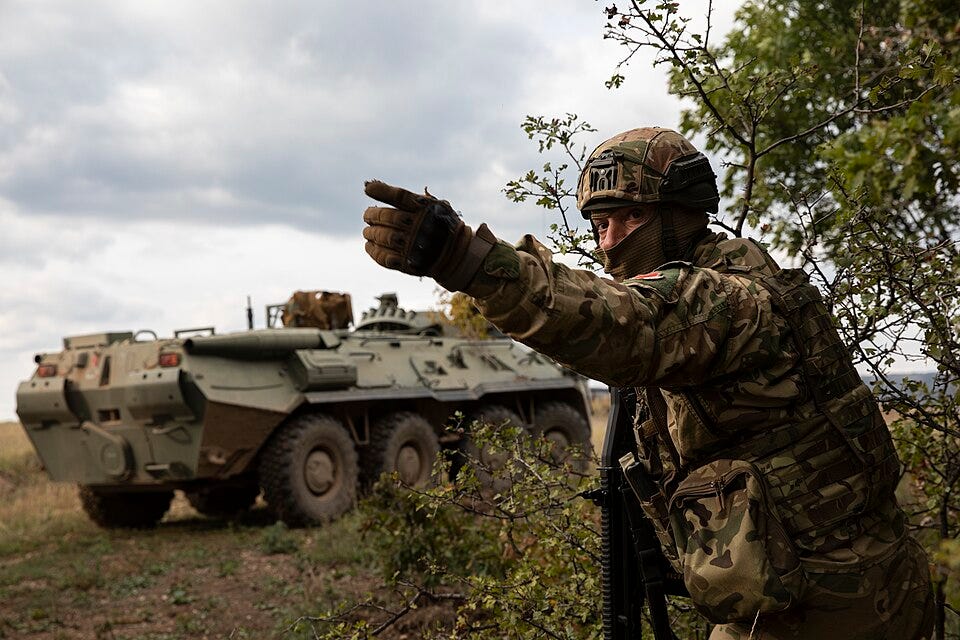
By the end of Viktor Orbán’s rule, Hungary had become better armed and harder to trust.
That captures the core tension in Hungary’s NATO story. Orbán kept Hungary inside the alliance. He raised defence spending, bought modern equipment, allowed allied deployments, and kept Hungarian forces present in NATO missions. The military file improved while the political file deteriorated.
The Zrínyi 2026 Defence and Force Development Programme, the Orbán-era military modernisation plan announced in 2016, was the centrepiece. It was worth roughly 3,500 billion forints, about $11.3 billion at the current exchange rate. Its main acquisitions included Leopard 2A4 and 2A7+ tanks, PzH 2000 self-propelled howitzers, Lynx KF41 infantry fighting vehicles, NASAMS medium-range air defence, Airbus H145M and H225M helicopters, and KC-390 transport aircraft. European Security & Defence has described this procurement drive as a major reshaping of Hungary’s force structure, while NATO’s defence-expenditure data shows the budgetary side of the same shift.
According to NATO, Hungary’s defence spending rose from 0.86 per cent of GDP in 2014, or 281.4 billion forints, to 2.05 per cent of GDP in 2023, or 1.54 trillion forints. It remained above the alliance’s 2 per cent threshold in 2024 and 2025. In the narrow accounting sense, Orbán could claim that Hungary had become a more serious defence spender.
The spending had operational consequences. Hungary contributed to NATO’s multinational battlegroups and eastern flank deterrence, hosted one battlegroup, participated in exercises such as Steadfast Defender, and allowed NATO Response Force deployments in western Hungary after Russia’s full-scale invasion of Ukraine. Budapest also authorised the transit of NATO troops and weapons across Hungarian territory to other allied states, while banning direct lethal-weapons transit to Ukraine.
That is where the simple version of the story falls apart. Hungary became an ally, with new hardware and a dwindling reserve of confidence.
A useful ally with a veto habit
Orbán’s NATO adversity began with a formula.
From 2017 onward, Hungary tied NATO-Ukraine relations to the rights of the Hungarian minority in Transcarpathia, the western Ukrainian region bordering Hungary with a significant ethnic Hungarian population. This followed Ukraine’s education and language laws, which affected minority-language rights.
Orbán’s approach turned the issue corrosive.
His government repeatedly used NATO formats to press a bilateral dispute. Hungary blocked high-level meetings of the NATO-Ukraine Commission and later opposed NATO-Ukraine Council arrangements. Péter Szijjártó, Hungary’s foreign minister, said Hungary would continue blocking NATO-Ukraine Council meetings until Ukraine restored minority rights as they had existed before the 2017 education law. In October 2019, Hungary vetoed a joint NATO statement on Ukraine because it lacked language on ethnic Hungarian rights. Szijjártó said Hungary “had no other choice than to veto.” Diplomats accused Budapest of “holding NATO’s relations with Ukraine hostage.”
In 2022, Hungary also blocked Ukraine’s accession to the NATO Cooperative Cyber Defence Centre of Excellence in Tallinn. Telex later reported that the Hungarian veto had prevented the move before Budapest eventually gave its consent. The symbolism was grim for a NATO member, already facing questions about its own cyber and intelligence exposure, that blocked Ukraine from a cyber-defence institution while Russia waged war next door. All the while, allegedly passing sensitive material to Russia through the unusually suspect close relationship between Szijjártó and Lavrov.
A similar pattern emerged in Sweden.
After Russia’s full-scale invasion, Sweden and Finland applied to join NATO in May 2022. Most allies ratified rather quickly. Turkey and Hungary became the holdouts. Budapest repeatedly delayed parliamentary votes while claiming to support enlargement. The official explanation was a grievance dressed as a procedure. Zoltán Kovács, the government spokesman, linked the delay to Swedish criticism of Hungary’s rule-of-law record. Balázs Orbán, the prime minister’s political director, said Swedish political, media and NGO criticism had raised concerns among Hungarian MPs.
Hungary ratified Finland’s accession in March 2023. Sweden had to wait until early 2024. By then, Budapest was the last NATO member withholding approval. After Turkish ratification, U.S. pressure and Jens Stoltenberg’s direct engagement, Viktor Orbán told the NATO secretary-general that his government supported Sweden and would urge parliament to vote “as soon as possible.” The U.S. ambassador, David Pressman, told The Guardian that Washington was “disappointed” and that Hungary was “really alone.” Hungary’s parliament finally approved Sweden’s accession in February 2024, removing the last obstacle to Sweden’s membership.
This was Orbán’s NATO method, as we all came to know it. Hungary stayed within the rules and used them as levers. Procedure became bargaining.
The art of staying inside
Hungary’s Ukraine policy after 2022 heeded an identical logic.
Budapest kept NATO logistics open enough to preserve alliance discipline. It allowed NATO forces and equipment to move through Hungarian territory to other NATO states. At the same time, it banned direct lethal-weapons transit to Ukraine, refused to send weapons, and built domestic messaging around the claim that Western allies were trying to drag Hungary into war.
In 2024, Stoltenberg secured a compromise ahead of the Washington summit. Hungary agreed to allow NATO’s long-term support package and security framework for Ukraine to move forward. In exchange, it opted out of funding, personnel, and the use of Hungarian territory for those activities. The Associated Press reported that Orbán insisted Hungary would provide neither money nor military personnel, while Stoltenberg stressed that Budapest would not block NATO decisions shared by other allies.
Orbán rarely broke the alliance, but he made it bend to his will.
That was the deeper innovation. Hungary met targets. It hosted allied forces. Yet many consensus decisions became conditional. Budapest’s position had to be managed before the alliance could move.
The Russian exposure problem
Russia turned Hungary’s NATO issue from a procedural nuisance into a strategic concern.
Orbán’s government spent years framing Hungary’s foreign policy as one of sovereignty. In practice, Hungary became increasingly exposed to Russian influence in several strategic sectors. Paks II was the centrepiece: two new reactors at Hungary’s main nuclear plant, financed and built by Russia’s Rosatom. Nuclear Engineering International notes that the Paks II project was launched under a Hungarian-Russian intergovernmental agreement, with Rosatom supplying two VVER-1200 reactors and a Russian state loan financing most of the project. Alongside Gazprom gas contracts and Hungary's heavy reliance on Russia's crude oil, Paks II gave Moscow a durable foothold in Hungary’s strategic infrastructure.
Hungary repeatedly sought and obtained exemptions from restrictions targeting Russian pipeline oil. It also fought to protect Paks II. When Budapest agreed to the EU’s 14th sanctions package against Russia, it did so after securing assurances that the package would not threaten the nuclear project. Nuclear Engineering International reported that the EU exempted Paks II from the package after Hungary had demanded protection for the Rosatom-built project.
For NATO allies, this created a problem larger than energy. A member state with Russian nuclear contracts, gas dependence, political contact with Moscow, and leverage over sanctions could still sit inside NATO rooms. It could still receive intelligence. It could still shape consensus. It could still slow the bureaucracy.
The International Investment Bank brought that concern to light. In 2023, the United States sanctioned a Russian-controlled bank headquartered in Budapest and several of its senior officials. The U.S. Treasury described the IIB as a Russia-controlled financial institution and said its presence in Budapest allowed Russia to increase its intelligence presence in Europe, open the door for Kremlin influence in Central Europe and the Western Balkans, and serve as a means for corruption and illicit finance. For Washington, this was a public security warning aimed at an ally.
Pressman put the matter in unusually blunt terms. In a speech marking Hungary’s twenty-fifth anniversary in NATO, he described Hungary as an ally “that behaves unlike any other.” He warned that Hungary’s expanding relationship with Russia raised “legitimate security concerns,” language later reported by Radio Free Europe/Radio Liberty. He also called Hungary’s use of NATO to press bilateral minority-rights disputes “untenable.”
Orbán responded with the language of peace. He described sanctions as harmful and characterised Western governments as supporters of military escalation. In his telling, Hungary represented sobriety and restraint.
That message worked at home, for a while anyway. Hungary sits next to Ukraine, remembers great-power violence, and has little appetite for direct military involvement. Abroad, the same language corroded Hungary’s standing, recasting allied support for Ukraine as recklessness.
By 2026, Hungary could point to modernised forces and rising defence budgets. Beneath the equipment, the vulnerabilities were plain: Russian energy dependence, repeated vetoes, cyber exposure, Russian-linked finance in Budapest, and a foreign policy that made allies ask what Hungary would demand before the next decision.
What Magyar is really promising
This is what Péter Magyar inherits.
Tisza’s governing programme offers something more revealing than a new NATO doctrine: an attempt to rebuild the state behind the uniform.
The programme’s opening diagnosis says the outgoing government “wages a political war against the country’s Western allies” and has pushed Hungary into “dangerous dependence” on Eastern autocracies. It promises to restore Hungary’s international standing and its place in the Western alliance system, arguing that sovereignty will be strengthened through alliances. Tisza treats damaged alliance relations as evidence of weakened sovereignty.
Among its first measures, Tisza promises to restore Hungary’s international relationships with its traditional allies, naming the Visegrád Four, the European Union and NATO. It also pledges to prepare a report on “the extent of non-allied foreign influence” in national-security and economic terms. That sentence points to the hidden NATO issue: exposure.
The programme's security section provides further detail. Tisza says Hungary will again become a “useful, credible, respected, active and constructive” member of the European Union and NATO. It states that Hungary will look for friends in Europe, restore good relations with all neighbouring states, and strengthen traditional Visegrád cooperation, the regional grouping of Hungary, Poland, Czechia and Slovakia. It also states that Hungary will maintain its place in “traditional European and North Atlantic alliance systems.”
There is no hawkish flourish here. The same passage says there will be no conscription and no Hungarian soldiers sent to the Russia-Ukraine war or any other war. The position is that there will be no conscription in Hungary in the future, and Hungarian soldiers will not be sent to the Russia-Ukraine war or any other war.
Magyar leans towards a pro-NATO stance, faces west, and is cautious about sending troops. He offers steadiness instead of spectacle.
The state behind the uniform
The most interesting part of Tisza’s NATO position is the critique of the defence state.
The programme accepts the new defence-spending reality. It says Hungary has been among the NATO states that already met the 2 per cent GDP defence-spending requirement, while NATO countries must raise this toward 5 per cent by 2035. NATO’s own explanation of the Hague defence commitment divides the new 5 per cent target into at least 3.5 per cent for core defence and 1.5 per cent for defence-related security and resilience. Tisza promises to increase Hungarian defence spending to meet that expectation by 2035. It presents this as a serious fiscal challenge, while arguing that well-planned defence spending can support sectors such as health care, transport and industry.
Magyar’s NATO reset is about more than exclusively tone. Tisza accepts a more expensive alliance. A 5 per cent defence target would force hard choices. Defence spending would compete with health care, education, tax relief and infrastructure. The programme tries to soften this by calling defence spending industrial policy, meant to support domestic growth.
Tisza’s more pungent argument is aimed at the Orbán model itself. The programme acknowledges that Hungary bought hardware. It argues that the real defence system has weakened elsewhere. It says the Hungarian Defence Forces face recruitment and retention problems, infrastructure remains poor, and morale suffered after politically motivated purges. It also says defence development under Orbán focused too heavily on procurement, while human resources were weakened.
Orbán could point to tanks and other hardware. Magyar is asking allies to inspect the procurement, cybersecurity, and intelligence systems behind them.
Tisza also points to breaches affecting the Foreign Ministry and the Defence Procurement Agency. The programme treats those incidents as warnings about the state’s ability to protect procurement files, classified communications and operational data. That is where NATO confidence is built. The alliance needs Hungarian systems capable of handling sensitive information. It needs procurement that cannot be read through foreign eyes. It needs ministries that do not treat allied secrets as instruments of domestic politics.
Energy is a security policy
Energy is another hidden front.
Tisza promises to end dependence on Russian oil and gas by 2035 and diversify Hungary’s energy supply. The programme links sovereignty to self-sufficiency in energy, water, food, public services and critical infrastructure. In Hungary, energy dependence has never been separate from security policy. Paks II, Gazprom contracts, Russian oil exemptions and sanctions bargaining have all shaped allied perceptions of Budapest. A Hungary less dependent on Russian energy would give Moscow fewer pressure points and give allies fewer reasons for suspicion.
The timeline signals direction while acknowledging constraint. Hungary has binding multi-year contracts for Russian energy and ongoing commitments to Paks II. Its infrastructure and regional supply routes also limit the pace of reversal. Reducing dependence on Russian oil and gas will be gradual, shaped by prices, contracts, infrastructure and logistics.
Magyar’s argument is modest while realistic. Diversifying energy will take years. Hungary can take steps now to reduce exposure. The path is slow, but it exists.
The Ukraine constraint
Tisza offers Kyiv no shortcut. It rejects accelerated EU accession for Ukraine, insists that every candidate meet the same criteria, and promises a binding Hungarian referendum after the accession chapters are closed. It also keeps the defence of Transcarpathian Hungarian language and cultural rights inside the programme. Public summaries of Tisza’s foreign-policy plans have noted the same line: support for NATO and EU alignment, caution on Ukraine, no troops to Ukraine, no conscription, and a referendum on Ukraine’s EU membership. Reuters’ summary carried by MarketScreener captured that balance neatly.
Under Magyar, the change will be procedural, not emotional. The minority-rights issue will outlast Orbán; the difference is in how it is used. Orbán turned it into a lever inside NATO. Magyar’s programme points to bilateral talks, EU accession, neighbourly diplomacy, and legal conditions. Kyiv will be irritated. NATO allies will find it easier to live with.
Under Orbán, Hungary treated NATO membership as insurance, leverage and domestic theatre. The alliance protected Hungary. Hungary used the alliance’s procedures to extract attention. Each veto and delay became national defiance at home. Each Western criticism became proof that Budapest was under attack. Each accommodation from NATO showed that the system could be pressured from within.
Tisza’s agenda offers a different theory of sovereignty. Hungary’s security depends on restored alliances, reduced foreign influence, lower energy exposure, stronger cyber defence, better military personnel policy and a functioning legal state. In this view, sovereignty is built through institutional credibility rather than performed as an obstruction.
The inheritance
Magyar inherits both Orbán’s hardware and the damage Orbán left behind.
He can quickly change tone, stop surprise vetoes, and reopen regular NATO-Ukraine formats. He can coordinate with Poland, Romania, Czechia, Slovakia, the Baltic states, Germany, France, and the United States. He can order reviews of Russian-linked exposure and make Hungary unremarkable again at NATO tables. Here, unremarkable would be an achievement.
Deeper repair will take time. Restoring confidence will require consistent voting, responsible intelligence management, credible oversight of procurement, gradual reductions in Russian energy dependence, and timely participation in joint exercises. Under Orbán, Hungary conditioned cooperation on extracting concessions from its allies. Magyar must show that agreements will be honoured without having to bargain as the price of entry.
Hungary’s place in NATO was never lost on paper. That was the trick. Orbán kept the signature, the seat, the flag. The seat became less trusted, the signature less certain.
NATO will know Hungary is back when Budapest’s yes no longer requires an audit.
Source: NATO defence expenditure data; NATO Hague defence commitment; Tisza 2026 programme, A működő és emberséges Magyarország alapjai; Euractiv; Telex; The Guardian; Associated Press; U.S. Treasury; Radio Free Europe/Radio Liberty; Nuclear Engineering International; Reuters via MarketScreener.
I agree with Patrick, NATO needs all on board to resist Putin, hopefully he won't last much longer. But energy withdrawal from Russia will take time, as will a buildup of defense to 5%. Of course the Hungarians in trans Carpathia should be able to keep their language & culture.
NATO will need all its members on the same page in order to force Putin to stop his wars of aggression.