

Spain Is a Country I Love Deeply. That Is Why Vox Terrifies Me.
How Orbán’s politics found an ally in Spain’s far right, and why Vox threatens the plural country I’ve come to love.

I began writing this essay after reading María Ramírez’s Guardian piece on Pedro Sánchez, Spain’s reputation abroad, and the unrest gathering at home. The article caught the gap I live inside. The Spain admired from afar, and the Spain lived through high rent, late trains, low wages, many languages, headbanging bureaucracy, familiar affection, and undeniable anger.
From afar, Spain can appear almost enviable. Its economy has outpaced much of Western Europe. Its government has defended immigration while others race to sound more vicious. Social rights have moved into the mainstream. Spain has protected reproductive freedom, normalised LGBTQ+ equality, and treated migration as part of the country’s future. Reuters reported that Spain planned to “regularise about 300,000 undocumented migrants per year”, with the government saying it needed roughly 250,000 to 300,000 tax-paying foreign workers annually to sustain the welfare state.
This is not the usual story Europe tells about itself nowadays. Much of the continent has learned to speak about migration as a risk before it speaks about people. Spain has gone further than most in saying the obvious thing out loud. An ageing country needs workers, taxpayers, carers, neighbours, lives.
That is one story. The rougher one lives closer to the ground.
The comments beneath Ramírez’s article were almost as revealing as the article itself. Readers pointed to housing costs, low wages, corruption, delayed trains, small-business pain, and the gap between foreign admiration for Sánchez and the realities of local life. One reader mentioned “hyperpolitics”. Another described Spain as a jigsaw held together by dialogue, compromise, and patience.
That felt true. Spain is admired from the outside. Inside, it is exhausted, loud, anxious, expensive, and still somehow functioning.
That is the Spain I recognise.
My love for Spain grew gradually, first through Erasmus, then a Master’s, then through friends, nights out, late dinners, the tangle of bureaucracy, a new language, the relentless heat, work, public squares, small kindnesses, and the ordinary rituals of building a life somewhere new.
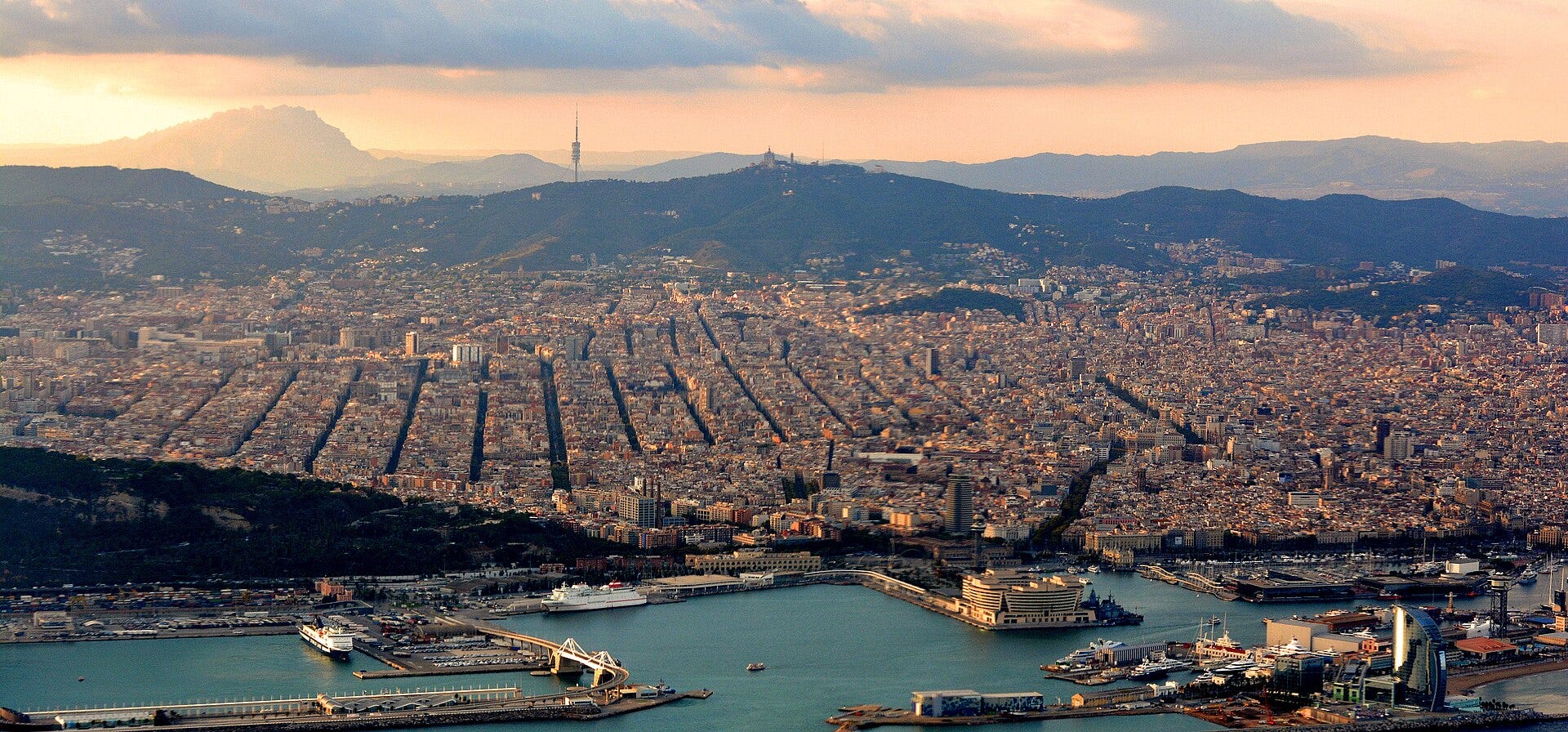
Barcelona entered me through routine. The walk to buy fresh bread. The sound of Catalan in a corner shop. Old men arguing outside a bar before lunch. The rent panic. The August heat pressing down on streets that smell of bins, sea air, and stone. The neighbour who complains about everything and still helps when something breaks.
At some point, Hungary began to feel more distant. Orbán had made the country I came from feel smaller, meaner, more suspicious of itself. Barcelona became the place I had chosen. Then it became the place that shaped me.
So this is where I write from. I am Hungarian. I live in Barcelona. I love Spain. I also treasure Catalonia and Barcelona.
I love Spain after the romance. I love it with my eyes open. The paperwork still drives me mad. The rent is brutal. The trains are always late. Tourists overcrowd most of the city. Politics seeps into every corner of life. And still, the attachment stays. Spain taught me that a country does not need to be neat to be loved. It can argue with itself in several languages at once. It can be wounded, generous, stubborn, funny, exhausted, and still open. Barcelona is that feeling made physical. Catalan in the corner shop. Spanish in the street. English at the next table. A city too expensive for its own people, too alive to become only a museum, too mixed to obey anyone’s fantasy of a pure nation.
That is why the rise of Vox chills me to the bones.
The modern far right can feed on countries that become too plural, too changed, too open for reactionary politics to tolerate. It feeds on the moment when a functioning society starts to feel unfair, when public anger is real, when trust has thinned, when people know something is wrong, and someone arrives to tell them exactly whom to blame.
For Vox, Spain’s diversity is recast as disorder. Catalan identity is framed as disobedience. Immigration becomes a threat. Feminism is twisted into an imposed ideology. LGBTQ+ rights are painted as a moral decline. Historical memory is rebranded as revenge. The nation’s plural identities are turned into targets.
Vox names this as unity. It says Spain needs order, borders, a common language, strong institutions, and protection from fragmentation. Its version of unity asks too many people to disappear.
Viewed from abroad, Vox can look like another entry in Europe’s hard-right catalogue. Another anti-immigration party. Another nationalist force. That misses the Spanish core.
Vox’s deepest project is Spanish central nationalism. Its 2023 programme, as summarised by RTVE, proposed an “unitary state”, the return of education, health, security, and justice powers to the central state, the illegalisation of parties seeking Spain’s territorial breakup, and the defence of Spanish across the whole country. The same programme vowed to repeal gender-violence legislation, LGBTQ+ and trans-rights laws, and Spain’s climate law, while taking a harder line on immigration.
Call it by its name. Hard-right nationalism with a programme for the state.
The Catalan question sits at the epicentre. Vox’s rise cannot be understood without the Catalan independence crisis. The party found its early force in the claim that Spain was being broken apart by separatists, indulged by the left, and mishandled by a weak mainstream right. It took that charge and pushed it into every other fight. Migration. Feminism. LGBTQ+ rights. Islam. Climate politics. Historical memory.
Living in Barcelona changes how this feels.
Catalan is no theory here. It is on the street, in schools, in shops, in offices, in friendships, in jokes, in the daily evidence that Spain contains more than one national feeling. You do not have to support independence to know that Catalan identity belongs to Spain’s democratic reality. Vox treats that reality as an insult.
Andalusia made the danger harder to ignore. On 17 May, PSOE was beaten in one of the places where Spanish socialism once felt almost enduring. This was Felipe González country, the old southern fortress, the region PSOE governed for decades after Franco. Then the floor gave way. The party fell to 28 seats, its worst result there since Spain’s democratic restoration. The PP won 53 of 109 seats, close to power but still two short of an absolute majority. Vox rose to 15. One extra seat, but that is how leverage works. Vox does not need a landslide when the PP needs its hand on the door. Ramírez’s Guardian piece described the result as PSOE’s worst in the region since the restoration of democracy.
This is how Vox gains power. It does not need to finish first. It needs to stand close enough to the PP that its demands become the price of government. “National priority”. Anti-migrant policy. Attacks on equality. Hostility to regional pluralism. The slow hardening of what the mainstream right accepts. Recent PP-Vox arrangements in Castilla y León have already brought “national priority” language into government deals, including restrictions around access to housing, services, and public benefits.
This is why Ramírez’s piece stayed with me. It wrote about Sánchez’s disunited image. Admired abroad, weakened at home. I do wonder in moments of anxiety what kind of right is waiting if he falls.
Spain’s problems are real and immediate. Housing is brutal, with rents soaring far beyond what most can afford. Salaries lag behind the cost of living, and the relentless pressure of mass tourism has warped entire cities. Young people are angry, and with good reason. Public services strain under increasing demand. Corruption scandals have eroded trust in the current government. Anyone living here feels the frustration keenly, without needing it explained by foreign admirers.
The question is what politics does with that frustration.
Vox hands Spain a list of scapegoats: migrants, feminists, queer people, Catalans, Basques, Muslims, Brussels, judges, journalists, and globalists. Anyone weaker than the state. Anyone convenient enough to blame. A script too familiar to me and many others.
That is what I recognise as a Hungarian.
Orbán’s politics prepared me for how quickly anger curdles into suspicion. When prices rise, blame Brussels. When hospitals fail, blame migrants. If teachers protest, call it foreign interference. When queer people ask to live freely, recast it as an attack on children. If journalists investigate, label them traitors. When civil society speaks, call it a conspiracy. Every frustration finds a target, and every target is pushed beyond the nation's boundaries.
Spain did not import Vox from Hungary. That would be too easy. Vox came out of Spain’s own unfinished arguments. Catalonia gave it a wound to press. The collapse of the old party system gave it space. Migration gave it targets. The mainstream right gave it oxygen by pretending it could borrow the anger without paying the price. Vox is Spanish in its obsessions, its resentments, and its chosen enemies. That is what makes it dangerous. It knows exactly where to press because it grew from the pressure points.
At this point, Orbán enters this story.
Even in an essay about Vox, I cannot stop writing about him. He is the bad flu that keeps returning. You try to move on, then there he is again, forming the air around another country’s politics.
He saw Vox as an ally. His world understood what Vox could become.
In 2023, Vox acknowledged financing election campaigns with large loans from MBH Bank, a Hungarian bank described by El País as close to Orbán’s world. El País reported that Vox had received 9.2 million euros from a Hungarian bank close to Orbán for its 2023 municipal and general-election campaigns. El País later reported that Vox again turned to Hungarian banking for a seven-million-euro loan for the 2024 European campaign.
The strongest version of the claim is political, not criminal. Spain’s anti-corruption prosecutors later archived a complaint over possible illegal financing, treating the Hungarian financing as a loan rather than a donation. No public evidence shows Fidesz directly wiring money to Vox. The political fact still stands. A major Spanish far-right party received campaign financing from a Hungarian bank tied to Orbán’s political and business world. Then Vox moved deeper into Orbán’s European camp.
In July 2024, Vox changed chambers in Brussels. It left Giorgia Meloni’s European Conservatives and Reformists group and joined Patriots for Europe, the new far-right alliance built around Orbán, Austria’s FPÖ, and Andrej Babiš’s ANO. This was not a technical shuffle in the European Parliament. It was Vox choosing its political home. Marine Le Pen’s National Rally joined soon after, and the group became the third-largest force in the Parliament. Vox had already taken Hungarian money through MBH Bank. Now it was sitting inside Orbán’s European camp. The relationship had now acquired a name, a voting bloc, and a seat in Brussels.
Orbán does not need to rule Spain to send aftershocks through Europe. His politics travels through money, alliances, conferences, slogans, and the constant search for someone to blame. I know this methodology. Make people feel they must earn their place, turn loyalty into a test, present the nation as fragile, then appoint yourself its only doctor.
For someone living in Barcelona, Vox’s presence in Spain would affect people I know. It would touch immigrant friends who already live with enough precarity. It would touch LGBTQ+ people who built lives in a country that became one of Europe’s most socially advanced. It would touch Catalan autonomy, language, and public life. It would touch on women’s rights and the legal framework Spain built around gender violence. It would touch the basic feeling of who gets to belong.
Barcelona is almost everything Vox mistrusts. Multilingual. Migrant. Feminist. Queer. Catalan. Spanish. International. Difficult. Expensive. Beautiful. Overburdened. Alive. It's a stark contrast to live in daily while the rise of the far right continues in all directions around us.
I have already watched Orbán’s politics narrow a country’s imagination. I have watched a government teach people that every independent institution is suspicious, every minority a problem, every foreign influence a threat, every criticism an attack on the nation. I have watched nationalism become less about loving a country and more about deciding who can be expelled from the idea of it.
Now I live in Spain, and I see a party with Spanish views, Spanish resentments, Spanish targets, moving inside a European camp Orbán helped build.
Spain has its own path. Vox can damage Spain in a Spanish way. It can make Catalan public life sound like treason. It can make immigrant workers sound like invaders. It can make queer people sound like a threat to children. It can make the PP depend on its votes, then pretend that dependency is normal. It can make enough people believe the Spain around them is less real than the Spain Vox wants to restore.
That promise is false.
The Spain around us is already real.
You see it in the ordinary friction and beauty of daily life. Catalan and Spanish voices sharing the same street. Immigrant workers holding up entire industries. Women refusing to go backwards. Queer people living openly. Young people shouting about rent. Grandparents protecting the public healthcare they built. Families improvising a future in cities that never stand still.
I love Spain because of the disarray. I love it because it gave me a new home after Hungary began to feel stolen by men who twisted power into patriotism. Spain did not save me. Countries do not do that. But it taught me to live inside disagreement without wanting it erased. It made me less willing to accept a smaller, more frightened version of community anywhere.
That is why the rise of Vox scares me.
Because I recognise the hate.
Because I know what happens when a country is told to fear its own plural life.
Because the first loss is often emotional. A place becomes more suspicious. Then meaner. Then smaller. Then people begin to forget it was ever larger.
My head is spinning. I was unaware of these internal changes in Spain, like so many Americans. We live such an insular life. Please continue to educate us!
Thank you for sharing your love of Spain, warts and all. A lovely essay to be enjoyed, savoured.