

Sixteen Years, Sixteen Tells
Orbán’s Hungary was engineered through law, decree and ballot. Its real nature emerged in flashes: a stadium rising in a childhood village, a university forced into exile, a media empire surrendered.

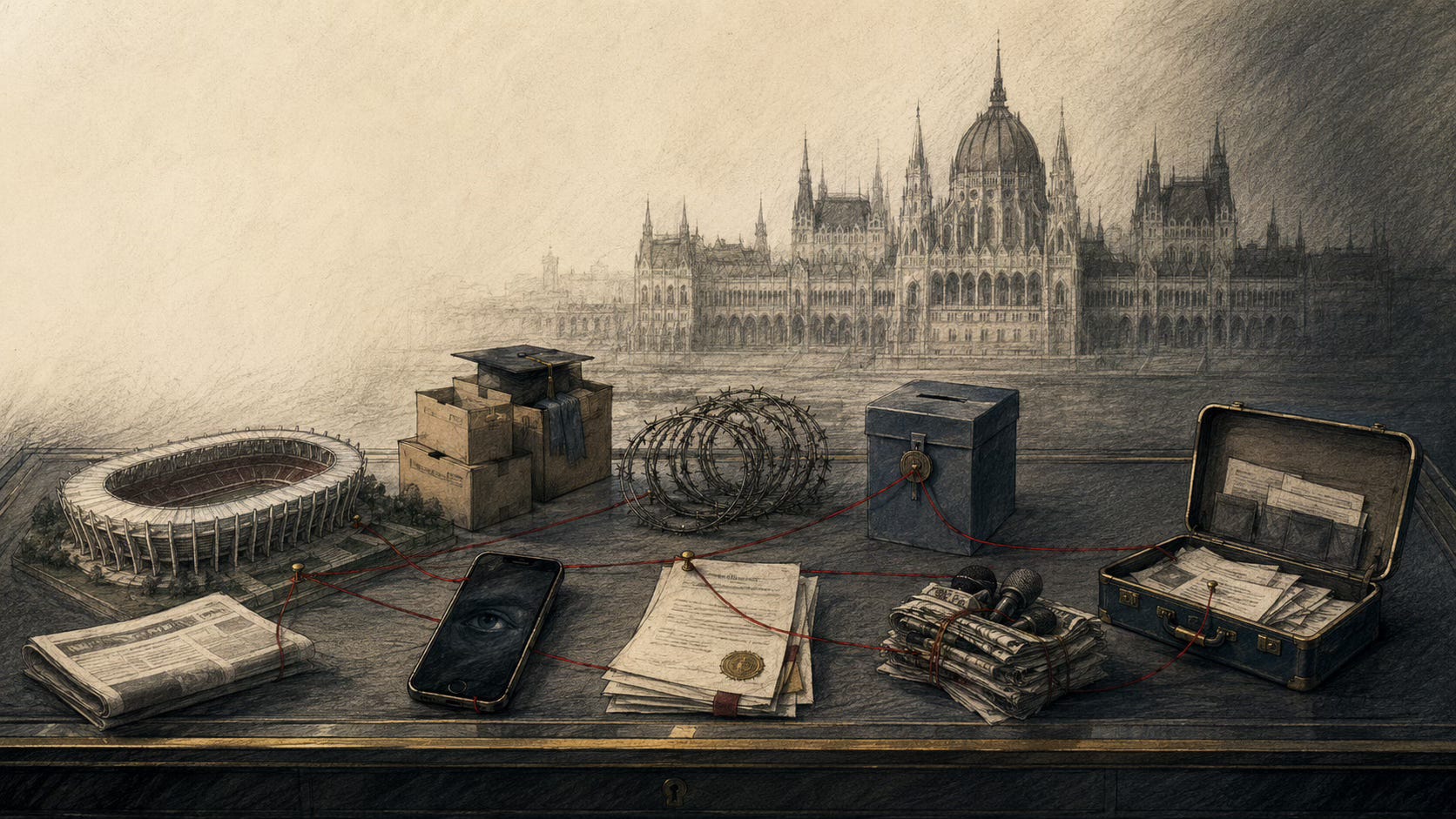
Every regime has its tells: moments when power forgets to disguise itself.
Some are grand: a constitution rewritten, courts brought under pressure, parliament reduced to theatre. Others arrive smaller, almost comic, until the comedy curdles: a stadium of more than 3,500 seats in a village of fewer than 2,000 people; 476 media outlets folded into a pro-government foundation; a university pushed across the border; a spyware scandal; a “temporary” emergency that settles in and refuses to leave.
Orbán’s Hungary did not arrive in a single dramatic scene. There was no day when democracy stood up, closed the door, and left a forwarding address in Vienna. Power advanced by increments. Each move came wrapped in law, patriotism, and bureaucracy. Every encroachment arrived with paperwork.
Brilliance and decay moved together, each advance leaving its shadow behind.
Sixteen years can be measured in elections, legislation, European quarrels, and corruption indices. Yet the truer measure lies in those moments when pretence fell away and the regime showed itself.
Here are sixteen tells from the Orbán years.
1. The First Instrument: The Press
What came first matters more than what came loudest.
Before much of the world understood Orbán’s ambitions, his government moved on the media. The 2010 law created a regulator with sweeping powers over outlets old and new. International observers warned of press freedom’s decline; Fidesz claimed normality. Authoritarians, after all, rarely announce: “Please enjoy our new censorship infrastructure.”
The aim was never total silence. That would have been crude, conspicuous, and inefficient. The deeper ambition was atmospheric: editors made wary, owners made anxious, public media made obedient, independent journalism forced into permanent defence.
From the beginning, the regime’s instinct was control: of the room, the narrative, and the boundaries of dissent.
2. The Manual Rewritten
Then came the Fundamental Law.
After winning a two-thirds majority in 2010, Fidesz rewired the state itself: a new constitution, new institutional rules, new electoral maps, checks that no longer checked. The republic remained visible. Its manual had been rewritten.
This remains one of the great misunderstandings about Orbánism. It did not arrive as chaos. It arrived as law. Inside the European Union, power is safer when it wears a suit, cites procedure, and calls itself constitutional reform.
A coup on paper is still a coup, only dressed for Brussels.
3. The Nameplate at Tusnádfürdő
In July 2014, at Tusnádfürdő, Orbán gave the project its name.
By then, much of the regime was already in place. The media landscape had been transformed. The constitution had been rewritten. Independent institutions had learned the new discipline. The speech mattered because Orbán stopped speaking in hints. Hungary, he declared, was building an “illiberal state.”
This was political marketing rather than confession.
Modern autocracies do not always hide from language. Sometimes they invent a vocabulary in which the retreat from liberal democracy sounds like courage, renewal, and national maturity. Orbán understood this better than almost anyone in Europe. The word “illiberal” did not soften the project. It gave it intellectual furniture.
The regime had already begun taking the keys. Tusnádfürdő put a nameplate on the door.
4. Felcsút’s Cathedral
Then there was Felcsút.
Orbán’s childhood village became one of the era’s perfect symbols: the Pancho Aréna, a gleaming football stadium built in a settlement whose population was smaller than the stadium’s capacity. As fiction, it would have seemed too crude. As political architecture, it was almost elegant.
The stadium resonated because it distilled the regime into a single image: personal obsession, public money, local loyalty, national myth. An ordinary village was remade as a shrine.
Orbán has always understood football as more than sport. It is hierarchy, masculinity, loyalty, territory, anthem, tribe. In Felcsút, politics became landscape. The leader’s private mythology took a seat in the stands.
Every regime builds monuments. Orbán chose a stadium perched on the edge of his childhood.
5. The Gas-Fitter’s Miracle
No history of the Orbán years can avoid Lőrinc Mészáros, although many official explanations have tried heroically to make us do exactly that.
The former gas-fitter from Felcsút, Orbán’s childhood friend, became one of Hungary’s richest men at a speed that made capitalism look medicated. Companies linked to him won public contracts, expanded across sectors, and came to symbolise a new economic order in which proximity to power was no rumour. It was a business model.
Every regime breeds oligarchs. Orbánism created a political economy where loyalty and private gain blurred into one.
There was always an explanation: talent, timing, entrepreneurial spirit. Fairy tales for adults who never ask why the fairy godmother owns a procurement office.
6. Sovereignty With Patrons
In 2014, Hungary approved the Paks II nuclear expansion with Russian financing. The Russian loan was worth up to €10 billion and covered most of the project. This was no ordinary investment, but more so a generational commitment.
It came from a government that sprayed “sovereignty” everywhere, hoping to mask the underlying stench.
Orbán’s sovereignty was never independence from power. It was freedom from limits he disliked. Brussels became intolerable when it demanded rule of law. Moscow became acceptable when it offered cash, gas, and spectacle. Beijing became useful when it arrived with infrastructure and loans.
The Fudan University plan made the pattern still clearer. After forcing CEU out of Budapest, the government backed a Chinese university campus that would have been financed largely by a Chinese loan and built on land many had hoped would serve Hungarian students. CEU left. Fudan was invited. The symbolism did not exactly strain itself.
Sovereignty, in practice, meant choosing one’s patrons.
Hungary was being repositioned between empires while being told it had been liberated from them.
7. The Fence as Creed
In 2015, the refugee crisis gave Orbánism its most durable emotional product: fear.
The border fence with Serbia was physical, but its political function was symbolic. It turned Hungary into the front line of a civilisational drama staged for domestic voters and international admirers. The anti-migrant billboards were everywhere. Their language required no subtlety, since subtlety had been dismissed for insufficient loyalty.
The refugee became the regime’s instrument: a warning to the public, a motif for endless campaigns, a constructed antagonist in the government’s morality play.
From this point, Orbán’s language acquired a new discipline. Hungary was recast as embattled outpost, Europe as decadence, NGOs as infiltrators, migrants as existential threat, Brussels as adversary, and the prime minister as sentinel.
The fence did more than demarcate territory. It delineated belonging.
8. The Locked Newsroom
October 2016 brought an abrupt, administrative end to Népszabadság. The newspaper’s journalists found themselves locked out: excluded, literally and figuratively, from the public conversation. The official explanations arrived in the language of business necessity.
The image mattered more than the explanation.
A major critical newspaper vanished. Its archive was thrown into doubt. Its newsroom scattered. The message was unmistakable: opposition media might survive, but only in narrowing spaces, under pressure from owners, advertisers, regulators, and the state.
The Orbán government rarely needed to ban every paper. It needed to make one paper’s fate a lesson.
In authoritarian politics, examples do a great deal of work.
9. The University at the Border
The forced departure of Central European University remains one of the clearest moral episodes of the Orbán era.
CEU was a university: prestigious, internationally respected, founded by George Soros, operating in Budapest, and connecting Hungary to a wider intellectual world. That was precisely the problem.
The government passed legislation widely seen as targeting CEU. The university eventually moved its US-accredited programmes to Vienna. A post-communist country that once wanted to be seen as open, clever, and Western pushed out one of the region’s best universities.
That line echoes with the dull thud of history closing a door.
Orbánism feared prestige it could not control. It feared institutions it did not own. It feared a Hungary that belonged intellectually to more than one tribe.
So the university left. The country shrank.
10. The Convoy of 476
Then came KESMA.
In late 2018, hundreds of pro-government media outlets were placed into the Central European Press and Media Foundation. The number often cited is 476. Four hundred and seventy-six outlets, gathered into one loyal structure in the public interest, because apparently media pluralism is healthiest when it travels in convoy.
The most revealing part was the choreography. Friendly owners “donated” their media assets to the foundation. Orbán then exempted the arrangement from competition scrutiny, declaring it of national strategic importance.
There are moments when a regime stops bothering to hide because hiding would seem almost insulting.
KESMA was one of those moments.
Propaganda ceased to be an instrument. It became infrastructure.
11. The Decree Becomes Architecture
The pandemic was real. The political opportunity was real too.
The COVID-19 crisis in March 2020 provided the pretext for a sweeping expansion of executive power: Parliament granted Orbán indefinite authority to rule by decree. Outcry followed at home, among Hungary’s remaining independent voices, and abroad, from European partners. Fidesz’s answer was familiar: critics were dismissed as hysterical, even as the government insisted that extraordinary powers were the only path to calm.
The deeper problem lay in the governing habit the measure revealed. Orbánism had learned to rule through exception: migration emergency, security crisis, war, economic emergency. Temporariness became a way of life. Decrees stopped blending into the background. They became the architecture of government.
In many democracies, emergencies interrupt normal politics. In Orbán’s Hungary, emergency became normal politics.
The decree became the walls, the ceiling, the entire interior design.
12. The Listening State
In 2021, the Pegasus spyware scandal peeled back another layer of power. Hungarian journalists, lawyers, and other figures found themselves in the crosshairs.
For years, Orbánism’s public face was loud: billboards, TV panels, enemy lists, national consultations. Pegasus revealed a quieter ambition, one concerned not only with shaping what citizens hear, but with knowing what they say, write, and fear behind closed doors.
Propaganda speaks. Surveillance listens.
That is the darker pairing. One creates the public reality. The other watches those who refuse to live inside it.
13. Protection as Cruelty
The 2021 “child protection” law restricted LGBTQ+-related content in schools and media accessible to minors. The branding was predictable. It was for children. It was for families. It was for the nation. The government insisted, as governments of this kind always insist, that it was merely defending innocence.
Then came the reality.
The law trapped LGBTQ+ people inside a moral panic and dressed discrimination as care. This was Orbánism at its most cynical: find a vulnerable group, present it as a threat to children, then recast cruelty as protection.
The trick drew on an old authoritarian instinct. The leader claims to defend innocence, then uses that innocence as a weapon.
The child becomes a shield. The target is visibility itself.
14. Sacred Ground Cracked
In February 2024, the regime’s moral theatre cracked in the place it had claimed as sacred ground.
President Katalin Novák resigned after it emerged that she had pardoned a man convicted of helping cover up sexual abuse in a children’s home. Judit Varga, who had countersigned the pardon as justice minister, also left public political life. For a regime that had spent years speaking in the language of children, family, and protection, the scandal was especially corrosive.
This was more than embarrassment. It struck the regime at the precise point where it claimed moral superiority.
Orbánism had used “child protection” as a weapon against LGBTQ+ people, teachers, civil society, and dissenting cultural life. Then an actual child-protection scandal reached the highest levels of the state. The slogans could not absorb the impact. The apparatus stuttered. The family-values image, polished for years, showed its cheap seams.
The regime survived the scandal. Something in its moral choreography broke.
15. The Orderly Election
The 2022 election mattered because it showed how unfairness can look orderly.
Democracy’s choreography persisted. Opposition parties campaigned. Ballots were counted. The observers’ verdicts were delivered with bureaucratic precision. Yet the contest unfolded on terrain prepared over many years: newsrooms repurposed as amplifiers, campaign finance flowing through a one-way valve, and the state’s voice made almost indistinguishable from the party’s.
Orbán’s genius lay in transforming the meaning of elections rather than abolishing them. Legitimacy became ritualised.
This, above all, confounded foreign analysts. They searched for the familiar marks of classic autocracy and mistook the persistence of form for the survival of substance. In Hungary, the spectacle remained while the plot quietly changed.
The ballot box, emblem of choice, stood undisturbed. The path leading to it had been hollowed out.
16. The Exit Papers
The final tell may be the most revealing because it came after defeat.
In 2026, as the Orbán era neared its close, the regime behaved like a house where someone had heard footsteps in the hall. Figures linked to power rushed to move money abroad. Accounts were blocked. Investigations stirred. Gyula Balásy, the media magnate who had thrived on state contracts, began offering his companies to the state itself.
It was an almost perfect final scene.
For years, public money, private loyalty, and propaganda had fused into a single apparatus. Then parts of that apparatus suddenly rediscovered the public interest. Balásy’s firms had received hundreds of billions of forints in government contracts. Now the man whose companies helped sell the regime’s campaigns was offering them back to the state, as if the machinery of propaganda had merely been misplaced in the private sector all along.
Men who had grown rich under power’s shelter began searching for umbrellas.
No regime ends exactly as it governed. Some end with speeches, others with arrests or shredded documents. Orbánism, fittingly, seems to have entered its afterlife through paperwork, frozen accounts, legal manoeuvres, and awkward offers of patriotic generosity, and indeed shredding documents as alleged by Magyar himself.
What once strutted as permanent began to look as breakable as a glass trophy.
The Meaning of the Tells
It is tempting now to shelve the Orbán years as a closed chapter: a strange Hungarian detour, a cautionary tale with a tidy ending. That would be a mistake.
The deeper lesson is more uncomfortable. Orbán showed how democracy can be hollowed out while its shell remains. He showed how law can subvert legality, how elections can persist while fairness disappears, how corruption can become an organising principle, how propaganda can centralise without a Ministry of Truth, how emergency powers can become routine, how enemies can be manufactured faster than problems can be solved.
He also showed how long the obvious can remain deniable when each step is presented as technical, patriotic, temporary, or necessary.
That is why the small moments matter. The stadium. The speech. The newspaper. The university. The fence. The foundation. The decree. The spyware. The pardon. The bank transfer. Each was more than an episode. Each was a diagnostic image.
A regime rarely explains itself honestly. It reveals itself constantly.
For sixteen years, Orbán’s Hungary repeatedly revealed itself. The tragedy is not that the regime was invisible; it is that so many learned to call its logic normal, to accept spectacle for substance, and to treat each tell as just another episode.
The lesson is not only Hungarian. The most dangerous regimes are those that teach us to stop noticing what they have already shown us.
America owes Hungary a thank you for being the case study that perhaps brings its consciousness to the fore, to avoid the same debilities for as long. Eloquent analysis. Thank you.
Nice writing Péter, a good analysis of the roadmap, and for the Americans (US of) in the audience, the discussion of the various faeries that hang-around Mar-a-Largo is resonant.
"Every regime breeds oligarchs. Orbánism created a political economy where loyalty and private gain blurred into one.
There was always an explanation: talent, timing, entrepreneurial spirit. Fairy tales for adults who never ask why the fairy godmother owns a procurement office."