

Orbán’s Poisoned Miracle
In Göd, north of Budapest, the future arrived as a grey industrial wall.

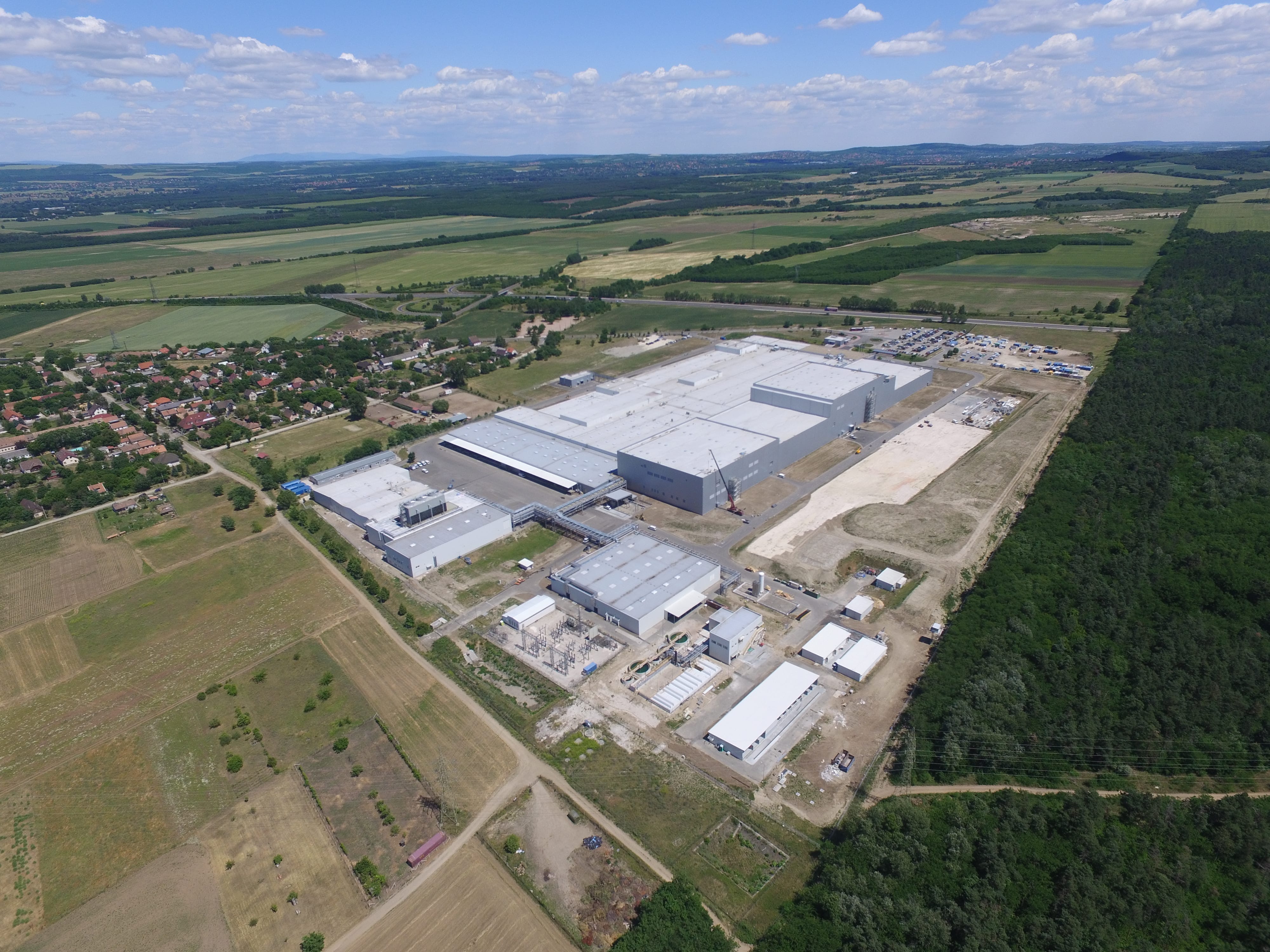
The mass of Samsung SDI’s battery plant rises beside a town that was never asked whether it wanted to become a symbol of Europe’s electric age. Residents live with the hum, the traffic, the rumours, the official reassurances. Zsuzsa Bodnár, a local journalist and environmental activist, told Le Monde that the noise barriers were not always enough to cover the “constant humming.” When locals were told that the smoke was only water vapour, she did not hear reassurance. She heard a reason to inspect more, not less. The factory uses around 30 hazardous substances, including nickel, cobalt, and manganese.
Another Göd resident, László Tóth, told Reuters that he watched large plumes of steam rise from the plant at night, a sight that turns official language into something intimate and frightening. “These battery plants were not supposed to be located next to human settlements but in deserts,” he said. “We did not need them. We used to have farmlands.”
Begin here, with the sound of Europe’s green transition beside somebody’s home.
Hungary’s battery boom was sold as the centrepiece of Orbán’s industrial future. In government speeches, it sounded clean and inevitable. Jobs. Technology. Sovereignty. A country pulling itself into the new electric age. In towns like Göd, the national triumph arrived as a decision made elsewhere. Factories came before answers. Workers carried the risks, residents carried the fear, and the state handled its deals with more care than the people living beside them.
Before anger hardened into politics, the battery boom had the shine of a national project. It gave Orbán’s ministers the language they liked best: jobs, investment, sovereignty measured in production lines. The ritual repeated itself across the country. A field became an industrial park. A foreign executive stood beside a Hungarian minister. Cameras caught the handshake, the hard hat, the ribbon, the announcement of another billion-euro future. In Budapest, each factory proved that Orbánism could still make the world come to Hungary. In the towns around them, the proof arrived more heavily, through traffic, noise, unanswered questions, and the feeling that the decision had already passed over their heads.
By the mid-2020s, battery production had become one of the government’s flagship economic projects, a way to sell Hungary as an EU manufacturing base for Chinese, South Korean, and German-linked electric-vehicle supply chains.
Then the miracle acquired a scent.
In Göd, the Samsung SDI plant turned the promise into a measurement. Átlátszó, a Hungarian investigative outlet, reported that official pollution data showed the plant released 88 tonnes of N-methyl-2-pyrrolidone, or NMP, into the air between 2019 and 2022. The name is dull enough to vanish on the page. The risk is not. NMP is a solvent linked to reproductive and developmental harm. Inside the plant, the numbers became uglier still. In 2021, workplace levels of nickel and cobalt reportedly exceeded permitted limits by factors of 10 and 20. Later reporting suggested that nickel-cobalt-manganese dust exceeded limits by up to 510 times.
Here, the economic miracle begins to leave a toxic residue.
Orbán’s government invited foreign industrial power in, backed it with public money, hurried the paperwork, and left Hungarian communities to fight for answers after the fact. Public money prepared the ground. The paperwork moved with unusual ease. By the time journalists, NGOs, workers, and residents forced real scrutiny into the open, the important decisions had already been taken. The government called it patriotism. Hungary building the future. Hungary attracting the world. Hungary refusing to be left behind. For people living beside the plants, modernisation arrived after their consent had been edited out.
Where the Promise Became Exposure
The disgrace was in the ease of it. The approvals moved quickly, the scrutiny remained thin, and local people were pushed to the edge of decisions that would shape the air, roads, noise and water around their homes. Industry supplied the image of national strength. The public was managed after the announcement.
Göd showed the sequence early. First came the investment, wrapped in the language of progress. Then came the permits, the official calm, the long struggle for documents. Journalists and NGOs had to pull the facts into daylight. Residents had to learn the vocabulary of chemicals and exposure limits. Workers remained closest to the danger, inside the factory that was supposed to prove the future had arrived.
Átlátszó reported that in 2021 and 2022, 133 workers at Samsung’s Göd plant were exposed to carcinogens on seven occasions. In 2023, another 44 workers were exposed to chemicals. Behind those numbers are shifts worked under fluorescent light, protective routines that failed, and bodies entered into official records only after exposure had already happened. At SK’s Komárom site, a gas leak hospitalised 14 people in January 2022. The company paid a HUF 1.5 million fine, about €4,000, a sum so small on the scale of the industry that it could be loose change.
That is why the controversy spread. What began in permits and subsidies ended in the air, in the dust, in wells, in factory shifts, in night noise, in waste streams, in lungs.
For years, Orbán’s critics had described corruption through contracts, loyalists, foundations, media ownership, EU funds and friends of friends. Many voters could push that away. Procurement scandals are complicated. Oligarch stories blur into one another. EU money can disappear into Brussels theatre.
The battery plants made the old accusations harder to brush aside. For years, corruption could be made to sound distant: a company registry, a procurement notice, an EU fund, another friend of another minister appearing in another contract. The battery boom brought it closer. It put the logic of Orbán’s Hungary at the edge of people’s towns, where it could be heard at night, smelled in the air, traced through exposure records, and felt in the private terror of parents wondering what their children were breathing.
You cannot call that Soros forever.
The Map of the Battery Boom
Outside Debrecen, CATL’s planned battery factory covers more than 220 hectares, roughly 300 football fields. The project was described as Hungary’s largest-ever foreign investment, worth about €7.7 billion. The Hungarian government committed nearly HUF 88 billion, around €227 million, in subsidies toward a HUF 3,000 billion development. Its first phase alone was projected to reach around 100 GWh of annual capacity.
The numbers showed what Hungary was being asked to become. Around Debrecen, the factory did not remain a factory. It began to pull the landscape into its orbit. Farmland, roads, power lines, water, permits, subsidies, labour, and even the silence of officials all began to bend toward battery production. The country was not simply hosting an industry. It was being reshaped around one.
CATL was only the beginning of what Debrecen was being asked to become. Around it, the rest of the battery world gathered. Separators, cathode materials, suppliers, roads, power lines, water needs, and promised jobs. Semcorp, another Chinese company, announced a €183 million separator-film plant and 440 jobs. EcoPro BM, a South Korean battery-materials company, planned roughly €715 million in investment in cathode materials, with reported production capacity of 108,000 tonnes. On paper, the figures had the grammar of development. In the towns and fields around Debrecen, they read more like a future arriving before consent.
The numbers kept swelling. Local media estimates put total state aid to battery companies at around HUF 1.5 trillion, about $4.2 billion, or 2 per cent of Hungary’s annual GDP. The state was betting a visible share of the country’s future on the battery chain.
And it spread. Göd had Samsung SDI, with around 40 GWh capacity by 2022 and a later planned expansion. Komárom had SK On. Iváncsa had another SK-linked battery operation and a “European validation plant.” Sóskút had Dongwha Electrolyte, a South Korean company planning two units, one for electrolyte production and one for NMP recycling, through a €32.1 million investment that would create around 90 jobs.
This new Hungary was presented as Orbán’s European triumph. Beneath it sat the familiar habits of his rule. Foreign capital above public interest, communities sidelined, favoured contractors near opportunity, oversight thinned, investors placed ahead of the people living beside them.
The Solvent State
NMP belongs near the centre of this story.
The name sounds technical, forgettable, bureaucratic. That dullness matters. It lets danger pass through public life as paperwork.
NMP does not need drama to be frightening. It enters through breath and skin. It follows the worker home in the ordinary language of exposure, limits, shifts, gloves, ventilation, pregnancy, and risk. A generous permit writes the uncertainty into daily life. How much vapour a worker may breathe. How much risk a pregnant woman should quietly carry. How much fear a nearby town is expected to absorb.
In Hungary, Átlátszó reported that the Pest County Government Office set the maximum NMP emission limit for Samsung’s Göd factory at 150 mg per cubic metre. The Komárom-Esztergom County Government Office reportedly authorised the same 150 mg/m³ limit for SK’s battery factory and NMP processing plant in Komárom.
The German figure cited in the research was 1 mg/m³. In Hungary, the reported limit was 150.
A number like that travels outward from the permit, into factory air, into local suspicion, into the quiet calculations of workers and families trying to decide what official reassurance is worth. The permit carried the hierarchy of the Orbán years in plain sight. Investment first, public health somewhere further down the page.
The Business of Being Close
The battery boom made the Orbán-era choreography of opportunity visible again. A major investment arrived, public money prepared the way, and private gain gathered near the project.
Direkt36 reported that the CATL project near Debrecen generated significant revenue for Verbau Kft., a company owned by Szilárd Benkő, described as a longtime friend of Péter Szijjártó. According to documents cited by the outlet, Verbau was awarded contracts worth nearly HUF 7 billion for construction work related to the factory. The reporting does not allege illegality or direct wrongdoing. However, the regime's proximity to it stands out like a sore thumb. A flagship state-backed project, public money, foreign capital, and a familiar name close to the contracts.
The CATL project arrived through channels Orbán’s Hungary had spent years perfecting. A government priority became a construction site. Public money softened the ground. Foreign capital supplied the scale. Around the edges of the project, familiar names appeared where access mattered most. In that world, proximity to the state was business logic. Opportunity moved through permits, procurement, obedient offices, quiet pressure and the discretion of people who knew which investments were meant to succeed.
Across the map, the pattern changed form without losing its character. In Debrecen, it appeared as land and subsidy. In Komárom: a gas leak, a fire, an explosion, and a fine. In Iváncsa, as noise and missing environmental procedures. In Sóskút, as waste.
The miracle, once paraded as green and modern, lingered in the air, in the land, in the permits granted, and in the promises that bound the political class to the factory floor.
The Towns Left Beside the Future
Resistance followed the factories.
In Debrecen, residents and farmers sued the Hajdú-Bihar County Government Office over the CATL factory’s environmental permit. They argued the plant posed pollution risks and should not operate so close to homes. The authority rejected the claims.
In Iváncsa, Átlátszó reported that SK On Hungary had been granted a licence for a “European validation plant” next to the battery factory, where safety testing and destruction of 124,000 battery cells and modules per year were planned. According to the report, the Hungarian authorities did not require the facility to be subject to an environmental and disaster management permit.
Residents complained for months about noise from the battery factory, just 600 to 700 metres from their homes. Six hundred metres is a short walk, the space between a factory and a bedroom window.
In Sóskút, a town about 20 kilometres west of Budapest, the battery chain took another form. Waste. Dongwha’s planned electrolyte and NMP-recycling units alarmed locals. A Heinrich Böll Stiftung report described significant quantities of waste being sent to Sóskút and noted that the mayor had to be escorted away by police after public outcry at a January hearing.
On the ground, the green transition looked like residents packed into town halls, mayors leaving under police protection, journalists chasing documents, monitoring questions, lawsuits, exposed workers, fines, disputed permits, and ministers still speaking of strategic success.
Around Debrecen, the resistance also became personal. Éva Kozma, president of the Association of Mikepércs Mothers for the Environment, told Le Monde that after her group requested documents on the factories’ environmental impact, the state’s sovereignty apparatus cast her as part of an alleged Soros network. “Then they labelled me a traitor to the homeland,” she said. “For my parents, who have always voted for Fidesz, you can imagine the shock it was to see their daughter portrayed as a foreign agent just because we asked the authorities for documents.”
The public anger came from a sacrifice imposed from above. People rejected the role assigned to them inside the clean European economy. Host community. Risk absorber. Taxpayer. Mute observer.
The Waste Nobody Wanted to Name
The waste question may be the most underdeveloped part of the public story, and potentially one of the most dangerous.
Research by Heinrich Böll cautioned that Hungary’s battery factories may be producing hazardous waste in quantities exceeding the country’s capacity to regenerate, neutralise, or recycle. According to the report, residues not managed by these methods may have been disposed of at both documented and undocumented locations, although public information on storage conditions and long-term waste management remains limited. These observations are based on available data and do not, in themselves, prove regulatory breach or legal noncompliance.
That warning carries weight, however. Environmental scandals rarely end when the smoke clears.
Air pollution surfaces first, drifting from headline to household. Workplace exposure becomes a campaign line, spoken at rallies and whispered in factory break rooms. Waste waits. It becomes hidden archaeology, unearthed later in files, landfills, transport records, and permits that faded into bureaucratic oblivion. Contaminated soil and cleanup costs quietly pile higher. The most expensive truths stay where power prefers them, in the ground, in the archives, and out of public view.
A new government will have to ask questions beyond a single factory or official, down to the choices that allowed these dangers to multiply.
Where did the waste go?
Who transported it?
Who was paid?
Which sites received it?
What was recorded?
What went unrecorded?
Which permits were granted without proper scrutiny?
And who decided that the public did not need to know?
Sovereignty for Samsung, Suspicion for Journalists
The pressure around the reporting revealed as much as any chemical reading.
Átlátszó reported that Telex had cited a leaked March 2024 document in which Samsung SDI management in Göd discussed possible measures to shut down Átlátszó or prevent it from continuing to report on the factory. The company reportedly expected the government to restrict Átlátszó’s work in some way. Three months later, the Sovereignty Protection Office, an Orbán-era body created to investigate alleged foreign influence, launched an investigation into Átlátszó.
Read that again.
A Hungarian investigative outlet reports on a foreign-owned factory. Management reportedly discusses ways to silence the outlet. A state body, invoking “sovereignty,” inspects the journalists.
That moment belongs to the twilight of Orbán’s era.
Sovereignty, in this usage, gave Hungarians no right to know what was happening in their towns. It gave the state a language for intimidating those who asked.
The contradiction proved fatal. Orbán’s government spent years warning about foreign interference, networks, money, and influence. When Hungarian journalists investigated a foreign-owned industrial giant, pressure fell on the press, not the company.
The word “sovereignty” had been emptied and refilled with bogus menace.
When Fidesz Voters Started to Suspect
The battery factories did not bring Orbán down on their own. That would be too neat, and too false.
His downfall came from a wider collapse of trust. Inflation, exhausted public services, corruption fatigue, EU isolation, the pardon scandal, foreign-policy arrogance, and the sudden rise of an opposition movement capable of turning resentment into power. The battery boom gathered those failures into a story people could see, smell, measure, and map.
It struck Orbán where his mythology was supposed to be strongest.
The scandal cut into the roles Orbán had spent years writing for himself. His family politics now sat beside fears about reproductive toxins. His sovereignty politics sat beside dependence on the Chinese and South Korean giants. His labour politics sat beside imported workers, wage pressure and crowded dormitories. His economic miracle sat beside subsidies and public anger.
By early 2026, the political damage was visible. Le Monde reported that the controversy over the battery industry had become a central element of Tisza’s campaign. Péter Magyar interviewed a former employee of the Göd plant who spoke about serious abuses and health risks. In Debrecen, Tisza’s local candidate Zsolt Tárkányi publicised alleged irregularities and claimed that at least two employees had suffered poisoning. Tisza launched a petition calling for a public investigation and for those responsible to be identified directly and politically.
Then came the polling.
A poll cited by Le Monde found that 72 per cent of Hungarians believed government officials were likely aware of the health risks at Samsung’s Göd factory.
An environmental scandal becomes a scandal of power when voters begin to suspect that the state knew.
The Moment Corruption Got a Body
By then, the old language of scandal had changed texture.
Corruption became a construction contract. Sovereignty took the shape of a Chinese mega-plant.
Family policy became a question about reproductive toxins.
For the better part of a decade, Orbán’s government decried illegal immigration, casting itself as Hungary’s protector. Meanwhile, as the battery industry grew, the state issued nearly 100,000 new work permits to non-EU nationals from 2019 to 2025, tripling previous numbers. Workers arrived from Vietnam, Indonesia, Mongolia, and beyond to staff plants in Göd, Debrecen, Iváncsa, and Komárom. The Hungarian Trade Union Confederation found that many earned just 60-70 per cent of the local average wage and lived in crowded dormitories. Unions and NGOs noted that the influx of foreign labour pushed down wage offers for Hungarian applicants. In battery towns, job postings listed pay below past rates. Researchers observed that manufacturing wages stagnated or fell, even as the state poured in subsidies.
The worker's story has its own silence. At BYD’s Szeged site, Chinese migrant workers told The Guardian of seven-day working weeks, excessive overtime, recruitment-related debt, and crowded dormitories. One Chinese worker said some employees choose to work seven days a week because “only those who come from China choose to.” Asked what conditions were like inside the site, another worker replied, “Nothing out of the ordinary, when you’re a migrant worker.” A Szeged resident put the other half of the question plainly. “As a resident of Szeged, I feel that there was not enough information.”
The official rhetoric of protection gave way to a harsher reality, with cheap labour, weak disclosure and industrial speed doing the real work.
Economic competence shrank into subsidies for industries facing public anger. Towns protested, sued, documented, and still remained unheard. Brussels, Soros, liberals, migrants, NGOs. The old vocabulary kept conflict at a distance. The enemy was always somewhere else.
The battery scandal brought the conflict home.
The argument over the rule of law moved from courtrooms and reports into vents, air, workers’ breathing, permits, company measurements, state knowledge, and public experience.
Orbánism had always asked Hungarians to tolerate indignity in exchange for stability. The battery boom revealed the next demand. To absorb the risks of investment.
That was harder to sell.
Europe’s Dirty Workshop
Europe’s battery rush found in Hungary a place where it could move faster, cheaper, and with fewer questions.
The European Union’s Green Deal and commitment to electrification created pressure to build battery production capacity and strategic supply chains inside Europe. The official language was technological sovereignty and climate necessity. On the ground, countries competed to host the industrial mess behind the clean image of electric mobility.
Germany and France brought stricter standards, stronger oversight, and more institutional scrutiny. Hungary offered incentives, flexibility, political centralisation, lower labour costs, and speed. For companies seeking an EU production base away from Western European resistance, that package had obvious appeal.
Europe wants electric cars, supply chains closer to home, and less dependence on Chinese imports while still relying on Chinese technology, capital and production capacity. Hungary gave that contradiction a convenient address, inside the EU, cheaper than the West, politically centralised, strategically eager, and willing to move fast.
Orbán understood the bargain.
To Europe, Hungary could be a battery hub.
To China and South Korea, it could be a subsidised production base inside the EU.
To German carmakers, it could be a nearby supply chain.
To Hungarian voters, it could be sold as national success.
Beneath those overlapping promises waited a harder reckoning. The failure was not the ambition to build a cleaner economy. It was the bargain Hungary made around the factories, and the way that bargain passed through a state shaped by entrenched interests, weak oversight, and contempt for local consent.
The clean image of electrification could be sold in Berlin, Brussels and Paris. The solvents, dust, dormitories, water anxiety, and public hearings were left to towns that had already discovered the future had been approved.
In Orbán’s Hungary, public purpose kept becoming a private opportunity.
What Must Now Be Opened
For the new government, this is a test.
Investigating Orbánism through spectacular scandals will be easier. Villas, foundations, propaganda contracts, pardon files, oligarchs, ministries, media empires. The battery state demands a deeper inquiry into the development model itself.
Not just who got rich.
Who was exposed?
Who approved the permits?
Who set the NMP limits?
Who decided that 150 mg/m³ was acceptable?
Who inspected the factories?
Who saw the reports?
Who knew about workplace exposure?
Who compared the company’s internal measurements with official submissions?
Who accepted fines that looked microscopic beside the scale of the projects?
Who tracked the waste?
Who protected the journalists?
Who threatened them?
Who told towns that the future had already been decided?
And perhaps the most uncomfortable question. How much of Orbán’s Hungary was built on the assumption that ordinary people would simply absorb the cost?
The Poisoned Miracle
Follow the factories and the Orbán years become legible. Foreign capital flowing in, public subsidies lavished, familiar intermediaries near the contracts, oversight grown thin, secrecy spreading, intimidation practised, propaganda refined, and local communities left at the edge of the spectacle.
Orbán’s fall did not come from a single plant in Göd or a construction site outside Debrecen. Yet these places shone a light on what the country had lived under. This was a government fluent in the language of nationhood, yet practised in the art of exemption; a state that exalted investment, yet distrusted its own people; a politics that wore the mask of protection while asking citizens to live with risks they could never fully understand.
Hungary was promised the future.
Some towns received solvents, toxic dust, noise, lawsuits, police-escorted hearings, and silence.
This is the bitter dividend of the miracle.
Sources and Further Reading
Main reporting and investigations used for this article:
Le Monde: “The battery plant scandal that could scuttle Viktor Orbán’s election campaign”
Reuters: “Hungary PM Orbán’s battery bet turns into election headache”
Direkt36: “Szijjártó’s old friend made billions from the Debrecen battery factory”
Background on the battery boom and major investments:
How horrible & typical of wealthy elites & corrupt politicians. Regular people always matter, their health, their security and their environment. I bet none of these plants are anywhere near any of the corrupt classes homes. It is time the corrupt are all reined in fined and all power taken away from them.
Exhaustive essential research and deep reporting by Peter Dosa , Orban’s Poisoned Miracle .
A serious government/oligharchical overreach and the consequences upon its citizens suffers a community of land owners of which may never resolve or restore their lives ever after . Just the continuous slow death of a community with contracts for more harm and the silencing of anyone who wants at the truth. This is a familiar situation playing out here in America with it's AI plants all the same with some successful push back from the people, for other communities not so .
The section of this reporting on What Must Now be Opened should be the starting point to any endeavor on such a large scale as this battery/AI plant/America. Then maybe just maybe countries around the world can call themselves real and responsible innovators.
When something sounds good to you don't fall for it go deeper and find if research says otherwise