

Orbán’s Late-Stage Election Playbook in Hungary
Security dramas, foreign interference claims, and an uneven political playing field are defining the final stretch of Hungary’s election campaign.

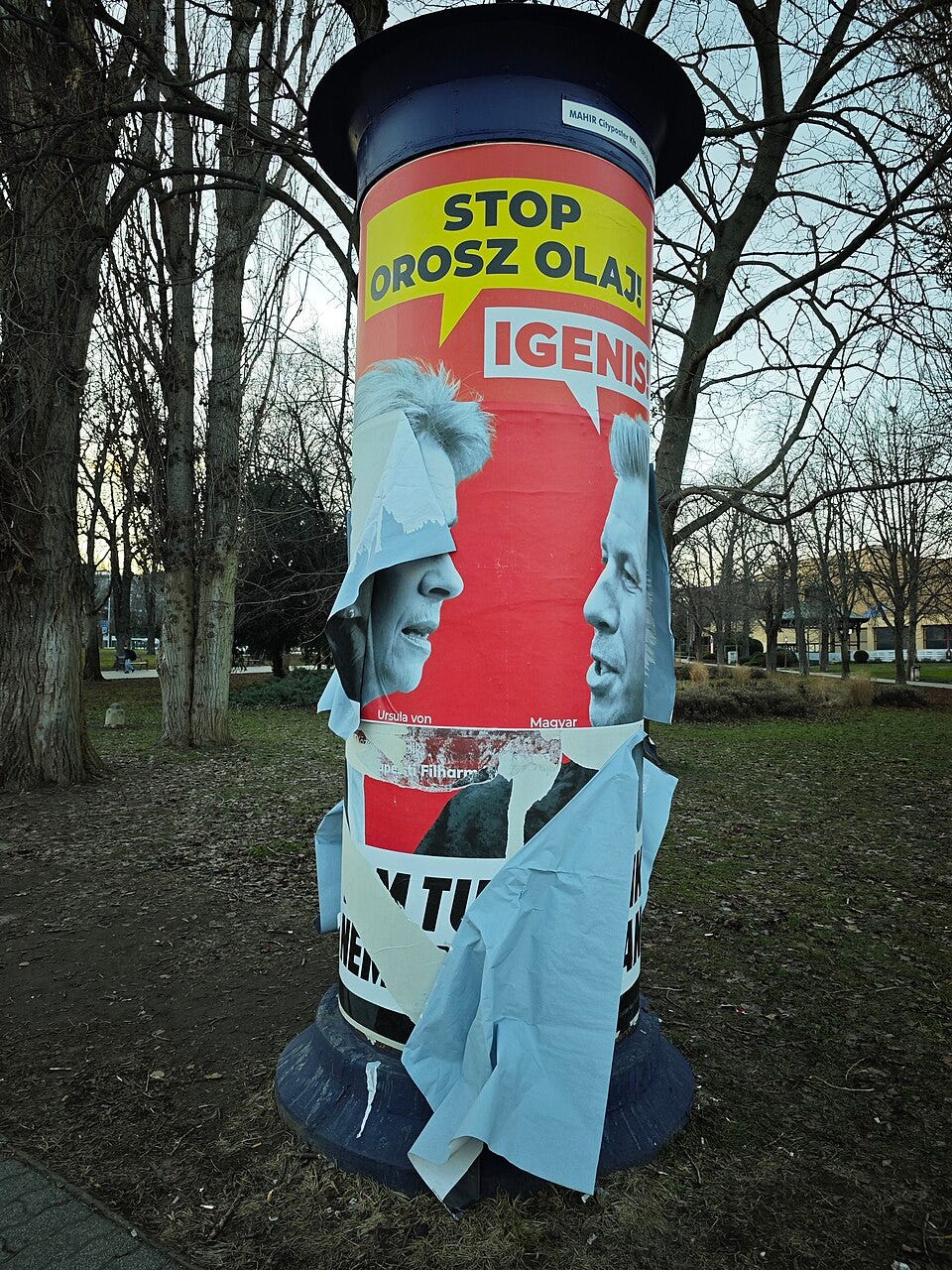
Orbán’s “war or peace” playbook frames Hungary’s election as a national survival contest, normalising competitive authoritarian tactics within the EU. By blurring state–party lines, freely using public resources, and dominating the media environment, the government treats crisis management as routine. With the election closing in, Hungary is split and increasingly jittery. OSCE/ODIHR is already flagging an uneven field and warning that the opposition is boxed in at every turn. The campaign shows how pressure shapes the choices available to both sides.
Two key events in early March reinforced the story of external threats. Hungary detained seven Ukrainian cash-in-transit workers and seized a convoy with $40 million, €35 million, and 9 kilograms of gold. The National Tax and Customs Administration launched a money-laundering investigation, bringing in its Counter-Terrorism Centre (TEK). Second, an investigative report claimed Moscow sent GRU-linked “election fixers” to Budapest. This claim is based on anonymous sources and has not been independently confirmed. Our labelling keeps “documented” facts (the convoy seizure) distinct from “unverified” allegations (the Russian operatives).
Timeline of recent moves
Oct 2025
Move: “State of danger” extended to May 13, 2026
Mechanism: Governing by decree
Likely effect: Emergency flexibility covers the campaign.Nov–Dec 2025
Move: Pension top-up announced
Mechanism: Fiscal sweetener
Likely effect: Buys votes among retirees; locks in costs.Jan 2026
Move: “National petition” mailings & “war or peace” posters
Mechanism: State communications + advertising
Likely effect: Re-centres the campaign on geopolitical fears.Late Jan 2026
Move: Ukraine “election meddling” accusation; envoy summoned
Mechanism: Diplomatic clash
Likely effect: Converts criticism into a sovereignty issue.Feb 2026
Move: OSCE/ODIHR flags unfair conditions
Mechanism: International review
Likely effect: Highlights incumbency advantages such as media bias and administrative resource use.Mar 5–6, 2026
Move: Cash/gold convoy seized; Ukrainians detained, then expelled
Mechanism: Security operation
Likely effect: Creates a made-for-TV “foreign threat” episode.Mar 6, 2026
Move: Report alleges Russian “election fixers” in Budapest
Mechanism: Covert influence claim
Likely effect: Adds another interference narrative (unverified).
Tactics to tilt the playing field
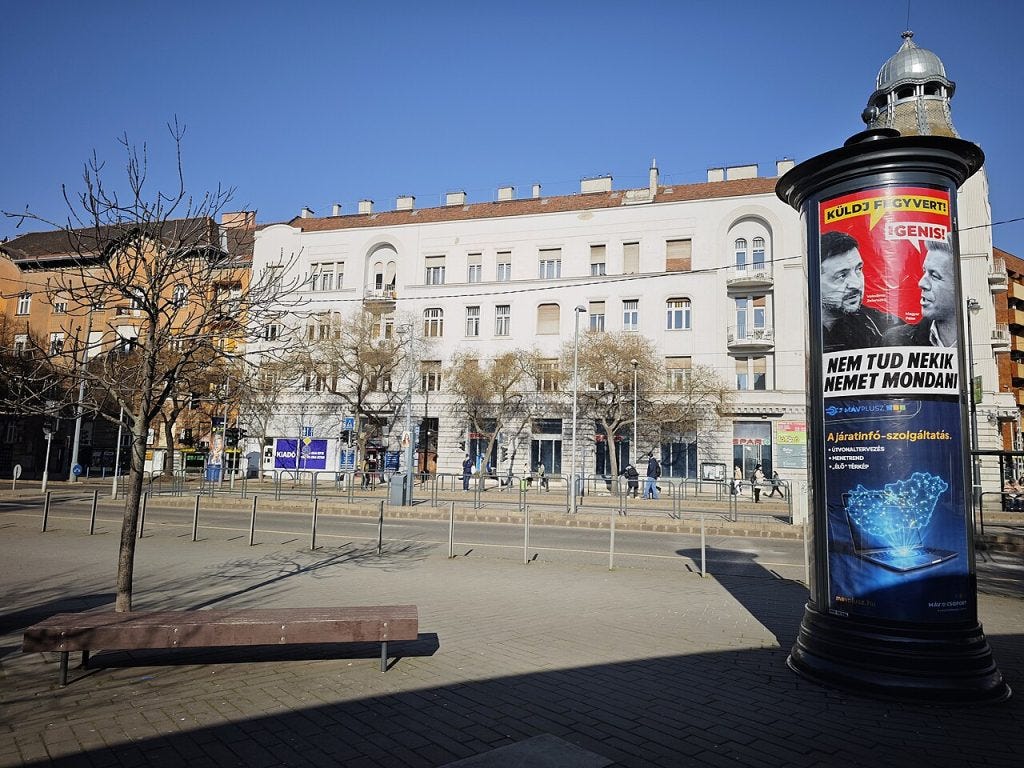
The late-stage strategy is simple: define the terms of debate and force opponents to fight inside that frame. Threat manufacturing is the anchor. For example, Reuters describes the “national petition” as a mail campaign urging Hungarians to reject EU aid to Ukraine, implicitly branding opponents as “pro-Brussels/pro-war”. Meanwhile, the Druzhba pipeline dispute ties this frame to daily life: “peace” is pitched as stable energy and prices, while dissenters are blamed for risking external coercion.
Fear appeals: The government highlights real concerns but dramatises them. By focusing on hypothetical dangers, it blurs the line between fact and fear. This framing has shifted opinions: in a March Medián poll, the share of voters citing “war or peace” as the top issue rose from ~24% to 41%. State media and Orbán’s campaign kept “war or peace” as a constant backdrop, forcing the opposition into a defensive posture.
Vote-buying: Pre-election handouts are precisely timed. Reuters reports the pension “top-up” was announced now to grab headlines, with its cost deferred to future budgets. State-aligned media guaranteed saturation coverage, turning these giveaways into de facto campaign ads. By spending selectively on large voter blocs (such as retirees), the government in turn gains short-term votes but burdens any successor government.
Media dominance: The incumbency advantage is structural. EU monitors note that state advertising accounts for over 30% of the market. Meanwhile, the pro-government media conglomerate (KESMA) captures about 75–80% of that spending. There’s no watchdog making sure coverage is fair or transparent. The government’s line sets the tone on big TV and print, while the opposition is pushed to the margins, barely getting a look-in.
Legal entrenchment: Electoral rules have been locked in the incumbent’s favour. The “state of danger” covers the campaign, allowing new rules to be imposed by decree. Legal experts note that the election date itself cannot be postponed once set; however, emergency powers can still change campaign regulations or restrict rallies. ODIHR also observes that public officials face no legal ban on campaigning and can use administrative resources, giving Orbán’s side an effective legal green light.
Constitutional locks: Key rules (such as district boundaries) are codified under supermajority requirements. The Venice Commission warned that fixing constituency maps in “cardinal” law (requiring a two-thirds vote to change) makes future reforms extremely difficult. The 2022 map thus remains enforced regardless of this election’s outcome, embedding the incumbent’s structural edge.
The Oschadbank convoy case
This March incident became a media spectacle despite many open questions. Hungary’s customs authority says it detained seven Ukrainians and two armoured vehicles carrying $40 M, €35 M, and 9 kg of gold en route from Austria to Ukraine. It alleged a former Ukrainian security officer supervised the transfer and that its Counter-Terrorism Centre led the operation. In short, NAV called it a major counter-espionage case.
Ukrainian state bank Oschadbank tells a different story: the convoy was a routine cash transfer between Raiffeisen Bank Austria and Oschadbank Ukraine under an international agreement. It describes the detention as an unlawful “kidnapping” of its staff. Oschadbank even cited GPS data placing the vehicles at a Budapest security agency, implying Hungarian authorities knew exactly what they were doing.
AP reported the Ukrainians were released the next day, while Hungary kept the cash and gold. Reuters noted Hungary planned to expel them. Crucially, none of the underlying evidence has been made public – no court filings or published warrants. The money-laundering charge exists only in official statements. That legal grey zone gives the government weeks of headline-grabbing security drama—while the real details stay buried in the fog.
The Russian interference claim
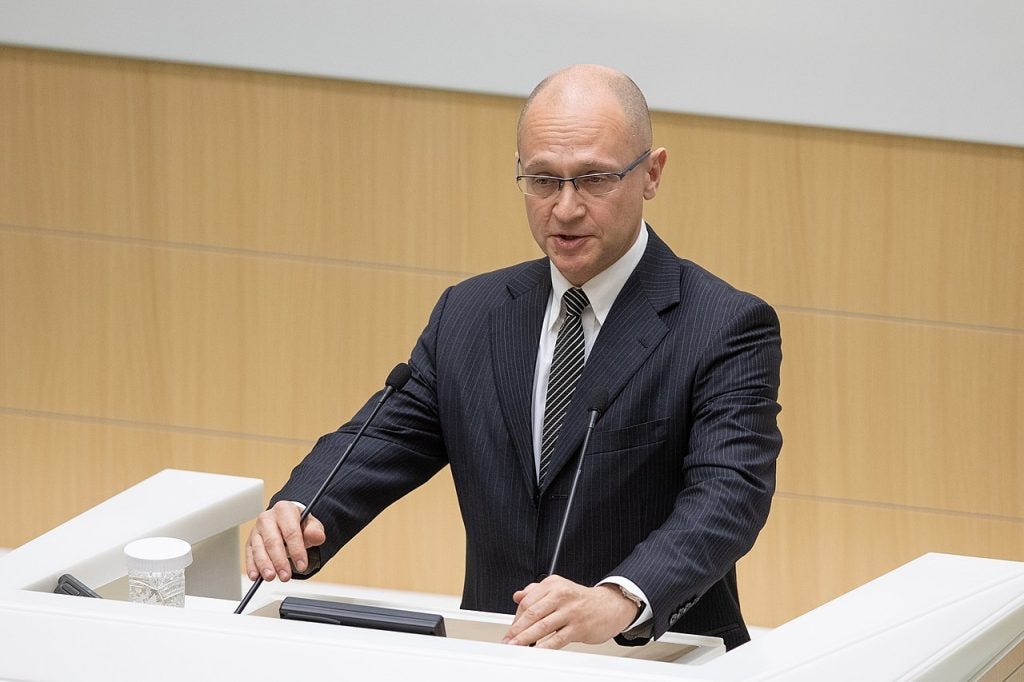
On March 6, investigative outlet VSquare reported that a GRU-linked team was operating in Budapest to help Orbán’s campaign. It alleges three operatives, under diplomatic cover at Russia’s embassy and overseen by Presidential Envoy Kiriyenko. If this holds, it’s Russian meddling in Hungary—out in the open, and on a whole new level.
For now, it’s just smoke—no names, no charges, no proof. The story weighs on the campaign, but hard facts are still missing. The information comes from anonymous sources and has not been confirmed by Hungarian or Russian authorities. In Hungary’s highly controlled media, Orbán’s side will likely dismiss it as a smear. Analysts note that modern influence operations can be subtle: OSCE/ODIHR warns that third-party and online campaigning are hard to track in real time. Even unproven allegations can muddy public perception, fitting into the government’s broader “outsiders vs Hungary” narrative.
Zelensky’s interventions
Ukraine’s President Zelenskyy has unintentionally fed Orbán’s narrative. At Davos, he quipped that any leader blocking European aid “deserves a smack”. Days later, he said Ukraine would give Orbán’s “address… to our armed forces” if aid were blocked. Hungarian media instantly cast these comments as direct shots at Orbán, and the government didn’t miss a beat. Team Orbán’s message is simple: this election is about shielding Hungary from foreign hands. It’s a narrative that pays off—every outside critique gets spun as another sign Hungary is under siege, feeding the government’s playbook.
Unresolved uncertainties
Convoy evidence: Still locked away. Beyond official lines, there’s no sign of warrants, bank records, or court orders—just a lot of unanswered questions.
Russian fixers: This allegation is based on anonymous intelligence leaks. No public documents or diplomatic notes confirm it.
Campaign dynamics: On the ground, OSCE/ODIHR is flagging the tilted field and the risks of foreign meddling. But how much it all adds up to is anyone’s guess—the true impact is tough to pin down.
Hungarians have the final say in a mere 33 days. But when the system is this stacked, does the ballot box still mean what it should?
Originally published on The Hungary Report, where I publish independent analysis of Hungarian politics and EU affairs.
Excellent analysis, Peter—your breakdown of Orbán’s “war or peace” framing and the way it weaponizes fear through manufactured threats like the Oschadbank case is spot on. It’s deeply concerning how these tactics, combined with media dominance and vote-buying, are eroding democratic norms right under the EU’s nose. Hungary needs more voices like yours calling this out before it’s too late for fair elections. Keep up the vital work!