

Opinion: The End of the Strongman Spell
For sixteen years, Viktor Orbán turned Hungary into the authoritarian right’s model state. If he loses on April 12, the myth of strongman inevitability may crack with him.

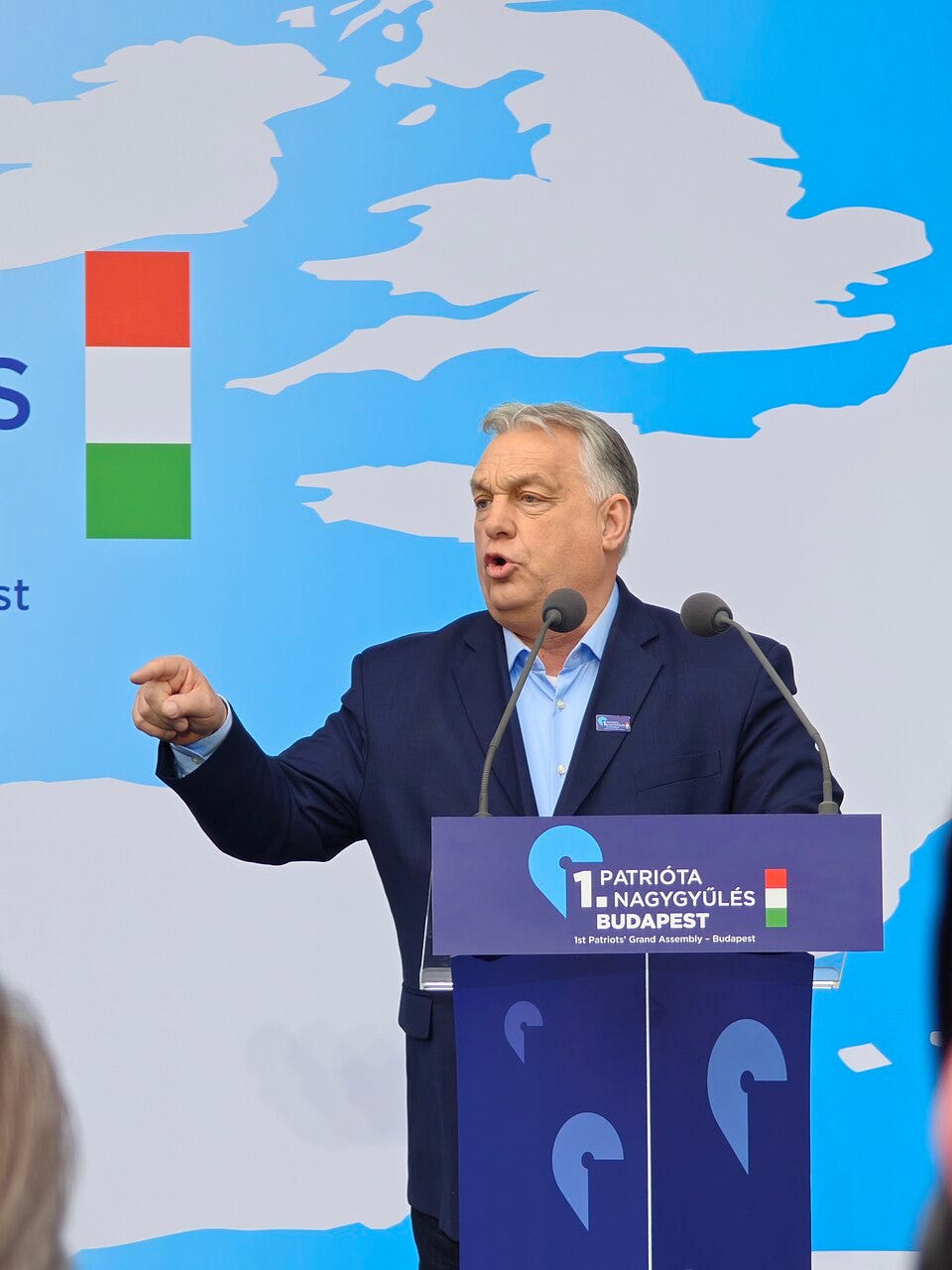
Something is wrong in Budapest, and you feel it before you can name it. The trams run. The cafes fill. The Danube moves through it all, indifferent as ever. The spring light falls on the Chain Bridge the way it always has. Then you look up.
Where is he? Sixteen years of omnipresence. The face on every surface, the voice on every channel. And Viktor Orbán has simply disappeared from his own election campaign. What replaced him is stranger than his absence. In his place: Zelensky. A wartime president who has held his country together against a nuclear superpower for four years, and is doing it rather well. Turned into a bogeyman by the government that claims to be protecting Hungary from him. The message is not meant to make sense. It is meant to make you stop thinking.
It is not working.
There is silence about stagnant wages, collapsing hospitals, and shrinking towns. The slow ruin of a country that Fidesz has governed for nearly a generation. After sixteen years, the ruling party has run out of things to say about Hungary itself. All that remains is the threat, the enemy, and fear, doled out in careful portions until election day.
This year’s most consequential European election takes place in an often-forgotten country right in the centre of Europe. For sixteen years, Fidesz did not govern Hungary. It consumed it. Courts, universities, the civil service, media, money: bent, captured, or hollowed out, one institution at a time, until the line between party and state stopped meaning anything at all.
And what happens here will not stay here.
If Orbán loses on April 12, it will not just be a Hungarian upset. It will mark the first major electoral defeat of the authoritarian right’s most successful European prototype. Budapest has become a pilgrimage site for this reason. No one comes for the goulash. They come because Orbán is the exhibit they point to when they need proof that their project can work. Lose the exhibit, and the argument begins to wobble.
That is why Marco Rubio turned up in Budapest, dispensing blessings and hints of financial support. J. D. Vance is expected next. Trump has already appeared by video to offer his ‘complete and total endorsement.’ Europe’s nationalist right keeps arriving, treating Budapest less as a capital than as a shrine. They are not here for friendship. They come because they know exactly what an Orbán defeat would mean.
The method
For sixteen years, the world watched Hungary and drew the wrong conclusion. A populist kept winning elections, so the world assumed the explanation was popularity. It was not. It was architecture. A state rebuilt, piece by piece, to make losing impossible.
This election is a referendum on that architecture.
Orbán’s real export was never policy. It was a method.
The method is straightforward, once you see it. You do not abolish democracy outright. Too obvious. Too messy. You keep the shell. Elections are held. Parliament sits. Flags flutter. The anthem plays. Everything looks democratic from a distance, which is the point. Then, quietly and patiently, you hollow it out from within. The courts are bent. The media is captured. The opposition is starved. Loyal oligarchs are rewarded. Dissent is punished. The state becomes a weapon, rebranded as governance. The republic is wrecked, and the paperwork looks perfectly routine.
Orbán even gave this formula a brand name: “illiberal democracy.” The honest translation is authoritarianism with better PR.
Hungary became the showroom. The place where aspiring strongmen could watch how to dismantle a liberal democracy without ever quite admitting that is what you are doing. Seize the state. Grind down dissent. Saturate the public sphere with propaganda. Enrich your friends. Leave just enough of the democratic furniture that no one can quite prove the house has been robbed. Then sell the whole thing as respectable conservatism. That is what made him indispensable to the international right. Hungary was not just a country. It was a proof of concept.
Once you see this, the parade of admirers makes perfect sense. Geert Wilders came. Santiago Abascal came. Alice Weidel of Germany’s AfD stood in Budapest attacking Ukraine as ‘the most corrupt regime on Earth,’ as if she were not standing inside the most corrupt state in the European Union and parroting Kremlin talking points almost word for word. Javier Milei flew in from South America. Benjamin Netanyahu endorsed Orbán by video. They were not there out of concern for Hungarian village life or the fate of the country’s public hospitals. They were there because they know exactly what it costs when the model fails.
That is why April 12 unnerves them. Orbán may lose, even inside a system built to guarantee Orbánism.
This is not a fair contest. It never was. The party and the state share the same wallet, the same offices, and increasingly the same face. There is no campaign budget because there is no separation between the two. The treasury is the fund. The state is the machine. On TikTok, pro-Fidesz accounts multiply daily, churning out AI-generated filth aimed at Magyar and anyone else who might still be reached. Fake screenshots. Doctored videos. Invented quotes. Staged hysteria. Russian propagandists and digital assets reportedly deployed to keep Orbán afloat. Someone even registered as an independent candidate under the name Péter Magyar in a rural constituency, hoping to siphon votes from the real one. This is not electioneering. It is an occupation.

The spell
For sixteen years, his greatest achievement was never victory itself. It was making defeat seem structurally impossible.
That is what strongmen need above all: inevitability. They must appear immovable. Permanent. Too deeply embedded to be removed. Their supporters must feel safe in that permanence. Their opponents must feel exhausted before the contest even begins. The idea that nothing will ever change here is the system’s central achievement. It is also a lie. In Hungary, in 2026, the lie is running out of road.
When a government stops talking about the economy, the economy has already delivered its verdict. Orbán has nothing to say about three years of near-stagnation, industrial output in freefall, or a deficit that burned through nearly 40 per cent of its annual target before March. So he says nothing. The silence is the confession.
The statistics fill it. Somewhere in Hungary tonight, a patient is waiting too long. Not because the doctor does not care. Because the system was never fixed, never funded, never prioritised. Hungarian life expectancy sits 4.4 years below the OECD average. That gap has a name. It is called policy. Diseases go undetected because the money went elsewhere. Treatment arrives too late for the same reason. The hospitals are open. Barely counts.
Public services are decaying. The population keeps shrinking. Even the old slogans have lost their sting. The migrant invasion never arrived. Brussels did not destroy Hungary. The hospitals, however, are managing that task quite well on their own.
One story captures the texture of this better than any statistic. Until very recently, Hungary’s flagship national psychiatric institution, the country’s official centre for mental health, was run by a man with no psychiatric qualifications whatsoever. What he did have was a background teaching astrology and magic at the Nimród Academy of Life Philosophy. Under his leadership, forty doctors signed a petition. Fifteen specialists resigned. Two patients died by suicide in a single weekend. The staff had been sending warnings to the ministry for years. The ministry did not reply. He resigned in March 2026, two weeks after the suicides, only after the story broke publicly. The institution is still open. That is, at this point, the most that can be said about it.
So the regime needs a new enemy at the gate.
Ukraine will do.
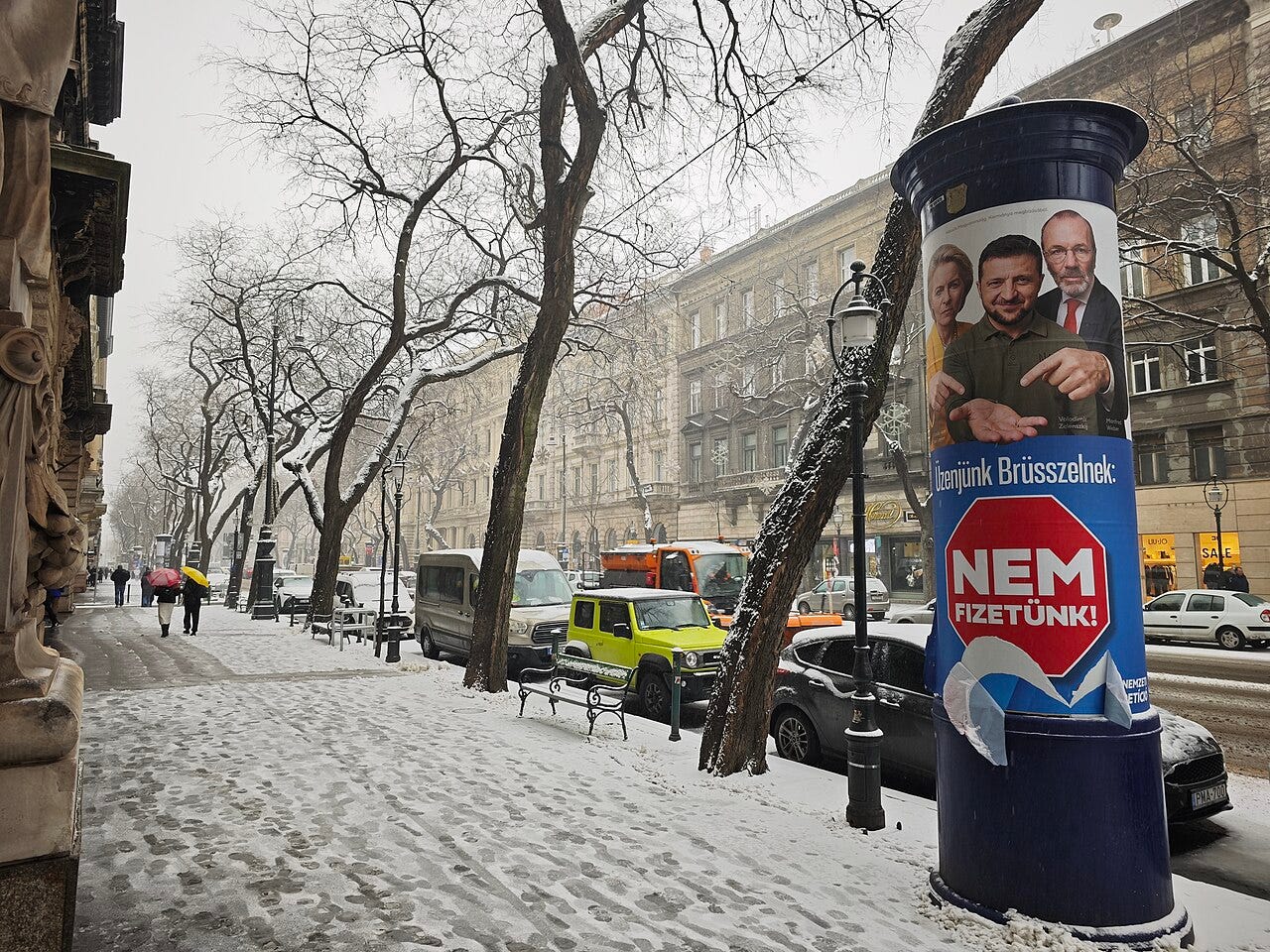
The threat was never meant to be believed. It was meant to be felt. Fear does not require evidence. It requires repetition, volume, and a closed information environment. The content does the rest. Zelensky on a golden toilet. Zelensky snorting cocaine. Zelensky plotting Hungary’s destruction from somewhere vaguely foreign and vaguely sinister. Fabricated Magyar clips. Fake war scenes. Cartoonish humiliation rituals. Designed not to convince but to contaminate. Saturate the public long enough, and reality itself starts to blur. Which is not a side effect of the strategy. It is the strategy.
A deliberate assault on the shared sense of what is real, conducted at scale with state resources before a single ballot is cast.
The enemies change on schedule. Migrants. Brussels. Soros. Gender ideology. Now Ukraine. Each one arrives just as the last has worn out its usefulness. The method never changes. Find the threat. Stoke the fear. Call yourself the wall.
The propaganda is the smaller part. The real ambition is to overwrite reality itself before voters reach the ballot box.
That is why this election matters so far beyond Hungary.
The morning after
Winning is the easy part. What comes after is harder, slower, and far less photogenic. A captured media landscape does not rebalance itself in a weekend. Patronage networks do not dissolve just because voters have had enough. Sixteen years of deliberate construction leave a particular kind of wreckage. Engineered, from the start, to outlast any single election.
The machine does not leave with the man. The courts stay bent. The loyalists stay embedded. The oligarchs keep their contracts. The newsrooms remain captured. None of it gets undone by one good night at the ballot box. Whoever inherits Hungary inherits the wreckage. And the hard, slow, unglamorous work of rebuilding institutions that Orbán spent a decade and a half hollowing out. Nobody will be watching that part. There will be no crowds.
Budapest is not the end of this story. It is the test case. If a system this fortified, this deeply wired into the state, can be dismantled by voters inside the rules it designed for itself, then every strongman who studied the Hungarian model has a problem. The playbook has a flaw. The exits were always there. That would matter in Washington. It would matter in Warsaw. It would matter in Paris, in Rome, in every capital where ambitious little Orbáns are quietly constructing their own versions of the same machine. The lesson would not be that authoritarianism is finished. It is far from finished. The lesson would be more unsettling: even a system rigged entirely in its own favour can, in the end, still be beaten. The outcome is not always written. The certainty was always performance.
What it means
For ordinary Hungarians, none of that is the point. The point is simpler and more personal. Wages that never recovered. Hospitals that never got the money. Schools that never got the investment. Towns that kept emptying. Newspapers that either vanished or became something you could not trust. For those who relearned the habit of lowering their voices when politics comes up. For those who stopped expecting things to get better and, somewhere along the way, stopped noticing they had. For them, an Orbán defeat would not be a grand philosophical event. It would be something more basic. Proof that the system can be shifted. Proof that permanence was a fiction. Proof that fear is not consent. Proof that the country does not belong, indefinitely, to one man and his cronies.
Sixteen years. He used them to loot the state, capture the courts, silence the press, and call it governance. The hospitals rotted. The schools emptied. The young left. The money went to his friends. And he stood in front of it all, wrapped in the flag, and called himself Hungary. He was never Hungary. He was what happens when a small man with a big ego is left alone with a state for too long.
April 12 is thirteen days away.
I’m just hoping this guy isn’t a Trojan Horse. We’ve seen this movie before. We have several of them serving in the US Senate as Democrats; voting in lock step with MAGA on key issues.
Not to mention, we already have a Putin marionette dancing around the Oval to the tune of YMCA; so……🤪
I have an idea. Trump and MAGA have endorsed Orban. All democrats need to do is start an ad campaign of what a decade of of management under an authoritarian kakistocracy can do to a nation.
Hungary is a perfect example of a failed European state from the perspective of economic prosperity. Hungary’s economy is consistently at the bottom fifth EU in economic health, and wealth. Its infrastructure is in shambles and the only reason they are a viable state is because of Orban’s extortion racket—$98 billion in EU loans to allow the EU to arm and fund Ukraine’s defense from the Red Menace.
Bottom line, Orban is running an extortion racket; otherwise, Hungary would be far worse economically than they are currently! IMHO…:)