

I Don’t Know Where I’m Going. But I Know I’m Not Going Backwards.
Six months of writing, questioning everything, and slowly finding my way back into the world.

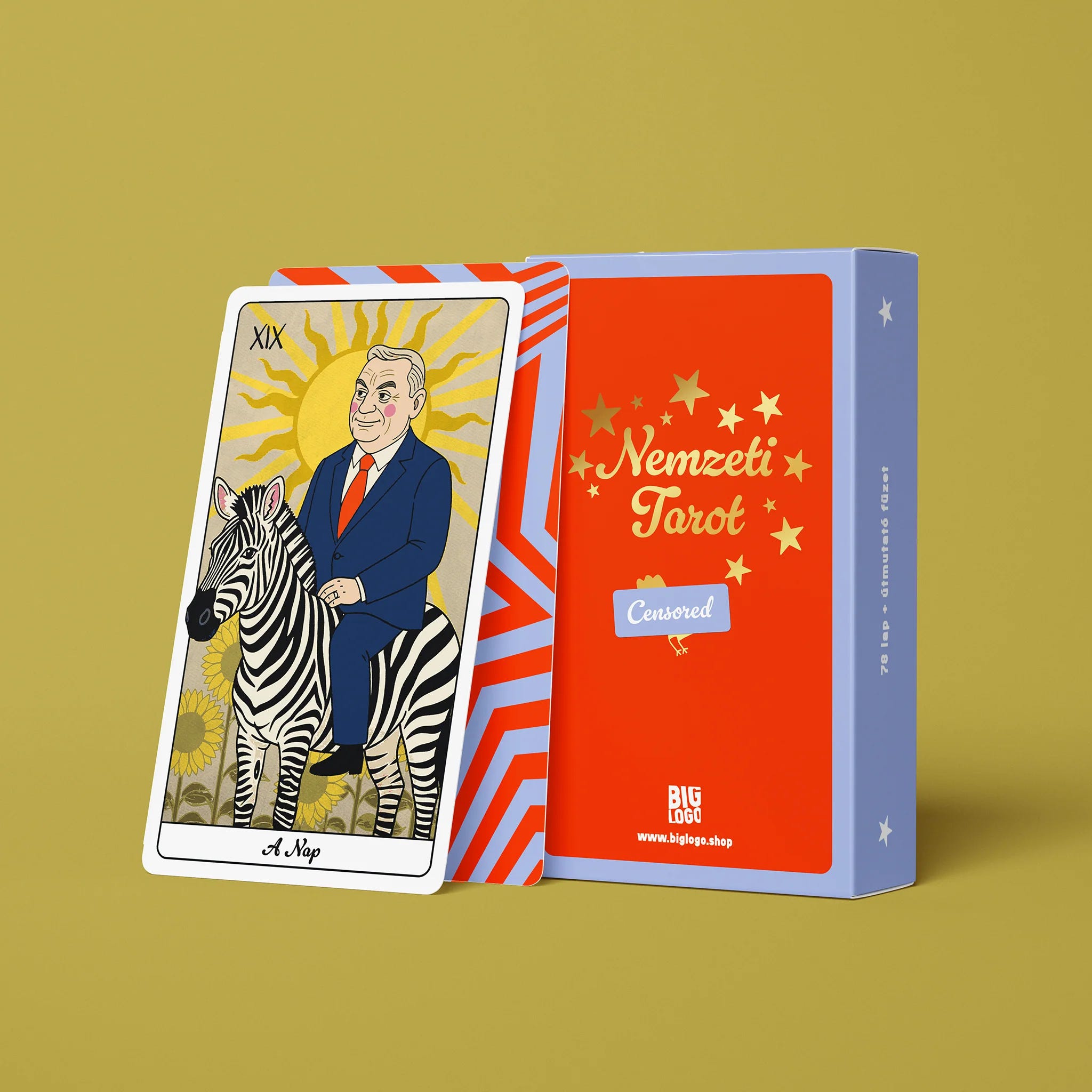
A few weeks ago, I found myself emailing Kim Lane Scheppele about where I could get my hands on a deck of Hungarian political tarot cards.
This was not where I expected my year to go.
The serious conversation had already happened. Rory Truex had invited Kim and myself onto the Civic Forum to talk about Hungary, democratic recovery and what people elsewhere might learn from the country trying to rebuild itself. We recorded the conversation, Rory went on holiday, and when he came back, he emailed us the links.
Kim replied to the thread. She mentioned that she had been reading my commentaries on Hungary, which was already quite surreal for me, and then sent us one of her favourite cartoons from the election.
Rory laughed.
I laughed.
Then Kim sent more.
There was apparently an entire collection of tarot-style cards featuring Hungarian political figures. The incoming health minister dancing. The outgoing foreign minister. Péter Magyar. Judit Varga, his ex-wife and Hungary’s former justice minister, with a nod to the carpentry she took up when she left politics.
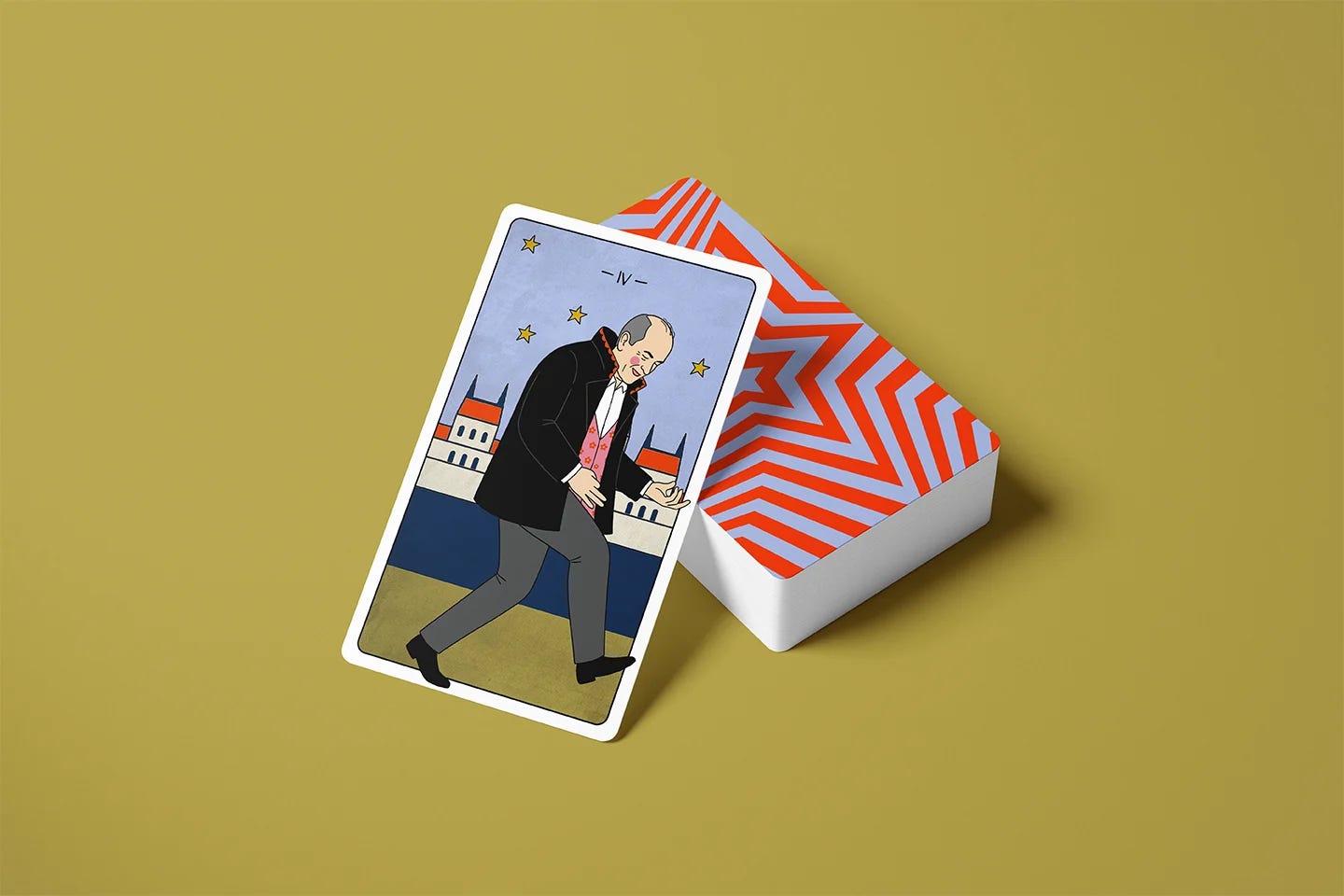
By this point, I had completely lost it.
I wrote back saying the meme and the cards were still cracking me up and that I wanted to get my hands on the collection. I also wrote something that had been floating around my head for a while: one of my favourite things about Hungarian politics right now is that it is allowed to be fun again.
Kim replied with the link to the full Nemzeti Tarot set.
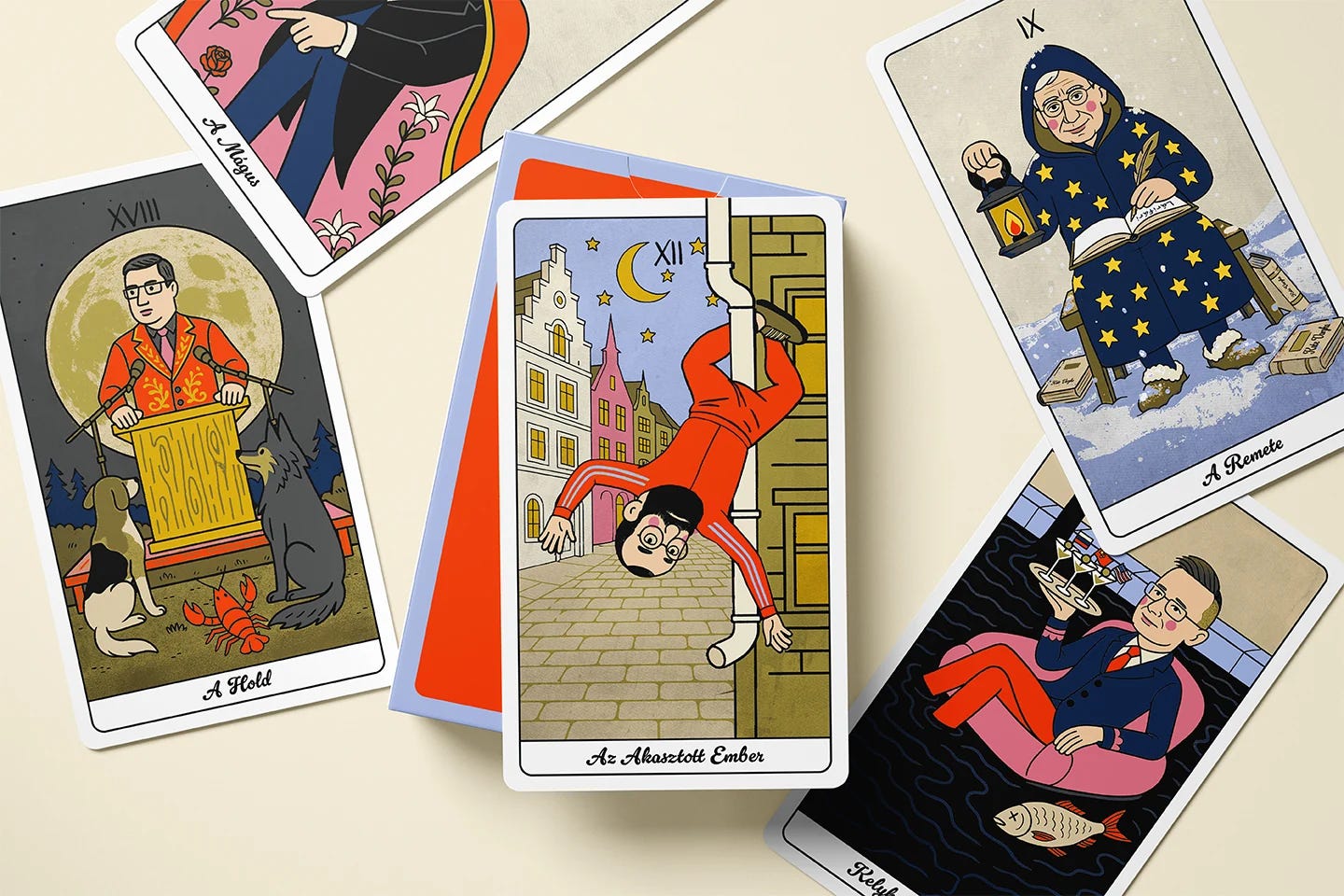
I remember looking at the email and thinking: what the hell is my life?
In a good way.
I had known these people long before they ever knew me.
Of course I did. I studied political science. I had come across their work, read it, cited people in the same world, and listened to the arguments they were having. If you spend enough time researching authoritarianism, democracy, or Hungary, you eventually encounter people like Rory and Kim.
I admired them enormously.
“Heroes” is a slightly embarrassing word to use about academics, but in some ways, yes, they were.
They belonged to that world on the other side of articles, books and university reading lists. You read people like that. You listen to them. You occasionally argue with them in your own head. The possibility that one day they might know who you are feels remote enough that you do not really think about it.
I certainly never imagined I would meet them.
I definitely never imagined that I would talk with them about democratic reconstruction and then, a few emails later, find myself asking where to buy Hungarian political tarot cards.
Six months earlier, there was barely a Hungary Report.
There were barely any readers.
And I was in a fairly bad place, if I'm being honest.
That sentence requires some caution because I had, and still have, so much in my life. I have an amazing partner. I have my kitties. I have people I love. I live in Barcelona. There were many things around me that made me feel incredibly lucky.
Though I was exhausted.
My health had been difficult for some time. Work was making it worse. I had spent only a few years in the corporate world when I began seriously imagining another forty years of some version of the same thing.
I could not see myself doing it.
That frightened the shit out of me.
There were evenings when work finished, and very little of me seemed to remain for whatever came afterwards. Then another morning arrived, and I started again.
I could do my job. I could see people go for dinner, laugh, follow politics, read, travel, and make plans for the weekend. Life continued moving, and I moved with it.
Inside my own head, things had become strangely flat.
I felt like a zombie.
My brain had gone into autopilot.
What I missed most was curiosity.
I missed following an idea merely because I wanted to know where it went. I missed getting lost in something difficult. I missed finding some obscure political detail and disappearing into it for a few hours until several other things suddenly made more sense.
I even missed university, which is comic because I was hardly the model student.
Concentration was always difficult for me. I enjoyed the social side considerably more than some lecturers would probably have preferred. There were classes where my body had fulfilled the attendance requirement while my mind had crossed several intergalactic borders.
Still, I wrote essays I cared about. I wrote a master’s thesis that meant something to me. There were times when I could feel my mind properly working, when one thought would catch another and suddenly I could see a connection that had been sitting there all along.
I missed that feeling.
This was also the year I started therapy.
The idea had lived somewhere in the background for a long time. I knew there were things I should probably deal with, including my OCD. I had become very good at keeping certain thoughts at the edge of my vision, close enough to know they were there and distant enough that I could get on with the day.
Therapy has helped me enormously.
I can only speak for myself, but it is one of the best decisions I have made. It has helped me understand my OCD better, and it has made me recognise patterns I had carried around for years without really understanding them. The way I deal with conflict. The way I respond to pressure. The way my mind can grab hold of something tiny and keep turning it over long after the useful thinking has finished.
I have learnt so much about myself.
There is plenty left.
My health is still something I have to manage. OCD nonetheless has its own ideas about how much attention a mundane thought merits.
But I am more aware of what is happening inside me now.
And one thing became increasingly difficult to ignore.
I had spent a lot of my life rolling over.
Something happens.
Fine.
Do not create a problem. Keep everybody happy. Do the sensible thing. Carry on.
Work brought that into focus for me.
I had a very rough year in the corporate world. I spent time in a workplace where I did not feel that my health was treated with the care I needed.
For a while, I thought mostly about that particular experience.
Then my view widened.
We give an extraordinary amount of ourselves to work. Our hours are organised around it. Sleep organises around it. Health, relationships, and entire years twist around it. Exhaustion becomes familiar enough that you stop noticing how strange it is. You tolerate things because rent has to be paid, because everybody else seems to be getting on with it, because adulthood apparently involves an impressive amount of swallowing shit and continuing with your afternoon.
I had become quite good at that.
I did not want to become better.
Somewhere in the middle of all this, I started writing.
That sounds much more calculated than it felt.
The first version of The Hungary Report was a WordPress site that I built myself. I learnt enough coding to make it function, played around with the design, broke things, fixed them, published articles and sent them out into the immense internet, where most of them promptly disappeared.
I had wanted to write publicly for a long time.
I was always scared of doing it.
There is a wonderful safety in saying you want to write, because wanting still lives in the private, untested space where no one can judge the page, only the intention; publishing, by contrast, turns the work into something exposed, finite, and answerable to other people’s eyes.
The article inside your head can remain brilliant forever. The book you might write one day can be magnificent because nobody has yet had the opportunity to read page one.
Publishing destroys that little fantasy.
There is the sentence.
You wrote it.
People can read it now.
They can dislike it. They can misunderstand it. They can scroll straight past it because somebody else has uploaded a video of a dog wearing sunglasses.
By January and February, though, fear had begun losing some of its authority over me.
Things were pretty still pretty rough.
Writing was unlikely to make them much worse.
Well, that's what I told myself.
Eventually, I moved The Hungary Report from WordPress to Substack because I realised that building a website and finding people to read it were two completely different jobs.
At first, almost nobody did.
I remember some of those first subscribers.
I still recognise their names.
Every so often, somebody likes an article or leaves a comment, and one of those names appears on my phone. Immediately, I am back in those first weeks when the audience was small enough that every new subscriber felt enormous.
They probably have no idea I recognise them.
I do.
I always believed I could produce work worth reading. I struggled more with the idea that strangers would choose to spend part of their day on it.
People have jobs, children, relationships, friends, football, podcasts, television, books they keep promising themselves they will finish, newsletters they signed up for at two in the morning, and the endless administrative burden of keeping it all together.
Why would somebody give twenty minutes of that life to something I wrote about Hungary?
But people did.
More followed.
I am still slightly bewildered by it.
Something written alone at my desk in Barcelona started conversations thousands of kilometres away.
People wrote to me about their own countries.
Journalists began asking what I thought about things.
People whose work I had known before they knew my name started appearing in my inbox.
Some became friends.
Sometimes somebody writes to me, and halfway through the conversation I realise they should be talking to somebody else. I send an introduction. Another conversation begins somewhere, and I might have almost nothing to do with what happens afterwards.
I love that.
I love connecting people.
I love the fact that somebody can read something you wrote on a random Tuesday, send an email, and a few months later there is a friendship, a collaboration, an argument, another introduction, another person you would never otherwise have known.
Six months ago, none of those lines existed.
Then there was the more modest change.
My brain started coming back.
I do not really know how else to describe it.
Writing regularly has forced me to think harder than I have in years.
An opinion may live very comfortably inside your own head. You understand what you mean. Your assumptions know exactly where to hide. You can carry an idea around for weeks, feeling extremely intelligent about it, because nobody has yet asked it to survive contact with paragraph three.
Then you start writing.
The first paragraph goes down.
Fine.
The second.
Still fine.
Somewhere in the third, the argument you have been confidently repeating to yourself develops a massive black hole.
So you start looking.
You find the original law.
Then the government document.
You read the Hungarian version because the English summary has left something out.
You check the date.
You find another source.
That source complicates the first one.
Now you have another problem.
You message somebody who knows more than you do.
They tell you that you have misunderstood something.
Half the article changes.
Ultimately, you discover that the sentence you loved most is doing absolutely nothing, so you delete it and spend a brief period in mourning.
This is more or less my life now.
I love it.
Parts of my university-era brain have returned: research, sources, finding connections, asking whether the evidence can truthfully carry the sentence I want to write.
I am also discovering how I learn when nobody is grading me.
Nobody assigns the reading.
Nobody has instructed me to spend three hours buried inside a Hungarian government PDF.
There is no professor waiting for the essay.
Something catches in my head, and I want to understand it.
So I follow it.
One source leads to another. A name appears twice. A date looks strange. A claim sounds too neat. Something does not quite fit. I keep going until I can see its shape more clearly.
Sometimes it feels as though parts of my brain that had not spoken to each other in years have started communicating again. Old connections are waking up as fresh ones appear around them.
I am getting better at research because the work requires it. I am learning how to report directly. How to contact people. How to interview them. How to recognise when a source is weak. How to separate what I know from what I suspect. How to admit when I cannot prove something.
I am learning how to edit too.
That part is the most harrowing for me.
I am deeply self-critical. Sometimes far beyond usefulness. I can fixate on a paragraph for an absurd amount of time. Part of that comes from wanting the work to improve. Part comes from OCD, which has an impressive ability to transform one awkward sentence into an emergency requiring immediate national mobilisation.
I still publish something and find a sentence I want to change five minutes later.
I still open older articles and encounter lines I once thought were excellent with roughly the same feeling as discovering an old photograph of myself dressed terribly and apparently very pleased about it.
A few months ago, I genuinely wondered whether my writing was getting any better.
I think it is.
Improving has made me more conscious of everything I still do badly, which I suppose is one of writing’s less generous rewards.
I still hesitate around the words “writer” and “journalist.”
They feel too large.
I had written academic work before all this. I knew I could write. I had essays I was proud of and a thesis I cared about. I also knew that occasionally a sentence would come out in a way that felt particularly mine.
I suspect some of that comes from the slightly confusing collection of places that made me.
I am Hungarian, grew up in Ireland, and have lived in Spain for years.
I write in English, while Hungarian and Spanish continue their lives somewhere behind it. Different rhythms, jokes, histories and ways of looking at people have accumulated there.
They have shaped how I speak.
They have shaped how I think.
I barely considered any of this until strangers started telling me that something in the writing felt familiar to them.
That remains strange.
Writing is incredibly solitary.
Most days it is me, too many browser tabs and some obscure Hungarian document, while Barcelona continues outside with absolutely no concern for whatever constitutional problem has taken over my afternoon.
Then I press publish.
Somebody enters the thought.
They might disagree. They might correct me. They might send me something I missed. Sometimes they tell me that something I wrote about Hungary made them think about their own country, their parents, their memories, something they had been trying to understand about themselves.
Those messages stay with me.
So do the people.
Today, while working on this piece, I had a call with one of my subscribers.
He is Hungarian, a writer and poet, from a very different generation from mine.
We talked for a while.
I listened. I learnt things. I finished the conversation with more in my head than I had when it began.
Six months ago, this person was absent from my life.
Now there are people scattered across countries and generations whom I know because I wrote something, they read it, and eventually one of us decided to say hello.
I find that incredible.
I am also just incredibly grateful.
For all of them.
For the people who read. The people who write back. The people who disagree. The people who correct me. The people who tell me some completely unexpected stories about their own lives. The people who have called, introduced me to somebody else, invited me somewhere, trusted me with something, or simply appeared.
Some I have never met in person.
Some are from completely different generations.
Some live thousands of kilometres away.
Some have become part of my actual life remarkably quickly.
They have made my world feel much larger.
And, strangely, they have made me appreciate the ordinary parts of it more, too.
I speak up more.
I ask more questions.
I join conversations I might once have avoided.
I have made friends where I live. I know my local shopkeeper now. We talk.
That sounds tiny written down.
It does not feel tiny to me.
At the beginning of this year, my world had become narrow. Now it keeps expanding in unconventional directions.
Therapy has helped with that.
Writing has too.
Research teaches you to ask for the original source. Reporting teaches you to ask another question. Editing teaches you to hold your own certainty lightly for a while.
Those habits have followed me away from the page.
I roll over less easily.
I argue sometimes.
I say when something feels wrong.
I ask why.
I listen more carefully.
I have become more curious about other people.
I have become more curious about myself too, in what I hope is the healthy meaning of that sentence. Curious enough to work out what I actually think. Curious enough to ask why I react the way I do. Curious enough to stop assuming that whatever path I happened to be on was automatically the path I had to keep following.
My days have an axis again.
I wake up and see what happened.
Something catches.
I start reading.
One thing leads somewhere else.
I talk to somebody.
I try to understand what I think.
Then I try to explain it.
The following morning, something else begins.
Meaning is probably the word for what this has given me, although I remain negligibly embarrassed by its size.
Meaning sounds enormous.
Most mornings, it looks incredibly ordinary.
Coffee and twelve open tabs. A highlighted PDF. A WhatsApp message asking somebody whether I have understood something properly. Four hundred words deleted because they are absolute rubbish. An early subscriber’s name appearing under a new article. A call with someone from another generation. A joke reaching from Princeton. My shopkeeper stopping for a chat. A sentence finally doing what I wanted it to do.
That is more or less it.
And I find myself wishing these things for other people now.
I hope people find something that sparks their curiosity again.
I hope they meet someone they never expected to meet.
I hope they have conversations that leave them knowing more than they knew an hour earlier.
I hope they find something that makes them excited about being here.
I think I am starting to feel that excitement again.
Tonight I am going out to watch a solar eclipse.
Technically, this will be my second. There was one over Europe in 1999, when I was one year old, so I am willing to accept that tiny Peter may have had an important astronomical experience and simply failed to retain adequate notes.
I remember absolutely nothing. Obviously.
So I am counting tonight as my first.
I am ridiculously excited.
I get to go outside, look up, and see something I have never consciously seen before. Spain is one of the places crossed by tonight’s eclipse, and I feel incredibly lucky simply to be here for it.
If you are somewhere you can see it, I hope you go outside too.
Please protect your eyes.
Unlike Donald of Orange, wear proper eclipse glasses. I still remember the astonishing image of Donald Trump standing at the White House during the 2017 eclipse and looking directly towards the Sun without them. Some photographs require no improvement from a writer.

I would like all of us to retain our eyesight for the next article.
There are still days when I feel completely out of my depth.
Imposter syndrome remains remarkably punctual.
I worry about my health.
I worry about work.
I worry about money.
I worry about the future and whether any of this can ever become something sustainable.
I have no clear idea what I will be doing a year from now.
Sometimes that scares me.
Sometimes it scares me a lot.
I am still new to all this. Every time I learn one part of the job, another five seem to appear behind it.
I am slowly becoming more comfortable with uncertainty.
I know what I want to do tomorrow.
I want to read.
I want to ask questions.
I want to talk to people who know things I do not.
I want to keep learning.
I want to keep writing.
Perhaps the most bizarre part is that I began doing this partly to escape my own thoughts.
Writing still gives me that feeling.
The rest of the world recedes for a while. There is the thing in front of me and the attempt to understand it well enough to give it words.
Somehow, that individual act has carried me further into life.
It has given me people.
It has given me curiosity.
It has made me pay attention again.
And today something else happened.
People have been telling me for a long time that I should write a book.
I have thought about it. Dismissed it. Returned to it. Changed my mind. Walked around the idea for months and found an impressive number of ways to avoid deciding what such a book might actually be.
Today, for the first time, I think I know where it starts.
I’m not telling you yet.
I have to keep something to myself.
Tonight, I am going to watch the Moon pass in front of the Sun.
Tomorrow, I’ll get up and write.
I don’t know where I’m going.
But I know I’m not going backwards.
A small note: I’ve attached a few images from the Nemzeti Tarot deck below for anyone curious to see them, though I don’t think they deliver outside of Hungary. The images are from BigLogo, where you can view the full set here: Nemzeti Tarot.