

Hungary After Dark: What the Old State Wrote Down
Inside the cabinet summaries, cost tables and missing records that show how Orbánism turned political messaging into government action.

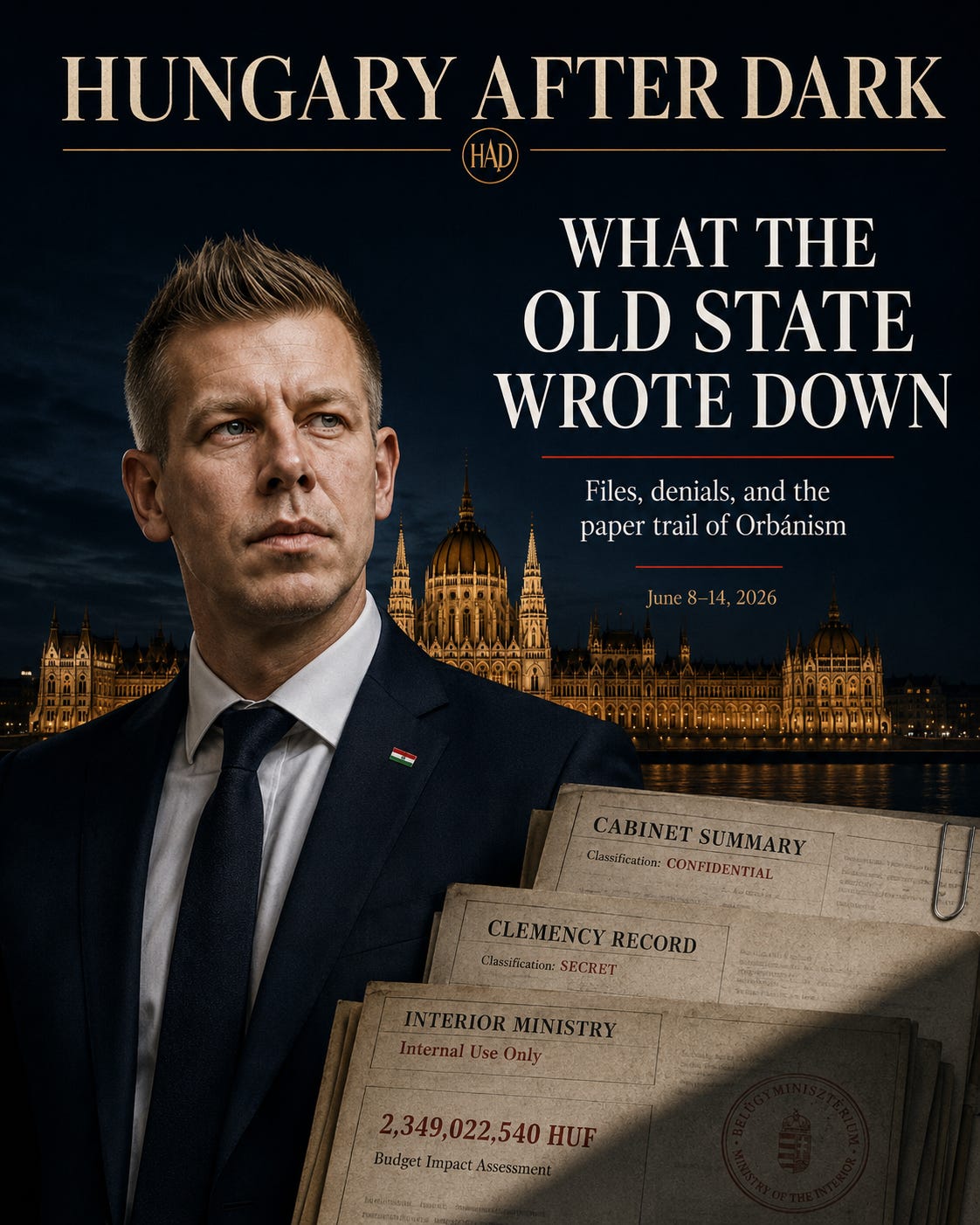
This week, the new government published the sort of documents Orbán’s government was never assembled to explain in public: cabinet summaries, Interior Ministry submissions, cost estimates, clemency records and consultation papers. Read together, they demonstrate how political messaging became government action.
2,349,022,540 forints.
Its force comes from its refusal to behave like a slogan.
The figure appears in government documents as the gross one-off cost of creating a 500-person reception station at Vitnyéd-Csermajor, a former agricultural site near the Austrian border, where Fidesz politicians would later insist there would be no migrant camp.
What gives the number its power is its specificity. It arrives stripped of ideology. No references to sovereignty, Brussels, invasion or national survival. Just a location, a capacity, a staffing requirement, an implementation schedule and a budget calculated to the forint.
Administrative records have a different weight. They are produced to enable decision-making, not to persuade voters.
The documents released by the government concern Hungary’s response to a ruling by the Court of Justice of the European Union (CJEU), the EU’s highest court, in case C-123/22. The judgment addressed Hungary’s asylum and migration obligations and compelled the government to consider practical compliance measures. The effect of the released material comes from reading it in sequence. The further one moves into the file, the less the familiar political language matters. Arguments about sovereignty, border protection and migration give way to the mechanics of government: officials assigning responsibilities, ministries comparing options, timelines being fixed, capacities calculated and costs attached to decisions. The revealing story begins where rhetoric must become concrete enough to be planned, funded, and carried out.
The paper trail moves quickly. On July 7, 2024, the then Fidesz government established a working group following the CJEU ruling, comprising the minister leading the Prime Minister’s Office, the justice minister, the minister responsible for European Union affairs, and the interior minister. On July 25, the discussion had reached a possible accommodation near the Austrian border, including an open camp. By August 21, the government had authorised the interior minister to invest in the Vitnyéd property to make it suitable for receiving refugees. By September 11, the Interior Ministry material discussed a new reception station 23 kilometres from the Austrian-Hungarian border, a three-month implementation schedule, 500 places, 42 border guards, 87 new staff, and billions in costs.
The August 21 cabinet material, as reproduced in the government’s presentation, says that “the government authorised the interior minister to carry out investments at the Vitnyéd property for the purpose of making it suitable for receiving refugees.”
That sentence is one of the centrepieces of the week.
It is difficult to square with the later public performance.
Having read it, and as far as the available documents indicate, one passage stands out to me. In English, it reads: “The government determined that by 2026 it was necessary to sharpen the political conflict around migration.” The line appears in the government’s presentation of the underlying cabinet material. This suggests that migration was being discussed not only as a policy issue but also as a political strategy. Even without placing too much weight on that single sentence, the broader record points in the same direction: while the public debate focused on political messaging, government officials were simultaneously engaged in detailed administrative planning.
By September, the file had settled into numbers. The creation of a reception station suitable for 500 people was listed at gross 2,106,297,200 forints. Production-unit costs were listed at gross 203,550,000 forints. Equipment for 42 border guards came to gross 39,175,340 forints. The total one-off cost was given as gross 2,349,022,540 forints (about $7.7 million at current exchange rates). The annual costs were larger: 87 new staff for the National Directorate-General for Aliens Policing at gross 769,607,840 forints; operation and guard-protection expenses for the Vitnyéd-Csermajor Reception Station at gross 1,754,991,668 forints; and an additional 450,000,000 forints in financing needs for the National Office for the Judiciary. The annual total was gross 2,974,599,508 forints (about $10 million).
This was a document with 500 pages, a staffing plan, border-guard equipment, a three-month implementation estimate and more than 5.3 billion forints in combined first-year and annual operating costs (roughly $17 million combined).
Publicly, Fidesz politics had left little space for that kind of administrative language. Migration was made into the central emotional architecture of Orbán’s rule: Brussels as pressure, migrants as threat, sovereignty as permanent defence, the Hungarian border as proof that the government alone could see what others refused to see. By the time the subject reached voters, law and cost had largely disappeared from view, leaving the performance of refusal.
The denials followed.
On the government’s presentation, Alpár Gyopáros, a Fidesz MP and government commissioner responsible for regional development, appears beside the sentence: “There will be no migrant camp in Vitnyéd-Csermajor.” Tamás Menczer, Fidesz’s communications director and one of the party’s most prominent public spokesmen, appears with his own familiar line: “We do not want immigrants.” The final slide shows Gergely Gulyás, then the minister heading the Prime Minister’s Office and one of the government’s chief public voices, telling the Hungarian News Agency on September 26, 2024: “There will be no refugee camp of any kind in Vitnyéd; the government has no such plan.” Beneath that, the same slide includes a line reported by HVG: “There may be summer camps for students.”
A state was costing a reception station while politics denied a camp. A file discussed a 500-person facility, while a minister told the public the government had no such plan. An Interior Ministry submission discussed a site near the Austrian border, while the public answer focused on schoolchildren and summer camps.
The documents leave open questions about political intent, final approval and implementation. They still show serious administrative preparation for a reception facility, while the public message remained categorical.
That contradiction needs no embellishment.
Péter Magyar understood the force of it quickly. When Fidesz figures moved toward the explanation that the project had been a legal manoeuvre or some kind of ingenious tactical trick, Magyar asked the questions that now hover over the whole affair: if it was only a trick, why was it hidden, why was it denied, why were Hungarians told something else, and who would have paid for it?
The strength of those questions comes from their simplicity. A trick rarely requires a gross 2.349 billion forint implementation estimate, an annual cost line approaching 3 billion forints, 87 new staff, guard-protection costs and a three-month construction schedule. A trick rarely requires the interior minister to brief the cabinet that the planned camp at Vitnyéd-Csermajor would have a budgetary resource need.
Vitnyéd gives us a rare glimpse of Orbánism in a more vulnerable form. The public performance was loud, moralised and absolute. The internal record was practical, legalistic and expensive. The old government told its voters that migration could be defeated through will, refusal and the correct enemy vocabulary. Simultaneously, its officials were reading court judgments, discussing accommodation, calculating costs, and preparing for contingencies.
This is where the week begins for me, with the old state telling one story in public and writing another in its files.
What the files changed
For weeks, Magyar’s government has spoken about restoring public media, unlocking European funds, reforming child protection, strengthening transparency, tracing public money and revisiting decisions taken under the previous administration. This week, those ambitions began appearing in the form that will determine whether they matter: draft laws, consultation papers, official records, ministerial files, cabinet summaries and institutional redesigns.
Election victories change authority. Documents change the state.
The government is now trying to act on the instruments that made Orbánism durable. Media structures, asset declarations, procurement rules, foundation law, secrecy practices, child-protection management, emergency-law finance, construction permitting and cabinet minutes now sit inside the same political argument because they are all parts of the same inheritance. Orbánism survived through speeches and party discipline, and through forms, mandates, exemptions, boards, definitions, procedures, and files that almost no one outside the system was expected to read.
The Fidesz congress gave the week its other portrait.
While the new government was publishing records and presenting legislative packages, Orbán was asking his party for another mandate. He received it almost completely. At the Budapest congress, 729 delegates voted to have him remain Fidesz president. No one voted against him. Eight abstained. The result looked overwhelming, but its shape felt strange. Orbán was re-elected as party president after losing the state, and his new mandate lasts only one year.
That is a revealing arrangement.
Fidesz is still Orbán’s party, but the meaning of that fact has changed. He has said his place is in the renewal of the national camp, which suggests how he now sees himself. He is no longer the head of government, no longer the man signing budgets and chairing cabinet meetings, yet he is still trying to remain the central interpreter of the political community he built.
That makes his position more spectral than before.
Orbán’s words used to arrive with institutions behind them. A sentence could become a campaign, a decree, a television segment, a school poster, a public procurement priority, a budget line, a foreign-policy veto. Now he speaks from inside the party, while the state he used to command is being opened by someone else.
The quotes around him tell the story of a man trying to turn defeat into continuity. After the election, he said, “We cannot go on like this,” and that “a complete renewal is necessary.” He said he was trying to “somehow overcome this shock” and accepted “full responsibility.” At the congress, he reportedly said it was time for a “younger generation” to take over, while also insisting, “I never retreat.”
The sentence resembled a statement of personal political identity.
He accepts responsibility and stays. He speaks of generational change while remaining indispensable. He vows renewal from the centre of the room. He recognises defeat as a shock, then turns it into a message of survival.
At the congress, he reportedly listed ten reasons for Fidesz’s defeat, including the party’s failure to answer Tisza’s corruption allegations during the campaign. That is a notable admission as it recognises the wound while leaving the system unnamed. Corruption appears as a campaign-management failure, something the party did not rebut effectively enough, while the state is now releasing records that make the allegation much harder to contain within campaign language.
Orbán is trying to turn Fidesz into an opposition party while preventing Fidesz from becoming a post-Orbán party.
As is the tension inside the Fidesz congress. Orbán remains powerful enough that no one voted against him. He is weak enough that his mandate had to be limited to one year. He speaks of renewal while preserving command. He promises reorganisation while the government he led's files are being read back to the country.
Magyar’s response was brutal. He said Orbán had become the Ferenc Gyurcsány of Fidesz and added that there is no democratic opposition with a mafia boss. Gyurcsány, Hungary’s prime minister from 2004 to 2009, became a deeply polarising figure after the leaked “Őszöd speech” and the political crises that followed, remaining a symbol of opposition failure for many Fidesz voters long after leaving office. The comparison was designed to wound because it touches the deepest fear around Orbán now: that he may become the figure whose continued presence prevents his own side from understanding why it lost.
The files released this week make that position harder. Fidesz can still tell its voters the ancient story about sovereignty, Brussels, migration, foreign pressure and national survival. It can still speak in the emotional language that carried the party through years of power. But now that language has to live beside cabinet summaries, Interior Ministry notes, cost tables, Justice Ministry memoranda and consultation documents.
Records have a way of narrowing the distance between what was said and what was done.
Hungary is beginning to read the internal record of how Orbán’s state actually functioned.
The broadcaster and the money
The public media reform bill goes after one of Orbánism’s daily instruments of control. The bill would dismantle the MTVA structure, restore MTI, the Hungarian News Agency, as a separate news agency, create new oversight bodies and introduce more transparent leadership procedures. The official moral pitch was clean enough to remember: “Real public media is a common cause for all of us.”
The sentence is right and, therefore, dangerous to leave as is.
Orbán’s public media drew its strength from centralisation, opacity, controlled incentives, and a system in which editorial independence could be made fragile without being formally abolished. The institution learned to function as a government communications agency while preserving the vocabulary of public service.
A serious reform, therefore, has to reach into the structure. On paper, the bill appears to understand that. Breaking up the old command arrangement, restoring a separate news agency, creating a public-media board, attaching oversight to large contracts and leadership selection, and rebalancing the Media Council could make future capture harder if the rules are written tightly enough and if the appointments process can survive political pressure.
The vulnerable point is the transition. Until new leaders are appointed, professional direction would rest with the minister responsible for social relations. That arrangement may be administratively practical, but transitional moments are often when institutions are most exposed. Old arrangements are being dismantled, new ones have not yet hardened, and temporary authority can shape the permanent settlement before the public understands where power has moved.
The same danger appears in the EU-funds package in a less visible form. A rule can look clean on the page and still fail if the people meant to enforce it remain weak, cautious or politically exposed.
Hungary wants access to European funds that have been frozen or delayed due to rule-of-law concerns, and the official language openly links the bill to the EU’s super milestones. This is compliance legislation first. The question is whether compliance becomes a set of domestic safeguards that still matter after Brussels has been satisfied.
The package is built from dull instruments that become dangerous when enforced: asset declarations, family disclosures, procurement visibility, criminal penalties and stronger powers for the Integrity Authority.
Brussels wants enforceable safeguards because the old system made public money too comfortable around political loyalty. Magyar’s government wants the money released because the budget needs it and because the promise of European normalisation must become visible in everyday life. The EU agreed in late May to unlock 16.4 billion euros for Hungary after rapid reforms, including 10 billion euros in recovery funds and more than 6.3 billion euros in cohesion funds, while Hungary also formally requested to join the European Public Prosecutor’s Office.
The old system turned public money into a zone of political comfort. The new system has to turn records into consequences that can survive an appeal.
Where the record stops
The pardon dossier raises a different set of questions because it reveals part of the story and then shows where the public record still disappears.
The released Justice Ministry documents suggest that the ministry’s internal assessment diverged from the final outcome. One document records that ministry officials did not support granting clemency in the relevant case, while another shows that parliamentary state secretary Róbert Répássy also did not recommend approval. The phrase worth holding onto is almost painfully bureaucratic: “does not recommend.” Katalin Novák nevertheless granted the pardon, and Judit Varga countersigned it.
Hungarian politics rarely gives you a cleaner bureaucratic wound than that: a file saying no, followed by a state that somehow said yes.
That discrepancy makes the decision harder to understand as a routine ministerial process. The essential question remains the same as it has since the scandal first broke: who initiated the decision, through which channels did it travel, and why did the final act move in the opposite direction indicated in the ministry record?
The government’s own summary acknowledges that the entire decision-making chain cannot be reconstructed without documents held by the Sándor Palace. The presidency cannot claim constitutional dignity while keeping crucial records beyond meaningful public scrutiny in a scandal that helped define the collapse of trust in the old order.
This is where Tamás Sulyok returns to the week without taking it over. Last week, he refused to leave office. This week, the presidency matters because the archive appears to stop there. The public has seen enough to know that the official story remains incomplete. It has not seen enough to understand how the decision truly moved through the state's highest offices.
The papers do not prove who pushed the pardon. They prove that the chain of responsibility still disappears at exactly the point where public scrutiny should begin.
Child protection belongs beside that dossier because it shows what happens when state language and institutional reality separate for too long. The government announced leadership dismissals and a proposed one-billion-forint compensation fund for victims of abuse. Its phrase was “Renewal is needed in child protection.” The sentence is soft, perhaps deliberately so, but the attached measures are more concrete than the language.
For years, child protection occupied a prominent place in government rhetoric. It appeared in campaigns, cultural disputes and constitutional language. It gave the old government moral vocabulary. The institutions responsible for actual protection often received less attention than the political uses of the phrase. This is why the government’s first measures matter, even though they are nowhere near enough. A one-billion-forint fund and leadership dismissals may show that the issue has moved from symbolism into administration, but lasting reform will require staffing, inspections, mental-health support, whistleblower protection, case review, and sustained attention to keep the issue alive after the scandal loses its immediate political force.
Files can expose what happened. Institutions still have to become capable of preventing it.
The technical state
The consultation papers posted this week looked dry from a distance, which is exactly why they matter.
The teacher-pay package says the government committed under EFOP Plusz to keep average teacher pay at 80 per cent of average graduate earnings between 2025 and 2031. The correction must be made by June 30 and applied retroactively from January 1. The impact sheet gives the affected groups as 146,000 teachers and 24,000 vocational instructors, with a budgetary effect of 7.7 billion forints.
The new government is inheriting a promise made under Orbán and having to legalise the remaining fraction under deadline pressure. The politics here is a percentage point, a repayment risk, a budget line and a deadline that could become expensive if the state misses it.
The construction-transparency consultation is even more revealing. Its justification says the public ÉTDR information surface was abolished on August 16, 2024, reducing access to documents and weakening proactive access to public-interest data. It says the change “explicitly made it harder for citizens to exercise their constitutional rights.” It also says the disappearance of public surfaces obstructed information-gathering on investments and construction projects, including investigative journalism.
That sounds small until you think about what opacity does. A public interface disappears, fewer people can see what is happening, fewer affected citizens can intervene, local projects become harder to scrutinise, and power moves more easily through a procedure that appears too technical for politics. Orbánism lived comfortably in places like that.
A municipal tax annex did the same work in fiscal form, listing 853 local-government entries, 202 positive payment obligations and about 5.878 billion forints due by June 30 from municipalities with a 2025 local business tax surplus. Budapest and its districts were listed at zero; Kazincbarcika alone owed 787.6 million forints.
The household files are more intimate. The Babaváró draft says borrowers who took out the loan between July 1, 2019 and June 30, 2021, would otherwise face the June 30, 2026, childbearing deadline, with the possible repayment of 5 to 7 years of interest subsidy in a lump sum and higher monthly instalments. The impact sheet identifies 25,000 affected borrowers. The draft extends the deadline to November 1.
These are policy cliffs written in domestic language. A family misses a deadline, a subsidy becomes a debt, a monthly instalment changes, and a state promise turns into household pressure. Much of post-Orbán repair will look like this before it looks grand: missed percentages, legal deadlines, public interfaces, interest-rate clauses and family-support cut-off dates.
The Ukraine emergency-law consultation tells the same story in a different register. One of the measures adopted under Hungary’s Ukraine-related state of emergency was a cap on certain reference interest rates, designed to shield borrowers from rapidly rising financing costs amid inflation and energy shocks following Russia’s invasion. The cap took effect on January 1, 2022, as a temporary measure expected to last only six months, but it was repeatedly extended and, from April 17, 2026, was set to continue indefinitely. The new draft argues that the measure “cannot be maintained” and that it would end on September 30. Orbán’s state of exception will not disappear through a dramatic political announcement. It will unwind through technical financial rules, expiry dates and legal amendments that most citizens will never read.
The state is full of small instruments that decide whether citizens can see, challenge, receive, appeal, understand or survive a decision. This week, the new government found several of them.
The June 11 government briefing widened that same picture from rules to capacity. The government said it would publish government and strategic-cabinet minutes from 2010 to 2026 in phases, with secrecy reviewed on a case-by-case basis. It also discussed hospital cooling, water management, deferring a Budapest payment at the mayor’s request, and a review of the Mohács Danube bridge contract due to some prices appearing excessively high.
Magyar’s political strength has been his ability to give public anger a target. That was essential in opposition. The government asks for something more difficult, because it requires confrontation and administration on the same working day.
Hungary has to keep public services functioning while examining how they became so brittle.
That is the work now.
The line
Fidesz is already learning how to answer this week.
It does not need to explain every document. It only needs to make the act of disclosure feel like persecution to its own voters. The party will speak of revenge, censorship, political purges, Brussels obedience, foreign control, sovereignty and the misuse of a supermajority. Much of this will be shameless. The party that built public media into a government instrument will now worry about media freedom. The party that ruled through emergency powers will now develop a sudden tenderness for procedure. The party that made migration into a national panic industry will now complain when its own migration paperwork is read aloud.
The reversal is amusing.
Magyar’s advantage is that the documents appear substantial. His obligation is to make disclosure systematic.
Hungary does not need a politics in which each government opens the files of its enemies while protecting the files of its friends. The archive must become public memory: governed by rules, publication standards, complete document sets, transparent redactions and equal access for journalists, researchers and citizens alike.
Because this week was never really about migration, public media, clemency, procurement or even Orbán himself.
It was about the distance between narrative and record.
The Vitnyéd files showed ministries preparing for a migration-related scenario that public rhetoric denied. The pardon dossier revealed a chain of responsibility that still disappears before the Sándor Palace. The public-media bill placed one of Orbánism’s central instruments under reconstruction. The EU-funds package translated external pressure into domestic safeguards. The child-protection measures moved the scandal into the administration. The consultation papers revealed how much of Hungary’s transition will unfold not in speeches but in technical provisions, deadlines, databases and procedures.
Orbán’s congress sharpened the contrast. He was re-elected Fidesz president by an overwhelming vote, but only for one year. He spoke of renewal while remaining indispensable. He accepted responsibility while retaining command. He promised reorganisation while the state he once led began publishing records of how that state had actually functioned.
That was the image of the week.
On one side stood the old system with its leader, its mythology and its language. On the other stood the paperwork.
For years, the mythology dominated. Hungary was told stories about sovereignty, migration, Brussels, foreign influence and national survival. Those stories shaped elections, campaigns and political identities. But governments do not ultimately run on stories. They run on submissions, signatures, annexes, procurement notices, staffing plans, budget lines and cabinet decisions.
Power speaks in public.
It writes in private.
And sooner or later, every political era leaves behind two histories: the one it told about itself and the one it recorded.
What made this week remarkable was that those two histories briefly appeared side by side.
The speeches were still there. So were the slogans, the warnings, the enemies and the familiar lines. But beside them now sat cost estimates, ministry memoranda, consultation drafts, legal opinions and cabinet materials. The rhetoric remained intact. The paperwork arrived anyway.
That is why these documents matter.
Not because every file is a scandal. Not because every contradiction is proof of deception. Not because every unanswered question already contains its answer.
They matter because records have a peculiar dignity. They are created for action, not applause. They are where governments stop performing and start deciding.
The regime change has progressed beyond personalities, documenting the long-hidden enigmas.
And perhaps that will become the enduring image of this moment: a country standing in a long-locked archive, pulling open drawer after drawer, while dust rises into the light.
Fidesz is fading into memory.
Magyar is trying to keep that memory alive.
Source: This issue draws on Hungarian government materials published or surfaced between June 8 and June 14, including government releases on child protection, EU funds, public media, state transparency and service capacity; consultation files on teacher pay, the Ukraine-related emergency-law amendment, construction transparency, Babaváró and municipal payment obligations; the pardon-case dossier and linked Justice Ministry files; and the Vitnyéd-Csermajor dossier with cabinet, Interior Ministry and submission materials. It also draws on the June 13 Vitnyéd presentation; AP reporting on EU funds, EPPO accession and Ukraine accession talks; Financial Times reporting on the Integrity Authority; Reuters, Telex, 444, HVG, Direkt36, Válasz Online, The Guardian and Liberties; Welt reporting on Orbán’s first post-election interview; and Bild / MTI reporting on Orbán’s re-election as Fidesz president.
Péter,
This report on a week's developments looks like the densest thicket in Equatorial Africa. (I used to hunt there, I know what I am comparing with...)
I commented your recent report with saying: "The dance is just about to begin." It really is! Magyar and his team knows where they arrived at, and understand the terrain and the obstacles.
What has remained of Fidesz, they lost orientation, their ship is moving on a stormy see, with no control or foresight.
The two sides show an absolute imbalance. Fidesz still tries to communicate as if two equal sides would collide. Sooner or later they have to learn the truth. The later, the darker.
That is the key: Orban was just enough of a performer to seal his own downfall. Trump is even more performance-oriented. There are dozens of autocrats, around the world, who don't worry about either performance or record-keeping. They have muscle acting on their behalf. Orban is far too urbane a man to let brutes do his dirty work. Trump is neither urbane nor cautious, but his brutes will be resisted.