

Hungary After Dark: The State Reaches the Servers
Investigators moved on Fidesz’s digital infrastructure, the prosecutor general resigned, four state-backed deals became criminal complaints, and Viktor Orbán declared resistance.

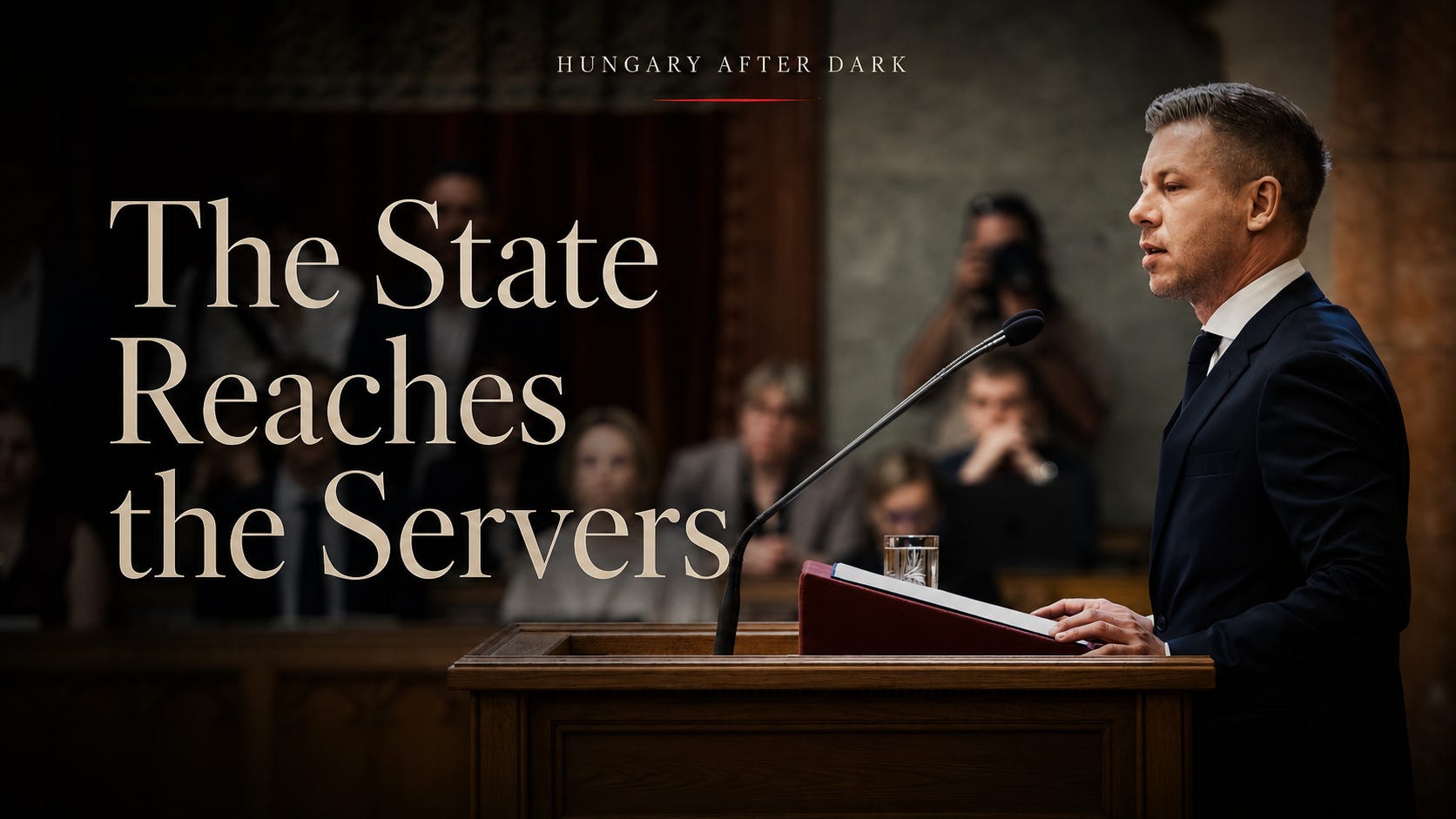
This week in Hungary delivered another episode of what Péter Magyar likes to call absolute cinema: prosecutors entering a data centre, Viktor Orbán standing outside his own headquarters, and the party that once seemed capable of reaching into every institution in the country announcing that it could no longer reach the internet.
On 21 July, prosecutorial investigators entered a Magyar Telekom data centre on Asztalos Sándor Street in Budapest, where Fidesz hosted part of its digital infrastructure. According to the party and subsequent reporting, investigators sought access to systems containing Fidesz’s internal communications and databases. The party’s website and email service reportedly went offline.
The following day, Orbán appeared on the pavement outside Fidesz headquarters and delivered what amounted to a victim statement. The building had been cut off, he said. The people inside could not get online.
It was a small complaint from a man whose power had never been small.
Over more than a decade, Orbán built a political system in which the boundaries between party and state, private fortune and public authority, personal loyalty and professional advancement became increasingly difficult to locate. Ministers, foundations, state banks, media companies and contractors formed the visible parts of that system. The servers were less visible, though no less important.
Now he stood outside his fallen regime, complaining that it had stopped answering.
There are few images more satisfying than the man who wired the Hungarian state around his political party, claiming that he could no longer connect to the internet inside his own headquarters.
Reporting connected the operation to an investigation involving spending by the National Cultural Fund, though the precise legal basis for accessing the party’s systems remains unclear.
There is, unsurprisingly, an outcry from Fidesz. But Hungarians made a choice at the ballot box, and we have the right to understand what Fidesz has done to us and what it has taken. At the same time, Fidesz can use the speed of the transition and the investigations now underway against Magyar and Tisza. The party appears almost relieved to play the victim and present itself as the defender of democracy.
Still, the scene on Asztalos Sándor Street celebrated a change. The state under the new government had made physical contact with the party's technical apparatus that governed Hungary from 2010 until April of this year.
The transition had reached the servers.
Over the following days, it thrust through the prosecution service, the state export bank, Hungary’s nuclear expansion project and several of the country’s most important cultural institutions. Each action belonged to a different legal category. Searches, criminal complaints, resignations and management dismissals carry different evidentiary weight and different consequences.
Together, they revealed a state commencing to test the powers it had inherited.
The top prosecutor leaves
On 22 July, Prosecutor General Gábor Bálint Nagy announced his resignation.
His statement possessed a sentence that should resonate throughout the entire week:
“The prosecution service must not become an instrument in the struggles of political actors.”
Gábor Bálint Nagy asked for his mandate to end on 25 August. The prosecutor general is proposed by the president and elected by parliament for a nine-year term. The appointment requires a two-thirds majority. Resignation does not require acceptance, although the accelerated timetable created immediate questions about succession and the operation of the prosecution service after his departure.
The statement offered each political camp the interpretation it required.
Fidesz presented the resignation as evidence that prosecutors were being subjected to intolerable political pressure. János Bóka, the party’s newly appointed parliamentary group leader, said the departure showed that Péter Magyar’s government was moving towards direct political control of the prosecution service.
Magyar celebrated the same event as liberation.
Many regard Gábor Bálint Nagy as an Orbán loyalist, particularly after a prosecution service that repeatedly failed to pursue cases involving politically connected figures. Hungary’s refusal to join the European Public Prosecutor’s Office was one of the previous government’s defining institutional choices.
Following the guarantees
The following day, the government moved from personnel to money.
At its 23 July briefing, the Ministry for the Economy and Energy announced four criminal complaints concerning transactions involving the state-owned Hungarian Export-Import Bank.
Taken separately, the cases involved a hotel, a motorway through central Africa, railway carriages for Egypt and a loan to a friendly foreign government. Brought together, they suggested an unusually unambiguous map of the Orbán economy: private advantage protected by political proximity, public risk concealed inside institutions whose authority had been borrowed from the state.
The first complaint concerned approximately HUF 59 billion ($185 million) in financing linked to a company with business interests tied to István Tiborcz, Orbán’s son-in-law.
According to the government, the decision was taken within two days and breached Eximbank’s internal procedures. Officials referred to suspected disloyal management and related offences.
For now, these remain allegations in a criminal complaint, as prosecutors have yet to establish that an offence occurred.
The second case involved approximately HUF 126 billion, about $395 million, for a proposed motorway between Zambia and the Democratic Republic of Congo. The project was associated with Duna Aszfalt, the construction group linked to László Szíjj, one of the businessmen who prospered most visibly under Fidesz.
The Hungarian state reportedly guaranteed up to HUF 101 billion, about $317 million, of the exposure, despite the financial and political risks surrounding the project. The private company stood to benefit from the concession. Hungarian taxpayers waited at the end of the arrangement, where they would have discovered what had been done in their name if the project failed.
The third complaint concerned approximately HUF 176 billion, about $552 million, connected to the Egyptian railway project involving Dunakeszi Járműjavító and a Hungarian-Russian consortium.
The Orbán government presented the deal as evidence of Hungary’s expanding commercial reach. Whereas, the new Tisza government has focused on dividend withdrawals, subsequent losses and possible negligent or disloyal management.
Those suspicions now rest with investigators.
The fourth case concerned the €1 billion loan Hungary granted to North Macedonia.
The loan bore an interest rate of 3.25 per cent and a full Hungarian state guarantee. Magyar’s government argues that the arrangement imposed a fiscal burden of approximately HUF 90 billion, about $282 million, and reflected political favouritism towards an allied government.
The four transactions differ in purpose, structure and legal status. One touches the business network surrounding Orbán’s family. Another involves a construction company pursuing a concession in Africa. A third sits inside the Hungarian-Russian commercial relationship. The fourth concerns state lending to a politically aligned government.
Their common feature is the transfer of risk.
During the Orbán years, the Hungarian state repeatedly placed its credit, authority and future obligations behind projects whose rewards flowed towards a narrow circle. The risk remained where it had begun, with citizens who had never been invited into the conversation.
Eximbank’s own figures give some sense of the scale. The Hungarian state guaranteed the bank’s obligations up to HUF 4.3 trillion, about $13.5 billion. Around 80 per cent of that capacity was reportedly already in use by the end of June.
The significance of these complaints extends beyond the satisfaction of seeing names such as István Tiborcz or László Szíjj attached to an investigation. Moreover, they concern the intricate ways through which private wealth, foreign policy, and state finance were fused.
The complaints consist of pages, signatures and transaction numbers. Behind them stands a simpler arrangement: the beneficiary close to power, the state behind the debt, and the public at the end of the chain.
Paks changes hands
On 24 July, the transition reached Hungary’s most expensive and geopolitically sensitive investment.
Economy and Energy Minister István Kapitány dismissed Gergely Jákli as chief executive of Paks II and appointed Attila Ságodi as his successor the same day.
Paks II is the planned expansion of Hungary’s only nuclear power station. Its foundations lie in the 2014 agreement signed between the Hungarian and Russian governments. The original financing structure projected a cost of approximately €12.5 billion, with up to €10 billion supplied through a Russian state loan.
The project gave Moscow a long-term position inside Hungary’s energy system. It gave Orbán another vast area of public spending protected from meaningful public scrutiny.
Legislation adopted in 2015 allowed information underlying key project decisions to remain inaccessible for 15 years. A much broader category of technical, commercial and subcontracting information could be withheld for 30 years.
The Orbán government defended those restrictions on commercial and national-security grounds. Their practical effect was simpler: Hungarian citizens were expected to finance one of the largest investments in the country’s history while being denied access to much of the material required to evaluate it.
The European Commission approved the project under state-aid rules in 2017, after closing its procurement infringement procedure the previous year. Those decisions settled specific questions under European law. They did little to resolve the political problem created by a Russian-built nuclear project, financed through a Russian loan and governed through contracts hidden from the Hungarian public.
By the end of 2025, the value of ongoing investment reportedly stood at HUF 528.2 billion, about $1.66 billion. The state had provided approximately HUF 160.8 billion, about $505 million, in additional capital. The company’s balance sheet had reached HUF 645.5 billion, about $2.03 billion.
First concrete was poured in February 2026, formally moving Paks II into the category of a nuclear plant under construction.
The change at the top was visible. The obligations beneath it were not. They remain inside contracts written to survive governments, elections and public curiosity.
István Kapitány’s ministry has begun reviewing the project and its inherited agreements.
The political significance lies in the structure being opened.
Paks II was among the deepest commitments made by the Orbán government. Russian interests, Hungarian public money, European law and decades of secrecy had been welded together inside a project designed to outlast its political architects.
Cancellation would carry enormous financial, diplomatic and legal consequences. Continuation would leave Magyar’s government responsible for an inherited structure it spent years condemning. Renegotiation could lead to delays, compensation claims and further cost increases.
There is no clean way out of Paks II. Every route passes through obligations accumulated by people who expected to be gone long before the final bill arrived.
For now, the government has changed the man at the top.
The cultural administration begins to move
Later that day, three senior cultural officials were dismissed.
The directors of the Hungarian Natural History Museum, the Museum of Applied Arts and the National Széchényi Library lost their positions following a government review. Reporting cited workplace complaints, input from unions and works councils, and concerns about staff safety.
These dismissals inhabit a different category from the search involving Fidesz or the complaints concerning Eximbank.
Their removal still holds broader political significance.
Fidesz ministered culture as an instrument of state power. Museums, theatres, universities, archives and research institutions became parts of a wider campaign to determine who could speak for Hungary, how the country’s history would be presented and which figures would receive the money, buildings and positions required to shape public life.
The system was built through appointments that appeared administrative when viewed alone. Together, they formed an architecture of memory, prestige and permission.
The dismissals showed that the transition had begun to reach this managerial layer of the Orbán-era state.
They also created another obligation for the government. Removing directors requires a signature; building institutions capable of operating independently requires transparent competitions, credible appointments and rules that survive changes in political power. Hungary has seen many waves of replacement presented as renewal, but few governments have left behind institutions strong enough to resist the next one.
Orbán discovers resistance
Fidesz had already prepared its answer.
On 21 July, the party issued what it called a Declaration of Resistance.
“The era of arbitrary rule has returned to Hungary.”
The declaration depicted the constitutional changes adopted by the new parliament as an assault on democratic government. Fidesz pledged peaceful resistance, support for those affected by the new authorities and the systematic recording of alleged abuses.
The following day, Orbán intensified the accusation.
“This new political system is not a democracy. It is tyranny.”
By the time he reached Tusványos in Romania on 25 July, the transformation was complete.
“Instead of opposition self-reflection, we must switch to a politics of resistance.”
I examined the speech itself in The Republic of Viktor Orbán. Here, its importance lies in what it offers Fidesz after defeat, as a doctrine that allows every investigation to be recast as persecution and every former official to be cast as a future martyr.
Orbán has understood that ordinary opposition offers him very little.
Fidesz lost the election decisively. Its support has fallen with remarkable speed. Polling reported in July placed Tisza at 58 per cent and Fidesz at 16 per cent among the wider electorate. Among committed voters, the figures were 74 and 19 per cent.
A party facing numbers like those cannot rebuild itself through committee speeches and amendments to government legislation. It needs a more detailed explanation of its condition.
Orbán is building one.
Electoral defeat is recast as dispossession, investigations as persecution, removed officials as victims of political revenge, and searches, audits and dismissals as evidence that Hungary is living under tyranny. The eventual return of Fidesz is cast as an act of national restoration, almost biblical in scale.
At Tusványos, Orbán elevated the fate of his party into the fate of Hungary itself:
“The question is not what will happen to Fidesz, but what will happen to the homeland.”
To Hungarians, the claim carries the peculiar insolence of a man forgetting the architecture he built. Fidesz and Hungary were made to inhabit the same political body, until a wound to the party could be announced as a wound to the nation, and loyalty to Orbán as loyalty to the country itself. Once that fusion had been completed, anyone who stood outside it, an investigator, a minister, a judge, could be cast not merely as an opponent, but as an alien force acting upon Hungary from beyond its proper body. Orbán’s language should not be dismissed as performance alone. After so many years in which his authority and the authority of Hungary were made to overlap, he may no longer possess a political vocabulary capable of separating his own defeat from the country’s humiliation.
This is what makes the resistance narrative more powerful than a simple lie. It offers an explanation that its author may also have come to believe.
Orbán gave supporters a timetable. He suggested that the real reckoning for Magyar’s government would arrive on its 134th day, when the excitement of political change would meet economic pressure and public disappointment.
The date delivers supporters a promise. Orbán presents the government’s strength as temporary, hardship as the force that will expose its limits, and discipline as the path back to power. Fidesz is asked to remain intact, endure the interval and wait for the country to drift once more towards those who still regard themselves as its rightful custodians.
Orbán is on an endeavour to keep his political class loyal while investigators, ministers and auditors are sniffing out the depth of the corruption beneath his rule.
Former officials must be persuaded that today’s investigation could become tomorrow’s proof of heroism. Businessmen need to believe that the arrangements protecting them can still be restored. Voters must be taught to interpret each accusation as confirmation that their side is being hunted.
The resistance narrative performs all three tasks.
It also gives moral grandeur to a far less noble activity: waiting for the country to fail badly enough for Fidesz to return.
Magyar at Facebook speed
The government has also provided Orbán with material.
The clearest example came before the search, when Magyar attempted to nominate Judit Polgár as Hungary’s next president.
Polgár is one of the greatest chess players in history and a national figure capable of commanding admiration far beyond party politics. Magyar presented her as someone who could serve until the adoption of a new constitution.
“Our country needs unity, peace and a president every Hungarian can be proud of.”
The idea had obvious appeal, meanwhile the process surrounding it was chaotic.
The proposal appeared through Magyar’s social media before anything resembling broad consultation had taken place. Tisza said Polgár had unanimous support inside its parliamentary group. Within a day, she declined.
“I do not feel I have enough strength to take upon myself the historic responsibility of uniting a divided nation, and therefore I cannot accept the invitation.”
Magyar accepted responsibility.
It was one of his most emphatic statements of the week. It was direct, unqualified and rare in a political culture where responsibility is usually passed around until nobody can remember who first dropped it.
The criticism from some of his own supporters was still instructive. Commenters questioned why a decision of such national importance had been conducted through Facebook. Others asked what purpose the Tisza application served if citizens were expected to monitor Magyar’s personal page throughout the weekend.
Those comments were anecdotal; they were not evidence of national opinion. Still, their substance deserves attention.
Magyar continues to govern at the speed of a movement leader. He posts, announces, provokes and corrects. That rhythm created the momentum that carried him from outsider to prime minister.
His description of Gábor Bálint Nagy as an “Orbán puppet” pleased supporters. His response to Orbán’s Tusványos speech went further:
“There is no point wasting time on a failed mafia boss beyond saving.”
Magyar still moves at campaign speed, but he carries the public with him. He explains each step, reads the comments, joins Reddit discussions, and now takes the case for change on a national tour. The pace is extraordinary; it can be scary, yet the work remains visible, argued over in public, and repeatedly returned to the people whose mandate set it in motion.
That momentum is now passing into law. On 27 July, parliament is due to elect a new Constitutional Court judge for a nine-year term. The following day, MPs are scheduled to vote on the National Asset Recovery and Protection Office and begin debating the full disclosure of the previous system’s secret service activity.
The transition is beginning to acquire durable institutions in full view of the country. Its strength may lie precisely there: in speed joined to explanation, and power exercised before an audience invited to answer back.
What lay beneath the spectacle
By Saturday evening, the week had left behind a strange inventory of server racks, resignation letters, loan files, nuclear contracts, dismissal notices and a declaration of resistance carried onto the Tusványos stage.
Each belonged to a different institution. Together, they revealed the hidden passages of the Orbán state: money moving behind secrecy, loyalty rewarded through appointment, public authority converted into private shelter, and institutions trained to forget whom they served.
Those passages are now being opened. Magyar is moving at extraordinary speed, explaining each step, reading replies, entering Facebook discussions, and carrying the argument across the country. The process is noisy and occasionally clumsy, though it remains visible. For many Hungarians, including myself, politics feels personal, reachable, and meaningful for the first time ever.
After years spent writing about doors closing, there is an odd joy in watching them open. Democracy rarely returns in ceremonial dress. It comes back through late votes, corrected announcements, crowded halls, furious comments and citizens discovering that their questions may alter the next decision. At times, it feels like watching evolution happen in public, one awkward and astonishing movement after another.
This is why the week felt more versatile than its separate scandals and appointments. A state that had been arranged around one man is beginning to recover the use of its own limbs. It is stretching, stumbling, arguing and learning to stand.
This week, the state reached the servers.
These days, Hungary feels unfinished. After so long inside another man’s design, that incompleteness feels very much like freedom.