

Hungary After Dark: The Man Who Wouldn’t Leave
Tamás Sulyok refuses to resign. Parliament now faces its first major post-Orbán test: removing entrenched figures left behind by the former regime.

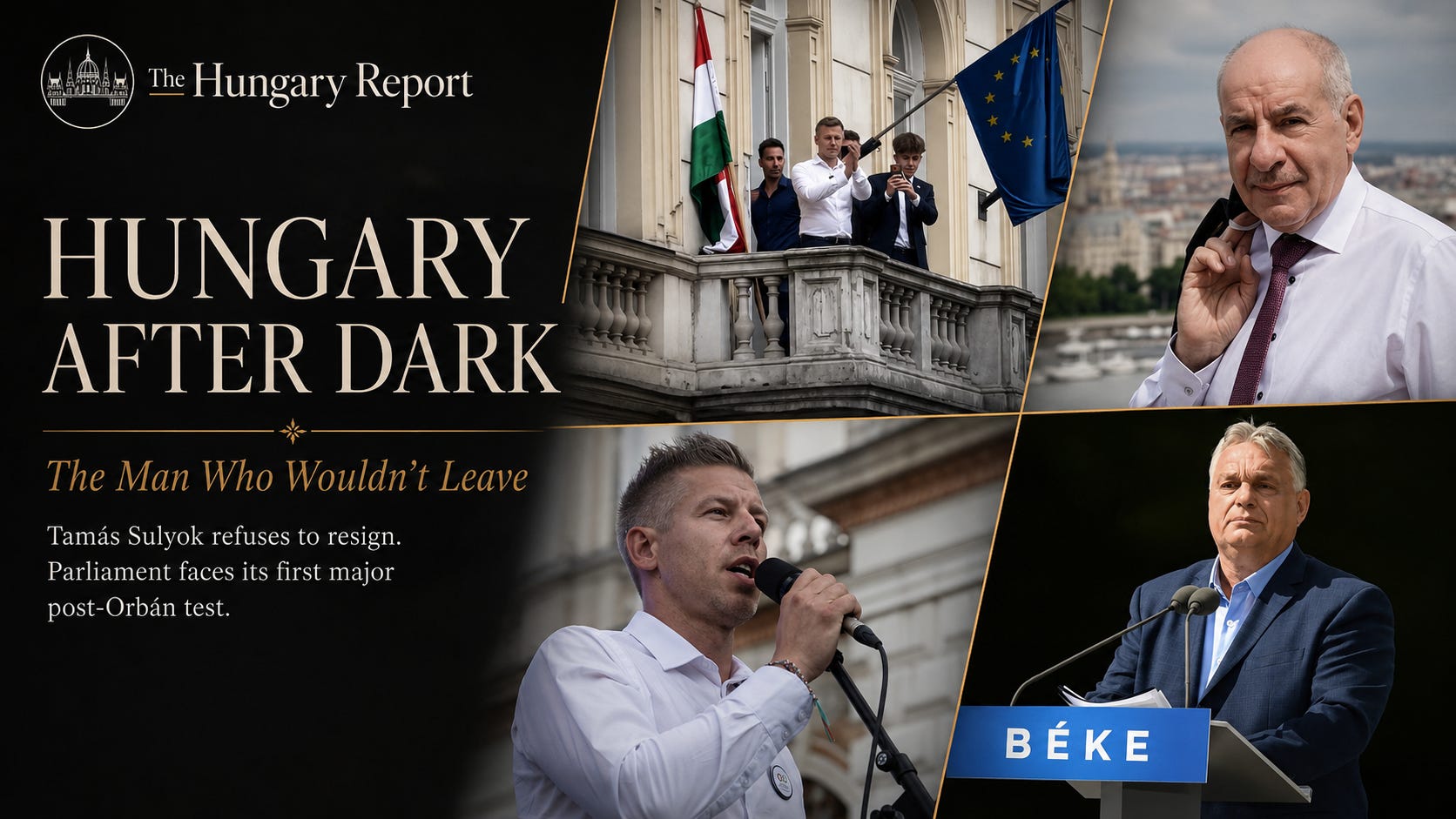
I keep coming back to Tamás Sulyok sitting there, perched up in his castle overlooking Budapest.
The presidency is not Hungary’s most influential office. That is effectively the point. Sulyok takes a central place this week because he is still there, because he was chosen under the old order, because Péter Magyar has asked him to leave, because he has refused, and because Parliament is now becoming the place where Hungary has to decide how a democratic mandate deals with officials installed precisely to outlast one.
I know this is constitutional procedure. I also know it does not feel like procedure when you are watching it happen to your own country.
On June 1, Prime Minister Péter Magyar again asked President Sulyok to resign. Sulyok refused. Magyar then said his government would use Tisza’s two-thirds majority to amend the Fundamental Law and force Sulyok from office, though the exact mechanism remains unresolved. Sulyok replied with the sentence that has been on my mind all week: “Neither democracy nor the rule of law can be built on threats.” Reuters reported the confrontation here.
It is a skillfully crafted sentence, and also an infuriating one, precisely because eloquent language can be employed in bad faith.
The remnants of the old regime here defend themselves through procedural language, claiming legality and restraint while obscuring how those mandates were created, protected and made useful.
That is why this week felt so tense. It was not just the week Sulyok refused to go. It was the week Orbánism again became visible as a structure of survival: enduring offices, persistent mandates, parliamentary choke points, public media habits, foundation boards, asset declarations, prosecutor caution, and individuals who now claim the deep moral value of procedure after losing the system that protected them.
Orbán is no longer in the prime minister’s office, but his influence remains embedded in institutions.
What mattered
The most urgent issue now is the collision between a newly won democratic mandate and a constitutional structure deliberately shaped to preserve the outgoing regime’s power.
Hungary voted for regime change on April 12, but Orbánism was built to last beyond elections. The presidency is only one example of this legacy, still holding power long after voters demanded change.
Sulyok’s mandate runs until March 2029. Magyar says the public chose a new constitutional path with Tisza’s two-thirds majority. Fidesz calls the pressure on Sulyok an “unlawful ultimatum.” Sulyok says democracy cannot be built on threats. Magyar argues that old officeholders must leave so democracy can be rebuilt. Parliament must now decide whether to create a legal mechanism to remove Orbán-era holdovers who refuse to resign.
This is the first true stress test of the new era, because it questions whether institutions shaped under Orbán can support democratic renewal or become respectable shelters for the old order.
Sulyok and other Orbán-era holdovers need to be removed, and institutions need to be opened to democratic accountability. Hungary should not be trapped within constitutional structures built to shield a defeated regime.
But I also want the method to matter.
Perhaps this is especially important now, at the very moment when methods may determine the legitimacy of renewal. The ultimate challenge is utilising power to resuscitate democracy without repeating the Orbán era’s abuses and centralisation.
That is the delicate balance Magyar must strike. He is correct that the old order cannot govern from behind institutional walls, but in pursuing reform, he now faces the danger of letting urgency override the caution needed to avoid repeating the Orbán era’s central habit: treating constitutional power as whatever the winner can force through.
Telex reported that when Magyar’s parliamentary group was asked to endorse the strategy, even his own MPs did not yet know the exact constitutional route for removing Sulyok. That does not prove recklessness, but it does show how quickly the political mandate is outrunning the legal architecture around it. The country wants change faster than the rules can be written.
This week, Hungary stands between political urgency and constitutional caution, as the first post-Orbán parliamentary showdown unfolds.
The president is still sitting there
There is something almost too neat about the image of Magyar at Sándor Palace on June 1.
The new prime minister outside. The old system still inside. Hungary watching a constitutional dispute unfold in real time, knowing that everyone is talking about law while everyone understands that the real subject is power.
Sulyok does not have Orbán’s executive authority, but he has enough leverage to matter. The Hungarian president can sign laws, return legislation to Parliament for reconsideration, or refer bills to the Constitutional Court, which means even a largely ceremonial office can slow or complicate the new government’s reform agenda. His refusal to resign made this leverage clear: limited powers can still obstruct democratic renewal when the political context gives them weight.
The presidency now embodies the lingering power of the old regime.
Sulyok has become the first respectable bunker of the old state.
I do not mean this as a personal psychological diagnosis; I mean it institutionally. The office now carries more political weight than its official powers suggest. It stands for a wider category of Orbán-era appointments: people whose mandates continued beyond the election, who now treat the election as just another fact, and who claim continuity is democracy while removal is revenge.
There is a legal argument here, and a political trap.
The trap is that Orbán’s people now want to turn their staying power into democratic virtue. The president’s mandate, the prosecutor’s independence, the media authority’s continuity, and the Constitutional Court all become sacred. Every office Fidesz filled, shaped, pressured or insulated is suddenly treated as a delicate constitutional flower the new majority must not touch.
Hungary cannot pretend these offices emerged independently. They were shaped by the previous regime and, in part, designed to preserve its influence beyond the election cycle.
A recent survey cited by Telex found that 64 per cent of Hungarians want Sulyok to resign, but the majority support alone is not enough. If his removal is not constitutionally sound, the old regime will claim victimhood, and the new government will inherit a wound it does not need.
Parliament’s decisions will determine whether Hungary achieves democratic renewal through lawful reform, or merely repackages the old logic of power under new management.
Parliament gets the argument
I have been watching Parliament this week with the strange feeling that the country has returned to the place where politics is supposed to happen, while also knowing that the place itself carries the memory of what happened to it.
For years, Parliament was too often reduced to scenery: a beautiful building used to process decisions made elsewhere, a theatre of votes whose outcome everyone knew, a place where democratic form remained visible even as party discipline, emergency powers, loyal institutions and one man’s authority hollowed out the substance.
Parliament is central again, and that is both hopeful and risky.
Tisza’s two-thirds majority gives the government the legal power to undo parts of the old order, but the legitimacy of that work depends on restraint, clarity and durability. In many democracies, supermajorities are designed to encourage broad consensus for constitutional change. Under Orbán, Hungary’s two-thirds threshold became something else: a tool for unilateral redesign. The Fundamental Law was amended repeatedly; electoral and judicial structures were changed; loyalists were entrenched; and constitutional amendment became a governing instrument rather than a national settlement.
Now Tisza has the numbers to dismantle parts of that inheritance. Its legitimacy depends on showing that dismantling is different from taking possession.
Magyar is adept at compressing moral anger into executable action. That was exactly what the opposition lacked for years. The old democratic opposition could often explain, condemn, mourn, document, and occasionally form committees about Orbánism, while Orbánism continued to govern the country with the relaxed confidence of a system that had stopped expecting consequences. Magyar broke that rhythm. He made politics feel immediate again.
Governing means channelling urgency into reform that lasts. This week, Magyar sounded like three politicians at once. On Sulyok, he was the insurgent tribune rejecting old officials as masks for Orbánism. On EU funds and the budget, he acted as a prime minister seeking a solvent and credible state. On corruption, asset declarations, and the National Bank scandal, he sounded like a prosecutor asking why these issues had never been properly examined.
All three versions of Magyar are useful.
The prime minister must win inside Parliament. The prosecutor must respect evidence. The insurgent must remember that victory does not remove limits. The challenge is not to slow the transition into paralysis, because the old system wants exactly that. The challenge is to move quickly and set rules clearly enough that the public can see the difference between accountability and appetite.
The old order deserves removal. The real measure is whether that removal leads to lasting renewal or simply substitutes one imbalance for another.
