

Hungary After Dark: The First Week Inside
The cordons have come down. Emergency rule has ended. Hungary is moving from public theatre to institutional repair, and the public is not turning away.

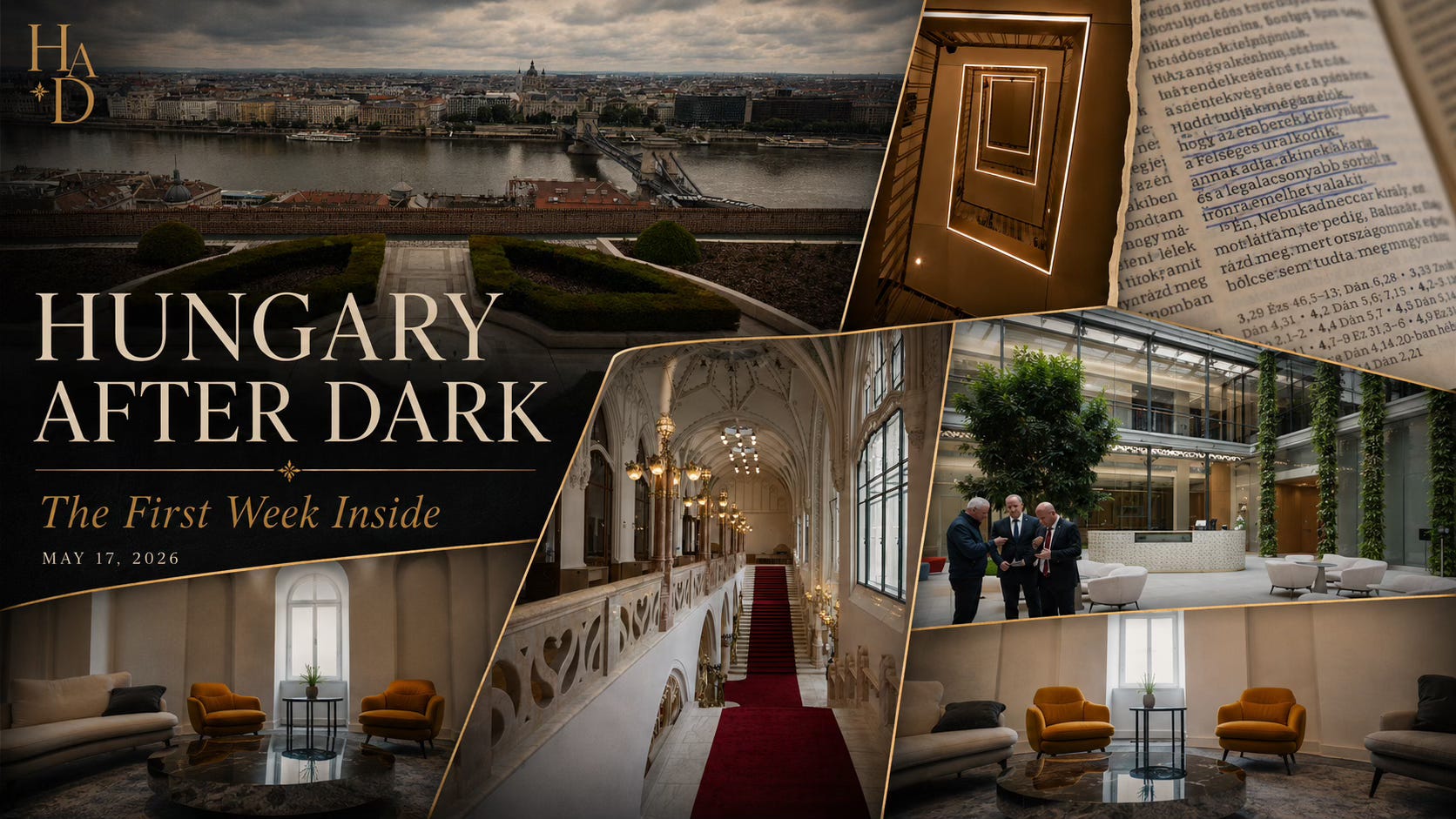
Hungary After Dark is my paid weekly dispatch from the aftermath of the Orbán era: part analysis, part political diary, part nocturnal record of what is shifting, what endures, and what the week has exposed beneath the surface. This is not a news summary. It is an attempt to chart the rooms where power is being reassembled, in a country that remains restless but hopeful even in the first days of recovery.
May 17, 2026
For the first time in years, Hungarians crossed thresholds that had been closed to them.
Government spaces once sealed off behind barriers, police lines and political choreography stood open. The break with the Orbán era was not only rhetorical. It was physical, visible and, for many people, strangely intimate. Citizens walked into places that had been made to feel distant from them, as if public power had somehow become private scenery.
This is only remarkable because the boundary between public office and private possession had been blurred for so long.
The new government opened the Karmelita and the former Prime Minister’s Cabinet Office, two buildings that had become part of the visual language of exclusion. Barriers came down. Rooms were shown. Spaces were reclaimed. Péter Magyar helped remove the fencing around Orbán’s former office and said there was “no place for cordons” in Hungary after the change of regime. AP reported the moment as one of the clearest visual breaks with the previous government.
The image worked because it did not stand alone.
This week, the mood shifted in Hungary. The government turned from the emotional force of transfer to the practical work of governing. The transition left the square and entered the filing system. It became less theatrical, more administrative and far more revealing.
Magyar’s government has began opening the drawers of the public institutions it inherited.
The new government now faces ministries, emergency laws, spending obligations, command structures, media habits, international repairs and institutional routines that survived the regime that created them. This is the first movement toward real institutional change, and it is more hopeful than victory language because it is happening in the part of politics where slogans usually go to die: budgets, decrees, thresholds, files and offices.
The public does not seem to be turning away.
Recent polling shows Tisza with commanding support while Fidesz has fallen to roughly one-fifth of the full population. These are not election-night emotions. These are after-the-fact numbers, recorded after the speeches ended and governing began. A 21 Kutatóközpont poll reported by Telex put Tisza at 60 percent and Fidesz at 20 percent in the full population, while Republikon’s latest figures placed Tisza at 57 percent and Fidesz at 23 percent.
Hungarians are not only responding to the removal of Orbán. They appear to be responding to the early shape of the replacement: open public spaces, less propaganda, an end to emergency rule, and a government that at least begins by treating power as something that must be accounted for.
This is not aftermath.
It is entry.
The old regime lost, and the public is stepping into places that were previously off-limits.
