

Hungary After Dark - The Emptying Room
Issue 3 · April 26, 2026 · By Péter Dósa - Orbán is leaving Parliament. The rest of the regime is looking for quieter exits.

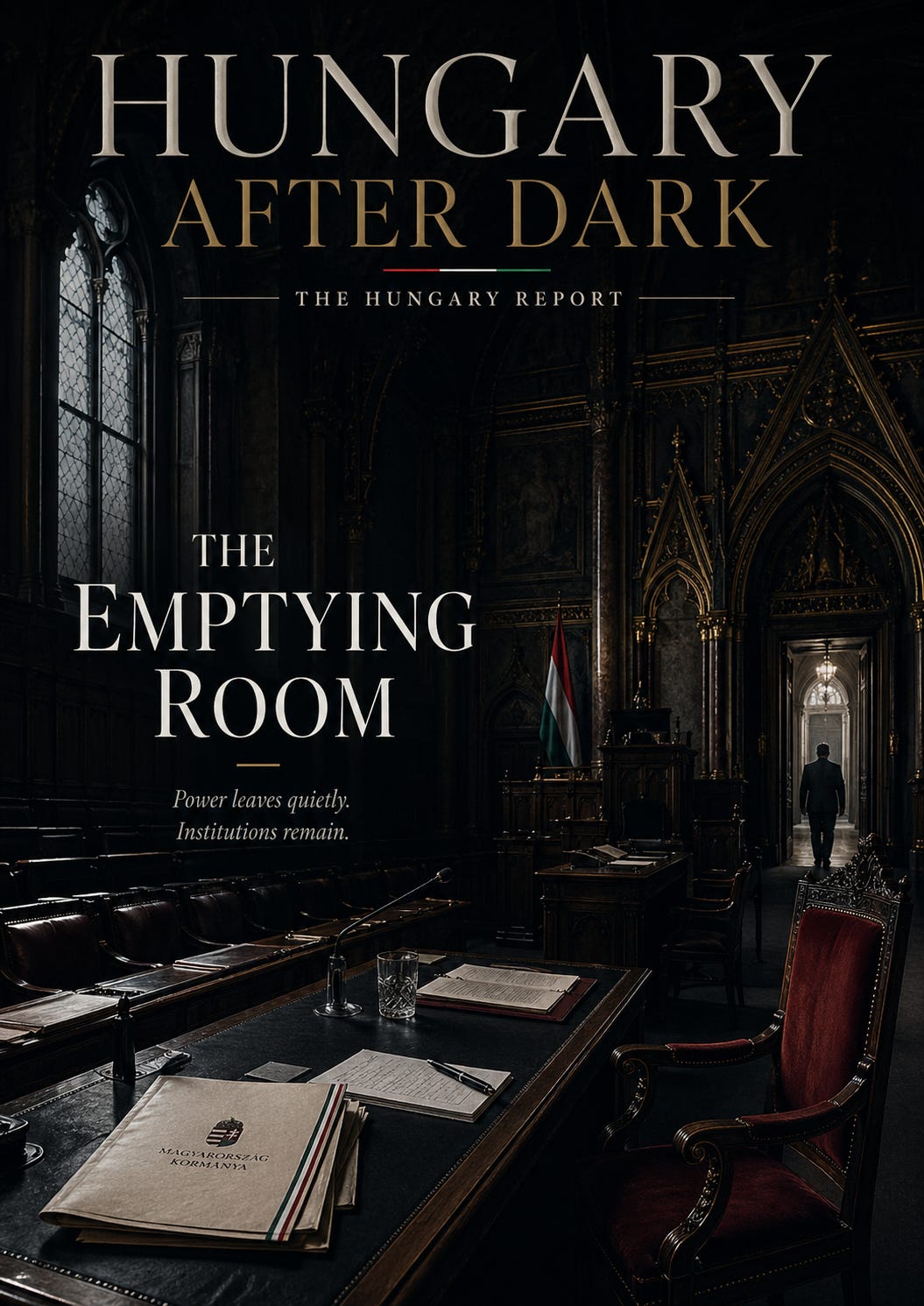
This week in one line: The old regime began to dissolve, its absence more telling than its defeat.
The line that stayed with me: Orbán claimed he was needed elsewhere. After thirty-six years, defeat made Parliament irrelevant to him.
The old guard is leaving the room. Parliament grows quieter before the new session, its absence already carrying meaning. Consequences gather at the edges of sight.
What mattered. What it means. What comes next.
The strange thing was not that Orbán refused to sit in Parliament.
That almost made sense. A man who spent sixteen years making the chamber smaller than himself was never likely to enjoy becoming a defeated former prime minister inside it. Parliament served Orbán when it ratified his power. It serves him less when it displays his defeat.
Stranger was the fact that he was not alone.
Kósa Lajos, another veteran of the Fidesz era, also announced that he would not take up his mandate after 36 years. Bánki Erik is stepping back too. Senior KDNP figures are leaving the chamber as well. Not every exit means the same thing. Some are retirements. Others are tactical. A few may aim to salvage dignity after voters stripped away the set pieces.
Politics is choreography. This movement is unmistakable.
Men who spent decades treating Parliament as their natural habitat have suddenly discovered life outside it.
That is the image of the week: the room emptying, one presence at a time.
The first week after Orbán’s defeat was about shock. The result was real. The map had changed. Fidesz had lost places it had treated as permanent property. Brussels recalculated. Kyiv watched. Moscow adjusted. Hungary caught its reflection, surviving an ordeal and unsure what to make of the aftermath.
A colder week settled over Budapest, the air heavy and unmoving, pressing down on what remains.
The question is no longer victory. It is disappearance: who can still slip away, what remains concealed, and which fragments of the old order can fade before scrutiny arrives.
What mattered
Orbán refused to become leader of the opposition in the very place opposition is meant to happen.
That is the first fact of the week: he will not take up his parliamentary mandate. Instead, he positions himself as needed elsewhere, reorganising the “national side.” Orbán does not want to sit across from Péter Magyar as a defeated politician among politicians. He prefers to remain outside the chamber, casting himself as guardian, victim, organiser: the man wronged not by voters, but by history, Brussels, betrayal and whatever else remains in the cupboard of wounded authoritarian mythology.
Meanwhile, Péter Magyar escalated his claims about the old regime’s money and media. He alleged that oligarch-linked wealth is moving abroad, high-value transfers have been suspended on suspicion of money laundering, and parts of the propaganda infrastructure may be sold or repositioned. These are allegations, and they require evidence, process and legal care. Politically, though, the claims show exactly where the shift is heading: away from speeches, towards ownership, documents, deadlines and control.
The media landscape is shifting as well. Reports suggest that TV2, a longstanding pro-government pillar, is already recalibrating. Public media remains more entrenched. For years, it constructed a parallel country, a place where Orbán’s permanence was presumed, Brussels appeared adversarial, Ukraine was viewed with suspicion, enemies seemed to multiply, and dissenting voices were cast as betrayal.
Now the question is what will emerge as that constructed reality unravels.
Practical deadlines loom. Magyar travels to Brussels for EU funds, while Hungary’s emergency legal order approaches expiry. This less cinematic but crucial front, frozen funds, legal decrees, procurement files and media ownership, will decide whether democratic change becomes governance or remains caught in the machinery of the previous era.
The real questions are now procedural, administrative and brutally specific. Where are the bottlenecks? Which institutions can still stall change? What evidence may disappear before anyone can trace it? And can a country, taught to inhabit a single official reality, be led out without being blinded by exposure?
Paid subscribers get the map: who holds the levers, where the bottlenecks are tightening, and how Hungary’s next phase will be fought on the page and behind closed doors.
