

Hungary After Dark — Power, on Paper
A week of favours, missing money, salary cuts, Brussels pressure, and the old system’s talent for surviving in plain sight.

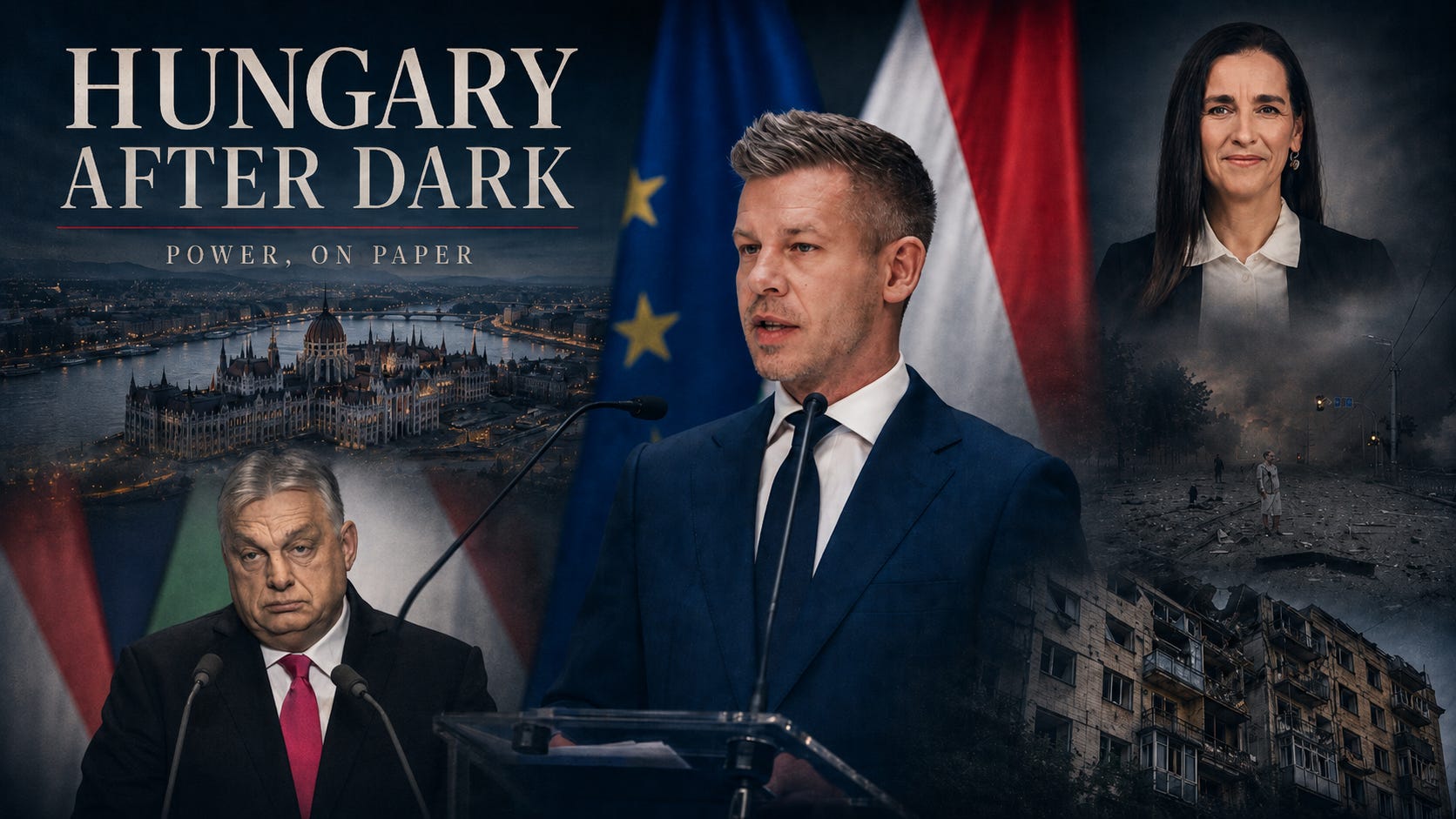
Hungary After Dark is my weekly dispatch from post-Orbán Hungary. A personal reading of what surfaced, what shifted, and what the week revealed once the official noise faded.
A small note before we begin. The Hungary Report is my one-person project: researched, written, translated, edited, and produced by me. Hungary After Dark is the paid Sunday edition, where I try to give readers the deeper weekly reading rather than another scroll of headlines. Every issue means hours inside the Hungarian press, government notices, interviews, investigations, budget lines, speeches, and political noise, then the slower work of turning all of that into something clear enough to be useful outside the country.
I am at the stage where a stronger base of paid readers would make a real difference. It would let me move closer to doing The Hungary Report full time, with more original reporting, deeper weekly analysis, better explainers, and a more consistent English-language window into Hungarian politics. One subscription will not save independent media. But it does help keep this small desk open: reading closely, translating the chaos, and refusing to let Hungary be explained only by the people who made it harder to understand.
All week, I kept thinking about what happens after a country steps inside the building.
The first days of transition were carried by images. Cordons falling. Emergency rule ending. Citizens entering public spaces that had been sealed off for years, places treated as private scenery by a state that forgot who owned them. It felt physical, almost intimate. The public moved into rooms it had been trained to approach from a distance.
Then the week changed register. The open doors led inward, toward records. The pardon file led to the budget. The budget led to signatures. The signatures led to appointments, deadlines, old obligations, and the kind of official paper that does not look dramatic until someone finally reads it closely.
This is where regime change leaves the square and enters the archive.
A country does not wake up clean because a government falls. It wakes to contracts, debts, favours, loyalists, legal snares, and sudden converts to procedure — people who, until very recently, treated rules as an inconvenience.
Hungary spent the week reading what was left behind.
The files did not flatter the country.
The pardon file moved
The Endre K. pardon scandal returned this week in the form that now carries the most weight. Documents.
This is the case that blew open Hungarian politics in 2024, after President Katalin Novák pardoned a man convicted in connection with the cover-up of abuse at a state-run children’s home. Novák resigned. Judit Varga, the former justice minister who had countersigned the pardon, left frontline politics. The wound never really closed.
The released material showed that warnings existed inside the system. The Justice Ministry had material pointing against clemency. The Sándor Palace also had an internal rejection draft. Yet Novák granted the pardon anyway.
The question is sharper now. Why did the warnings lose to the favour?
Then Tamás Schanda, Novák’s former chief of staff, told 24.hu that Zoltán Balog had “firmly and emphatically” asked for Endre K. to receive clemency. Balog later said the story stops with him.
That sentence carries more than it admits. Balog was no distant petitioner. He was a former Orbán minister, a Reformed Church bishop, and one of those figures who moved easily between morality, state power, and personal access. The old system called this national seriousness. In the file, it looks like influence in ink.
The documents tell us more. They still stop short of responsibility. We now know more about who pushed. We still do not know enough about why the institutional warnings failed, why the pardon moved forward, and whether anyone else stood behind the request.
This case now reaches beyond Katalin Novák, Zoltán Balog, or Judit Varga. It exposes the old system’s moral plumbing. Pressure entered through one pipe, resistance collapsed in another, and responsibility evaporated before it reached a name.
Disgust has already done its first work. It broke the silence. Now the file needs a room, a chair, and a name across the table. Someone has to ask, calmly and in public, how a warning became irrelevant, how a favour moved faster than the institution meant to stop it, and who learned to look away before the signature landed.
The missing budget line
The next document belonged to a colder part of the state.
After the pardon file, with its moral heat and human disgrace, the budget seemed almost dull. That is where its force lies. Budgets are where governments leave fingerprints, not in the language of confession, but in the placement of a line, the absence of one, and the quiet confidence that nobody will read closely enough.
The Magyar government says it found HUF 286 billion — roughly $925 million at Sunday’s Telex exchange rate — in spending missing from the visible budget. Telex obtained the handover document and checked the budget law. The three disputed items were not where they should have been. They concern expressway availability fees, the Hungarian section of the Budapest–Belgrade railway, and the Iváncsa battery-plant rail connection.
A budget line should exist.
Orbán’s Hungary taught the public to watch for the spectacular object — the stadium, the castle office, the yacht, the propaganda poster, the oligarch’s estate. Corruption came dressed for the camera. The deeper inheritance resists photography because a state can be quietly warped through budgets, procurement tricks, deferred obligations, creative accounting, and lines that surface only after the old government has left.
Fidesz denies wrongdoing and insists the previous government played by the rules. Good. Keep the fight on paper. Show the handover material, the signatures, the omissions, and the choices. Let the facts do the work before they harden into slogans.
If the missing money becomes a chant, the old state claims a small victory. If it becomes a clear trail of obligations, signatures, dates, and names, then the country gets something harder to dismiss.
