

Hungary After Dark: From Audit to Case File
Five criminal complaints, European prosecutors, secret police files, a darkened newsroom, and a prime minister bargaining away two centimetres on Reddit.

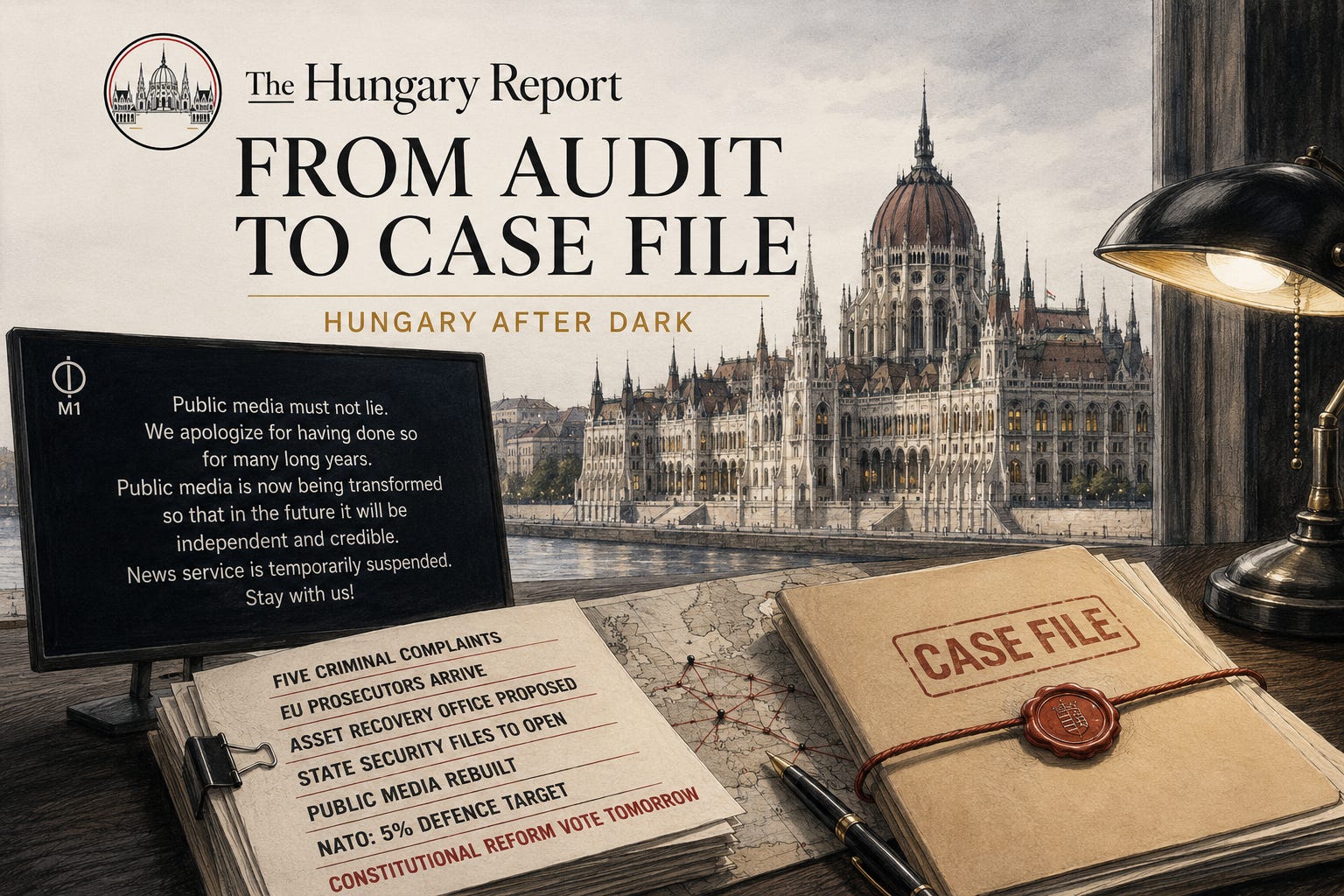
By the end of this week, Hungary’s audit had acquired case numbers.
On 9 July, the Prime Minister’s Office announced five criminal complaints concerning an alleged HUF 106 billion ($340 million) in public losses. The following day, the government submitted legislation creating the National Asset Recovery and Protection Office. Brussels approved Hungary’s entry into the European Public Prosecutor’s Office, while EU finance ministers approved a revised recovery plan covering €10 billion in grants and loans.
Parliament also prepared the release of communist-era state-security files. The Defence Ministry began reviewing contracts signed since 2022. Public news broadcasts were suspended while the state broadcaster was rebuilt. At NATO’s Ankara summit, Hungary joined a commitment that could eventually place defence and security expenditure at 5 per cent of GDP.
For months, Hungary has counted what the Orbán government left behind. This week, that counting turned into action.
Before we dive in, thank you to everyone who supports The Hungary Report, whether through a paid subscription or simply by reading and engaging. Your support — at any level - helps keep this publication open, independent, and accessible to all, even as Hungary changes rapidly. If you find value in this work, please consider upgrading to a paid subscription for just 5 euros or dollars a month; your support truly means the world to me and helps ensure I can continue this reporting for everyone.
The first five complaints
The government says its review of inherited documents has uncovered five cases involving a combined HUF 106 billion in possible damage to the state. These are allegations submitted to investigators. No court has yet established criminal responsibility.
Seven organisations received HUF 1.52 billion, around $4.9 million, between 2021 and spring 2026. According to the Prime Minister’s Office, their personnel and finances overlap, with former Fidesz parliamentary candidate Nóra Király appearing across all seven.
OBSERVER Médiafigyelő received media-monitoring contracts worth HUF 30.9 billion, about $99 million, between 2020 and 2026. The government says the price rose sharply without an evident expansion of the service.
A separate HUF 40 billion programme distributed around 15 million data erasure codes via veglegestorles.hu. Officials suspect that payments may have covered cases in which no corresponding service was performed.
Another complaint concerns HUF 34.3 billion, about $110 million, and three properties transferred to the Hungarian Orthodox Exarchate despite records the government describes as incomplete or contradictory.
The final case reaches into Fidesz’s post-election campaigning. One of the black-clad men accused of confronting protesters during Viktor Orbán’s tour reportedly appears in a document as a party contact, complete with a fidesz.hu email address.
That is the sort of detail that makes you put the coffee down.
It draws a troubling line between one participant and the former governing party. It does not establish that Fidesz organised or directed the confrontations. Investigators will still have to determine exactly what the connection means.
The files span civic grants, media monitoring, digital services, church property and campaign organisation. Contracts expand. Documentation thins. Personnel overlap. The state pays, and the public purpose becomes harder to reconstruct.
A press conference names a sum. A prosecution must prove it.
The office designed to see the whole picture
The government submitted the bill creating the National Asset Recovery and Protection Office, or NVVH, on 10 July.
Its proposed powers are broad, and Magyar has been quite direct about why he believes they have to be.
Public wealth under the Orbán government rarely moved through one obvious transaction. Money could begin in a ministry, pass through a tender, enter a foundation or private company and disappear behind several layers of contracts, ownership and financial arrangements. One authority might see the tender. Another might see the tax records. A third might encounter the company years later, once the money had already travelled.
The NVVH is designed to assemble those fragments.
Under the published proposal, the preliminary unit could examine bank accounts, state registers and official records before a criminal proceeding formally begins. It could draw on the police, prosecutors, and the National Tax and Customs Administration, enter premises connected to an investigation, and inspect contracts, servers, and financial accounts.
The government’s argument is straightforward: another office capable only of writing reports would leave Hungary with a thicker archive and the same missing money. The new body is meant to trace the route, assemble the evidence, and carry viable cases to court and for recovery.
Magyar has called it one of the strongest offices of its kind in the European Union. Tisza presents it as a permanent safeguard against the misuse of public wealth, including by future governments. Its own account of the proposal says asset recovery, judicial independence and the rebuilding of the democratic state were central promises that now have to become law rather than remain campaign language.
The office would report to Parliament rather than to the government. Its president and four deputies would be elected by a two-thirds majority for six-year terms. Three deputies would be prosecutors. Staff would be barred from party membership and political activity, while the leadership would receive continuous police protection.
This remains a proposal, and Parliament may still alter its design. Clear appeal rights and judicial review would strengthen the office by making its decisions harder to dismiss as political commands.
For now, the logic is clear, though. Tisza knows the Orbán state scattered information across institutions while wealth moved freely between them. The NVVH is its attempt to see the full arrangement rather than one suspicious contract at a time.
If it works as promised, Hungary will finally have an institution built to follow the money all the way home.
Europe returns via prosecutors and institutions
On the same day the NVVH bill entered Parliament, the European Commission approved Hungary’s participation in the European Public Prosecutor’s Office.
EPPO investigates and prosecutes fraud, corruption, money laundering and serious cross-border VAT offences affecting the EU budget. Orbán’s governments repeatedly refused to join, leaving Hungarian cases involving European funds largely dependent on domestic prosecutors.
That refusal is now over.
Hungary became the twenty-fifth participating member state. It must nominate three candidates for the post of European Prosecutor, from whom the Council of the European Union will choose one. The government must also establish offices for European Delegated Prosecutors inside Hungary.
Membership has been approved. The Hungarian operation now has to be built.
The next important decision will be whom the government nominates, and whether those prosecutors can use their independence to follow the evidence wherever it leads.
EU finance ministers also approved Hungary’s revised recovery plan on 10 July. It covers around €10 billion, including €6.5 billion in grants and €3.5 billion in loans.
The Council said approval “should allow” the money to be disbursed. The Hungarian government said it would “certainly” arrive.
Hungary must still complete reforms and investments, submit payment requests and satisfy the Commission that the required milestones have been met. The broader €16.4 billion figure cited by the government also includes cohesion and other funding routes.
Brussels now looks less like a stage prop and more like an institution. The money comes with milestones, and fraud involving EU funds can reach prosecutors outside Hungary’s domestic hierarchy.
The oldest files receive a due date
Hungary has spent thirty-six years arguing over the files of the communist state-security services.
This week, Parliament approved another attempt to open them by a vote of 188 to zero. The law’s preamble admits that justified public disclosure “has not yet been fully realised.”
The first publication is scheduled for 22 October 2026, the eve of the seventieth anniversary of the 1956 Revolution. The release is expected to include the so-called Hatos Karton records and unclassified information recovered from magnetic tapes.
A 13-member advisory committee will examine files that the security services still want to keep classified. Five members, including the chair, will come from or have expertise in national security. Six will be historians, archivists or lawyers nominated by the culture minister. Two will be proposed by opposition groups.
The committee can recommend declassification. The formal classifier retains the final decision, and the government will appoint all thirteen members for an indefinite period.
Hungary’s oldest unresolved archive received its first deadline in the same week that its newest files produced criminal complaints.
The screen goes dark
At 4 pm on 7 July, M1 interrupted its news service.
“Public media should not lie. We apologise for having done so for many years. Public media is currently being transformed so that in the future it can operate credibly and independently. News services are temporarily suspended. Please stay with us.”
For the first time in years, Hungarian public media admitted the obvious: it had lied.
Kossuth Radio’s news output also stopped, while some frequencies carried Bartók Radio’s classical music. Other programming continued.
For more than a decade, public media operated as an extension of government communications, with ministerial claims presented as news and critics attacked or excluded. Hungarian viewers paid for a broadcaster that had turned journalism into government messaging.
The apology addressed a real abuse. Watching the state broadcaster admit that it had misled the country is a symbolic yet historic moment for us Hungarians.
At 7:56 pm, M1 resumed broadcasting with A tanú (The Witness), a 1969 satire of Stalinist Hungary that remained banned for a decade.
It was a superb programming choice, though the bar had admittedly been lowered by years of government propaganda.
Magyar called the shutdown “a historic day.” Orbán called it “Tisza tyranny” and directed viewers to Hír TV, where the reassuring absence of self-reflection remained available around the clock.
For a few hours, the old newsroom vanished, and no one yet knew what, if anything, would take its place.
Five per cent
At NATO’s Ankara summit, allies reaffirmed a commitment to spend 5 per cent of GDP on defence and security-related requirements by 2035.
Five per cent is the kind of number that looks tidy in a summit declaration and enormous in a finance ministry.
The target includes at least 3.5 per cent for core military requirements and up to 1.5 per cent for resilience, infrastructure and related expenditure. It will shape future procurement, borrowing and domestic investment.
Additional security spending will compete with hospitals, schools, railways, housing and debt reduction.
The government argues that the wider category can include health capacity, transport links and civilian infrastructure with security value.
The pledge arrived as the Defence Ministry launched a review of contracts signed between 2022 and 2026. The internal working group can examine completed and active agreements, demand documents, and conduct hearings. Its report is due by 31 December, though publication is not required.
Hungary is reviewing one defence-spending wave while preparing for a much larger one.
The former rulers discover restraint
On 9 July, Fidesz held a “Stop Tyranny” demonstration outside Sándor Palace. Former president János Áder spoke. Viktor Orbán promoted the event and stayed away, remaining the absent guest of honour.
The target was the proposed Seventeenth Amendment to the Fundamental Law, which would end Tamás Sulyok’s presidential mandate and impose term limits on parliamentary seats. It would also restore Constitutional Court powers, narrow the reach of two-thirds legislation and reduce the Budget Council’s authority over an elected government.
Public institutions should remain capable of surviving their occupants.
Fidesz now warns that constitutional power is being used too aggressively. Its own record is the reason that warning lands as hypocrisy.
The party adopted a new constitution after 2010 and amended it 15 times. It ended Supreme Court president András Baka’s mandate more than three years early after he criticised judicial reforms. It terminated the term of Data Protection Commissioner András Jóri when it replaced his office. It lowered the judicial retirement age from 70 to 62, forcing hundreds from office.
European courts later ruled against Hungary in each area.
At Thursday’s rally, Fidesz MP János Pócs said the party’s amendments had always served “the interest of the country.”
The sentence contains the central Fidesz theory of constitutional law. Its own use of power represented the nation. Another majority using similar authority becomes a tyranny.
That history does not excuse sloppy constitutional work. The government should publish the full case against Sulyok and explain why the existing removal process is inadequate.
I support much of the amendment. Restoring the Constitutional Court’s authority, reducing the reach of two-thirds laws and preventing parliamentary seats from becoming lifetime possessions are defensible reforms. The government will strengthen its case by explaining the most controversial provisions with the same confidence it uses to defend the broader package.
Elizabeth Tóth, one of the speakers, called the 12 April election “the Trianon of the Hungarian nation.” A democratic transfer of power had become territorial dismemberment.
Fidesz spent years merging party, state and nation into a single political identity. Defeat acquired the emotional form of national loss.
The full rally deserves its own account. I wrote about its Stalinist warnings, improvised history, and accidental Örkény satire in “Fidesz Holds a Protest Against Fideszism”.
The following day, around a thousand people joined Mi Hazánk’s “Family Pride March.” László Toroczkai declared:
“Today, we are the oppressed.”
The march was presented as a celebration of families. Most speeches concerned LGBTQ+ people, same-sex couples and adoption.
The political right now speaks in the language of grievance, even as its institutions and preferred definition of family remain deeply entrenched. Power is being recast as injury.
Sulyok’s travel also became part of the dispute.
Magyar accused him of spending twelve days in the United States between 26 February and 10 March at a public cost reportedly exceeding HUF 120 million, around $385,000.
The itinerary included diaspora events, official commemorations and tourist sites, including Southfork Ranch, made famous by Dallas. Sulyok’s son accompanied him.
The Palace says the son’s costs were settled in accordance with the rules.
That answers the accounting, but not the itinerary.
The prime minister enters the comments
By Saturday evening, Magyar had moved from NATO, EPPO and constitutional conflict to Reddit, where he negotiated his height down by two centimetres.
Holidaying in Turkey, he held an Ask Me Anything session that drew around 6,600 comments.
“In theory, 178, but many people dispute that, so let’s agree on 176. Seventy-eight. Okay.”
Measurable reality is now part of the government’s consultation process.
Asked about false reporting on Hír TV, Magyar said press-correction rules and sanctions should be tightened.
He is right that deliberate falsehoods should carry consequences. The rules still have to apply to every broadcaster and every future government, including his own.
Asked about the detention of a politician, he replied:
“We cannot interfere in the administration of justice.”
That sentence should become ordinary in Hungary.
An employee of the National Development Centre described poor morale, absent communication and fears that experienced staff were leaving. Magyar replied that he would investigate.
Government reform still depends on civil servants who process claims, prepare contracts and understand the institutions inherited from the previous administration. Political change may arrive through constitutional amendments, though somebody still has to answer the email and upload the form correctly.
Magyar also promised to publish the 63-point list he says hangs in his office to prevent power from going to his head. Other answers produced commitments involving direct presidential elections, reduced VAT on medicines and asbestos removal.
It was open, lively and distinctly Magyar. It also produced a substantial set of promises that his government will now be expected to keep.
The ordinary state
The government also repealed the Orbán-era teacher performance-assessment regulation. No assessments will be carried out during the 2025–26 academic year while a replacement is designed.
Health Minister Zsolt Hegedűs said health workers require a pay rise of at least 20-25 per cent. At Budapest’s Bajcsy-Zsilinszky Hospital, patients were meanwhile waiting in air-conditioned military tents outside the emergency department.
Penalties for continued use of paper medical referrals were postponed because the electronic system remains unreliable.
This is the fainter part of governing, though it is usually the part people notice first. A constitutional court may protect democracy. A functioning referral system ensures that someone reaches the correct doctor.
The purpose of recovering public money is to return it to the hospitals, schools and public services people actually depend on.
Tomorrow, the amendment goes to a vote
Tomorrow will be the most significant political day of the week.
On Monday, 13 July, Parliament is due to vote on the Seventeenth Amendment. The package would end Sulyok’s presidential mandate, introduce parliamentary term limits, restore powers to the Constitutional Court, narrow the reach of two-thirds laws and weaken some of the institutional locks Fidesz left behind.
The slogans heard outside Sándor Palace will meet the voting board inside Parliament.
With Tisza holding a two-thirds majority, the amendment is expected to pass without much hassle. The details will still be worth watching closely: whether the government accepts any final changes, how opposition MPs vote and what Sulyok does once Parliament has acted.
The wider agenda also includes teachers’ right to strike, school autonomy, public health measures, and medicine subsidies. The NVVH’s final powers, budget and appointments deserve close attention. So do Hungary’s nominees for European Prosecutor, the first payment request under the recovery plan and the editorial charter of the rebuilt public broadcaster.
The government inherited missing records, captured institutions and contracts whose public purpose is now disputed. This week, it began acting on what it found.
The files are opening. European prosecutors are arriving. Public money that once disappeared behind opaque contracts is moving back within reach.
The harder work is institutional: building bodies that can investigate allies, admit mistakes and survive changes in government.
The audit now has case numbers.
Tomorrow, constitutional repair reaches a vote.
Source: Prime Minister’s Office; official NVVH bill and consultation materials; Tisza Party; European Commission and Council of the European Union; NATO; Magyar Közlöny 2026/88; Hivatalos Értesítő 2026/30; Telex; 444; Átlátszó; the Sándor Palace; and Péter Magyar’s Reddit AMA. Dollar conversions use approximately USD 1 = HUF 311.67.