

How Panic Became Part of the Border
Ceuta’s defences rested on Moroccan control beyond the fence. When Rabat relaxed its grip, Europe’s panic enlarged the power it had already surrendered.

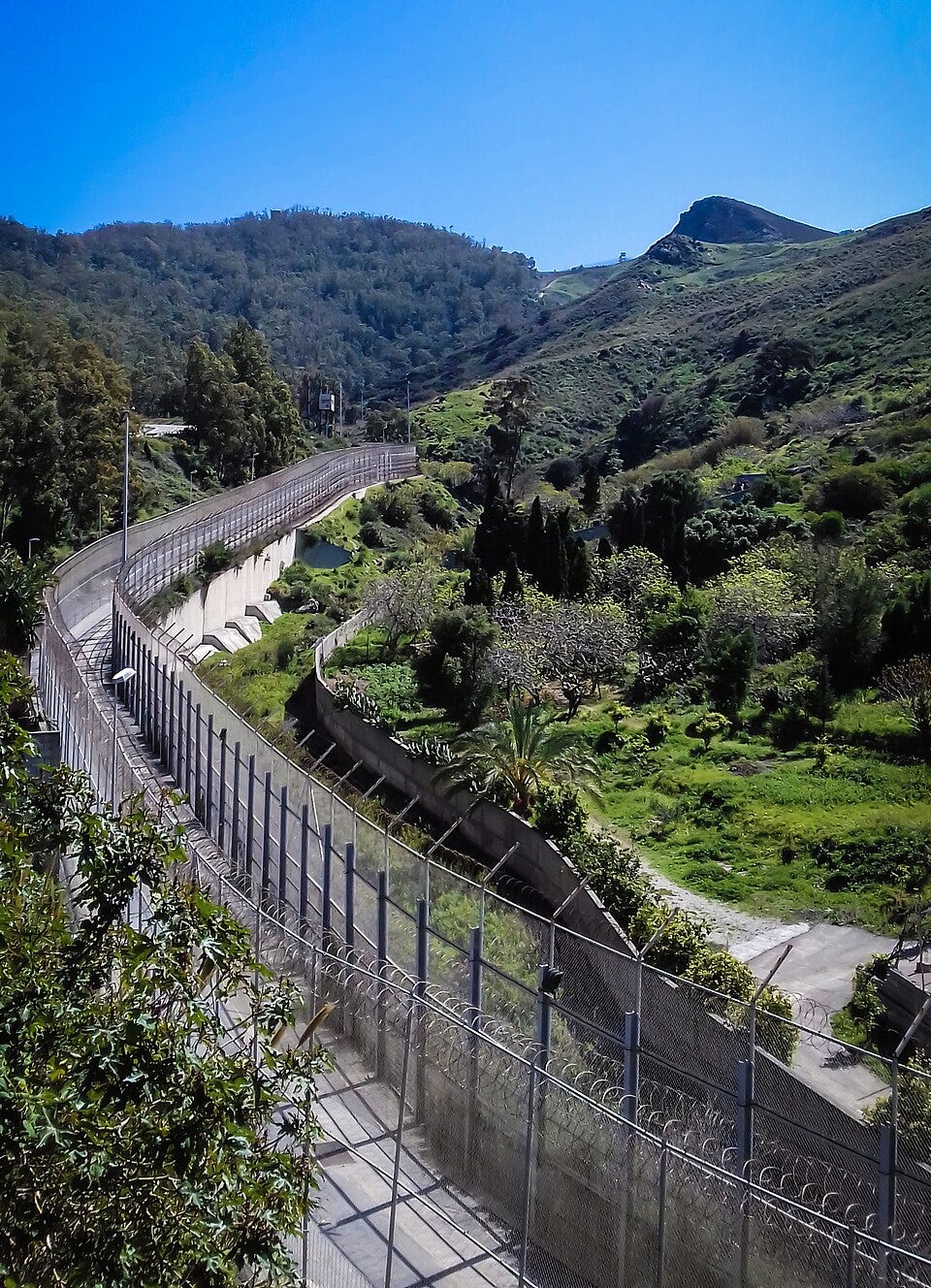
At Ceuta, Europe had spent three decades building permanence out of wire, concrete and borrowed authority.
Steel fencing sealed the landward frontier, while cameras, thermal sensors and watchtowers surveyed the beaches and the water curling around the Tarajal breakwater. Spanish police and the Guardia Civil controlled the enclave itself. Beyond them, Moroccan forces patrolled the roads, neighbourhoods and shoreline through which almost every journey towards Ceuta had to pass.
The border appeared to rest on Spanish concrete and European surveillance. Its daily strength came from work performed earlier and farther away, where Moroccan patrols dispersed gatherings inland, exchanged intelligence with Madrid and kept the approaches from filling faster than the enclave could absorb.
Europe had spent heavily on detecting movement. Its security ultimately rested on how another government chose to respond to what the cameras revealed.
During the final days of July, that dependence became visible.
False messages had told thousands of people that the border was open. As crowds gathered in northern Morocco, surveillance around Ceuta dwindled until control was effectively lifted, according to reporting on Spain’s preliminary intelligence assessment. Officers were seen standing aside, while people who later reached Ceuta described being waved forward or driven towards the sea.
The rumour soon obtained physical force. Buses, regional trains and taxis carried people north towards the Moroccan city of Fnideq, where the roads filled and the shoreline became a gathering point. Others approached on foot. Many entered the water holding rubber rings or improvised floats, with telephones and documents sealed in plastic to protect them from the salt water.
By the time Spanish forces understood the scale of the movement, the approaches were already full.
Spain’s interior minister, Fernando Grande-Marlaska, later told an emergency meeting of EU governments that an estimated 72,000 people had entered Ceuta. In comparison, the enclave has around 84,000 residents. Reception centres filled, child-protection services buckled, and thousands slept on beaches, pavements, and the ground near the city’s mosques.
At least seventy-five bodies had been recovered by Tuesday, Grande-Marlaska told his European counterparts, warning that the figure remained preliminary. The dead had drowned around the breakwater or been crushed as the crowd forced its way over wet concrete and through narrow points of entry.
A seventeen-year-old girl from Tangier reached Ceuta after losing her mother in the chaos and watching Spanish police recover the body of her eight-year-old brother.
“I saw people stepping on the dead. Now we are children begging on the street.”
She was among hundreds of unaccompanied minors stranded in Ceuta, where youth facilities had filled, and children were asking strangers for food.
Moroccan enforcement then gathered again at the border. Officers sealed the approaches, and Rabat accepted the return of tens of thousands of its citizens. By Tuesday, Grande-Marlaska said about 70,000 of those who had crossed were back in Morocco, leaving Spain to determine the status of roughly 2,000 people who remained.
With the fences still standing, the decisive change had occurred along the roads, beaches and gathering points controlled by Morocco, where restraint disappeared and later returned.
Within hours, the human catastrophe formulated a more practical political expression.
The far right called it an invasion.
The power beyond the fence
Spain’s recent migration figures describe a country where irregular arrivals had been falling.
Between January 1 and July 15, the Interior Ministry recorded 14,479 arrivals by land and sea, compared with 19,222 during the same period in 2025. The national total had declined by almost a quarter, continuing the steep reduction recorded the previous year.
Nevertheless, Ceuta was moving against that current. Recorded land arrivals had risen from 1,133 to 2,826. Swimming attempts were becoming more frequent, reception facilities were approaching exhaustion, and local authorities had begun warning Madrid that the enclave’s margin of safety was narrowing.
The divergence exposed what the national figures concealed: Spanish officers operated inside the territory, European financing supported surveillance and patrol capacity, and Moroccan forces interrupted journeys before people reached the fence. The drop recorded in Madrid, therefore, began with enforcement exercised outside Spanish territory.
That division of labour gave Rabat influence over the rhythm of the frontier. Moroccan forces controlled the roads and gathering points around Ceuta, along with much of the advance warning. Their decisions shaped whether people approached gradually or arrived in numbers capable of overwhelming the enclave within hours.
Researchers describe this relationship through the language of migration diplomacy, in which human mobility enters the bargaining conducted between states. Lorena Gazzotti’s research on European aid and Moroccan border policy shows that Rabat shapes the terms of cooperation through facilitation, negotiation, and obstruction, rather than acting as a passive recipient of European instructions and money.
The danger surfaced indisputably in 2021. After Spain admitted Brahim Ghali, the leader of the Polisario Front, for medical treatment, Moroccan guards temporarily eased their controls, and about nine thousand people entered Ceuta. The European Parliament later condemned Morocco’s use of migration and border control as political pressure against a member state.
Later, Spain endorsed Morocco’s autonomy proposal for Western Sahara. Diplomatic relations improved, Moroccan officers resumed preventing crowds from reaching the enclave, and the frontier became quiet again.
Its concrete had not thickened, nor had its cameras learned to see farther; what had changed was the relationship with Rabat.
When the anthropologist Ruben Andersson visited Ceuta in 2023, a senior Guardia Civil officer described the vulnerability in language stripped of diplomatic courtesy:
“Rabat knows it can destabilise Spain with migration.”
The officer was unnamed and spoke without Madrid’s formal authority. The sentence nevertheless captured the power concealed inside Europe’s border policy. Ceuta appeared to be under Spanish control, while much of the authority determining its daily security lay across the frontier.
What Madrid knew
Morocco’s conduct forms only part of the failure.
Madrid had received months of evidence that pressure was rising. Swimming attempts had increased, reception services were filling, and Ceuta’s child-protection authorities were operating far beyond their intended capacity.
After the crossing, a bitter dispute emerged over what Spain’s institutions had known. Cadena SER reported that warnings had come from the National Intelligence Centre, the Ministry of Inclusion and Migration, and Ceuta’s department for minors. On July 27, after fifty-two undocumented children entered the enclave, local authorities asked for a migration emergency to be declared.
A day earlier, Ceuta’s presidency councillor had raised the installation of additional anti-intrusion barriers during a meeting with Spain’s secretary of state for security. The proposal was rejected. CNI-linked sources later said that the intelligence service had repeatedly warned of the possibility of a mass entry and insufficient resources at the frontier.
Grande-Marlaska has disputed that account. He maintains that neither the CNI nor any foreign intelligence service issued a specific warning that an entry of this magnitude was imminent.
The disagreement must now be examined on the basis of documents rather than ministerial assertion. Madrid possessed a pattern of danger whose elements were visible before the final crossing: rising attempts to swim, exhausted reception services, repeated local warnings, and the recent memory of Morocco’s conduct in 2021.
Spain had also promised a comprehensive security plan after that earlier crisis, yet key elements remained unfinished when the new crossing began.
Madrid must explain which warnings reached the Interior Ministry, what reinforcements followed and why the state remained unprepared for a danger identified by its own officials in increasingly urgent terms.
The far right took those failures and supplied a cause that the facts could not sustain.
The invasion that lasted 48 hours
Across the pond, Donald Trump blamed Spain’s “weak law, bad management”. The US State Department described the crossing as the result of Madrid’s alleged efforts to facilitate mass illegal migration into Europe. JD Vance promoted a Fox News report that placed Ceuta in northern Spain, moving the enclave across the Mediterranean through political convenience. Politicians elsewhere claimed that the people emerging from the water were already travelling towards Britain or Germany.
An Associated Press examination found the central claims unsupported, though the story had already entered European diplomacy.
Moreover, Italy and Denmark organised a letter signed by 20 other EU governments, accusing Spain of pursuing policies that act as migration “pull factors”. Italy also imposed temporary checks on arrivals from Spain, extending the panic far beyond the point of crossing.
Under the Schengen Borders Code, the Schengen acquis applies throughout Spain, including Ceuta. Special rules require identity and document checks when travellers leave the enclave for mainland Spain or another Schengen country. Reaching Ceuta, therefore, offered no unrestricted passage into continental Europe.
After the emergency meeting, Grande-Marlaska said Schengen had been “in no way compromised”, with “no secondary movement, nor even the possibility of any”. Around seventy thousand people had crossed into Spanish territory and returned to Morocco without opening the corridor towards Europe that politicians had announced.
In addition, Spain’s regularisation programme offered no route to status for the new arrivals. The government’s published eligibility rules required presence in Spain before January 1, 2026 and at least five months of continuous residence. Applications had closed on June 30; thus, someone entering Ceuta at the end of July could not qualify.
The Supreme Court judgment circulating online had been distorted just as severely. The court ruled that immediate rejection applied to people crossing physical barriers such as the fences. Someone intercepted at sea had to enter the ordinary legal process, including identification, access to a lawyer and an assessment of any request for protection. The judgment allowed eventual removal after those guarantees had been observed.
EU migration commissioner Magnus Brunner eventually acknowledged that the regularisation programme had no “direct link” to Ceuta. He then criticised it as “not a good signal” for the rest of Europe.
Even after Brunner severed the causal link, the political judgment attached to Spain’s policy survived. Regularisation remained suspect because it represented an approach to migration that several European governments had already decided to punish.
The twenty-two governments adopted their position while irregular arrivals into Europe were declining. In a letter to Pedro Sánchez, Ursula von der Leyen said arrivals had fallen by fifty-five per cent over two years and by thirty-seven per cent so far in 2026.
France, Portugal, Luxembourg and Ireland refused to sign the accusatory letter. The Élysée told Le Monde that it had brought Spain little solidarity and had principally served to exploit the crossing.
A falling number of arrivals had produced an increasingly fevered language of collapse.
Living in Spain, I have listened to the word invasion leave party accounts and recompense into ordinary conversation before any correction arrives. It shifts from television studios into cafés, workplaces and neighbourhood debates, where language designed to inflame gradually acquires the colour of description.
Millions will remember bodies emerging from the water and crowds pressed against the frontier. Far fewer will remember that almost everyone returned, that regularisation could not apply to them, or that Ceuta never became an open corridor into Europe.
The image remains long after its explanation has been abandoned.
How rumour became a route
The political falsehoods surrounding Ceuta were preceded by messages that helped gather the crowd itself.
The Associated Press traced part of the mobilisation to an Instagram account called Haraga Ceuta, whose video persuaded three young men in Larache, about 150 kilometres away, that the border would open. A TikTok video mapped the swimming route. In the Facebook group Fnideq Bab Sebta, users circulated vessel-tracking screenshots to identify moments when coastguard patrols appeared lighter, while others discussed inflatable boats or advertised wetsuits.
The rumour had gained a destination, a route and the appearance of practical authority.
It reached a generation already surrounded by reasons to believe it. Morocco’s economy is projected to grow by 4.5 per cent this year, while youth unemployment remains at thirty-seven per cent, and nearly one in five university graduates is without work. The messages gave existing desperation a date and the promise of an opening.
Both governments blamed smugglers and organised trafficking networks. Returning migrants interviewed by the AP described a looser mobilisation.
“No one smuggled me there.”
The short route around Tarajal allowed many people to travel independently, buy a flotation device and enter the water. Criminal groups may have transported some participants, amplified rumours or sold equipment, while the wider movement grew through informal organisation and thousands of individual decisions.
Ashraf, a twenty-eight-year-old Moroccan, had ignored his mother’s warnings after seeing posts claiming the border was open. He remembered swimming among bodies while people clung to one another in the water. He said Moroccan officers pushed people towards the sea while shouting:
“Swim, swim.”
His testimony coalesces with video evidence, journalistic observation and Spain’s preliminary intelligence assessment, which reportedly found that Moroccan enforcement diminished as the crowd gathered and returned after tens of thousands had crossed.
Personal hope, digital rumour and state calculation converged in the same water.
Spanish intelligence services reportedly believe Rabat did not create the original online mobilisation. Their assessment places Moroccan authorities at the point where rumour cultivated catastrophic force. Surveillance dwindled as the crowds formed, control was effectively lifted, and some officers were suspected of facilitating passage.
Juan Jesús Vivas, Ceuta’s conservative president, called the crossing an atrocity and gave the clearest formulation of the evidence published so far:
“If not orchestrated, at least encouraged or permitted by Morocco.”
On the other hand, Rabat denies relaxing its enforcement. Moroccan diplomats blame criminal networks, online misinformation and the Supreme Court judgment, which they say had “deactivated the deterrent element” created by rapid returns. One official argued that a swimmer who reached Spanish territory would believe he had reached “El Dorado”.
That defence exposed the conditions on which cooperation had rested. Moroccan patrols beyond the fence and Spain’s ability to return people rapidly had become complementary parts of the same frontier. A judicial ruling requiring identification, legal assistance and consideration of protection claims was treated as a weakness in deterrence.
The published record now supports a grave and specific conclusion. Moroccan authorities saw pressure gathering, allowed it to reach Ceuta on a scale they ordinarily prevented, and restored enforcement after the enclave had been overwhelmed.
Whatever Rabat’s role in the first message, it controlled the roads along which the rumour travelled towards catastrophe.
The gatekeeper’s bargain
Morocco’s immediate motive remains uncertain. Ten days before the crossing, Pedro Sánchez had visited Algeria, Rabat’s principal regional rival and the main supporter of the Polisario Front. He described Algeria as a strategic partner and friendly nation, announcing a new phase in bilateral relations.
The visit gave Rabat a plausible reason to warn Madrid. Moroccan authorities may also have recognised a spontaneous opportunity, allowed the crowd to grow and then lost control of the human consequences.
A government can use a crisis whose elements arise from many sources. Influence over the surrounding conditions may be enough.
Europe has spent years paying Morocco to prevent people from reaching its territory. The bargain has reduced arrival figures while granting Rabat increasing power over the pressure visible at Ceuta. Every emergency produces calls for stronger deterrence and closer cooperation, raising the value of the same Moroccan assistance whose temporary withdrawal contributed to the disruption.
At meetings of EU governments, officials reportedly expressed strong suspicions that the crossing had been coordinated. The same officials recognised that Spain could not press the accusation too far. Rabat was needed to accept returns, seal the approaches and continue policing the routes towards Ceuta.
Europe suspected its gatekeeper while depending upon that gatekeeper to end the crisis.
A senior Moroccan diplomat stated the relationship candidly:
“We are not Europe’s police.”
Today’s EU emergency ministerial meeting confirmed how quickly this dependence could reproduce itself. Brunner declared that the Union had passed the test and praised Spain for containing the movement. Ministers acknowledged that Schengen had held and that the regularisation programme had not caused the crossing.
They then discussed offshore processing centres, third-country return hubs, greater border surveillance and stronger enforcement beyond European territory. Italy urged the Union to finance facilities modelled on its legally troubled agreement with Albania, while other governments demanded more spending on the external frontier.
The accusation had lost its causal foundation, whereas the policies it was meant to justify continued through the meeting.
Brussels also proposed deeper cooperation with Rabat. Von der Leyen called for stronger physical barriers, faster returns, better early-warning arrangements and additional support for Morocco, which she described as an important strategic partner.
Europe had discovered the danger of its dependence and answered by investing further in it.
Another warning arrangement offers little protection when the government issuing the warning chooses to remain silent. Cameras and databases can identify movement, though they cannot compel a sovereign partner to intervene.
The stillness around Ceuta lasts as long as Rabat finds it useful.
The foreign theories
Uncertainty over Morocco’s motive produced a second contest over authorship.
Spain had refused the United States access to the Rota and Morón bases for operations connected to the war against Iran. Pedro Sánchez told parliament that every relevant flight plan had been rejected. To add to this, relations with Israel had deteriorated over the genocide in Gaza and Spain’s recognition of Palestine, while Morocco had strengthened its military and diplomatic ties with both governments.
Those circumstances justified scrutiny and supplied the raw material for an elaborate theory.
The available reporting establishes political hostility and extensive exploitation after the crossing, while providing no substantiated indication of direct planning.
American and Israeli figures used Ceuta to attack Sánchez after the crisis began. Russia also recognised its value. Ukraine’s foreign minister said more than 1,500 publications concerning Ceuta had appeared across pro-Russian networks, using the images to intensify conflict inside Europe.
The European External Action Service is now investigating whether Russian actors played an active role. Brunner said attribution remained premature, though repeated attempts to spread disinformation were already apparent.
The far right blamed Sánchez’s migration policy and declared that Europe had been invaded. Some of its opponents assembled an American-Israeli operation from genuine diplomatic conflicts. Both accounts compressed a long chain of responsibility into a single convenient author, though only the far-right version moved rapidly into government policy.
When panic becomes leverage
The far right increased the political value of the crossing.
Coercive migration draws much of its force from societies already prepared to interpret human movement as civilisational collapse. For a neighbouring government, a brief surge may be enough when the resulting images fracture alliances, threaten free movement and drive the targeted government into a defensive crouch.
The temporary weakening of Moroccan control divided European governments, reopened debates over Schengen, and forced Sánchez to respond to accusations of national surrender. Every state controlling a route towards Europe could see how little movement was required to produce a continental response.
Panic had become part of the frontier.
The crossing continued as a political event after the movement itself had stopped. Livestreamers kept their cameras trained on Ceuta’s beaches, while politicians and online personalities replayed distant footage in which individual faces dissolved into a single threatening mass. As Jonathan Liew observed in The Guardian, the fortified frontier had become a source of content for audiences thousands of kilometres away.
The spectacle carried the crossing farther than the people themselves had travelled.
Trump, Vox and their allies gave coercion precisely the reaction that magnified its value. A catastrophe largely contained within days continued to disturb European politics after Morocco had sealed the approaches again.
The frontier, hence, extends far beyond the fences at Ceuta. It reaches television studios, party offices, and ministries, where migrants climbing out of the water are summarised into a story of national collapse.
That story changes policy.
The far right demands greater deterrence, stronger external control and deeper reliance on governments beyond Europe’s borders. Its prescriptions would bind Spain more tightly to the Moroccan cooperation whose withdrawal exposed the enclave.
Here in Spain, the rhetoric turns strangers into evidence and neighbourhoods into symbols. It shapes which communities are treated as suspect and which cruelties acquire the language of administrative necessity.
It also damages honest criticism of Sánchez’s government. His defenders feel pressure to minimise a genuine institutional failure because every admission is seized upon as proof that Spain has surrendered. People demanding better preparation, transparent intelligence and adequate resources for Ceuta risk being lumped into the same conversation as those who describe human beings as an invading army.
The lie contaminates the argument around the truth.
Spain needs a full investigation into the warnings its ministries received, the readiness of its border forces, the capacity of Ceuta’s reception services and the security plans left unfinished after 2021. The families of those who died deserve an account of what Madrid knew, what Rabat withheld and which decisions might have spared them.
By the beginning of the following week, Moroccan patrols had returned to the roads and beaches leading towards Ceuta. Spain was installing a five-hundred-metre floating barrier along the maritime frontier.
The barrier carried a legal purpose alongside its physical one. The Supreme Court had restricted immediate returns at sea because cameras, drones and open water did not constitute the kind of physical obstruction required by Spanish law. By placing a material line across the water, Madrid hoped to bring future attempts within the procedure, permitting faster rejection at the frontier.
Europe’s response to a judgment requiring due process was therefore written into the sea itself.
Most of those who had crossed were gone, and the enclave again resembled the border Europe had spent decades constructing. Its return to calm rested once more on Moroccan control of the approaches.
European leaders called for closer coordination with Rabat and for further investment in preventing people from reaching European territory. The familiar promise resurfaced through new barriers, new surveillance and a deeper transfer of preventive authority beyond the reach of European law.
Ceuta’s cameras continued watching the water. Beyond their field of vision, Europe had left another government with the power to decide when pressure would gather at the frontier.
At least seventy-five bodies had been recovered, the approaches were sealed again, and the continent had shown every gatekeeper how little movement was required to make its governments turn upon one another.
Whatever subject you turn your attention to, Peter, you always deliver in expert fashion 👍