

Fidesz Holds a Protest Against Fideszism
After losing power, Viktor Orbán’s party has discovered tyranny, political persecution and a second Trianon.

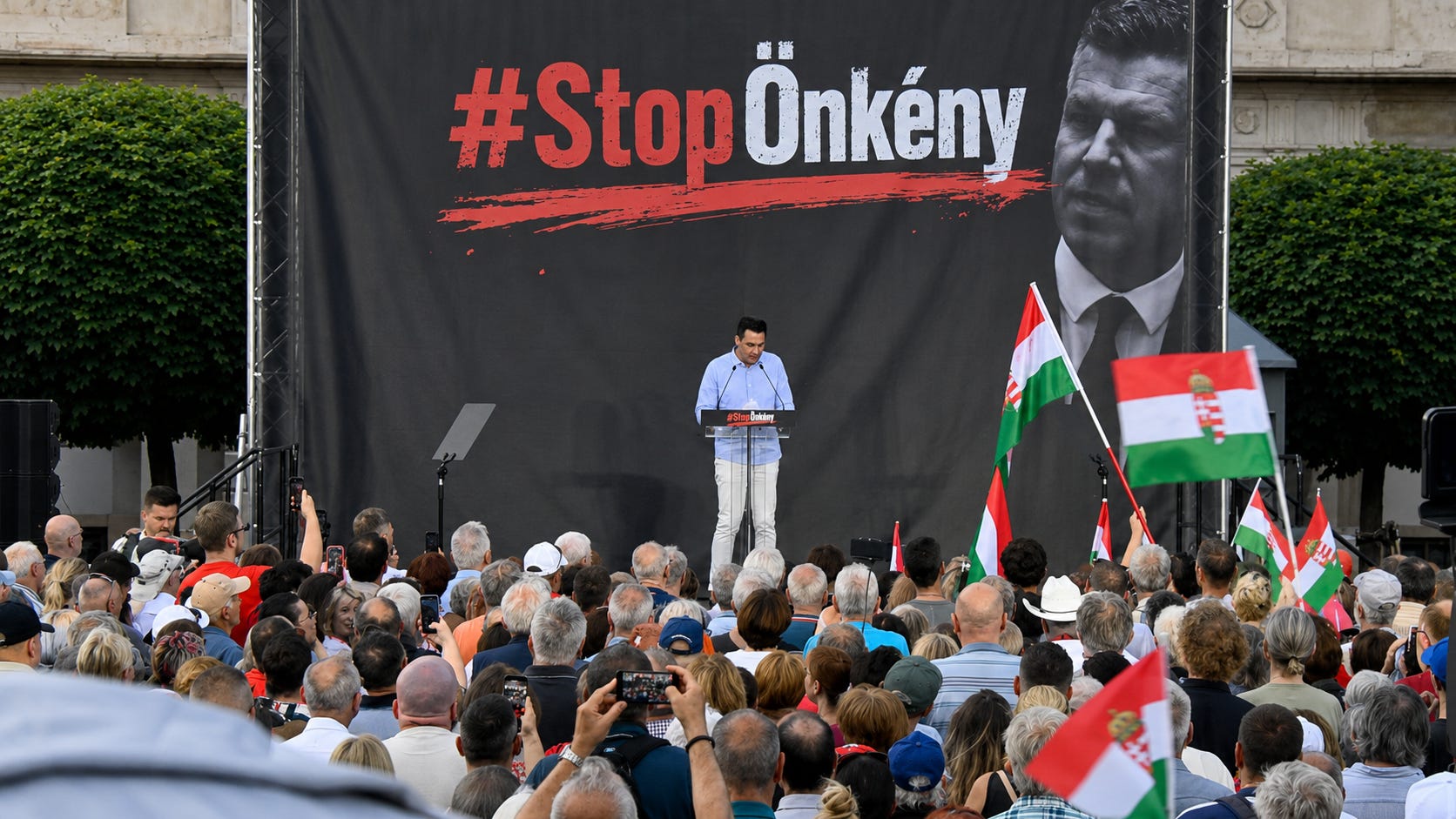
Viktor Orbán spent several days conjuring Hungarians to a demonstration against tyranny. On Thursday, the loyal supporters showed up, while Orbán stayed at home; perhaps it is easier to stage defiance from behind a screen.
Bertalan Havasi, his communications director, later explained that the former prime minister feared his presence would divert attention from President Tamás Sulyok, whose removal the protest had been organised to oppose.
His modesty proved administratively demanding. It required an official explanation, a stream of Facebook posts and a promise that Orbán’s own appearance would come soon enough.
Even Orbán’s absence had to be carefully handled.
Throughout the evening, he praised the speakers, disputed Prime Minister Péter Magyar’s estimate of the crowd and shared footage of the demonstration. He remained its absent guest of honour, an eclipse photographed from every angle.
By Friday morning, Orbán was posting that tyranny had taken over Hungary and that the age of csengőfrász was returning. The term refers to the fear people felt during the Stalinist era when hearing the doorbell, as it could mean the secret police had arrived.
Orbán governed Hungary until April. By July, he was pretending he had been hiding from a dictatorship instead of running one.
Thursday’s gathering outside the Sándor Palace, the official residence of the Hungarian president, was called “Stop Tyranny.” Fidesz and the Christian Democratic People’s Party organised it against the proposed 17th amendment to Hungary’s Fundamental Law.
The amendment would end Sulyok’s presidential mandate, impose limits on parliamentary service, restore an upper age limit for Constitutional Court judges and return important review powers to the court. It would also reduce the reach of two-thirds legislation, curb the Budget Council’s authority and establish a National Asset Recovery and Protection Office.
I myself am inclined to support the amendment.
Hungary cannot repair institutions built to keep Fidesz in control after it lost power if it leaves those instruments in place. Orbán’s government used long fixed terms, loyal appointees, and two‑thirds voting rules to retain influence over courts, regulators, and public bodies even after leaving office. The amendment starts removing those specific arrangements.
The government has not fully explained why Sulyok’s removal cannot be handled through existing constitutional procedures, though special times may call for special measures. It should still specify the failures it attributes to him and why they justify intervention. The proposed asset recovery office also needs clear safeguards: who appoints its leadership, how decisions can be challenged, and what prevents political misuse. Finally, the consultation period was brief, but it did at least amount to a real consultation in Hungary for the first time in decades, with people invited to share their thoughts and opinions, even if meaningful public scrutiny of this amendment remained difficult.
Those concerns deserve to be taken seriously. Even so, the broader case for institutional reform is still compelling. Tisza secured 53.18 per cent of the party-list vote and 141 of Parliament’s 199 seats after campaigning on rebuilding the state and replacing Orbán-era appointees. Turnout was close to 79 per cent. Today, the polls show even stronger support for Tisza than on election night, with Fidesz down to historic lows.
Magyar has described the purpose of the amendment with exceptional clarity. Its provisions, he said, should ensure that “the Hungarian state can never again be captured.” He promised to “free Hungarians from the political and economic mafia” and declared that “what was stolen from the nation, the Hungarian state will take back.”
It is an ambitious programme. Against Thursday evening’s offering, it seemed more like a well-run ministry than a fever dream: communist terror, fascist terror, BlackRock, Pride, Tinder, the abolition of counties and the renewed partition of Hungary.
Trianon, rescheduled
Elizabeth Tóth, a recently emerged pro-Fidesz TikTok creator introduced as a civil activist, informed the crowd that “the Trianon of the Hungarian nation” had occurred on April 12.
The Treaty of Trianon, signed in 1920, removed roughly two-thirds of historic Hungary’s territory and left millions of ethnic Hungarians outside the country’s new borders. Its consequences remain embedded in Hungarian politics, family memory and national identity.
April 12, 2026, was an election.
Tisza won it decisively. Tóth interpreted this exercise in popular sovereignty as a form of territorial dismemberment.
Trianon had apparently been rescheduled. The new instrument of national mutilation was a counted ballot.
The comparison was historically unhinged and politically incoherent. Fidesz spent years fusing party, state and nation into a single identity. Orbán led the “national government.” His supporters belonged to the “national side.” Favoured businesses became “national capital.” Critics were cast as foreign agents, cosmopolitans or servants of Brussels.
Within that political vocabulary, Fidesz became something larger than a party seeking office. It claimed custodianship over Hungary itself.
Electoral defeat, therefore, acquired the emotional shape of amputation. Fidesz lost power, and its supporters were told that Hungary had been taken away with it.
April 12 was recast as Trianon. Magyar’s appearance alongside Volodymyr Zelenskyy was construed as treason. Efforts to scrutinise public wealth were denounced as communist terror. Even the substitution of the archaic administrative term vármegye with the standard Hungarian word for county was portrayed as a threat to local identity's continuity.
Tóth warned that without the vármegye structure, Hungarians risked losing the bonds holding their communities together.
Hungarian identity survived Ottoman occupation, Habsburg absolutism, two world wars, state socialism and several decades during which counties were simply called counties. It may finally meet its administrative Waterloo at the hands of a new order.
Tóth also accused Magyar of behaving improperly on Tinder, of silencing conservative newspapers, of destroying Orbán’s achievements, and of betraying Hungary at the NATO summit. Within minutes, the constitutional status of the presidency had become entangled with utility prices, dating profiles, Ukrainian diplomacy and municipal signage.
The rally brought together a broad range of Fidesz-aligned grievances, placing disparate concerns side by side without resolving their contradictions.
A civil demonstration, organised by the party
Several attendees described Thursday’s gathering as a civil event.
Its organisers were Fidesz and KDNP, and Orbán himself lent it prominence through his political channels. The stage was occupied by a familiar cast: Fidesz MPs, former Megafon figures, Orbán’s communications director, a pro-Fidesz influencer, and János Áder, a former president elevated to office by a Fidesz parliamentary majority.
It was civil society in the expansive Fidesz sense: a spontaneous expression of public sentiment equipped with party organisation, parliamentary speakers and a professionally assembled stage.
Before the speeches began, an elderly woman sprinkled holy water around the square. Some of it landed on a Telex reporter’s ankle. I bet that reporter felt cleansed of her sins after reporting the truth for years.
Father Zoltán Osztie then took the stage and moved through BlackRock, hidden global powers, fascist terror, communist terror, Pride, gender ideology and the spiritual condition of the Tisza government. He announced that the crowd embodied love, dignity and reconciliation. He later described Pride as an event staged “in the name of hatred” and warned that international financial forces stood behind governments.
Within hours, the Esztergom-Budapest Archdiocese clarified that Osztie had appeared without its authorisation. Its priests were reminded that their mission concerned the Gospel and the service of their communities.
Even the Church seemed surprised to find itself among the scheduled performers.
The sound system displayed similar serendipity. People toward the back could barely hear the speeches. At one stage, the chant nem halljuk, meaning “we cannot hear,” merged with nem hagyjuk, meaning “we will not allow it.”
For several minutes, it was impossible to tell whether the crowd was mounting a heroic stand against tyranny or politely petitioning for someone who knew how to operate a soundboard.
A man then arrived carrying a sign reading “Stop Örkény,” a pun that replaced the Hungarian word for tyranny with the name of István Örkény, a Hungarian writer known for his dark, absurdist satire of political life.
Protesters surrounded him, shouted at him and drove him from the square.
A demonstration against intimidation had paused to intimidate a man carrying a literary pun.
Örkény would have had a hard time improving the scene.
The museum of newly discovered principles
The protest’s allegation was that Tisza had used its two-thirds majority to change constitutional rules, replace public officials and restructure independent institutions.
Fidesz has considerable experience in all three areas.
After returning to government in 2010, it wrote a new constitution and later amended it 15 times. At Thursday’s protest, Fidesz MP János Pócs acknowledged this record and explained that those amendments had served the national interest.
This contains the complete Fidesz theory of constitutional law.
A Fidesz amendment is presented as the voice of the nation itself, while a Tisza amendment is cast as an act of tyranny. The votes behind them carry the same legal weight; still, their meaning is made to hinge entirely on who casts them, as if legitimacy were a matter of political allegiance rather than law.
Fidesz now regards the early termination of Sulyok’s mandate as an attack on institutional continuity.
In 2011, its judicial restructuring ended the six-year mandate of András Baka, president of the Supreme Court, more than three years early. Baka had publicly criticised the government’s judicial changes. The European Court of Human Rights later found that Hungary had violated his rights to access a court and freedom of expression.
The same government terminated the mandate of Data Protection Commissioner András Jóri when it replaced his office with a new authority. The Court of Justice of the European Union later ruled that Hungary had violated EU law.
Apparently, fixed mandates enjoyed a lengthy sabbatical.
Fidesz is equally outraged by the proposal to restore the retirement age for Constitutional Court judges to 70. In 2012, Orbán’s government reduced the retirement age for judges, prosecutors and notaries from 70 to 62, forcing hundreds from office. European judges found the measure discriminatory.
Seventy has enjoyed a lively career in Hungarian constitutional thought. It was once too old for judges. It later became perfectly acceptable for Constitutional Court members. By Thursday evening, it had acquired the dignity of a principle handed down somewhere between the Golden Bull and the Ten Commandments.
The amendment would also restore powers that Fidesz removed from the Constitutional Court, including the power to review budget and tax legislation in full. It would allow the court’s members to choose their own president and narrow the field of cardinal laws binding future governments.
Magyar has said the Constitutional Court should once again become “the guardian of the laws.” He described parliamentary office as neither “an entail, a noble rank, or a way of life.”
These reforms are sensible.
A member of parliament does not acquire a hereditary title through repeated placement on a party list. A Constitutional Court performs little constitutional judging after its jurisdiction has been hollowed out. A Budget Council should not possess the means to force an elected government into dissolution. Public institutions should remain capable of surviving their occupants.
Sulyok presents the most delicate case.
Fidesz selected him after Katalin Novák’s resignation. He was one of several Orbán-era officeholders Tisza promised to replace after the election. His continued presence would leave a central constitutional office in the hands of a figure chosen by the previous government during the transition toward a new settlement.
The Hungarian Helsinki Committee has described his removal as a personalised intervention while accepting that such measures can be permissible during constitutional restoration when no less restrictive option exists. They also argued that Sulyok repeatedly failed to perform his constitutional duties and that the government should explain those failures in greater detail.
That is close to my view.
The government would do well to set out, with precision and candour, the case against Sulyok, and to explain why the existing removal procedure falls short. Having done so, it should proceed with the amendment.
A political system designed to preserve one party’s control should not become untouchable merely because that party has finally lost office.
Ninety-nine per cent clean
Havasi provided the rally’s most concentrated dose of incidental comedy.
He called Magyar a “pocket dictator.” He warned of police officers arriving at dawn, of hostile algorithms, and of punishment for expressing political opinions. Then he announced that Fidesz’s political community was “99 per cent clean.”
The one per cent, presumably, was already on the run in the United States or the UAE.
The figure was wonderfully precise. It suggested that someone had inspected the party, checked behind the foundations, opened the concession agreements and found only a light film of oligarchy around the edges.
Havasi then promised that nothing would be forgotten, everything would be recorded, and everything would eventually be settled.
The speech against political intimidation concluded with an assurance of future reckoning.
Other speakers invoked the return of the secret police. Fidesz MP Gábor Szűcs compared the proposed Asset Recovery Office to the ÁVH, Hungary’s Stalinist political police. He suggested that ordinary families could face investigation simply because they had received state assistance.
According to the proposed amendment, the office would investigate the illegal use of public property, cooperate with judicial authorities, and represent the prosecution in relevant proceedings. Its leaders would require a two-thirds vote in the parliament, while its staff would be prohibited from party membership and political activity.
Its powers need close scrutiny. Hungary has ample experience with supposedly independent bodies that have turned into political weapons.
The comparison with the ÁVH still reveals a peculiar understanding of who should fear an investigation into missing public assets.
Magyar directed his warning at “the janissaries of the Orbán system” who treated Hungary’s common property as spoils of war. Shell companies, proxies and hurried transfers would offer little protection, he said. “What was stolen from the nation, the state will take back.”
Fidesz responded as if such investigations would target ordinary Hungarian families.
That reaction suggests it interpreted scrutiny of public assets as a threat to its own network.
The opposition's debut
At the end of the rally, the speakers returned to the stage, and the crowd sang the national anthem. The organisers had supplied an instrumental recording without vocals.
It was an oddly exact conclusion. Fidesz provided the melody of national resentment, leaving the audience to fill in the words.
Orbán remained elsewhere, posting.
He praised Sulyok, celebrated Áder and ridiculed Magyar’s claim that only 150 or 200 people had attended. One commenter asked where the former prime minister had been. Another observed that the boss appeared to be the only person who had forgotten to turn up.
Orbán’s absence exposed Fidesz’s cowardice and intellectual bankruptcy.
The party now pretends to resist the very system it engineered. It gutted independent institutions and packed them with loyalists, reduced public media to a propaganda arm, and rewrote the constitution whenever it suited its immediate interests. What it calls principle today is the wreckage of its own design.
Its conversion is not just late; it is cynical. Constitutional arguments do not become credible simply because those who dismantled the system now claim to defend it.
Tisza should set out, with full clarity and precision, the grounds for Sulyok’s removal and establish firm, credible safeguards governing the Asset Recovery Office.
It should then proceed with the amendment, not as an end in itself, but as a measured step toward the restoration of a more resilient and genuinely democratic constitutional order.
Hungary cannot repair a captured state while preserving every device designed to keep it captured. Voters endorsed institutional change with rare clarity. Magyar has defined the work ahead as ensuring that the state can never again be seized by one political network. That is a legitimate use of constitutional power, provided the resulting institutions are stronger than the government that created them.
Thursday’s protest made it painfully clear that Fidesz still has no idea what this distinction even means.
An election was recast as Trianon, asset recovery as Stalinism, and even routine administrative reform was framed as a threat to the nation’s identity. Orbán’s absence was presented as an act of public service, while a priest spoke of reconciliation through BlackRock conspiracy theories, and a crowd gathered in defence of political freedom drove out a man for carrying a pun.
Fidesz showed up to protest the same methods it used while in power.
It arrived one constitution, 15 amendments and a lost election late.
Source: National Election Office; draft 17th amendment to the Fundamental Law; Hungarian government; Telex; 444; Hungarian Helsinki Committee; European Court of Human Rights; Court of Justice of the European Union.
Well summarised, and with pleasantly salty commentary. Thank you.
That’s a great way to put it.