

Everything You Need to Know Before Hungary Votes on Sunday
An explainer on the election, the system around it, and what could happen if the result is close.

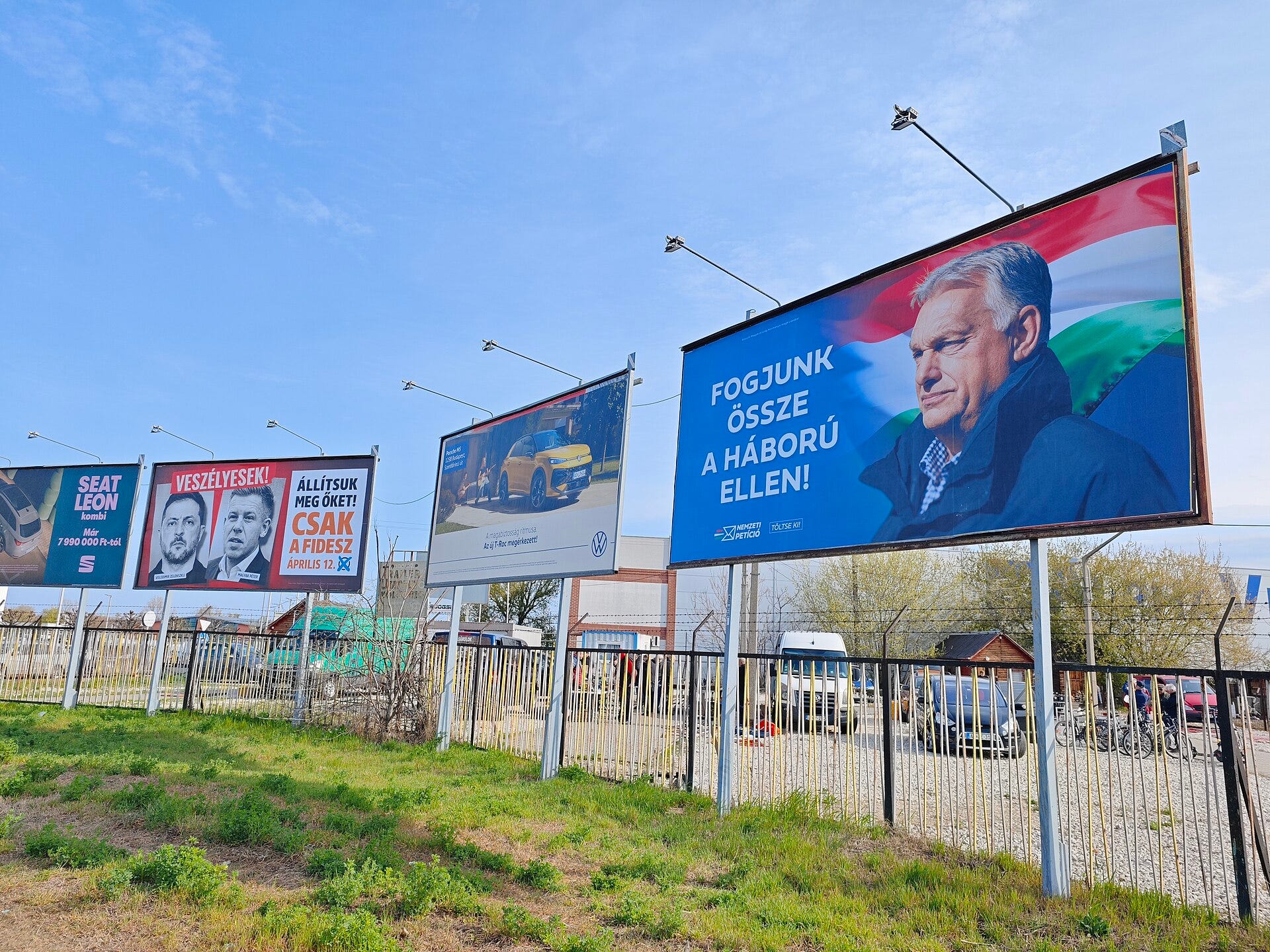
Sunday is a test Orbán did not expect to face. He spent sixteen years building a system designed to make the result predictable before anyone voted: through media control, campaign finance asymmetry, and an electoral map drawn to his advantage. That system is now being stress-tested, and whether it holds is no longer a theoretical question.
There is a version of events in which Hungary’s elections are free and fair. Polls open on time. Votes are cast in secret. The count proceeds under observation. International monitors are present. Orbán wins again because Hungarians choose him again. That version is not false. It is incomplete. What it leaves out is sixteen years of deliberate construction: a media environment in which the opposition cannot reach voters on equal terms, campaign finance rules that exist on paper, and an electoral map drawn to Fidesz’s specifications. And underneath all of it, a voting system in which residents vote in person, while certain Hungarians abroad, a constituency that leans heavily toward Fidesz, vote by mail, with no postmark requirement and limited oversight. The OSCE/ODIHR has flagged this pattern across multiple election cycles. Its language has grown less diplomatic with each report.
Péter Magyar and the Tisza party have forced a kind of contest Orbán has not faced before: real breadth, a single opposition force capable of pulling votes from across the old fragmented field. Some parties have stepped aside to make it possible. There is no shared ideology behind that decision, only a shared calculation that this may be the last open window. What has emerged is a wager, and everyone placing it knows the odds may not come again.
Wait, do Hungarians actually vote on a Sunday?
Yes. Sunday elections are the norm in Hungary. Polls run from 6:00 to 19:00 on a date set by the president within a fixed April-May window. Registration is automatic for residents. The right to vote is personal, untied to community, affiliation, or collective identity. The system is built to look routine, and much of it is. The lines it draws are another matter.
How do the votes turn into seats?
Orbán rewrote the rules before he could lose under them. The 2011 electoral law, passed in the dead days before Christmas, was neither negotiated, consulted, nor even debated with the opposition. It halved the size of parliament and rewired the logic of victory. Scholars call it an early marker of illiberalism, and in practice, it has become one of the regime’s most reliable shields.
The new system is blunt. Before the 2011 reform, Hungary’s parliament had 386 seats. Now it has 199. Of these, 106 are decided in single-member constituencies, where whoever comes first wins: no runoffs, no minimums, no second chances. In a fractured field that rewards the party with the deepest, most disciplined base. Fidesz has that base, and it drew the map. The other 93 seats are distributed through national party lists, but only among parties that clear the threshold. Two ballots, two systems, both shaped by the same hand.
But the two tiers are not separate. Constituency results also feed back into the national list through compensation votes. Votes cast for losing candidates are added to the party’s list total, and some surplus votes from winning candidates are added too. The effect is that a party dominating the constituencies can amplify its advantage across the whole system. A small shift in votes can trigger a landslide in seats. Outsiders rarely grasp how steep the tilt is.
Is this election actually free and fair?
It depends on where you look and whether you are willing to call what you see by its name.
Hungarians can vote. Polling stations open, ballots are counted, and the ritual proceeds. But the field is not level. The OSCE/ODIHR has filed the same findings, year after year: the state and the ruling party are functionally indistinguishable; campaign finance operates without real oversight; communities dependent on public employment face pressure that is rarely spoken and rarely prosecuted; and the media landscape has been restructured, systematically, to make independent journalism economically unviable. These form a pattern. The ballot is real. The atmosphere around it is anything but neutral.
How do you rig an election without it looking rigged?
Through nothing that, from a distance, looks like interference at all.
The legal framework is not weak. The Electoral Procedure Act carries real prohibitions: vote-buying, voter transportation schemes, and the misuse of public resources for campaign purposes. The rules exist. The enforcement architecture exists.
What the OSCE/ODIHR has documented, year after year, is the distance between the two. Vote buying in communities where economic dependence makes refusal difficult. Voter tourism, meaning the organised movement of voters to constituencies with tight margins. Third-party campaigning is structured to circumvent financial disclosure requirements. Disinformation that moves faster than any correction mechanism can follow. State resources deployed just below the threshold of provable misuse.
The system learned to work around the rules, precisely and patiently over sixteen years, and built its operations entirely within the space the rules cannot reach. The achievement and the indictment are inseparable. Its leverage is greatest where dependence is deepest and oversight is weakest.
This is why Hungary resists easy explanation. The officials are present, the rules are written, and the count proceeds. The distortion begins long before anyone enters a polling station.
What can the opposition actually do to protect the vote?
The most effective response is unglamorous: party and candidate delegates on election committees. Their presence does not correct a media landscape built over a decade or reverse the effects of campaign finance rules that exist on paper, but it introduces a witness at the moment of counting, where direct interference is both most tempting and most detectable.
International observation extends that logic outward. The OSCE/ODIHR mission has deployed long-term observers who have been in the country for weeks, tracking the campaign environment, alongside short-term observers focused on election day itself. European institutional delegations add further presence. From the outside, the observation architecture is credible and serious.
The limits lie in what any outside observer, however credible, can see.
From inside, the scrutiny is thinner. Hungary still lacks a real framework for large-scale, non-partisan domestic observation. The gap is not just technical. It is atmospheric. The process appears to be monitored, but much remains unseen.
And what about Russian interference?
The interference question is live, documented, and unresolved. It has received far less attention in Western coverage than it deserves.
In early March, VSquare reported that the Kremlin had tasked political technologists with interfering in Hungary’s election, through a Budapest-based operation linked, allegedly, to the Russian embassy. European national security sources were cited. MEPs asked the Commission what it knew. Russia denied it.
Since then, the picture has not become clearer; if anything, it has become more crowded. On 8 April, Reuters reported on leaked audio in which Péter Szijjártó was allegedly heard offering Sergey Lavrov an EU document on Ukraine’s accession. Reuters could not verify the recordings. The Kremlin’s response, the same day, was a counter-accusation: unnamed EU forces, no evidence, maximum ambiguity. That is the playbook. Separately, researchers linked a fake Euronews-style article targeting Magyar to Storm-1516, a pro-Kremlin network that impersonates credible outlets to move disinformation into mainstream spaces before the outlets it mimics can respond. Each incident is deniable in isolation; in sequence, they describe a deliberately degraded information environment in the final days of a close election. The OSCE/ODIHR has made interference monitoring a formal part of its mission in Hungary. That is not a routine inclusion.
In the final days, the risk is slow, thickening confusion: more misinformation, reinforcement of the regime’s narrative, indirect attacks on the opposition, enough uncertainty to delay clarity. Russian interference, when it comes, does not need to decide the outcome. In a close contest, clouding the moment when certainty should arrive is sufficient.
What do the latest polls actually say?
For international readers, the key point is this: the latest independent polling does not disagree on direction. It disagrees on scale. The broad story across the independent houses is that Tisza is ahead. The argument is about how far ahead each pollster is measuring and which electorate they are measuring.
The independent cluster falls into three rough groups. At the top, Medián (58–35) and 21 Kutatóközpont (56–37) show large Tisza leads. Then a middle band: Závecz, IDEA, Iránytű, and Publicus all cluster between 49 and 51 for Tisza and between 37 and 40 for Fidesz among sure or likely voters.
It looks more confusing than it is because the polls are not measuring exactly the same thing. Some report the full adult population, some report party choosers, and some report only those who say they are certain or very likely to vote. They also use different methods. IDEA’s latest poll was an online self-completion survey; Medián’s March poll was conducted by phone; 21 Kutatóközpont used a hybrid design; and Iránytű’s latest poll was also by phone. Small methodological differences can widen or narrow the gap, especially at the end of a campaign when turnout assumptions start doing political work of their own.
The biggest split is between the independent and government-aligned clusters, not between any two houses within the independent band. Átlátszó described a clear divide, and Nézőpont remains the freshest public example: in mid-March, it still had Fidesz ahead 46 to 40 in its “most likely list result,” and then, on 3 April, published a seat model that still gave Fidesz a parliamentary majority.
That is why the cleanest way to read the polling is to weigh the independent cluster more heavily than any single spectacular number, to pay close attention to fieldwork dates and methodology, and to remember that Hungarian pollsters have house effects like pollsters anywhere else. Lakmusz found that in 2022, the most accurate final poll was Magyar Társadalomkutató, and Medián was second-closest, but it also noted that this did not carry over neatly to the 2024 European election. In other words: track record matters, but no one gets to be an oracle.
If you want one sentence to carry into Sunday, it is this: the centre of gravity in the independent polling points to a clear Tisza lead, most plausibly in the low-to-mid teens among sure or likely voters, with Medián at the optimistic edge and the government-aligned houses still insisting the regime can hold.
The seat models are even further apart. On 8 April, Medián’s mandate estimate, built from five polls with a combined 5,000 respondents and reported by Reuters, projected roughly 138–142 seats for Tisza. Nézőpont’s competing model still gave Fidesz 109 seats. The lesson is that in Hungary’s electoral system, a few points of vote share can become a very large gap in seats, depending on which constituencies are assumed to flip.
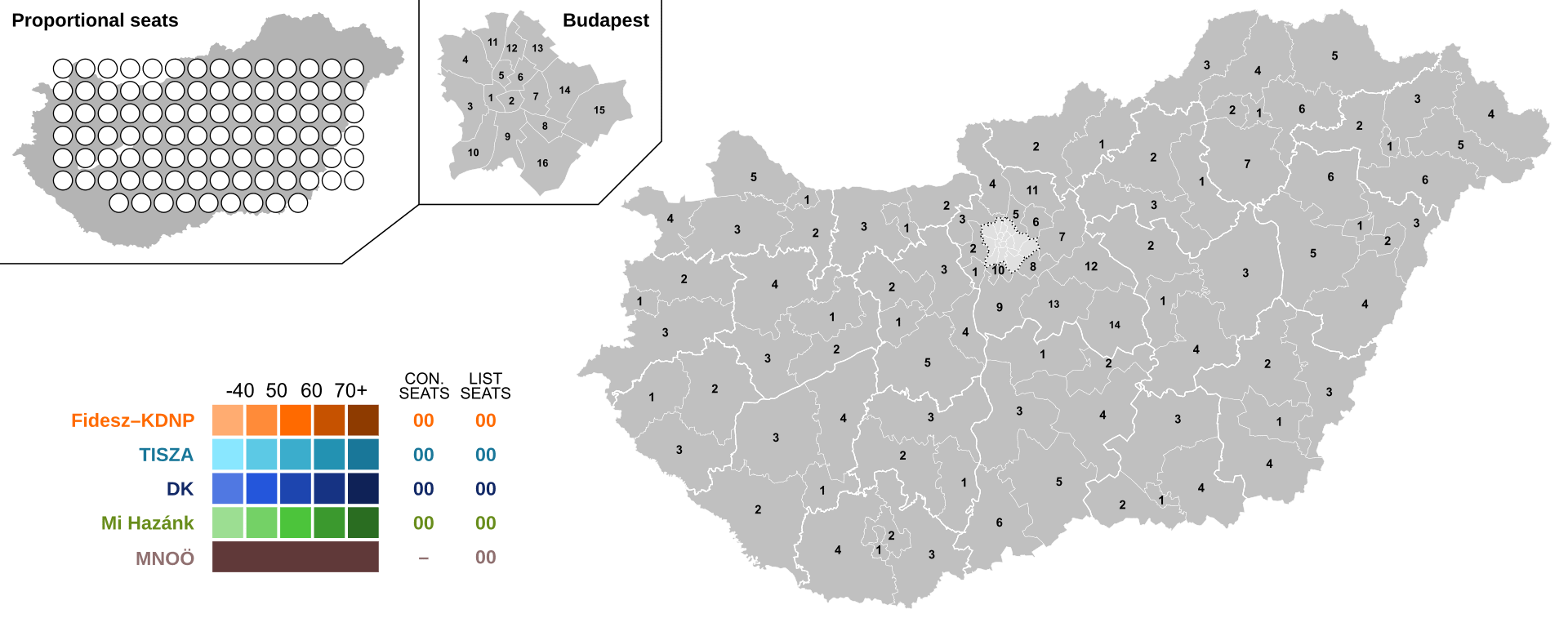
Note: These polls are not directly comparable. They use different field dates, survey modes, and turnout screens, and some report “sure voters,” others “party choosers,” and others use proprietary likely-voter models. Treat the numbers as a range, not a ranking.
What happens if Orbán loses?
Orbán’s leverage depends on the margin. He has had sixteen years to build the procedural architecture around him, and none of it was built for show. The tools are objections, appeals, recounts, narrative management, and legal challenges timed to generate uncertainty rather than to win. A decisive loss is hard to contest. A narrow margin can be made to look contested.
On paper, the transition is orderly. Parliament must convene within 30 days. The president nominates a prime minister. A majority of MPs, not just those present, must confirm. If that fails within 40 days, the president can dissolve parliament and call new elections. The outgoing government remains in caretaker capacity throughout. The architecture assumes both sides accept the same rules.
The threshold rules complicate the picture. A single party needs 5 per cent to enter parliament; a joint list of two, 10 per cent; three or more, 15 per cent. If Mi Hazánk clears the bar and the seat numbers are tight, it becomes a kingmaker. Reuters has identified that as a plausible survival path for a weakened Orbán. It would be a holding pattern rather than a stable government: deny Magyar the premiership, buy time, wait for the opposition to fracture.
But what if Orbán simply declares victory?
Legally, a public declaration carries no weight against a certified result. Politically, a close result gives Orbán time, uncertainty, and institutions built in his image. A landslide forecloses most of his options; a narrow margin leaves almost all of them open.
Watch the language. The first sign of a disputed result will come not from a courtroom but from the vocabulary Fidesz reaches for in the hours after polls close. Defeat and delegitimisation sound different tonight. By morning, that distinction may no longer hold.
Watch the OSCE/ODIHR preliminary statement. It will arrive within 24 hours, written in the careful, hedged language of international monitoring. Learn to read that language.
Watch the tight constituencies. Under the Election Procedure Act, recounts and legal challenges are available, and in a close result, they will be used. Each one extends uncertainty, and in a contested transition, extended uncertainty is a political resource.
Watch for the concession — or count the hours it does not come. That absence, if it arrives, will be the most important data point of the night.
Where can you follow it in English?
In English, follow Reuters for speed, Telex English for local depth, and the National Election Office for the certified numbers.
I will be here all day and night to keep you all updated. The night may be long.
Thank you for this analysis. We'll keep our hopes up for the opposition. Orban's rewiring of Hungarian politics in the last 16 years has shown other authoritarians how it might be done.
God, what a complex system!!! Makes the U.S. look easy by comparison.
THe only thing I agree with Hungarians about voting is to have it on Sunday. MAGAs love to go to church and many are fanatical. Many conservative churches have both morning and evening services and, of course, rich MAGAs go out for dinner in between.
Sunday voting sounds like it's made for religion free democracy! :)