

Europe Was a Road, Then a Classroom, Then a Home
How Erasmus turned Europe from a borderless idea into a life I could actually live.

I was six, in the back seat of a car from Hungary to Slovakia, when Europe first became real. The border checks had disappeared. I remember the unfamiliar lightness of crossing a line that no longer held us back. The absence itself was enough. Europe arrived not as a speech or treaty, but as a road that no longer ended where it used to. This was in 2004, and Hungary had just joined the EU.
At that age, you do not understand Schengen or treaties, accessions, Council decisions, funding periods, or the slow bureaucratic miracle that dissolves a border. You only sense that something which used to stop you no longer does.
The barrier was gone. The road just kept going.
That was probably my first political experience of Europe, although I only understood it much later. I did not know what had been negotiated or signed. I only knew the passage had changed. The road felt open in a new way, and even as a child, I could sense that this meant something.
That is still the Europe I trust most, the one that enters life quietly, almost without announcing itself. One day, a border guard is part of the journey. Next, he is gone. Nobody gives a speech in the car. The road carries on, and the world feels a little less fenced in.
Erasmus continued this European revelation for me. It gave movement a human scale. A classroom, a city that stopped seeming foreign, the rhythm of ordinary days lived somewhere else. It turned Europe from a structure into something I could recognise in my own life.
Erasmus started quietly in 1987. A few thousand students crossed borders, often unremarked. By 2024, roughly 16 million people had participated in Erasmus and Erasmus+, with more than 1 million departures and returns each year. Billions in EU funding turned into one of the engines of European life. Every trip changes something, even when the change is not visible at first. A student returns with a new language, a new friendship, a new doubt, a new direction.
There is something almost reckless, in the best sense, about that bet. Send people away while they are still young enough to be changed. Let them see their own country from elsewhere. Let them come back with comparisons no government can fully manage.
Years after that childhood journey to Slovakia, my sense of Europe shifted again. I moved to Ireland, and Hungary began to look different from the edge of Europe and the beginning of the Atlantic. Ireland was beautiful, strange, and generous, but not home. I missed Budapest badly. I missed my friends, my grandmother, Hungarian voices around me, lángos, pogácsa, and all the small tastes of home I had barely noticed until they were gone.
Ireland gave homesickness a shape. It gave me distance, a gentler rhythm of life, and another picture of what ordinary days could feel like. I missed Hungary more sharply there, but I also grew from the distance. Europe, when it works, allows that double feeling. You carry home with you, and another place changes how you carry it.
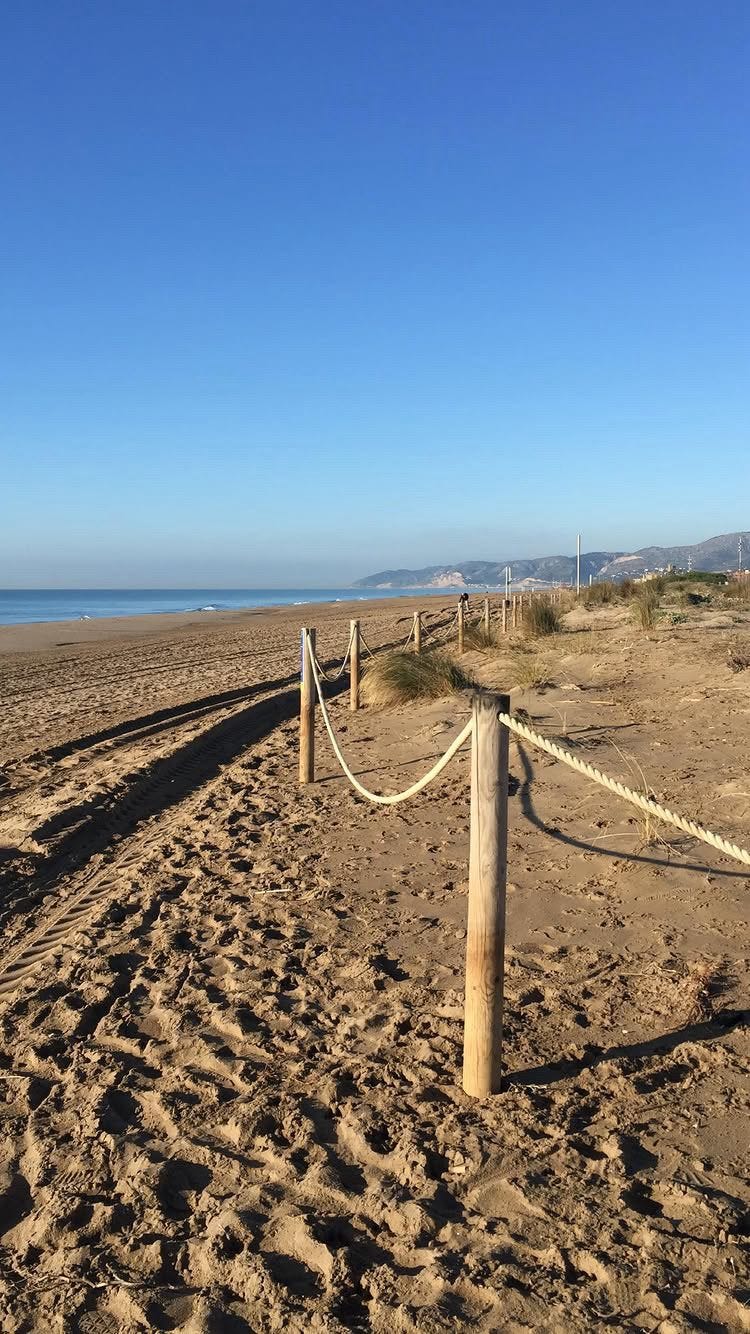
By my third year of university, I had run out of money. Erasmus, which can look like a privilege from the outside, became a loophole. I chose a teaching project over a semester in lecture halls. That is how I ended up in a public school in Gavà Mar, near Barcelona, with mornings blown open by the salt air.
Standing at the threshold of that school, it still feels unlikely. A classroom by the sea. Children careening through echoing corridors. Teachers drawing me in before I had found my footing. I was out of my depth, trying to teach English while learning the codes of another place. I filled a notebook with Catalan fragments, copied gestures, and waited for meaning to catch up.
Adaptation was not fluency but rather was presence. The school became less foreign as I stopped being so afraid of mistakes.
I loved it more than I expected.
The school called out a version of me I had not expected. I picked up the day’s pace, the quick jokes, the signals traded in the staff room. Teaching stopped being someone else’s job and, for a while, I let myself imagine doing it. Weeks before, I was still broke and drifting. Suddenly, I was walking by the sea, hearing my name in the corridor, feeling useful in a place that had only just stopped being strange.
Access is central to all of this. Erasmus can open a life, but only if the door is not blocked by money. Those who can pay deposits and wait for grants cross more easily. For others, Europe’s openness is still conditional. In 2024, around 265,000 Erasmus+ students were counted as having fewer opportunities—18 per cent.
For students who count every euro, the path is narrow but not closed. Extra support, a good coordinator, or a student network can make the difference. Sometimes, all it takes is someone who understands what it means to get through.
Some people I met that year are still with me. Erasmus friendships form quickly because everyone is a little uprooted. You borrow each other’s certainty. You eat badly and laugh about it later. (I lived on pot noodles and crisp sandwiches). You get lost. You tell someone who was a stranger last week things you might not yet know how to say to people back home. Those friendships still carry the memory of who I was then, younger and less certain, trying to become someone in a city I had just met.
No number can measure that, but the research catches part of the afterlife. Impact studies have found that former Erasmus students are half as likely to face long-term unemployment. Other research links Erasmus to better job outcomes, faster starts, and higher pay. The statistics tell only one part of the story. The stronger effects show up intimately, years later, as a life bends in a new direction.
Those findings make sense to me. Abroad, you learn things that do not look like skills at the time. You arrive not knowing how you will manage. You misread a room, then learn to read it. You start to separate what is yours from what is merely familiar. The world stops looking inevitable. Normal becomes local. Local becomes provisional.
Then Covid arrived.
At first, it still felt unreal, the kind of news you followed from a distance even as it moved towards you. Then Barcelona shut down, and the Erasmus year I had been building a life around was suddenly over. My friends began leaving one by one. Every goodbye made the city feel less like the Barcelona I had arrived in and more like a place closing in on itself.
I was frightened in the immediate, practical way of a young person abroad, trying to work out whether they could still get home. Flights were disappearing. Rules were changing. The easy European movement I had grown up trusting became a race against closure. I was lucky to get back on one of the last flights to Ireland, where I quarantined with my sister.
You learn what movement means when it stops. Airports empty. Borders harden. Everyone tries to get home. For me, Erasmus is inseparable from that rupture. It was a year of sun and sea, and also the moment I understood how easily freedom can vanish.
This experience stayed with me.
What stayed were the small dislocations. A school day had a different rhythm. Warmth sounded different in Spanish. Home looked clearer from elsewhere. Moving between Hungary, Ireland, and Spain did not give me a boxed identity. It gave me a wider frame of reference and showed me how each place shifted my sense of self.
By the ripe old age of 27, I have lived different chapters of my life in three EU countries. Budapest is home, in the deepest and most literal sense. Europe has become the larger frame around it. Not a replacement for Hungary. A wider and more fulfilling life around Hungary.
That is the quiet power of Erasmus. It leaves you with more than one emotional address. Budapest stays home, and so does a corridor in Gavà Mar, a room in Ireland, a language you once struggled with and later understood. Identity is not a locked room. It is a set of keys. Each experience abroad opens another way of seeing, another way of belonging.
Once Europe enters a person’s biography, it rarely stays inside the study-abroad box. It follows people into friendships, work, love, family, and the languages spoken around kitchen tables years later. There is a famous expression about one million “Erasmus babies”. It is an estimate based on extrapolated survey data, not a census of EU-funded romance. Still, the image holds something true. A rather large number of European lives exist because two young people once met in a place where neither of them fully belonged.
This points to something serious. Europe becomes part of a family history as the reason two people met.
Here, Erasmus becomes political. Evidence suggests that participation strengthens European identity and civic engagement. One Erasmus Student Network survey found that students’ sense of belonging to the EU rose after mobility, and that 76 per cent intended to vote in the 2024 European Parliament elections. Causation requires care. People who choose Erasmus may already be outward-looking. Still, the evidence points to something important. Institutions can reward openness rather than fear.
Erasmus does that.
Erasmus is Europe’s quiet answer to propaganda. It does not tell you to love Europe. It lets you live it.
This, Viktor Orbán never grasped. Or perhaps he did.
Erasmus unsettles authoritarian politics because comparison unsettles power. A young Hungarian leaves for a semester to collect credits, improve their English, and see how another university works, how another city functions, how a classroom sounds when people are not measuring every word against authority. They return with private evidence. That is harder to confiscate than a newspaper and much harder to counter with a billboard.
Hungary’s exclusion from new Erasmus+ funding agreements for many universities therefore cut deep.
In December 2022, EU institutions moved to block new Erasmus+ and Horizon Europe funding agreements with Hungarian institutions controlled by so-called public-interest trust foundations. These were not obscure bodies in the margins of education. They sat at the centre of Orbán’s university model. Foundation boards. Loyalists. Patronage. Conflicts of interest. Political control dressed up as reform. The freeze affected 34 institutions, including 21 universities.
Brussels did not invent this wound. Conversely, Orbán’s system made students pay for the capture of their own universities.
Universities should be places of free thinking, argument, experimentation, and doubt. Orbánism treated them as territory. Once that system wrapped itself around higher education, even Erasmus became vulnerable.
For Orbán, that suited the deeper project.
Students who never get to leave are easier to surround. The outside world can be reduced to a threat, Brussels to a billboard, freedom to a foreign trick. Erasmus breaks that enclosure in the most inconvenient way. No lecture. No slogan. Just ordinary evidence. A classmate. A landlord. A teacher who answers honestly. A city that works differently. A life that proves the propaganda was too small.
It was Orbán’s little iron curtain. No tanks at the border. No barbed wire. Just administrative rot around the universities, corruption dense enough to keep students in.
Hungary’s path back into Erasmus carries such weight because a route is being reopened.
It will not cleanse the universities of what was done to them. The foundation boards remain, as do the habits of obedience and the damage to trust. None of that vanishes because a student can fill in a mobility form again. But a Hungarian student can look at Barcelona, Lisbon, Bologna, Prague, Dublin, or Utrecht and see more than a name on a map. They can see a semester, a classroom, a possible self.
That opportunity should never have depended on surviving Orbán’s system first.
They should be able to go.
To study, to teach, to make mistakes in another language, to get lost in a city that slowly becomes yours. To return home with a life wider than the one you left. Freedom does not always arrive with drama. It might be a public school by the sea. The first conversation you manage without translating in your head. Or a child in a car, realising the border is gone.
The European Union is far from perfect. Its decision-making is rather slow. Its speech can be evasive. Its programmes do not reach everyone. Moral clarity often arrives late, if at all. Official language can drain the human meaning from what has been achieved.
Erasmus gave me a life that would have been smaller without it. What I found was Barcelona, first as a city I tried to understand, then as a place I knew how to return to. It left a door open in my life. Years later, I walked back through it. Barcelona stopped being a chapter and became home.
Orbán taught Hungarians to see Europe as a battlefield.
Erasmus enabled me to see Europe as a life.
Mine would have been much duller without it.
Dumbing down a populace goes hand in hand with the consolidation of power in the fist of oligarchy. Erasmus-and the University of Edinburgh- go a long way towards countering that opacity.
Thanks for this. -- The language wall, that barrier to . . . well, to deeper, more intimate mis-understanding -- when will Hungarian broadcasts, screenings, of foreign-language films be conducted in those foreign languages and subtitled, rather than dubbed into Hungarian ? An important step toward breaking down that wall, I should think.
But don't take my word for it. Ask Corvinus -- who in Latin, mark you, reputedly said, "Lingua unius uniusque moris regnum imbecille et fragile est." A brittle nation, a stupid populace, unable to learn from sources that the government did not control. Just the sort of stultification that Fidesz and Orbán were after, eh ?