

Desperation, not opposition, may be what finally loosens Orbán’s grip on power.
After sixteen years of manufacturing fear, Orbán is confronting the one thing his system was never built to survive: his own visible panic.

Viktor Orbán never needed tanks. He had something more durable. For sixteen years, he convinced an entire society that resistance was irrational, that the outcome was settled, that the only sensible response to his rule was accommodation. He captured the courts. He captured the media. He captured the electoral map and the constitution. But the real conquest was quieter than any of that. He captured the imagination. He made power feel permanent, indifferent, beyond appeal. Something you endured rather than challenged.
That is what makes these final days both revealing and corrosive.
The run-up to the April 12 election has produced a torrent of noise, intrigue, and manufactured crisis. Independent polls now place Péter Magyar’s Tisza party comfortably ahead of Fidesz. JD Vance is flown in to provide Orbán with a foreign seal of approval. There is a supposed intelligence operation against Tisza. A leaked audio recording surfaces in which Foreign Minister Péter Szijjártó appears to be briefing Sergei Lavrov on EU sanctions policy. Let that settle for a moment. The foreign minister of a European Union member state was apparently keeping the Russian foreign minister informed of the EU’s plans for Russia. Then, explosives are found near a gas pipeline on the Serbian border. Within hours, before a single investigator has reached the scene, the Hungarian government has its answer: Ukraine. Of course it does. The answer is always Ukraine. The answer has been Ukraine for two years. The answer will be Ukraine until April 12, and then, if Orbán loses, it will need to be someone else. Each episode arrives with its villain, each on cue, none surviving even cursory scrutiny. What emerges is not a nation under siege, but a government addicted to its own artificial atmosphere.
Orbán’s system has always run on fear: migrants, Brussels, George Soros, liberals, NGOs, journalists, independent universities, Ukraine, and anyone else convenient enough to play the enemy. The script is familiar. What is new is the tempo. The machine is not merely running; it is overheating. Panic is seeping into public view. The seams are splitting in plain sight.
Strongmen survive by projecting control. They must appear calm while others unravel, inevitable, even as opponents look doomed. For years, this was Orbán’s real advantage. Even his critics described him as immovable, a political fact to be worked around, not confronted. That was no accident. The system was built not just to win elections, but to make the opposition believe victory was impossible. Gerrymandering helped. The media monopoly helped. The patronage machine helped. But Orbán’s most potent weapon was psychological: what he constructed in the public mind.
Now, Orbán himself is the one puncturing his own myth.
Once, Orbán radiated the confidence of an unassailable regime. Now, the performance has changed. A government truly secure does not require this much theatre in its final week. It does not need validation flown in from Washington. It does not need to flood the final days with espionage, sabotage, and emergency. It does not campaign like a man who has already lost and is simply waiting for the count. Vance’s visit is presented as a show of strength. It is neither. For a decade, Orbán built his entire political brand on the sovereignty sermon: Hungary unbowed, Hungary untouched, Hungary alone against the meddling forces of Brussels and the liberal international order. He delivered that sermon at every opportunity. He is still delivering it, even as he invites an American vice-president to Budapest and a Russian intelligence service to work his streets.
Desperation does not just weaken power. It exposes it. Every conspiratorial lurch, every manufactured emergency, every invented enemy is a public confession: there is nothing left. Repression from strength can look orderly. Repression from fear is always transparent. A government that cannot campaign on hospitals, schools, or wages, on anything that touches the actual lives of actual people, has already lost the argument. The vote is a formality.
Orbán’s Hungary has not aged well. The confidence outlasted the competence by a decade. Hungary is poorer than its place in Europe should allow. Public services have been stripped to the bone. Corruption is not a problem the system is trying to solve; it is the problem the system was designed to produce. The generation that inherited all this has noticed. Reuters, citing a Median poll, reports that just 8 per cent of Hungarians aged 18 to 29 support Fidesz. That number is the future refusing to arrive. This is what a country looks like when its government stops offering a horizon and instead offers 16 years of the same man telling the same story about the old and new enemies. The young stopped listening. They are about to make that known.
Imre Nagy led the 1956 uprising against Soviet occupation. For that, they killed him carefully. Not in the chaos of battle, not in the heat of some public reckoning, but with the cold administrative cruelty at which these regimes excelled. He was arrested, tried in secret, hanged, and buried in an unmarked grave, as if the state hoped that by hiding his body it might also erase the meaning of his life. Then it told Hungary to forget.
And for decades, Hungary had to obey in public and remember in private.
His name was pushed out of schools. His grave bore no marker. His family mourned in silence. An entire country was forced to live with the knowledge that its former prime minister had been executed for wanting it to be free, then forced to behave as though this was not a national trauma but an administrative detail, something regrettable perhaps, but best left undisturbed. That is what an occupation does when it settles deep enough into a society. It does not merely terrorise the living. It reorganises memory. It teaches a nation to doubt its own dead. It turns grief into contraband.
And then, slowly, it stopped working.
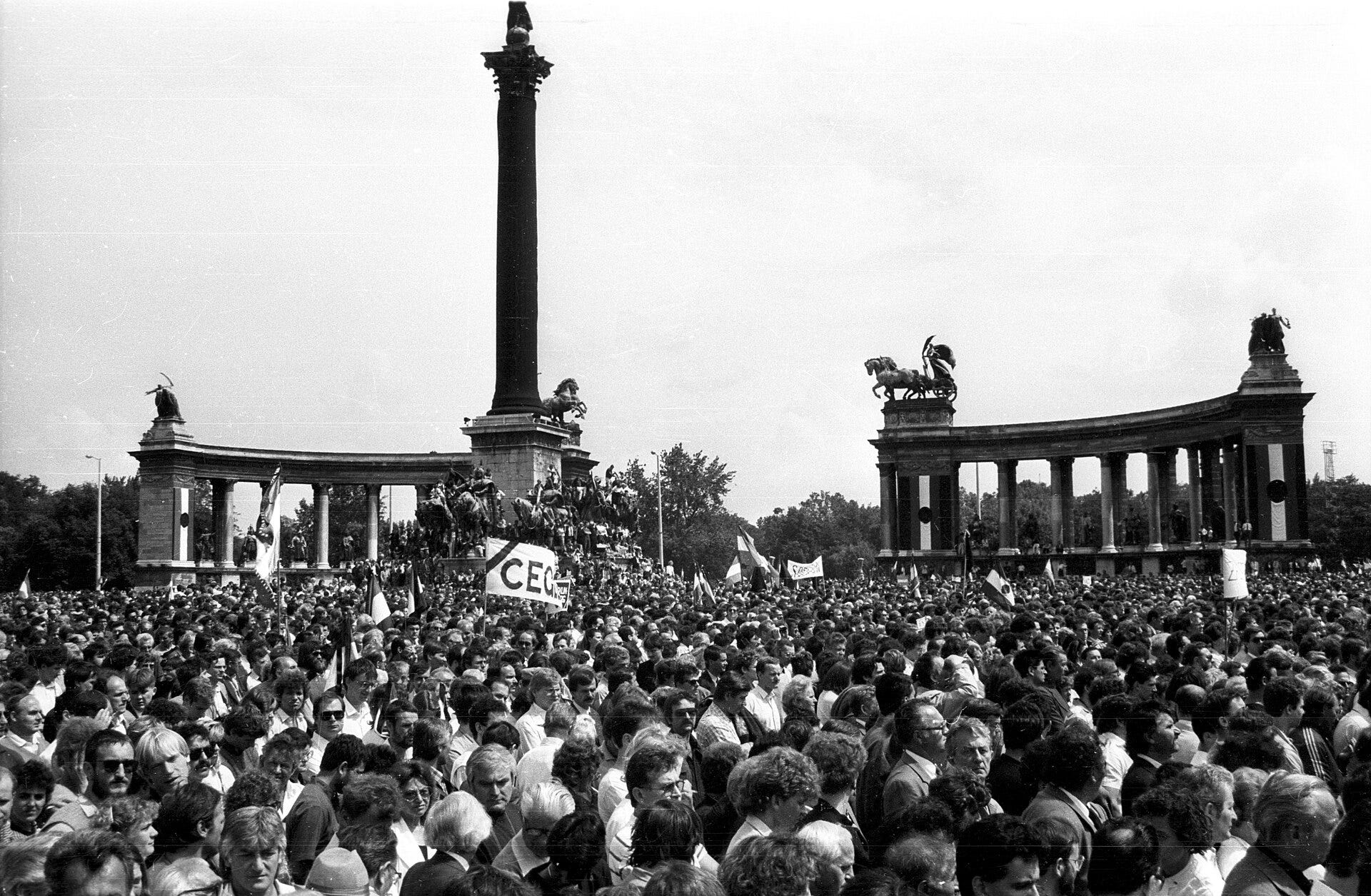
On June 16, 1989, a quarter of a million Hungarians came to Heroes’ Square. They came in their best clothes because some occasions demand it, because there are moments in a country’s life that people understand, without being told, will be carried inside them until they die. They came to say a name that had been forbidden. To stand in the open air of their own capital and grieve without lowering their voices. To do, publicly and together, what they had only ever been allowed to do alone and in secret. They carried thirty-one years of accumulated sorrow into that square. And for one afternoon, they were allowed to put it down.
The regime that had forbidden it all was dying in public. The crowd had come to watch it die, yes, but also to reclaim something stolen long before many of them were old enough to name it. Memory. Dignity. The right to mourn their own dead without permission. For one day, in that square, Hungary was allowed to tell the truth about itself again.
And maybe that is what made the day feel so overwhelming to those who were there. It was not only a funeral. It was the return of moral language to public life. The dead were named. The lie was broken. The country, however briefly, stood upright in its own history.
Viktor Orbán was one of the young men and women they trusted to guard what had been reclaimed that day. He has spent most of his time in office selling it back.
The man who once demanded Soviet troops leave now sits as Moscow’s most valuable asset in the EU. As one analyst put it, losing Orbán would mean that Putin would lose his top saboteur in Europe. No other country has served Russia’s interests so consistently or so obediently. The record is unambiguous. Within months of Russia’s invasion, Hungary began running interference on EU sanctions. What followed was not occasional obstruction. Hungary shielded Kremlin-linked figures from sanctions. It watered down measures agreed by every other member state. It extracted exemptions that served Moscow’s interests from inside the very institutions built to contain them. In February 2026, it went further still: Hungary vetoed the entire 20th sanctions package outright, the first time Budapest had blocked measures entirely, doing so on the fourth anniversary of an invasion that had killed hundreds of thousands of people and displaced millions more. There is no charitable interpretation. The man who once stood at a martyr’s grave and declared democracy and communism incompatible has since helped that same empire hold European territory by force.
The Kremlin, it turns out, has been watching closely. As Orbán’s poll numbers fell, Moscow acted. A covert social media operation was approved: pro-Fidesz content, manufactured and seeded across Hungarian platforms, designed to look like the voice of ordinary voters. Russia’s foreign intelligence service went further, proposing a staged assassination attempt on Orbán himself, a plan called “the Gamechanger,” calculated to fracture the campaign along the fault line of fear and national security. Investigative reporters have placed at least three GRU officers in Budapest, working under cover. None of this is accidental. It is the logical endpoint of a relationship Orbán has cultivated for years, and the most complete answer to what, exactly, he traded his 1989 speech for.
The irony is total. It is the kind of irony that does not make you smile; it makes you sick. Those who lived under Soviet occupation do not need it explained. They recognise the architecture: the managed information, the invented enemies, the foreign power with its hand inside the country’s institutions. They have seen this before. The only novelty is the name of the man who let it back in.
There is a kind of political unravelling that does not announce itself. It arrives in the details: a gesture slightly too urgent, a threat pitched slightly too high, an ally flown in from abroad who was never supposed to be necessary. Orbán spent sixteen years training Hungary to read his composure as an expression of power, his stillness as proof that the outcome was already settled. He was so successful that even his opponents absorbed the lesson. Now the same country that learned to read its confidence is reading its absence. And what it is reading, in the final days of this campaign, is not a leader in command of events. It is a man being overtaken by them.
None of this means Orbán is finished. It would be naïve to write as if he has already fallen. His system is deeply entrenched. The electoral map still favours Fidesz. The institutions are staffed with loyalists. A regime built over sixteen years does not collapse because its ruler has a bad fortnight. Hungarians, more than most, know not to celebrate too soon. And yet, there are already reports of Fidesz loyalists quietly moving assets to Dubai. Ferraris relocated. Money repositioned. That is not the behaviour of men who expect to win; rather, the behaviour of men preparing for the possibility that they will not. The rats, it seems, have started to leave the ship.
There is a pattern to how these systems end, and it rarely looks like collapse. At first, it looks like this: a leader who has spent years projecting calm begins to betray urgency. The machinery that once hummed quietly starts to grind. The enemies multiply. The emergencies arrive faster than they can be processed. And the population, trained to read the ruler’s composure as dominance, begins to read something else entirely in its absence.
The foundation of Orbán’s power was never the gerrymandering, or the captured courts, or the media monopoly, though all of those helped. It was the feeling he manufactured in the space between those things: the settled, airless conviction that resistance was not just difficult but somehow beside the point. That he had already won. That the country had already lost. The only sensible thing left to do was to accommodate. He built that feeling across sixteen years, institution by institution, until it stopped feeling like a political condition and started feeling like the weather. The tragedy is not that he succeeded. The tragedy is how many people, including his opponents, believed him. That is over now. The fear has not gone anywhere. It has simply changed direction, the way fear always does when the man deploying it starts to look more frightened than the people he is trying to control. There are Hungarians alive today who stood in Heroes’ Square in 1989 and felt, for one afternoon, that their country belonged to them. They have watched what Orbán did with that feeling.
History does not always move in the right direction. But sometimes, just sometimes, it remembers.
Excellent article. I know little of Hungary and that's why I subscribe, albeit I can only afford the free subscription.
Anybody J.D. Vance and Trump support is no friend of mine, nor of democracy anywhere.
Péter,
A thorough and deep-plowing analysis, as always. One point is not well presented, and needs further clarification. You say the reburial of Imre Nagy and his martyr associates was only one day when the old regime set its grip on the society lose. Being young, You can not remember personally that day, and identify yourself with the interpretation published and distributed widely in the Orbán era.
The Kádár regime was over, we lived already in the transition stage. The reburial was part of it, decided by then prime minister Miklós Németh. Viktor Orbán was invited, as the head of a young new party. Orbán's brave demand regarding the Soviet army's leaving Hungary was his personal wish, resonating with every Hungarian.
When I listened to Orbán then, I felt as if he was the Elephant in the china shop. Németh already agreed with Gorbacsev, whose peresztroika was not popular in Moscow, and we could see "brotherly" tanks on the streets of Budapest, like in 1956. Fortunately it did not happen, and Orbán himself certainly believes that he was chasing out the Soviets.